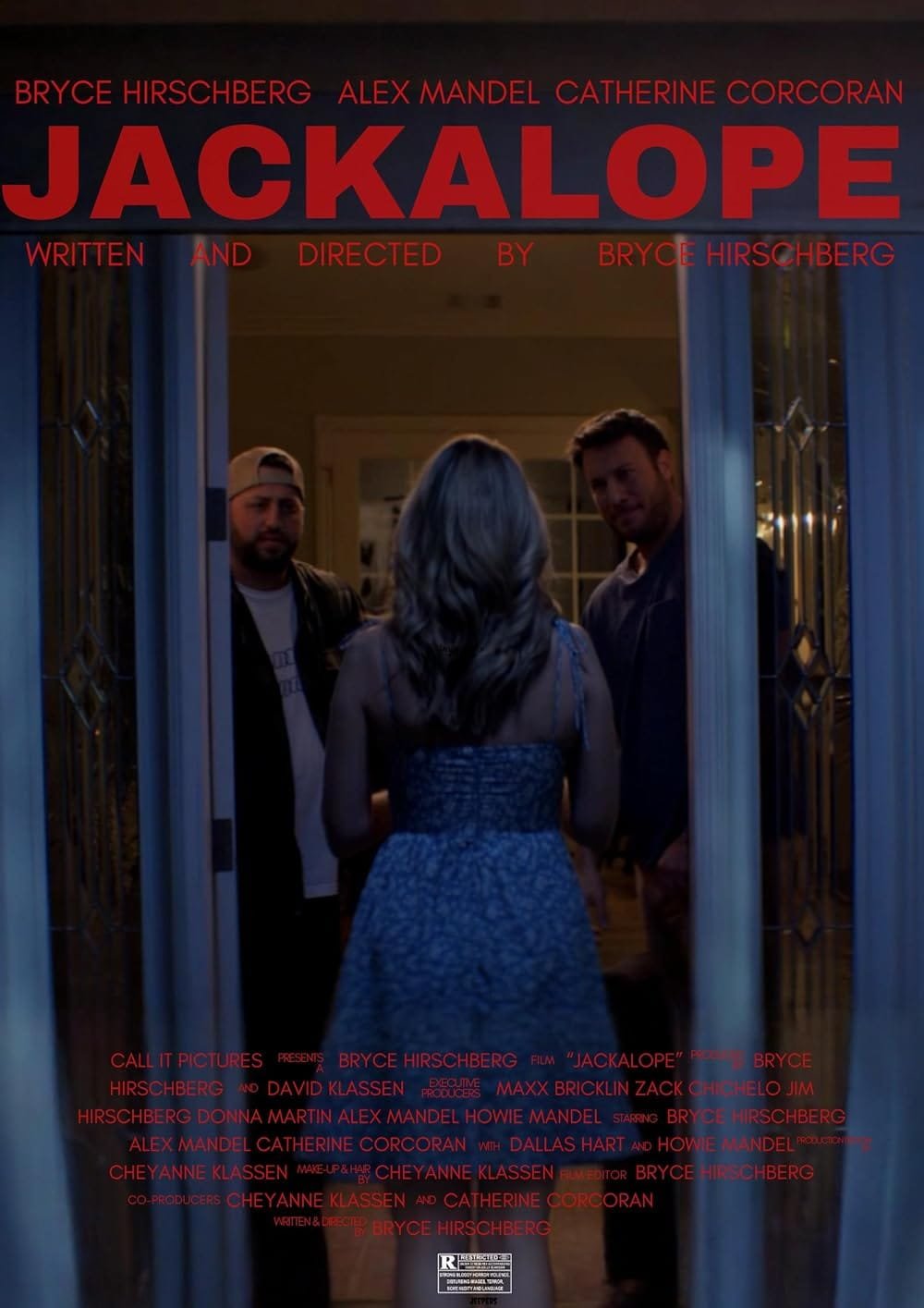

Any film which announces itself with a bright red, block-capitals title screen always speaks to high levels of confidence (go on, bet you can think of a few) and yeah, Jackalope (2026) fits this bill, too. If it’s guilty of anything, then it’s how it introduces a surfeit of ideas which it needs its audience to take at a mainly literal level, but regardless, this is a lively, often playful and acerbic meld of home invasion horror and something else entirely.
Brothers Conor (Alex Mandel) and Aidan (director and co-writer Bruce Hirschberg) are long overdue for a weekend away: it’s a chance to reconnect, or perhaps to ponder why it’s been so long since they spent some quality time together. Whilst they enjoy working through horror and true crime-adjacent riddles on the way there, their destination is not quite the standard-issue cabin in the woods: it’s grander than that. This is a family-owned second home, though admittedly it’s out in the boonies, and rather than bracing for the expected lack of cellphone network, Aidan goes one step further by deliberately disconnecting the perfectly functional WiFi, so he and Conor can avoid all unnecessary distractions. Oh, Aidan.
We start to get a sense of each man’s character; this begins, actually, when Aidan stops the car to pick up a dog they find, whereas Conor is horrified and thinks the dog must belong to someone. Aidan is more ebullient, Conor more reticent – even seemingly troubled by something, hence when Aidan speaks to their father on the phone (prior to fatally nixing the WiFi), dad talks like this is some kind of rescue mission for Conor. The brothers’ harmless chit-chat about hunting, shooting and bait may feel awfully like clear foreshadowing, but a clay pigeon session gives way to something much more interesting when, later that evening, there’s a surprise knock at the door.
There’s a young woman outside. Lilly (Terrifier‘s Catherine Corcoran) claims that she has rented the place for the weekend, which sounds plausible to Aidan: it seems that their father does let the house out in an Airbnb type arrangement from time to time, so there are apologies all round and – no WiFi, remember – they offer to let Lilly stay the night, given that they can’t sort anything out right then and there. Lilly’s relaxed manner and mild damsel in distress vibes induce them to want to help her, too. Flirtation soon gives way to awkwardness, and not long after that, a growing sense of high weirdness: but of what kind?
Jackalope makes use of some familiar-feeling horror elements, heading first this way then that, though remaining rooted in stereotypes and expectations around masculine and feminine behaviour, which are key to moving things forward and to anchoring the film as a whole. It’s also used to excuse some of the rather more incomprehensible things which the brothers will do on account of a hot stranger, or at least on account of a nice, humble, friendly (hot) stranger. Still, whatever else goes on, this is another modern horror film with a director whose investment in the project must be hugely personal – whenever you see one person directing, producing, writing, editing and starring, you know that much – but Jackalope avoids the feeling that nothing has been cut because every second of footage feels sacred to its creator. This can be, and often is, an error. This film boasts a nimble runtime of eighty minutes, with plenty of surprise shifts which keep things moving. Sure, there’s the odd issue around threat disparity, but that prompt pace, making good use of ideas and items already introduced, works in the film’s favour. The flawed, but plausible and largely sympathetic natures of the two brothers are important, too, allowing us to feel for them, squabbles and all, deeply troubling decisions and all.
The sheer amount of ideas being offered but not fully, or even partially expounded here can feel like a sticking point; for some audiences, the list of unanswered questions may impact on their overall enjoyment of the film. For this reviewer, it feels like a somewhat risky trade-off, and it would be great to know just a little bit more about some of the developments proposed in run-up to the film’s final act. However, there’s lots to like and admire here, and when those red capitals are back again to round things off, you still feel like that confidence is deserved. Extra credit goes to Catherine Corcoran, too, who’s really carving a decent niche for herself as a genre cinema actress. Good work.
Jackalope (2026) features as part of this year’s Raindance Film Festival.