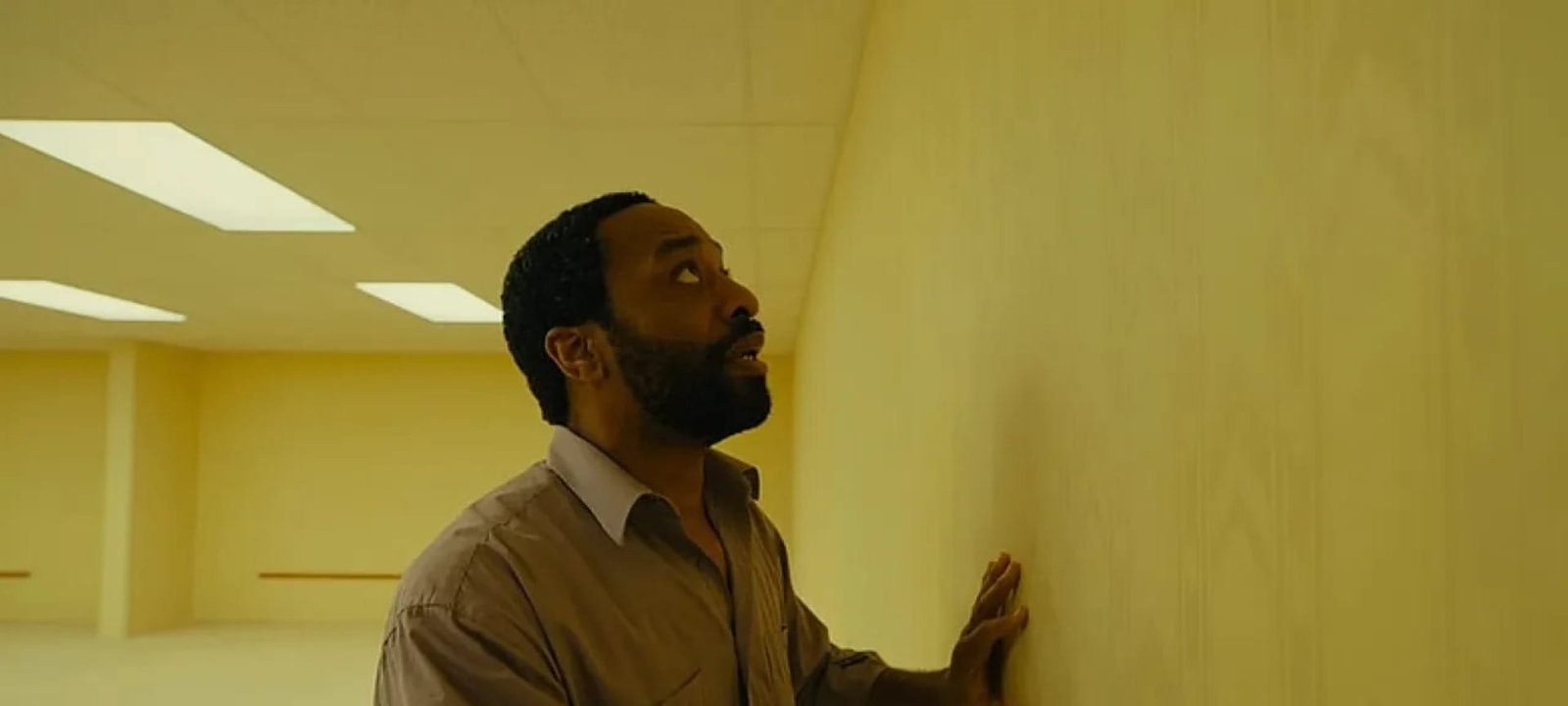
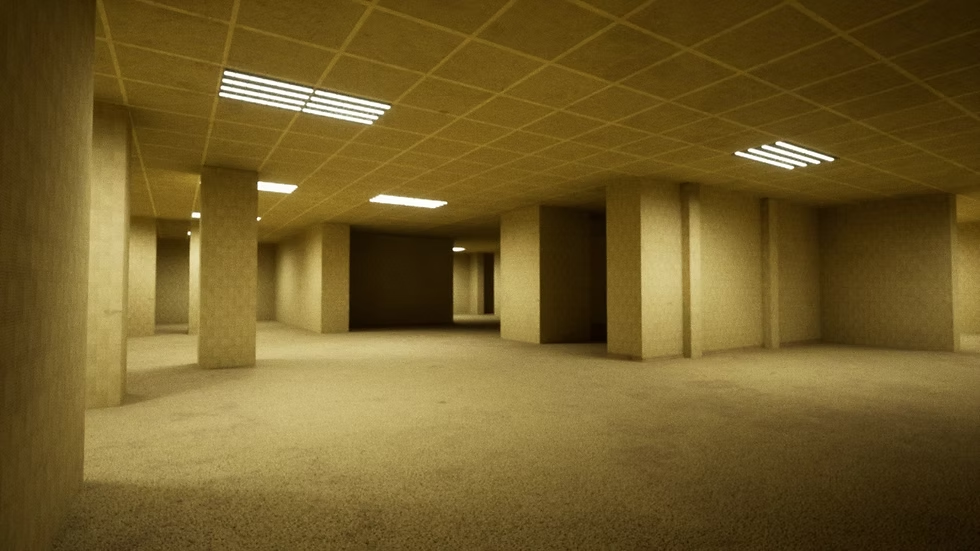
What kind of place is this?
Backrooms (2026) is another of those break-out indie horror films from a young director unburdened by the weight of a legacy, whilst still benefitting from the ever-growing wealth of horror cinema which operates like its own microculture, cross-pollinating titles, genres, ideas and styles. Alongside Obsession, it picks up its cues from a pre-existing webseries and its determined cult following – this is a new means of developing immersive fandom which didn’t exist twenty years ago – using these to build something more expansive as a feature-length. However, I don’t think you necessarily need extensive knowledge of the webseries which prompted Backrooms; at least, as someone unfamiliar with anything which came before the feature-length film, it didn’t feel like I was missing out on a wealth of prior understanding by being unfamiliar with what had come before – this puts you on the same level as the film’s characters, after all. Prior understanding is in short supply in the world of the film, and any moments of epiphany are hard-won. Treated as a standalone horror film, albeit one which feels ever more modern, even uncomfortably close via its colonisation of the 90s nostalgia which has now replaced the 80s as the technology of the uncanny, Backrooms works across the great universals of human alienation: part mystery, part existential horror, its spaces seem open only to those already trapped in a kind of limbo on the other side.
Clark (Chiwetel Ejiofor) is a man who very much fits this bill, stuck in a failing performative role as a failing furniture store owner who also now needs to sleep on-site, and we see him setting up a facsimile of domestic comfort, sleeping in a store bed and watching a store TV, before he sets one foot in the strange world nearby. His forced jollity in the cheap cable ads which have been pieced together by his co-workers – in which he’s not quite a pirate and not quite a sultan due to some flawed and confused, liminal branding – only serves to underline the deep unhappiness felt by this man. He’s lost his home and his wife, he hates his job and he cannot get past this feeling of revulsion for what he’s been left with. However, as we see during his therapy session with Mary (Renate Reinsve), what he really wants is an excuse. It’s deeply possible to sympathise with Clark, and also (or mainly) to see his need for a martyr narrative as key to displacing his own sense of responsibility. The film opens with the notion that people return again and again to learned behaviours even when they don’t really serve them anymore; the brain would rather do what it’s always done, instead of learning new ways to cope. Whilst not quite an everyman, Clark is familiar enough as a person locked into a loop. It’s this festering unhappiness which allows him, at last, to cross into the backrooms. Interestingly, it’s his increasing fixation on the internal rules and regulations of the store, embodied by its haywire electrical wiring, which finally draws him in – a fluke, perhaps, but it seems that the time is right.
We know others have been here; one of the deeply alienating things about the presentation of this space is that there are objects and even people present who could come from a different era. And we’ve seen an explorer getting lost here, too, trying desperately to impose order on the space via the use of contemporary 1990s technology, though it’s deliciously unclear how – or via whom, or when – the computer and audio equipment, together with the cameras, found their way here. Early in the film, the ill-fated Naren attempts to use the computer system to make an announcement, seeking a reunion with his team, but it fails him. Audience responses may vary with regards to the nominal-at-best framing device which is imposed on the backrooms by a small group of engineers and researchers, themselves mysterious, who are trying to quantify the space. However, this does at least suggest that what Clark finds – that you can cross in and out of the backrooms, at least until a point – is a commonality.
We also know that people seemingly untroubled by the pitfalls of entrenched self-doubt can find the backrooms, too: Clark’s unfortunate employees, Bobby and Kat, get drafted in by Clark when he first finds himself compelled to record and understand the place he has found. His instinct is to draw a map, to make notes, very much like the researchers themselves. He even quantifies the unquantifiable by drawing a door shape on both sides of the liminal wall, creating a permanent conduit, something which does, ostensibly, obey some sort of rule. Bobby and Kat can cross through this, but – perhaps because they shouldn’t have found the backrooms, or have no real reason to be there – the space reacts most violently to them. It’s intriguing that Bobby is almost immediately presented as a casualty of this place; he finds some of his own clothing, ageing and mildewed, in a part of the backrooms which feels like a trash pile. Those with the requisite self doubt last longer – why this may be, the film does not explicitly answer, but certainly those unable to escape their ‘real’ selves seem able to spend longer in the backrooms, becoming part of this aggregate space.
On liminality…
Liminal horror has grown to be a very popular topic in recent years, aided in no small way by a proliferation of internet horror and creepypasta fandom, the kind loved and cultivated by Backrooms director Kane Parsons, amongst thousands of others. Due to the strong visual component associated with that particular fandom, there is a possibility that liminality and liminal horror may be somewhat reduced by eager commenters and forum users keen to share creepy images of places, identifying them as ‘liminal’. It’s worth adding that, whilst liminal horror is a huge area of modern interest and a key component in the kind of horror we see in Backrooms, there’s more to it than incongruous images, much as they can be used as fascinating prompts for ideas and storytelling larger than themselves. ‘Liminal’ refers to boundaries or thresholds; these, in themselves, suggest new possibilities, as well as harrowing, epistemic breakdowns and shifts which jeopardise the safety and the sanity of observers and participants. Where something is newly possible, something is possibly harmful, eroding old certainties and notions of safety.
Liminal spaces in horror are incredibly diverse, but perhaps we can speak about some commonalities. The use of devices and structures which help people to transverse these spaces – elevators, staircases, doors – seem to recur in all manner of liminal horror. If we think about the mild but unshakeable horrors of Severance, a TV series which feels like it has some kinship with Backrooms, if only in its often minimalist corporate-style spaces, then we may remember the importance of the elevator which takes the ‘Outie’ employees up to their offices, transforming them into different people in the process. Even creature features – to summarise a wealth of titles a little crudely – are reliant on stairs and stairwells, gates and doors (think The People Under The Stairs, Nightbreed or even The Gate). Mirrors and other reflecting surfaces are like this, too, used in horror cinema to bend/refract the ‘rules’ of physics and thus normality, inviting other entities through – often to places where they ‘shouldn’t’ be. As a part of a furniture store, the backrooms can boast all of these elements: in fact, it feels semi-natural that they would be there. When Clark finds his way into the backrooms, and as he later acknowledges, it seems to be a continuation of the store, even if it immediately reveals itself to be a place without the usual rules, without certainties. He comments on the strange inclusion of a swimming pool in one of the rooms, for example: it’s a familiar enough feature, but doesn’t seem to belong in the same space as the store. Reflections, movement and accessibility are key features of the backrooms environment.
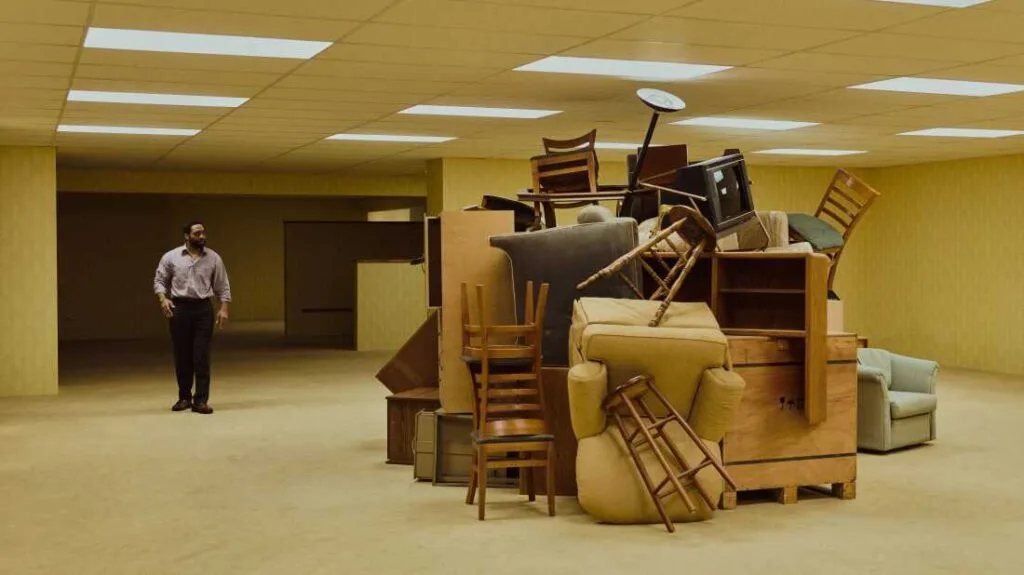
It’s also a pristine, expansive space dotted with items currently on sale in the store itself – but different, subtly at first, though enough to trigger a response to the uncanniness of the environment. In the first room, which we see alongside Clark, there’s a stack of furniture, with items stacked one on top of the other. There’s also a mirror-image ‘STOP’ sign positioned in one of the nearby alcoves, perhaps blending Clarke’s working world inside the store with the roads which get him there (and keep him on the other side of the looking glass); this is significant, this blurring at the edges, recognisable but warped. When Clark tries to pick up a chair from the first pile of furniture however, it resists his attempts, seemingly, mystifyingly fused to the chair underneath it. In other rooms, things here are much more incomprehensible, spanning from the recognisable yellow wallpaper and plush new carpet to forced perspectives, impossible stairwells and sharp inclines – all of which can, as we may have grown to expect as horror fans, be accessed and used by whatever else is in there. And what is in there? Again to make a link to Severance, there’s a kind of version of people who have been there. A copy, a flawed and static copy, distorted and mute, even if lacking the impromptu humanity of the Innies.
In Backrooms, it’s a suitable limbo state for a failed architect, this massing Escherian nightmare – and the way in which it is inhabited by Clark’s humiliating and failing alter ego is, in its own way, something which makes some kind of sense, at least on the conceptual level. The liminal space further defies norms whilst bolstering its impression as a space populated by half-memories or ideas by having items fused with floors and ceilings, furniture and even bodies half-emerging from structures and places which should be solid, dependable. It provides an overwhelming feeling of alienation. Also, and frighteningly, the trailing cables and audio equipment of the backrooms – suggestive at least of some kind of universality, via repeated announcements in a range of different languages – point to some kind of intent, some overarching design, but the film always retreats from any ‘overseer’ narrative. That would, after all, shrink the horrors of this place. The people who come here are equals, at least in terms of their initial understanding, and perhaps in what happens to them.
“You’re stuck right where you started.”
So are there any answers at all here? You could argue that Clark comes to understand something about his own particular limbo, having spent an unspecified amount of time – possible weeks – inside. He comes to a kind of false epiphany, revelling (unsuccessfully) in the false notion that he, this unhappy, seething and damaged man, doesn’t have to change – he can keep his flaws and even co-exist with his monstrous alter-ego, even if that revelation seems to be misconstrued, only offering a moment’s grace (plus some of the film’s most horrific sequences). The lurching, somehow dangerous and desperate ‘pirate’ which represents Clark’s professional and personal humiliation turns out to be a grave threat to him, and to Mary, who has herself stumbled into the backrooms by now, finding that she, too, is suitably damaged enough to trigger another version of herself which will also remain here, another inmate trapped by trauma. These nightmare avatars seem to reply on stasis in the world outside, as well as the world of the ‘store’. Whilst Mary is able to use her expertise to land Clark with a few unwelcome truths about his life, she is less well-placed to do that for herself, and she is haunted by childhood memories of parental ill-health and familial isolation. It’s fitting, and not a little cynical, that Mary can prompt Clark to do ‘the work’ in therapy which hasn’t helped her to escape her own Window Within (another mention of a liminal threshold). Ultimately, although Mary is desperate to re-orient herself, asking questions and trying to find her escape, Clark’s attempts to map this space are subsumed by his own wish to stay, unjudged and unchanged, in the backrooms. He thinks he’s happy there. This is the sort of belonging he felt he’d lost forever, another shot at a bizarre spin on domesticity and suburbia. Mary wants out – she fights to get out – and the world of the backrooms scales up in response to her terror, even if it still resembles Clark’s failures, rather than her own (for the moment, at least).
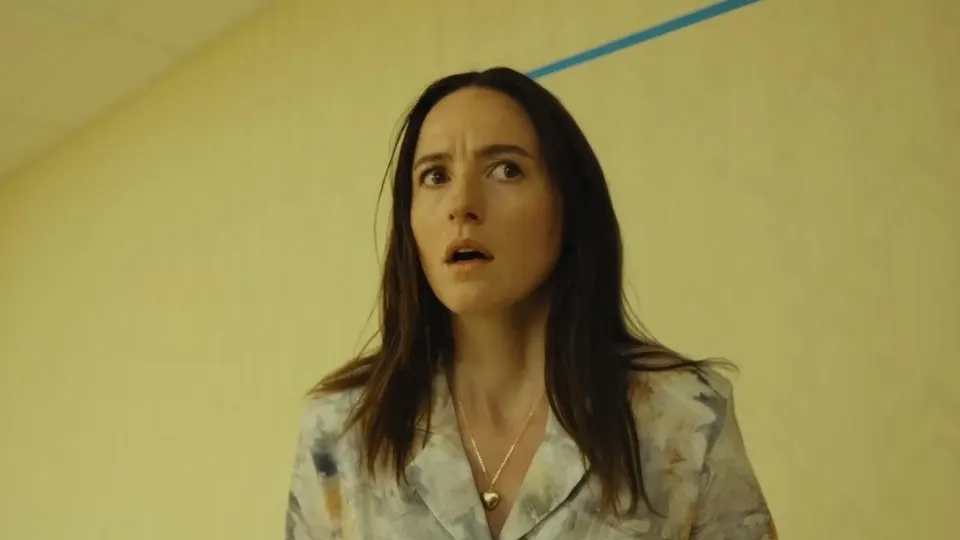
Others retain more curiosity; they want to keep a link to the backrooms, but not to remain there indefinitely. They want, perhaps, to be the framework which seems to be lacking from the equation. Most notably, the research team which seems able to remotely view what is happening in the backrooms have a longer, curious history with this place, even if they retain far more questions than answers. The CCTV network in situ seems to be theirs, or at least they have co-opted it somehow; you can only guess at what has had to go on in order to establish this link to the outside world, and what exactly they may have seen happen as a result. As explained by Phil in the film’s closing moments, they are still at a loss as to understand this location – but they persist. This dogged determination to impose a framework could operate as an allegory all its own, but perhaps their understanding, from the point of view of being as disinterested a set of bystanders as this place will permit, is naturally curtailed by their want of a personal connection, as enjoyed by Clark and endured by Mary.
What do they hope to gain from it? What is the nature of the knowledge they seek? Little wonder that this bizarre dimension can layer its metaphorical dimensions so effectively, holding some people away, holding some people within. As an allegory for labyrinthine personal trauma – expansive, expanding, looping and recurring, utilising the trappings of recognisable and entrenched nightmares – Backrooms does sterling work. But it also works brilliantly as a more literal, if lawless liminal space, full of incomprehensible and unheimlich visual elements which are both intriguing and profoundly unsettling. In many respects, it feels like the end point of a steadily modernising trend in horror to newly colonise – and then to render terrifying – the spaces and places we recognise in our everyday lives. Our homes, our places of work: these now bleed into one another, morphing and threatening us, with no grand gesture – no admitting the mysterious stranger, no solving a puzzle box, no selling one’s soul – now seemingly needed on our part.
If you have had your curiosity about liminal spaces whetted, take a look at Darkest Margins: 24 Essays on Liminality and Liminal Spaces in the Horror Genre (ed. Matt Rogerson) for more from me, as well as from a range of established and up-and-coming horror film writers on a range of titles.