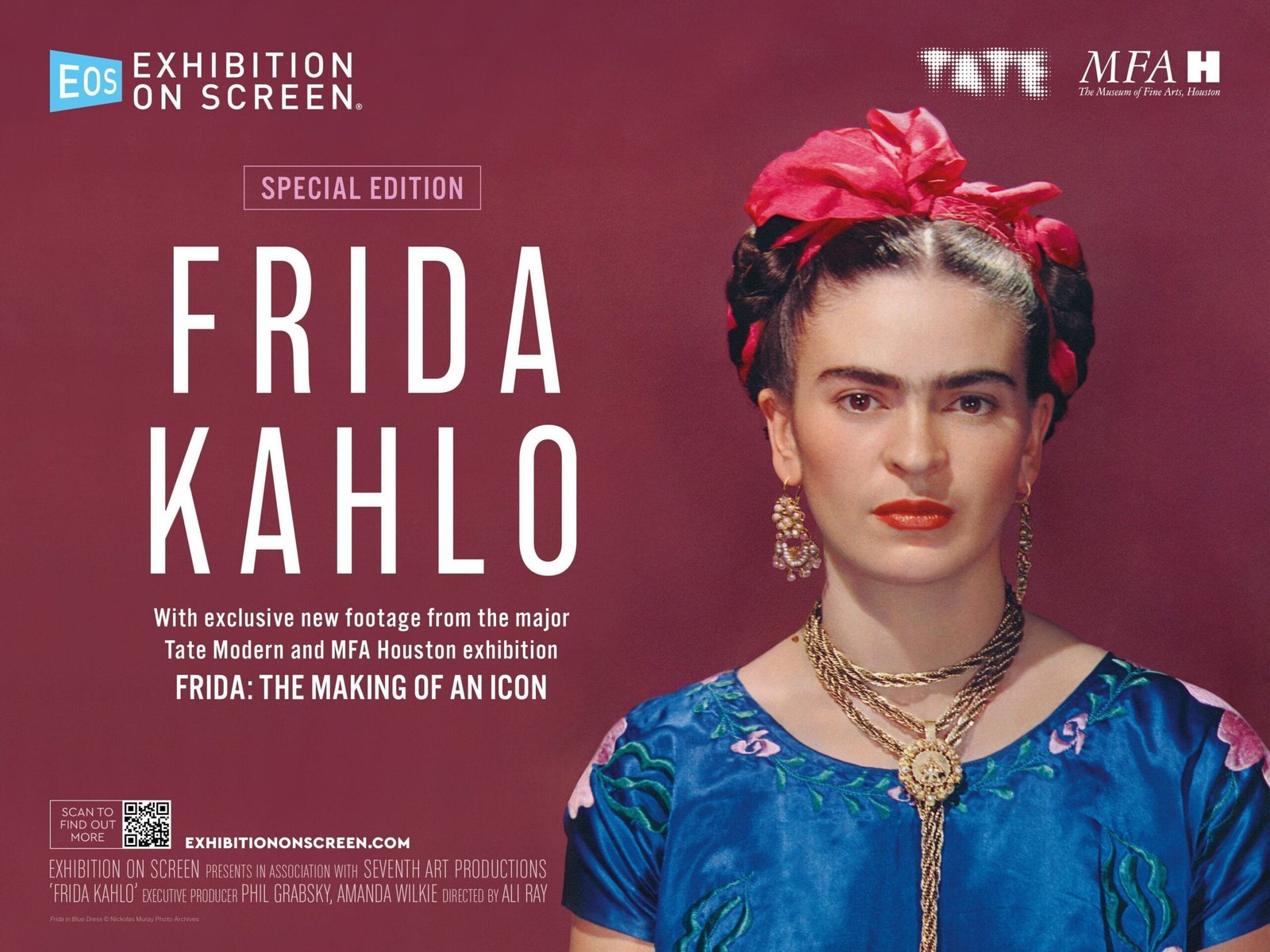
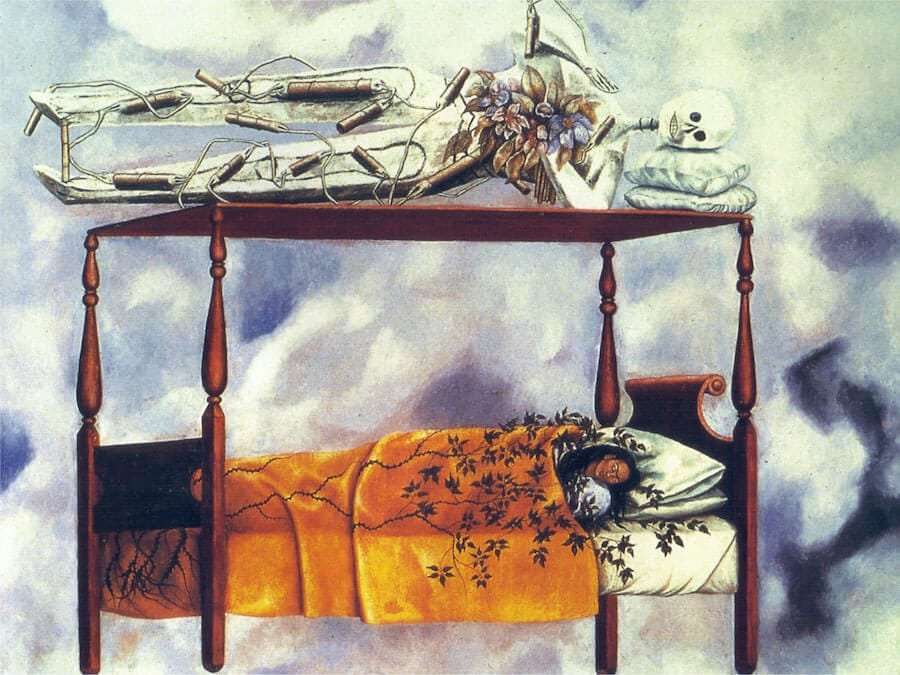
Frida: The Making of an Icon, part of the Exhibition on Screen series, opens with a recording of Kahlo’s painting El Sueno (La cama) – or The Dream (The bed) – selling at the Exquisite Corpus auction of Surrealist art at Sotheby’s for a staggering $57.4 million.
The painting depicts Frida sleeping on a wooden four-poster bed, with leafy vines creeping across the bedclothes, while hovering above the wooden canopy is a white, carnivalesque papier-mache skeleton whose bones are wired with sticks of dynamite. This painting, which symbolizes the ever-presence of death, the unpredictable nature of mortality and the excruciating chronic bone pain and disability Kahlo struggled with most of her life, was made in 1940. This was the year her friend and former lover Leon Trotsky was assassinated and also the same year she remarried her pathologically unfaithful former husband, the celebrated Mexican socialist muralist Diego Rivera, who had previously blown up their troubled marriage with the ultimate act of betrayal – conducting an affair with Frida’s younger sister.
Frida Kahlo’s life was marked with many such shatterings and mendings, both physical and emotional. The dynamited, ready-to-explode legbones of El Sueno (La cama) positioned above Frida’s sleeping form recalls what Andre Breton, the co-founder of the Surrealist movement and great admirer of Kahlo, said about her work – that it was a ribbon, wrapped around a bomb.
However, Frida’s beribboned image can easily be purchased nowadays for rather more trivial sums, printed across everyday items such as tote bags, water bottles and phone cases. I confess to owning a water bottle. Dressed in traditional bright Mexican skirts, blouses and shawls, wreathed with flowers and always bearing a solemn, steady gaze, Frida Kahlo has achieved levels of recognition well beyond the art world. She has become known the way perhaps Marilyn Monroe is known. As Monroe has become terminally iconized, her image mostly divorced from her artform and becoming more of a screen for personal emotions and various conspiratorial narratives, Kahlo’s powerful self-portraiture is similarly reproduced, admired and iconized, and slowly divorced from its origins and meaning.
Frida: the Making of a Icon, preceding a forthcoming new exhibition of the same name at the Tate Modern in London and MFA Houston in the USA, seeks to document Kahlo’s life and its relationship to her art, helping us understand what is actually behind the popular iconography. It uses extracts from Kahlo’s own letters and diaries and draws in various Mexican academics and art experts to help explain the entwining personal and socio-political factors that shaped her art and her iconic image.
The film explores Kahlo’s formative early years in the crucible of her art, Mexico City, where she was born in 1907 to a German photographer father and a Mestizo (mixed Indigenous and Spanish heritage) Mexican mother. Frida Kahlo was originally a sharp-minded student destined for a medical career. In 1925, aged 18, her career ambitions were destroyed by a catastrophic tram accident which smashed her spine and her right leg and crushed her right foot. Additionally, a metal handrail pierced her lower abdomen, shattering her pelvis into three pieces.
The legacies of this accident were cruel; crippling lifelong personal medical expenses, a lifetime of harsh surgeries, chronic pain, and due to the deep, permanent pelvic damage, an inability to maintain a pregnancy. Frida: the Making of an Icon recognizes the radical political nature of Kahlo’s painting in addressing these personal issues. In Henry Ford Hospital (1932) in which she memorialises a painful miscarriage she experienced in the United States while there with her husband, Kahlo rips up the European playbook regarding the depiction of women and of childbirth itself, until then hugely sanitized and largely confined to Madonna and Child imagery, while miscarriage itself remained totally taboo. She places her own nude, agonized and bloodied body as the subject of the painting, not as the sexually desired object. A pool of crimson vaginal blood collects around her, the sheer body horror of human birth and female gynaelogical trauma is exposed for perhaps the first time in the artistic tradition. Veins that resemble umbilical cords lead from her to floating objects around her – a fetus, a snail, a flower, a sinister medical machine, a human pelvis, each symbolizing something of her experience.
A year later Andre Breton would visit her in Mexico, look at this painting and admiringly call her work ‘pure surreality’, a label Kahlo rejected, noting her work flowed entirely from her reality, not her dreams.
Adding insult to severe injury after her tragic early accident, her formerly devoted boyfriend was promptly whisked away by his parents to Germany as they found the idea of him marrying a disabled woman highly unsuitable. However, this soon-to-disappear boyfriend gave Frida some books on Renaissance art to study during her long, painful convalescence and she began to paint, learning from the style of European Masters, producing her first self-portraits.
Another renaissance of sorts was happening in Mexico, which also profoundly influenced Frida Kahlo’s life – the Mexican Revolution of 1910-1920. Shrugging off an oppressive 30-year dictatorship, Mexico bloomed afresh with both democracy and a fresh cultural interest in its indigenous roots, seeking a new Mexican identity distinct from European cultural influences. Frida, who had by now joined the new Communist Party, met her soon-to-be husband, the artist and muralist Diego Rivera, through their shared political interests. Together they would pursue their own sense of Mexicanidad, literally a sense of ‘Mexicanness’ and a new Mexican artistic identity that eschewed colonialist tropes and looked to Mexico’s pre-Colombian past, as well as its mixed ethnic heritage borne of colonialism. She adopted Tehuana style clothing from the women of the Oaxaca region of Mexico. Clothing is a language, and shedding modern, fitted European dress styles for the rabona ruffled skirts, colourful rebozo (shawls), floral headpieces and the loose, boxy blouses of the Tehuana women not only spoke to her artistic commitment to her personal Mexicanidad, but also conveyed a feminist message that was radical in a still highly patriarchal culture – the Tehuana women being distinctive in Mexico for the matriarchal elements in their culture. What may seem a purely personal sense of style was a carefully constructed public image which always conveyed a strong political message. The clothing style also helped Frida obscure the lasting damage from her accident and to portray a strong sense of femininity. The long, ruffled skirts covered up her withered right leg, while the loose huipil tunics and shawls concealed the steel corsets she wore to support her damaged spine. This iconic clothing style was an artistic statement, composed of her signature blend of the deeply personal and political. Her 1943 self-portrait Diego on My Mind (Self-Portrait as Tehuana) is a primary example of the Tehuana style.
The film also explores the influence of cultural Catholicism on Kahlo’s art. After the 1932 miscarriage, she became fascinated with retablos, a type of Catholic devotional painting peculiar to Mexican culture. Retablos were narrative paintings created by specialist retablo painters on small pieces of metal which portray a personal disaster or emergency of some kind, for which a Catholic saint is then credited for helping them survive. A contemporary retablos painter (the tradition persists) is interviewed about his craft and cites Kahlo as a source of pride and inspiration in her use of the artform. Again, her work blended these deep cultural facets with more contemporary concerns – one of her most famous retablo-style works, A Few Small Nips (1935), portrays a femicide Frida had seen reported in the newspapers. She depicts the horrific, blood-soaked scene and the murdered woman, stabbed to death times by her husband, emblazoned with the text of his his defence in court, “All I gave her were a few small nips.” Still more layers emerge when Frida claimed it represented how lightly her own husband had destroyed her with his infidelity with her own sister, saying she felt ‘murdered by life’.
Frida: The Making of an Icon lets us linger over the works shown in this kind of depth, gradually building up an understanding of just how the Kahlo myth was constructed over the years. A final photograph, taken at the end of her life, seals the monumental nature of her life and work; a scene showing Frida, slightly wild-eyed and clearly in pain, a few days before her death, at her final exhibition. Unable to stand, sit up or walk anymore after escalating poor health and a leg amputation, her bed was instead lifted into the exhibit. In the photograph, multiple admirers eagerly cluster, bend and gesture over her struggling form, and the effect is almost religious in tone, oddly akin to a Caravaggio painting. The film goes on to tell us about various modern artists who have drawn inspiration from Kahlo and her work, but the final image left with me is of Kahlo’s final moments, a life of personal, political and artistic striving that built a powerful mythos, one which has persisted long past her death in 1954.
Frida: The Making of an Icon at Tate Modern in London, runs from June 25th 2026, to January 3rd, 2027.