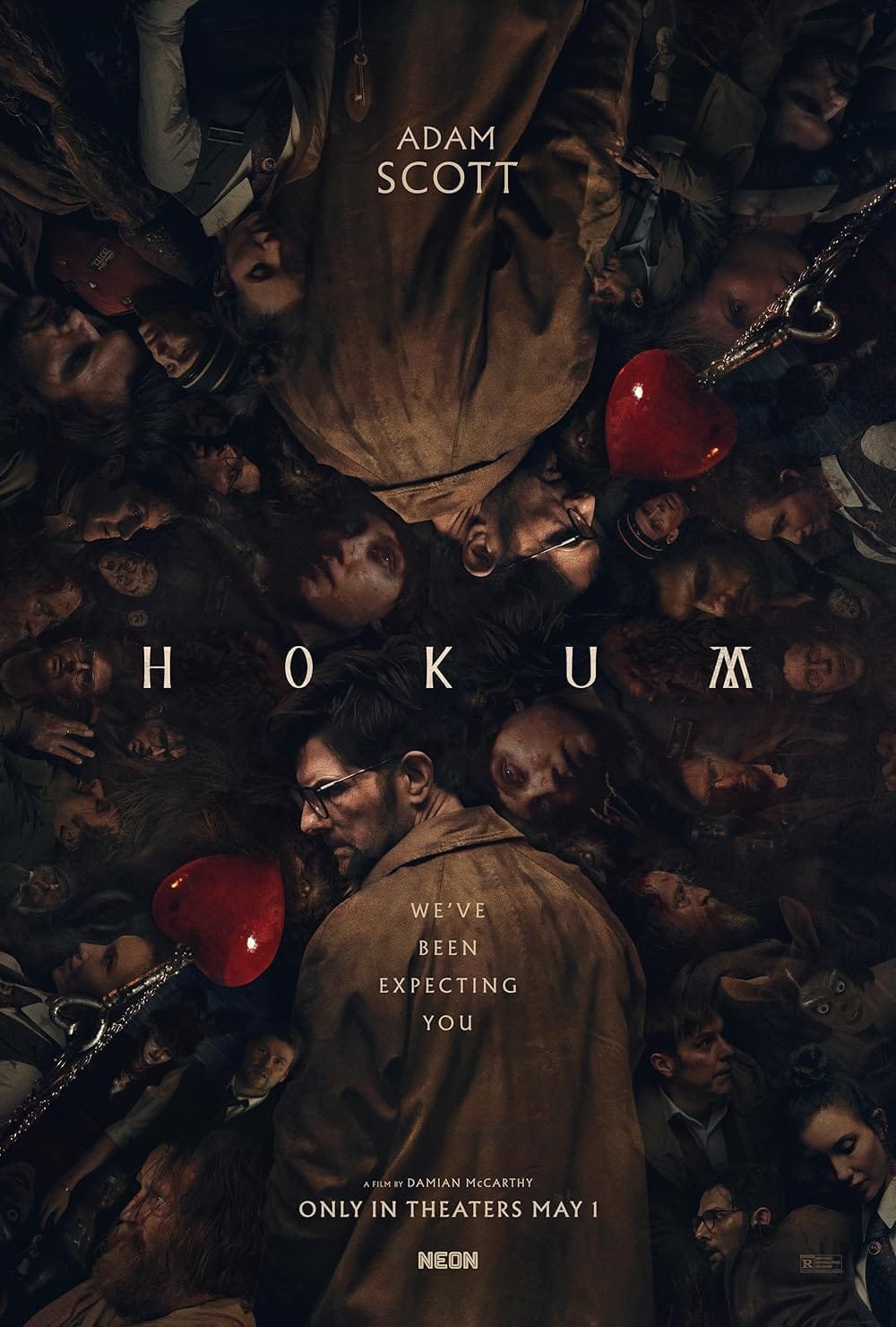

Hokum (2026) is all about the periphery of stories. Legends, tales within tales, rumours, fractured biographies. Feelings and memories, not linearity and convention – which works really well in this deliberately splintered, but always impactful horror. Even as the opening credits roll we start with a story within a story, given that our protagonist Ohm Bauman (Severance‘s Adam Scott) is an author just on the verge of completing his no-doubt successful Conquistador Trilogy (we know he’s successful just based on the fact that his house is constructed out of unadorned, bare concrete). But he’s hitting the dreaded writer’s block, uncertain on how to end his story; we watch as a bruised and battered soldier – his key character – staggers across a desert landscape, using a map to look for treasure, some final destination of his own. As Bauman grapples with this as-yet incomplete tale, he seems to be looking for his own map, and in a moment’s reflection on old photos and postcards, happens upon the idea of travelling to Ireland, visiting the hotel where his late parents spent their honeymoon many years ago. Perhaps some proximity to a place linked with happier times will help him – though this by no means seems sure, and his memories seem by no means straightforwardly happy either. Part of his visit will be to scatter their ashes.
So he finds his way to the largely unchanged, unrenovated but sill functional hotel, somewhere in rural Ireland. Let’s get to it: one of Hokum‘s minor sticking points is Bauman’s initial behaviour when he reaches his destination, even given his clearly depressed and prevaricating state – though, even in a film which cultivates its uncertainties, it does become somewhat more excusable as the film progresses and we discover more about him. At the start of his time at the Bilberry Woods Hotel, however, he veers between baffling rudeness (a bold choice from a horror writer, who must know remote hotels and troubled authors aren’t a good mix) and almost instant, needy friendliness with one member of staff, Fiona (Florence Ordesh), which perhaps makes up for him sneering at the manager and assaulting the bellboy with a superheated teaspoon. Perhaps the partially-heard tales of local witchcraft legends set him off somehow, or else it’s the jet lag. Fiona seems to take his vacillating ways in her stride, though, and feels instinctively that there’s something dangerously unsettled in his behaviour – even going so far as to demand his room be unlocked after he retires for the night, saving his life in the process.
In keeping with the film’s rejection of a conventional, linear plot structure, things lurch forward a little and then pause to fill in (some of) the blanks here. Bauman recuperates, but instead of hotfooting it back to the States, he returns to the hotel for his belongings and asks after the woman who saved him. It’s not good news. Fiona has disappeared: she hasn’t been seen since the Halloween party he was keen to avoid, by being dead if necessary. Feeling a big pang of responsibility regarding the disappearance, Bauman begins to ask around, and keeps being drawn back to something Fiona said: that she had heard rumours of ‘the witch’ in the Honeymoon Suite, and was desperate to investigate the room – long since locked up and abandoned. Stories of this witch have already appeared in the film. As much as folklore of this kind apparently repels him (folk horror lesson one: scoffing outsiders always need to get their heads around local lore eventually), Bauman can’t fathom why nobody has at least looked for Fiona in the suite in question. With the assistance of local woods dweller and rumoured wife killer Jerry (David Wilmot, and he actually comes across as a fairly stable guy, all told), Bauman decides he has to look for Fiona in the hotel itself – just like the police should have done. More narrative fragments billow into place, and Bauman ends up – alone – in the Honeymoon Suite. As an audience, we are in the privileged position, if you can call it that, or knowing that Bauman’s hunch is right, even if this only confirms to us that – whether supernatural or natural, real or psilocybin-tinged dream state – things are not looking good for him, or anyone who follows him there.
Director and writer Damian McCarthy has been honing his skills across a few decent titles in recent years: Oddity (2024) is an effective Irish folk horror in its own right, and feels very much like an antecedent story to Hokum – though the newer film definitely has the edge in terms of scares. There’s definitely been a progression and a growth in confidence. Sure, there are a few jump scares here, but far scarier is when the film allows you to glimpse or half-glimpse something devastating in the corner of the frame. A blend of a kind of ‘dark night of the soul’ and a more conventional haunted house story, right down to often doing away with the constraints of conventional, linear time and space, Hokum has elements of 1408 (2008) and The Haunting of Hill House (2017), though with one key, if ever-mysterious and often peripheral presence to bind the terrifying phenomena together: a bloody good witch, something of particular interest to this reviewer.
As the film builds and blends together a compelling sense of liminality out of its pulleys, abandoned spaces, hidden rooms and of course a vast, subterranean basement, the figure of the nameless witch offers up a number of interpretations, without ever forfeiting those seriously creepy scenes. And, like all good terrifying figures, less is more: she doesn’t get, or need, acres of screentime. Whilst she is bound by one ‘rule’ which, ahem, our protagonist is lucky enough to learn before he gets trapped in the hotel, she still operates as villain, moral arbiter and demon of conscience in various different moments, in a genuinely unsettling, unpleasant setting. But best of all, she remains a shadowy presence. Hokum trades narrative explication for mood and boundless nightmare, and it works fantastically well, even if, being picky, there are some minor pacing issues as we go: it works perfectly that this film with its reliance on grave uncertainties, never decides to just spill its guts, to tell us everything and move neatly on. Like folklore, the endings shift, change or disappear. And, yeah, perhaps our contested lead character turns out to be well-suited to the decidedly disarrayed, but no less compelling narrative style. A dubious character with a moral test in front of him? We’re back to the Conquistador Trilogy at this point, and we leave Hokum – probably, fittingly a blend word, ‘hocus pocus’ and ‘bunkum’ – as either a story of magic, or a ruse which may or may not have relied on altered states, but in any guise, an effective, self-aware, dread-inducing new folk horror.