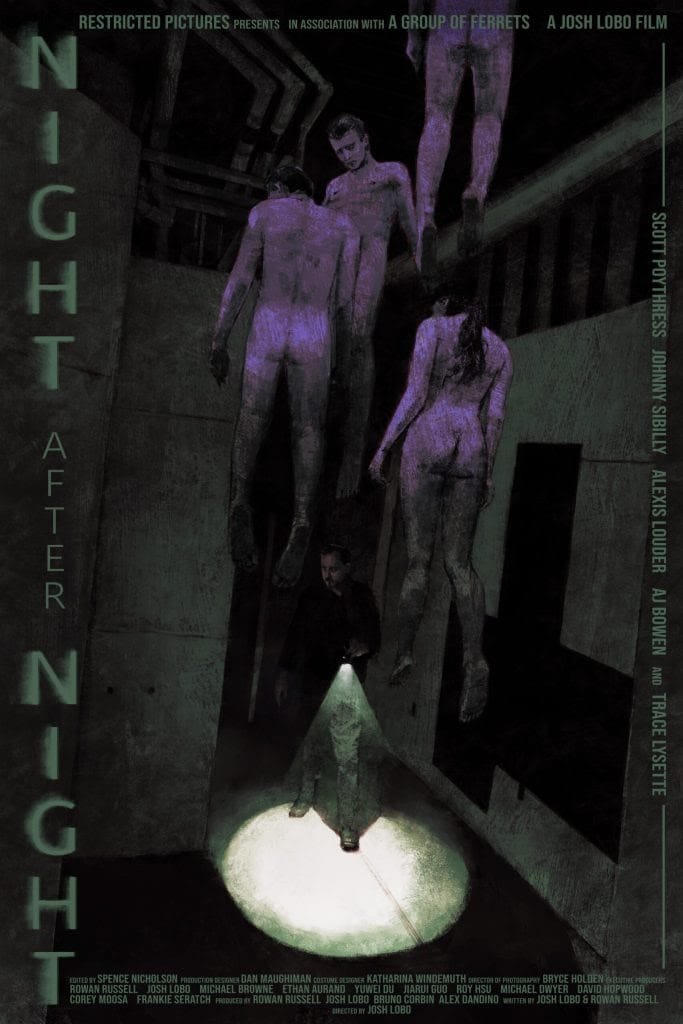
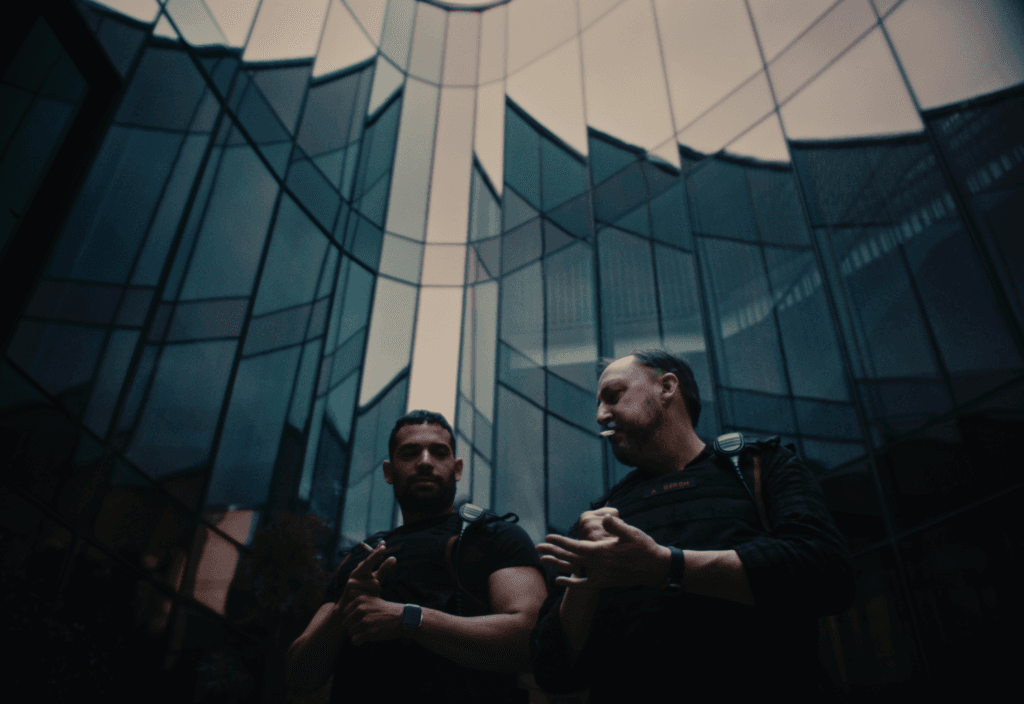
A nightmarish (and as-yet mysterious) opening scene segues into what appears to be something like normal life, as we get started with Night After Night (2026): this is a false impression which persists as a motif throughout this alienating, unsettling film. We meet security guard Andy (Scott Poythress) and his buddy Willis (Johnny Sibilly). They work for an exclusive university – acres of space, polished concrete, you know the type of place – and the two men develop a grudging work friendship. However, Andy values the discreet, even secretive work environment he has found. He isn’t apparently too keen on building bonds. Alternating between a lonely motel room and his place of work, he has apparently quite deliberately moved to the periphery of the everyday.
Having already reviewed the fantastic Recluse (2026) this year, it’s already clear that director Josh Lobo is already a master at sculpting an uneasy, rising atmosphere. And as in Recluse, Night After Night doesn’t need to travel much distance in order to generate that feeling. It has that same sense of tense, febrile outsidership; although Andy speaks directly to the audience via a voiceover, the presence of the voiceover can’t quite offer the consoling hook which it might: it, too, is struggling with the film’s emerging world. Audio design, also fundamental in Recluse, cloaks Night After Night in a similar weirdness, despite not being a plot point in its own right here. By the time Andy gets temporarily moved to a solo night shift, we’re ready for the persistent sense of something nightmarish – aural and visual – to bloom.
This it does. Whilst exploring the building, Andy finds a hitherto-hidden room, which he feels inclined to investigate. When he shines his torchlight into the room, he sees a mysterious, naked figure, cowering from him.
He’s unsure what to do (and well he might be); unable to confront the figure, he contacts his mysterious boss (Alexis Louder) but her advice is only this: use your best judgement. Arguably, he’s already a long way beyond ‘best judgement’. Poythress looks authentically exhausted and nervy from the start of this film; his estrangement from his family is briefly treated, but it’s enough to ground his mental state in something tangible. He soon enough sees other, different, nude, voiceless people in the building. Is this a haunting? Are they really there? Beyond Willis, the only communication he really has is with Therese, a woman living out of the motel room next door to his own. A faceless woman, discussing voiceless figures. When the film shifts its attentions briefly back to Willis (via an intertitle, a device I hate but which actually works here), we can expand our understanding somewhat – even if via two alienated men with compartmentalised lives and a sense of ingrained ennui, although each man reacts to the situation differently. As the figures keep on appearing, it could be that they are linked, in some way, to the mysterious work and ethos of the university itself. Equally, it could be a much more singular ordeal, simply brought out by these unique surroundings.
Whilst Night After Night offers brief hints of other films – it’s hard not to make some comparisons with It Follows and even The Shining – it also deviates from those, as this emphatically is not a clear narrative with clear, agreed-upon supernatural aspects. Its more… evasive than that, and its symbolic, even solipsistic approach (contrasted with the later arrival of another security guard, who tries to overlay meaning on the mysterious place where they work) will alienate some viewers. However, its broader, more malleable approach really does reward the attention. Cinematographer Bryce Holden has done it again, and the film’s artistic shooting style (blending timelines, high colour, black and white, negative flash transitions, a range of edits) serves its approach and ethos very well.
It’s heavy on the mystery, it’s more periphery than plot, and Night After Night works best when you accept its dedication to quieter moments of creeping alarm, where you could, if you were so inclined, project some of your own anxieties (Lobo has stated the film is a means of channelling his own anxieties about the world). It’s slow-burn, but in the year which invited us into the liminal spaces of Backrooms (2026) it certainly seems as though the surreal, shifting world of the after-hours workplace has a lot of diverse horror to offer, and this gloomy, metaphoric mood piece deserves acclaim.
Night After Night (2026) releases on 28th August 2026.