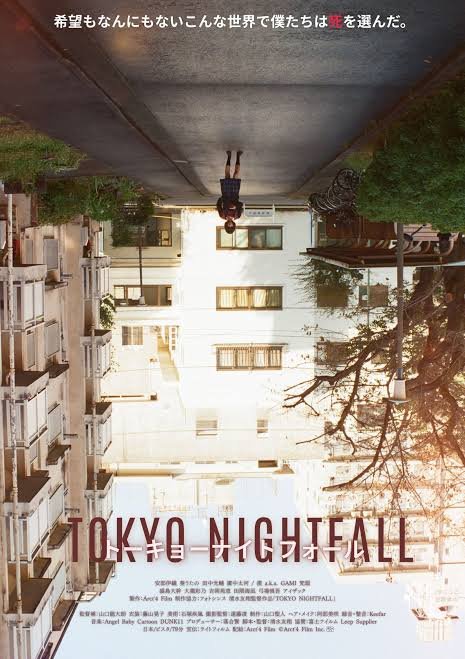
A young man called Amenashi (Iori Abe) is grieving the loss of his sister, Anna (Utano Aoi), who took her own life after witnessing a suicide – the experience of which seemed to draw her in, making her doubt in any sense of a future. In a broader sense, Amenashi is grieving the kind of optimism he and his sister felt before all of this happened; there are also hints at family troubles, though tellingly, we never see any of the mentioned family members in the entire film, and almost no one over the age of 25, either. Amenashi’s close friends Hattori and Nozu (Taiga Hironaka and Kosuke Tanaka) are all for distraction and entertainment to deal with their own sense of loss, but Amenashi has other ideas. He has signed up to attend a special event for people who, like him, are suicide-curious, but don’t want to go it alone.
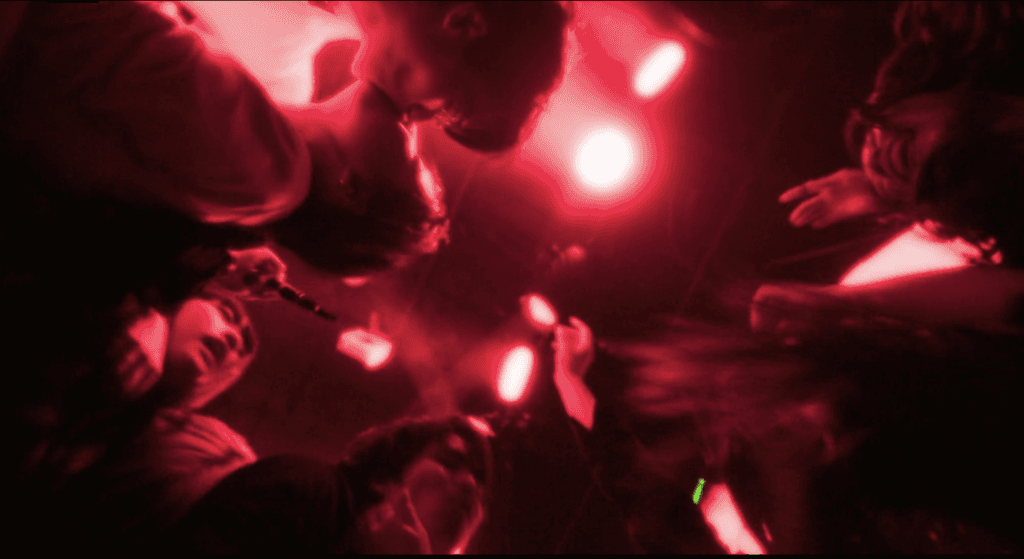
If that sounds a teeny bit like Sion Sono’s ferociously weird Suicide Circle (2001), then be forewarned: it isn’t, although later in its runtime Tokyo Nightfall (2025) does pull together some visually striking, shocking scenes which might recall the earlier, cult classic, and on seemingly no money whatsoever. However, the film as a whole takes a drastically different approach; even though there’s a hint that suicide itself can be, for want of a better word, ‘catching’ (think Heathers, think Bridgend), Tokyo Nightfall is a small, quiet, character-focused examination of suicidal ideation, though frustratingly, a lot of this is rather thinly communicated. The film has its strange paradoxes, too. Amenashi heads off to the suicide event, which is being hosted in a cellar bar with surprisingly upbeat, banging club music. Everyone there has come to the social event determined, it seems, not to be social, and it’s top-secret, but the bouncer/organiser lets Hattori and Nozu in when they tell him they’re looking for their friend. Problem: they’re there to dissuade their suicidal friend from ending his life, but not being suicidal themselves, they start quite enjoying themselves – at least at first.
The film doesn’t just stay with events unfolding in the club; instead, it chops up its timeline into sections, with a large amount of time dedicated to old footage the friends made of each other back when Anna was alive. In terms of providing context, this makes sense, and this is a film which can only really look backward, given its distaste (or its main character’s distaste) for looking forward. This technique also provides some, perhaps limited means of deciphering Anna’s motivations and issues, though – and this is something the film does a lot – much of this is to be deduced from characters looking wistfully into the distance. Amenashi does it too, and spends more screen time doing this than engaging in dialogue or action. In amongst all of this, the film frequently overlaps footage we have already seen, either presenting it from a slightly different angle, or extending it, so that the conversation we have already heard continues for a few more moments. It shows structural awareness, sure; it’s also – by its nature – repetitive, and adds to a suspicion that there isn’t really enough here for a feature-length presentation. As it stands, the film racks up around an hour and fifteen minutes, but a lot of that is the overlapping footage mentioned. As a viewer, it can feel onerous.
There are some surprises, not least the film’s moments of unexpected whimsy – Nozu is, for the most part, a stock comedic character, and before he quits his job Amenashi is a food delivery guy, which allows the film a few moments of breezy, observational humour – even if this is then followed by a shift back to ingrained ennui. On a similar note, the portrayal of the rather jovial suicide party will, and the next clause will be doing some very heavy lifting, not be agreeable to everyone. Whilst Japan does have a very high youth suicide rate compared to other developed nations, it’s probably more the treatment that these fatalities receive in the media and in culture that feels most striking and different for Western perspectives. It’s painting in broad strokes I know, but the thought of such an open treatment of suicide, even a non-graphic one, from a 21-year-old director just appearing in the US or UK, for example, seems highly unlikely, given the norm now seems to be to avoid the term ‘suicide’ altogether: we now see the term ‘unalive’ used instead.
But despite Tokyo Nightfall‘s attempts to grapple with a difficult and timely issue from the perspectives of young, rootless people, it can’t really get as far as anything which feels truly revealing or meaningful. It hints at elements of Tokyo life which are straining at the seams, alluding briefly to CSE, poverty and debt, but in its frequent repetitions and shifts, it stutters. It’s not without its ideas, but its issues overwhelm them. Still, in the film we get glimpses of a Tokyo which usually hides away – grimy, cramped, ignored places, which are easy to imagine providing a meaningless and remote kind of living for some of its residents. Perhaps the fact that it has been made, rather than how it has been made, is really the most significant aspect of Tokyo Nightfall.
Tokyo Nightfall (2025) will receive its World Premiere at this year’s Raindance Film Festival: for more details on screenings, please click here.