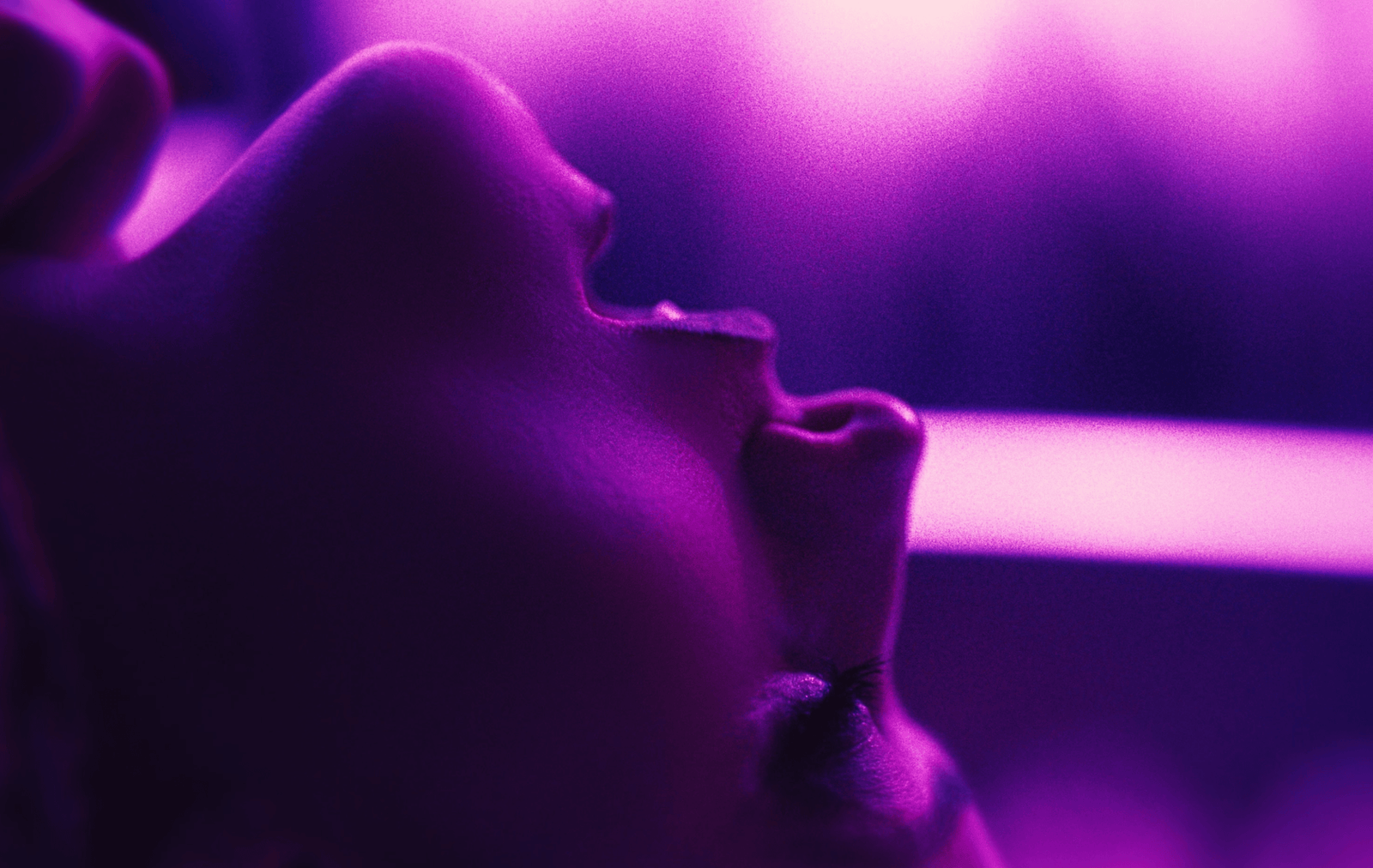

‘Tell me a story’, says the therapist at the beginning of Touch Me (2025) – though specifying that it should be a fantastical kind of story. Swap out the details, she says, but find a way of telling me about something which has traumatised you. Well, boy does Joey (Olivia Taylor Dudley) oblige, offering up a hell of an anecdote which, as requested, also hints at the issues which might just have brought her to therapy in the first place. This is the first of the ways in which this film plays with audience expectations, foreshadowing the high neon weirdness to come, whilst showing us something which feels troubled and real where it counts.
Back in the real world – let’s accept that the therapist’s office sits outside of the strictly real here – Joey is enmeshed in a relentless play-off between fantasy, inebriation and the unavoidable presence of reality, which keeps on pressing in at the corners, no matter how much red wine Joey and her housemate Craig (Jordan Gavaris) imbibe – and that’s saying something, because these two don’t drink by the glass, but by the bottle. But money, family, essential repairs: these inescapable factors prevent the desired full disengagement from adulthood. Desperate measures call for desperate times: Joey declares she’s going to go get a job. They need the cash. She doesn’t actually get a job, but she does run into a guy who looks just like the alien-in-a-tracksuit she made up for the therapy story and, oh. That was actually true. The world-saving, tentacle-sex maestro was a thing, his name is Brian (an unrecognisable Lou Taylor Pucci) and when he offers Joey a chance to reconcile with him and get away from it all, she takes him up on it, though taking Craig along, too. Since their bathroom is not currently in a functional state, it’s actually great timing.
Joey has already had a taster, but it turns out that Brian, plus his mysterious but loyal human employee Laura (Marlene Forte) have a lot to offer; in the main, this takes the form of unorthodox pseudo-therapy, dance, and almost inevitably, weird interspecies sex, which functions a lot like interactions with the Aylmer in Henenlotter’s Brain Damage (1988) – offering up a kind of narcotic effect which just so happens to destroy the feelings of anxiety which otherwise assail both Joey and Craig; misery loves company, and this seems to be one more reason that these two stick together so firmly. But with enticements like this on offer, jealousy soon raises its head and the more complex Joey and Craig’s responses to this unique style of ‘therapy’ get, the more troubling the whole set-up becomes. Which begs the question: is Brian really what he seems to be? What does he actually want?
The relationship between Joey and Craig is, by the by, utterly charming and plausible, and gets brought into ever closer relief by the crazy situation they find themselves in (and the lead actors are very well cast here, with Dudley in particularly doing a great job of balancing glamour with seeming authentically a little broken). This film boasts, from the opening monologue, a layered, witty and very funny script. It splices moments of genuine vulnerability with darkly comic content, trading off its diehard body horror sequences for plaintive, relatable conversation between relatable, flawed characters. But then we wheel back to the absurd, even if that never feels to the detriment of the film’s big heart as a whole. Brian’s role becomes more and more ambiguous even if always entertaining, but he has an important part to play here, and arguably this relates to another of the film’s themes, albeit given a characteristically oblique treatment: the relationship between poverty and privilege, and who gets to control what/whom. Sure, Touch Me often underscores something poignant with something ridiculous, but it does so to cast new light on its key players. Similarly, and in common with many of the best examples of the body horror genre, it breaks down boundaries – often literally – in order to interrogate very human, painfully contemporary concerns.
With its bold Yuzna-worthy aesthetics and shifting modes of storytelling, Touch Me uses the lens of altered states and body horror to tell an interesting, engaging story. Despite its similarly dark subject matter, it isn’t as bleak and sour-feeling as director and writer Addison Heiman’s previous film, Hypochondriac (2022) – a deeply personal project – but it’s still a film which uses fantasy in its own, intimate, unflinching ways, with seemingly absolute confidence in its use of mode and motif. Given all the tentacles, it remains a deeply humane film. This is such an enjoyable film too: it doesn’t stumble, and for that it’s glorious.
Touch Me (2025) will be available on Digital Download from 4th May.