In 1983, the Director Of Public Prosecutions published its first list of movies which were tagged with the tabloid-friendly label of Video Nasties. These cinematic outliers were deemed to have to power to deprave and corrupt and, if the title in question had been successfully prosecuted under the Obscene Publications Act of 1959, any dealer stocking it could be fined or jailed. In one case, involving Romano Scavolini’s Nightmares In A Damaged Brain, one of its distributors was sentenced to eighteen months in prison (eventually reduced to six months on appeal, but sheesh).
It was a heady time, driven by moral outrage, framed as a battle for the very soul of the United Kingdom, and the seventy-two films that appeared at one time or another on that DPP list attained a level of notoriety their filmmakers never expected (unless, arguably, you were Umberto Lenzi). Thirty-nine remained banned, thirty-three were dropped from the list. All of them became must see items, of course.
As the memory of those crazy days fades and those of us who lived through the Nasties era scratch our heads and wonder what all of that hysteria was about, did those movies actually threaten the fabric of society as we knew it? Let’s take a look at one of them…
THE BOGEY MAN (1980, dir. Ulli Lommel)
*** THIS REVIEW CONTAINS SPOILERS ***
When young siblings Willy and Lacey (real life brother/sister combo Nicholas and Suzanna Love) are spotted spying on their mother kissing her current boyfriend, her brutish beau ties Willy to the headboard of his bed and Lacey is sent to her room. Lacey frees Willy and her brother takes serious umbrage to being bound, grabbing a large knife from the kitchen and stabbing the boyfriend repeatedly. Twenty years later, Lacey and Willy live on a farm with their aunt and uncle, Lacey being married with a young son and Willy still mute from the trauma of two decades ago. A terrifying incident leads to the soul of their mother’s murdered boyfriend being released from his prison in a mirror, and the boogey man is back…
I say “boogey man” because The Boogey Man is the original US title of Ulli Lommel’s supernatural slasher but UK audiences clearly wouldn’t have had a clue what boogey men are so a renaming to The Bogey Man resolved the obviously massive comprehension issues across the pond. Was there a danger of Brits hearing the name of the film and thinking it was about a dance competition? Same issue in the States with that, to be fair. Anyway, Bogey in the UK, Boogey in the US. Sorted.
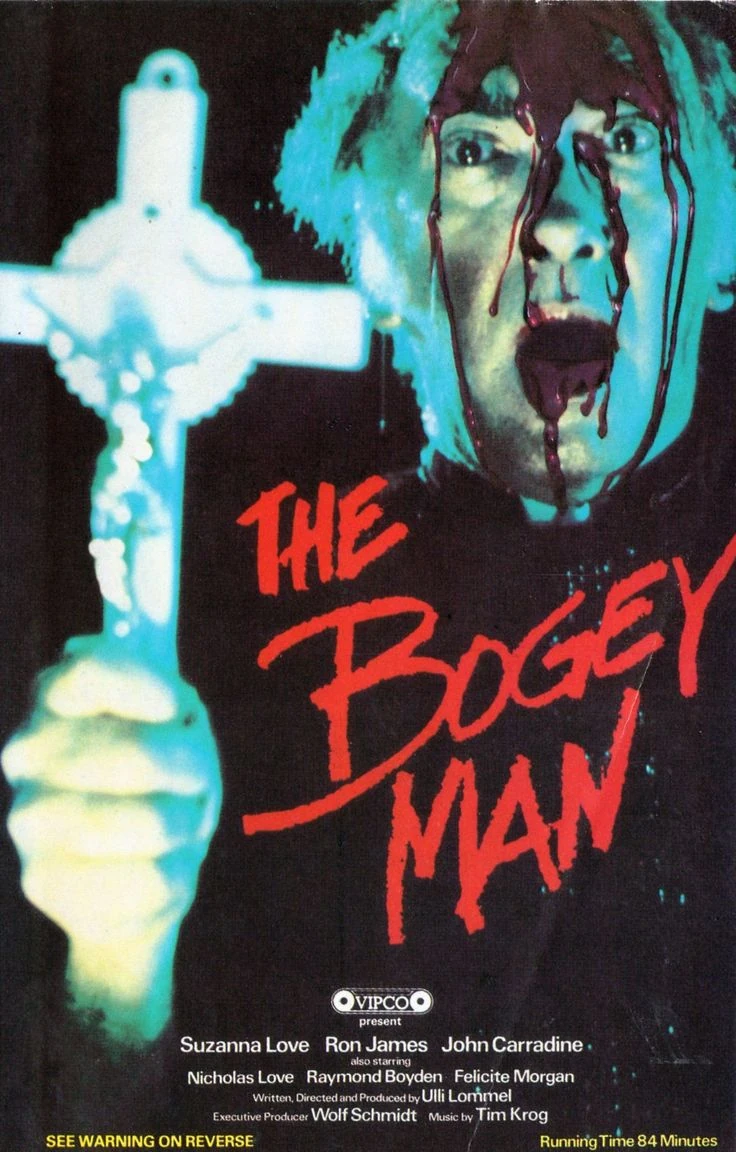
In my review of Absurd, I mentioned that I hadn’t gone out of my way to see those items on the Video Nasties list when I was underage. This is still kind of true with The Bogey Man, but a friend of mine was desperate to see it, mostly on the strength of the Vipco release’s lurid front cover, and the same rental shop which was quite happy to see me wander out of the place with a Joe D’Amato sci-fi gorefest were equally quite happy for me to experience some cursed mirror shard shenanigans at home. The assumptions was that I was renting it for my parents. Yeah, right.
Full disclosure: I really did not like that front cover. There’s a stylistically similar shot from Battleship Potemkin (bet you didn’t think I’d be referring to Sergei Eisenstein in this review) with blood running down a face that still gives me the ick in exactly the same way as the claret cascading down Llewellyn Thomas’ bonce freaked me out every time I clapped eyes on the box in the video shop. The late Mr. Thomas has this as his profile photograph on IMDb, which is a nice touch for the unsuspecting.
With one-time Warhol associate Lommel’s original background in more arty – though still gruesome – fare such as 1973’s Tenderness Of The Wolves (which boasts Rainer Werner Fassbinder as a producer), there’s more than a chance that the blood shower given to the character of Father Reilly was a nod to a classic from the 1920s and The Bogey Man does provide an intriguing bridge between the American slasher craze of that era and a more considered, European approach to its chills.
At the time, Lommel was married to lead actress Suzanna Love, a Dupont heiress who, after a debut appearance in 1979 musical Hair under the alias of Suki Love, acted in a series of her spouse’s flicks and more than likely assisted on the financial as well as the performance side. She’s actually pretty decent here as Lacey, even when she has to act possessed in front of an admirably straight faced psychiatrist played by John Carradine in one of his many late career horror movie cameo appearances.
In the case of The Bogey Man, there’s a case to be made that the British Board of Film Classification were going after the packaging of the video release more than the content of the movie. After all, it had been awarded an uncut “X” certificate for its bow at the cinemas and, although there are extra considerations to be made for home viewing in terms of the potential for repeat watching and pausing the more salacious moments, there’s nothing much to truly upset the viewer here. The murder set pieces are imaginative and budget conscious rather than aggressively gory, although the BBFC klaxon for blood running down breasts would be sounding in one sequence following a scissor attack.
Let’s be honest, Mike Lee, the head honcho of Vipco, knew how to pull in the punters, using the box design to promise a non-stop barrage of blood and guts and choosing the gnarliest still they could in order to tempt the public in the video shop. The case par excellence for this was their release of Driller Killer, the cover of which captures some screaming bloke, mid-trepanning. As a marketing tool (excuse the pun), it was effective. As a reason to ban the movie, it was even more effective.
The censorship journey of The Bogey Man is an interesting one, as the uncut version was dropped from the DPP Video Nasties list when a prosecution couldn’t be secured. Previously having been awarded a BBFC certificate with zero controversy attached probably didn’t help the forces of law and order. When it was re-released some years later, and the industry was arguably even more twitchy about horror movie content, forty-three seconds was trimmed, losing much of the dream sequence in which a bound Lacey is dragged along the floor and into a bedroom where she’s about to be stabbed. Even so, Vipco marketed the movie like it was still a ferociously transgressive genre piece, even though it never really was.
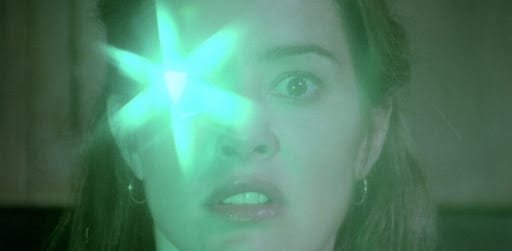
As with a number of the Nasties, modern viewers of The Bogey Man will be left scratching their heads as to just what the fuss was about. It’s less bloody than a lot of its peers and its killer, be it the stocking headed bloke in the mirror or the glowing glass shard out to wreak telekinetic havoc, is unlikely to be the stuff of nightmares. The proceedings don’t really kick into gear until about halfway through either, so folks expecting a spectral Friday The 13th riff will be twiddling their thumbs until the scissor kill and a kid getting surprisingly, though bloodlessly, offed.
Shot for around $300,000, the restrictions of the budget do occasionally show through (watch for the BBQ with a single sausage) but it’s attractively filmed and the performances are generally appealing. The electronic score from Tim Krog is evocative (although my podcast co-host will disagree vehemently with that) and the climax is a fun and fiery one, as a couple of likeable but disposable characters up the body count, Willy predictably speaks after twenty years of silence and a revelation about how to destroy the mirror finally sees off the bogey/boogey man. Or does it? The final shot suggests otherwise, and the sequel Revenge Of The Bogey Man, which was also handed a spot on the Nasties list, obviously confirmed that.
The Bogey Man may try to have its cake and eat it in terms of mixing ghost story and slasher plot beats and some of its attempts at chills may elicit chuckles for those visiting it for the first time forty-odd years on, but this remains a standout in Lommel’s filmography, many years before he started churning out almost unwatchable serial killer films on a dispiritingly regular basis. However, let’s forget where Lommel’s career ended up, and look back with fondness on this 1980 effort, which is both creative and charmingly ragged.
US audiences responded positively, and The Boogey Man made back its budget several times over at the box office. However, distribution company The Jerry Gross Organisation went bankrupt at the time of the film’s release, leaving the cast and crew wondering where the money had gone. That’s a shame, because the folks behind this deserved at least some kind of reward for providing such a singular take on the slasher genre. As a footnote, the UK release of The Bogey Man teamed it up with the 1978 Canadian apartment complex invasion thriller Blackout. That’s a double bill I would go back in time to watch.