
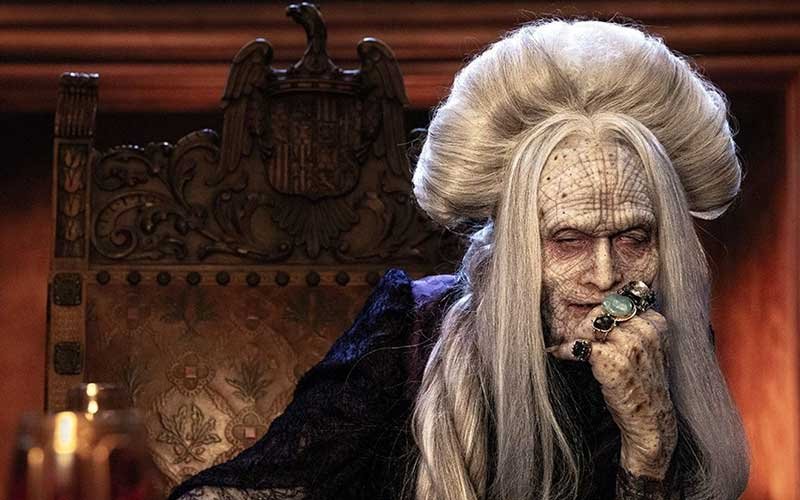
Here we are again, then. The year is 1480: Wallachian marital bliss (which seems to involve assaulting lots of cushions) gets rudely interrupted by the prospect of holy war. So off goes Prince Dracula (who keeps referring to himself as ‘Dracul’), campaigning against the invading Turks. However all his thoughts remain with his beloved Elisabeta (Zoë Bleu), whom he plans to send off to a different castle for safety. Bad idea: there are Muslim soldiers waiting in the woods, and she’s pursued. Dracula (Caleb Landry-Jones) does his best to wing it there in time, but actually ends up bringing about his beloved wife’s death anyway.
You know full well where this is going if you’ve seen Francis Ford Coppola’s Dracula (1992), and this film is, strangely, more of an homage to that film than a fresh retelling of Bram Stoker’s story. The whole ‘I renounce God’ thing isn’t present in the novel, but it’s a key element in the ’92 film and it is here too; arguably, providing a reason for Dracula’s malign eternal life has always been a good call. So Dracula the undead nobleman is born, and we move on, the film tells us, 400 years, to Paris. Well, 400 years-ish: the Eiffel Tower is already up. Doctors at a local sanitorium have a quandary, so having reached the limits of their professional expertise, they’ve reached out to a priest (Christoph Waltz) who knows a thing or two about these mysterious cases.
Their issue? They have a deranged society bride on their hands, a woman who, as they work out, is rather youthful-looking for her actual age: she is also lascivious, hates holy men, and caused a bit of a scene at her wedding breakfast, which seems to be the worst crime of all. The woman, Maria (Matilda De Angelis) presents an intriguing possibility for the priest, who has spent most of his life trying to track down the original source for all of the vampires running about in fin-de-siecle Europe, of which Maria is now one. The priest, who more accurately calls Dracul ‘Dracula’ throughout, is tantalisingly close to his goal.
Meanwhile, there’s the usual irresistible name-shuffling, plot-tinkering behaviour from director and writer Luc Besson, who here joins the ranks of filmmakers who want to do Dracula, but want to change the key characters and so forth. If you want a crack at Dracula and you haven’t changed things around, have you even written a Dracula screenplay? So here we have a Maria rather than a Lucy; we have a French estate rather than Carfax Abbey; we do have a Jonathan Harker though (Ewens Abid), though he seems to rock up in Wallachia on his own errand to get Dracula to part ways with some of his French property. Eventually, when pressed, we segue into the expected Mina/Elisabeta story arc, though it never feels like part of a cogent piece of storytelling. That’s the thing. The film is over two hours long, but it all feels strangely thin.
The past is a foreign country, and filmmakers always leave themselves open to comment whenever they try to blend imagination with verisimilitude: as such, the film’s own attempt to align its Prince Dracul with Vlad Dracula, dates permitting, impressive armour and all, feels a little clunky and budget-stretching with limited impact. Where the film settles more into its own mode of high camp, it actually feels more comfortable – there are moments where you feel welcome to laugh – but unfortunately, the brilliant Caleb Landry-Jones never really settles into his role here. Camp doesn’t come very easily to him – or at least, this particular variety of camp does not. Whilst he attacks the part with his usual relish, and looks rather dapper in select scenes, he’s hamstrung by all the limits to script, costume and development. The sense that so much of this film is a do-over doesn’t help matters. Imitation may be the sincerest form of flattery, but there are better ways. There are scenes which look to be verbatim copies from Coppola’s film, meaning they provide a sense of déjà vu, rather than an impression of their own. Even the portraits on the castle walls look more like Gary Oldman than Caleb Landry Jones. And, when Besson does add his own touches, they’re just too ludicrous, even for camp: a cute gargoyle army? Perhaps Besson likes a bit of What We Do in the Shadows. Oh, and then there’s the girlbait perfume motif…
This film has its visual charms; unmistakeably, there are some beautiful visuals, and equally unmistakeably, there are some interesting ideas. It’s just such a shame that despite the film’s unnecessarily bloated runtime and determination to head off on its own tantalising side quests, none of this really benefits the film as a whole. At its worst, this Dracula feels like a school play version of Coppola’s film: it just can’t match the older movie’s innovation or grandiloquence. Or budget; consider the wigs as proof of that. It was, to be fair, originally titled Dracula: a Love Tale, and that’s all it really is, or at least aims to be: the vampirism feels tangential overall, and as such, key players and plot points feel tacked on, secondary considerations and little more. It’s all watchable enough, it has its diverting moments, but this isn’t a great entrant into the vampire genre and on the whole it’s far more Argento than Coppola, which in this case is not intended as a compliment.
Dracula (2025) is available on Digital HD on December 1st and on DVD & Blu-ray from December 22nd.