Chris (Vinny Curran) is a happy fuck-up. We’ve all known people like him: he gets the most out of life whilst utterly out of his head, living day to day and squat to squat, and seems pretty happy with his lot – when he’s not in the grip of meth psychosis and imagining that the very birds in the sky are out to get him. Thing is, for every happy fuck-up, there’s a ‘concerned friend’, someone who will break off from whatever they’re doing to come and help and make it their mission to turn that person’s life around, regardless of whether that help was solicited or not, In Chris’s case, Michael (Peter Cilella) is that friend. But, when he sees footage of his best friend in an utterly depraved state, he doesn’t call Dr. Phil: he goes round to the shack where Chris is currently living, tazers him and handcuffs him to the pipework. He’s going sober, like it or not. Chris likes it not. This is going to be a long week…for Chris and for Mike, as Mike takes it upon himself to stick around and keep a watchful eye on his childhood buddy.
As Chris chides, pleads, and yells to be given his beloved pipe back, Mike – bored, feeling put upon and missing his wife – starts exploring the boonies where his friend has been living recently. It’s a strange place alright, populated almost exclusively by wackos and addicts who find themselves drawn there, to get high, to look at the stars or to check out some of the local legends. On the property itself, he finds lots of bits and pieces that have been left there by other folk passing through, all of them apparently a bit like Chris: he finds stacks of photos out back, some of them are seemingly of sinister goings-on…and then, he finds an outhouse, filled with archaic VCR equipment which he later finds out was left over from a research group working in the area. Curiosity gets the better of him, and he starts looking through some of the film reels. The evidently ancient footage and stills of unknown people’s stories begin to give way to something even more alarming: recent footage of him and Chris, shot by an unknown cameraman, sometimes from an inexplicably close vantage point. And it seems as though someone wishes them to follow some sort of trail – gradually, they’re following clues, finding more material relating to themselves, and soon, also getting hints of what might be to come.
The first thing I’d like to say about Resolution is this: it’s exceedingly rare for a film to be truly able to combine well-written humour with genuine creep factor. Exceedingly rare, but in abundance here. You could be forgiven for thinking, from the opening footage of Chris absolutely off his head, that this was going to be some sort of buddy horror, Tucker and Dale-style, but that could not be further from the truth. Yes, the jokes here land (not least because of the believable and well-acted relationship between Chris and Mike) but Resolution can turn it around, going from laugh-out-loud to cold shivers without either element feeling tacked-on. There’s a skill in evidence there. Quite often, new movies struggle to do either in any quantity, so it’s a testament to Justin Benson’s writing that this is the case.
I was also genuinely delighted that the movie uses some elements of that sub-genre, that sub-genre where, shall we say, film footage is unearthed (you know the one I mean) without provoking either my wrath or my nausea. And why? Because less is more, and this movie understands that. The use of a few seconds of ‘found footage’ here or there is sufficient to establish a motif which is carried on throughout; and, lest we forget, the idea that is presented here, of someone or something ever-watching the unfortunates in question, is a frightening one. Furthermore, it allows for what has in these post-Cabin in the Woods days as ‘meta’ elements to be woven in, though again, subtly so. Resolution allows us to consider stepping outside the film itself, wondering about what constitutes the movie, who is watching who, and what this sort of storytelling actually means.
It is this clever build-up and meshing of themes which provides the film with its Achilles heel, though. The closing half hour of this movie was almost unbearably tense: it had escalated the on-screen events carefully, and maintained my attention. Reflecting on this, I wonder, could the movie ever have rewarded that level of tension? It’s a make-or-break moment in any story, filmed or otherwise: this observation about storytelling feeds back into the themes present in the movie, too, but as a conventional viewer of a conventional movie for the moment, I do feel I wanted that much more from the conclusion. Also, there’s a final addition to the final reel which needn’t have been put there – it doesn’t unravel what went before it, thankfully, but it was unnecessary all the same.
My overall verdict on Resolution, however, is positive: this is a well-crafted exercise in tension, punctuated by believable, human relationships and razor-sharp humour, with some interesting reworkings of horror tropes along the way. In a sense, the success of the set-up is what must have made ending the movie all that more difficult. Nonetheless, I have no qualms about recommending this interesting indie: if all new movies tried for this level of engagement and initiative, as horror fans we’d all be better off.
I’ve always thought that the basis of a good short film was simplicity. With a limited time scale, it makes little sense to crowd your film with masses of ideas and impressions. And, sometimes, that simple, but beautifully-expressed idea can be incredibly creepy – not packing a punch, keeping the jump scares to a minimum, but effectively setting up a scare. Thus is the case with The Ten Steps: this is a film which deserves credit for holding out on the audience just long enough to plunge its main character into a seriously sinister punchline.
Director Brendan Muldowney introduces us to Katie (Jill Harding) and Stephen (William O’Sullivan), big-sister-in-charge and little brother respectively, who are home alone at their new house in Ireland while their parents seek to impress at a works dinner, one which could mean a big step up the career ladder for Katie’s father. For that reason, Katie’s aggrieved phone-call about her little brother messing around doesn’t go down too well.
She’s really in trouble when the fuses go, though. Left in darkness in a still-strange house, she has no choice but to call back. Her dad, sensing her growing panic, puts impressing his boss to one side to help her get down into the cellar to access the fuse box…
(Spoilers to follow)
The Ten Steps takes a sympathetic situation and extends it, using something very familiar to develop its horror and in so doing, grounding us in the situation; we’ve all had the lights go out on us and had to feel our way through the dark to restore order. Well, in this yarn, order isn’t restored, and we’re plunged into darkness ourselves as we’re left to ponder the implications of the film’s brilliant, understated ending. All of this works because of a strong array of performances, particularly from Katie, who carries the weight of the growing tension very well.
The film is very well balanced, too. We see enough of the light and ease at the restaurant to really appreciate the shift to darkness and isolation back at the house – as well as getting tantalising glimpses of something which goes beyond normal parameters. Camera angles, sound effects and dialogue build very steadily; this is a short film with a great idea of pace, which allows the film’s ending to have considerable weight, and without resorting to flashy reveals at any point. It’s a brilliant little ghost story, at its best with the lights turned low and the screen maximised, and a fine example of its genre.
(As a side-note, I’d like to say that director Muldowney is evidently a versatile filmmaker: I was surprised to find out, when I was seeking permissions to embed this film here at Brutal As Hell, that he also directed the rather more urbane feature Savage, which was favourably reviewed by Ben last year.)
As we sit in our lit, heated homes, awaiting the arrival of Trick or Treaters who invariably arrive with a watchful parent or two these days, it may be hard to recall just what the arrival of Winter may have meant for our ancestors. And yet, we mark the same date they did: despite the thousands of years intervening between us and them, and all of the events and changes which have happened in the interim, summer’s end – or Samhain, to give it its elder title – matters to many of us. We look forward to it, or we celebrate it, or engage with it in some way. That in itself is quite remarkable – but many people have no idea why they do what they do at this time of year; why they wear the masks, or light the lanterns…
Although much about the Celts is shrouded in mystery, or has been handed down to us by biased sources, we know that for our ancestors, Samhain was the beginning of a new cycle of light and dark, and as such, one of the most important – if not the most important – festivals of their year: it meant the approach of winter, a truly gruelling time of year, yet one still loaded with the promise of the spring that would follow. Life for our ancestors – those of us with Northern European heritage that is – would have been incredibly harsh during the months of darkness. Make no mistake, these were tough people: Roman historian Tacitus recalls the suppression of the Anglesey Druids by describing a “serried mass of arms and men, with women flitting between the ranks…In the style of Furies, in robes of deathly black and with dishevelled hair, they brandished their torches…” Any army willing and ready to face down the might of Imperial Rome in order to protect their holy lands would know and understand what Winter entailed in our inhospitable climate – and they would ready themselves.
One of the key associations of Samhain was the slaughter of livestock: at this time of the year, farmers would take an inventory of their animals, and kill large numbers of them. Sheltering and feeding an animal over the winter was not as important as sheltering and feeding themselves, after all; this may also be one of the ways in which the festival comes to be associated with death – and we know that the Celts once made human sacrifices, which may once have occurred at Samhain too. Indeed, this may also explain the bonfires which have migrated to November 5th in Britain, and the ‘burning of the guy’ which is now associated with Guy Fawkes may have its roots in old Samhain practices. Samhain is a festival and time of year heavily associated with fire: fire would be used to cook the slaughtered animals (perhaps giving us the term ‘bonfire’ – ‘bone-fire’) but it also had a deeper, ritual significance. Fire is also associated with protection and purification, and the huge bonfire which would be lit by each community would serve to unite them, as they moved into a time of threat, both from this world – and the Otherworld, the land of the dead, which was at its closest at Samhain.
The Celts believed that the Otherworld not only existed, but could be accessed: water and springs were particularly associated as points through which spirits could pass, and when at certain times of the year the divide between both worlds was at its thinnest, this meant that the spirits of the deceased could, in some circumstances, return to their families. Samhain was a time of year to honour the deceased, and even to urge them to rejoin the clan: there are some indications of a place at the table being laid for them, and of a light being lit and displayed to guide them back. But where the company of some spirits was desirable, other spirits were abroad, and these creatures might seek to do harm; like the Celtic belief in faeries and similar beings, the supernatural was an ambiguous thing, and faeries or spirits could be actively hostile to humans. The phenomenon of displaying the grinning death’s head of the Jack Lantern is a much later adaptation of the earlier practice, but some sources hold that it was intended to scare away the spirits of the dead who might not be so welcome…and the same may well be true of the old practise of ‘guising’, donning a mask or making oneself look as unseemly as possible to repel the influence of the malign spirits in their midst.
For all the hardship which the Romans inflicted upon the native populations of Northern Europe, their culture with regards the existing practices and festivals they encountered was often surprisingly pragmatic. Samhain continued under their rule, because they recognised in it elements which were familiar to them. The worship of Pomona, goddess of fruit and trees, and the Roman festival of the dead, Feralia, gradually became associated with Samhain. The departure of the Romans and the arrival of Christianity didn’t quell the Celtic New Year either, at least until Christianity as a force became more organised and doctrinal.
Fundamentalist Christianity still finds itself biting its nails about the continuation of the ‘Pagan festival’ of Halloween. Similar anxieties were held by some religious authorities hundreds of years ago. As a religion which essentially sells tickets to the afterlife, it was probably inevitable that it would eventually clash with a pre-Christian festival which espouses the belief that the dead are free agents (at least during certain times of the year) and that spirits have the power to return and influence the living, rather than being safely contained in Heaven (or Hell). This is perhaps why in the 9th Century Pope Gregory III moved an existing Christian festival, All Hallows Day, from May to November. It was a tactical move on the part of the Church, as outright suppression of the event would not have curried favour with congregations who still kept the festival. Still, the celebration of All Saints’ Day meant that Samhain would come to be known as All Hallows Eve – and then, of course, Hallowe’en. Interestingly, the dead under consideration were now Christian dead, but the association of the time of year with the dead was maintained, and instead of going door to door seeking fuel for the annual fire, now children might go door-to-door seeking alms, or asking for ‘soul cakes’ – baked for souls in Purgatory.
And so the festival survived renamed: it got through subsequent religious clamp-downs, Protestantism and Puritanism, and in the period of freedom which followed Puritanism was probably a decent excuse to have fun, play pranks and do all of the things which had been forbidden. Now it’s a secular holiday, and at the time of writing we’re left with a massively popular festival which reflects a little of all the things it’s ever been, whilst continuing to grow. The turnips used for lanterns in Europe have been replaced with the pumpkins native to America (the country responsible for a large upsurge in Halloween celebrations since the 19th Century) and the penitents collecting for the dead now arrive dressed as horror archetypes begging for candy, but still they come, still they keep the date.
For me, I like to reflect on the fact that we’ve kept this celebration which marks the start of the Winter, and on what we know of its origins. We may not fear the elements the way that our ancestors did, but their perseverance is why we’re here now, and the significance of the date has held. This time of year has mattered, in one way or another, for centuries. Happy Halloween everyone.
A young woman (Axelle Carolyn) goes to collect her post one day and discovers that she’s been sent a mysterious DVD entitled ‘Watch Me’. Curiosity, of course, gets the better of her. She places the disc in her player, and – that’s her first, significant mistake. What she sees on the disc doesn’t just repel her, it throws a lot of barriers between viewer and viewed into disturbing disarray.
(Spoilers to follow, so watch the film before you read any further…)
In less than ten minutes and with no dialogue at all, director Jamie Hooper weaves an interesting and atmospheric story here – and that’s despite utilising a trope I’m not altogether fond of. Here’s my mea culpa then, before we go any further: for those of you who regularly read my witterings here at the site, you’ll know of my antipathy towards the ‘person tied to chair’ trope. And, true enough, it’s a trope contained in this short film. The reason I’m not foaming at the mouth about now is because here, this plot device isn’t included as a justification for a ten-minute murder set piece; yes, it’s supposed to be unpleasant, but throughout, the film’s focus remains on Axelle’s character and her responses to what is appearing on her screen. Furthermore, although we are tantalised with the knowledge of what is happening, we actually see very little of it. Vision is about the reaction, far more than it’s about the action.
But there’s more to it that that, even: the film doubly distances itself from common-or-garden endurance horror by working on breaking down the barrier between audience and performance. I really liked the process where the character referred to as The Welder in the credits literally breaks down ‘the fourth wall’ – Axelle’s character’s TV screen here – with a hammer. That’s how a horror film does it: even Sadako never thought of that one. This sequence also forms part of the way Vision experiments with supernatural elements, which helps to enrich the sequence of events we see unfold, and pushes the idea of the omnipotent bad guy to an unsettling zenith.
Vision asks more questions than it answers. Mainly, you may find yourself wondering why Axelle’s character doesn’t just run away – why is she compelled to keep watching these awful events? Indeed, why would any of us watch something we found so appalling? There’s something of that in modern horror fandom, though: the best-known cult horrors of recent years have often been the most visually repellent, and Vision extrapolates from that tendency something which carries with it a decent dose of creep factor.
Massimo Dallamano’s a strange one. With his background as a cinematographer for Sergio Leone (working alongside him on the seminal movies A Fistful of Dollars and For a Few Dollars More), he brought a very distinct look and feel to his own movies when he moved into the directorial chair and tried his hand at all the major exploitation cinema food groups. I like to think of him as the minister who married this type of fare to a very particular and engaging sort of dreamy atmosphere. Both of the films I’m reviewing here, for instance, sound incredibly OTT on paper, and to be sure they have their moments, but what you might expect to be a barrage of excess feels rather turned down in the mix. And that’s not a negative criticism, not as such: the overarching sense I got from these examples of his work was of intrigue, rather than excitement.
Saying that, if nubile female flesh is your thing – and I’d be very surprised if neither of the other editors comment at this juncture to say that yes, yes it is – then you can’t go too far wrong with Super Bitch (1973), a film which is notable still further because the nubile flesh belongs to one Stephanie Beacham, who’s perhaps still best known, perhaps unfairly after all these years, for being ‘her out of Dynasty’. Anyway, back in the Seventies Ms. Beacham was starring with genre icon Ivan Rassimov in this soft-core spy romp where she plays Joanne, a high-class escort who, alongside her lover and boss, specialises in blackmailing her well-to-do clients by filming their sexual exploits (some of which are quite specialist: prepare yourselves for some nascent Furry action here). Can I also say – this is the most quintessentially British escort agency I can remember seeing on film, all impeccable manners (apart from the illegal filming, obviously) and tiny porcelain cups of tea. Well, all good things must come to an end – it turns out the agency is being investigated by one Inspector Cliff (Rassimov), a bent cop who’s also on the verge of infiltrating an international drug smuggling ring…but wouldn’t you know, both businesses are related? Prepare for double and triple dealings, a very unlikely criminal mastermind (Patricia Hayes), plot-irrelevant nudity which is often accompanied by jazz trumpeting (not a euphemism) and some truly global illegal goings-on. Oh, and the entire movie seems to be sponsored by J&B whisky.
That’s the thing about Super Bitch (which has also seen release under the titles Blue Movie Blackmail and, erm, Si pùo essere più bastardi dell’espettore Cliff?) Although it is a film punctuated by nude scenes, this is no hack work with nothing else on offer. Dallamano hasn’t cut corners, and if the script says New York, he has indeed gone to New York to shoot. Likewise London and Beirut, though pardon my ignorance if I haven’t correctly identified the real Beirut – the point is, most cult film directors would not have the budget for this and even if they did, they would struggle to capture the sense of distance and place which Dallamano does. He certainly brings his professional background into play; the stunts he uses, too, are well-handled, and there are a few Wild West moments. Now, I’ll admit, parts of the double-dealing elements of the plot lost me a little bit: this may well be because I was distracted, not by breasts but by the time capsule effect of seeing the Seventies coming back to life across a number of different countries – as this is something else which is very pleasing on the eye. Not as batshit insane as a lot of the Italian police capers of the day, Super Bitch is still very entertaining, and this release comes with some great extras into the bargain. The documentary Bullets, Babes and Blood: the High Octane Action of the Italian Police Film is a treat, and, for someone who knows generally rather little about this genre, serves as a fun introduction to it all. There’s a neat memorial from Ruggero Deodato on Ivan Rassimov, too, and there will be – with the final release – a collectible booklet with a new article from Calum Waddell.
Onto The Night Child (a.k.a Il medaglione insanguinato, 1975). Just as Super Bitch was a Dallamano foray into the world of crime drama which was so popular at the time, so The Night Child strove to cash in on the craze for crazy possessed children which had been kicked off properly by The Exorcist two years earlier. In this movie Michael, a documentarian on the lookout for Ol’ Scratch has, it seems, his own demons to look out for – especially in the form of a traumatised young daughter, Emily, who is in mourning for her mother, his wife, who died in a fire. The doctor insists that Emily should accompany her father on the next leg of his filmmaking, to Italy and to a town called Spolero, because constant mentions of Satan are good for distressed children. There, Emily keeps having visions of sinister figures chasing her, and of a mysterious medallion and – wouldn’t you know – her father has one in his possession, and allows her to wear it? Nothing can go wrong. Especially with even more J&B whisky appearing in so many frames…what, was Dallamano sponsored by the brand?
Moving on: as a strange, symbolic painting starts to form the bedrock of Michael’s research, he also has to contend with a sexually-repressed nanny, a child who seems to have developed an Electra Complex and a smoking habit, oh, and some unfortunate deaths. Again, on paper this sounds crackpot, but in its delivery it’s actually all a bit arthouse. Yep, this is The Exorcist, made by a Euro arthouse director. With a dash of Don’t Look Now thrown in. And again, nothing about this film looks unduly flimsy: the locations are superb, they’re well-shot and there’s not a cardboard set in sight. The Night Child balances the barmy with the beautiful, and as such it feels at times like a more accessible (read: linear) Argento – without sacrificing that pleasing strangeness which is half the fun of films of this era and place. Speaking of strangeness, yes, the little girl playing Emily is ‘her out of Flesh For Frankenstein’ and a number of other huge cult classics – Nicoletta Elmi, currently residing in the ‘where are they now?’ category, which is a real shame.
There are a plethora of extras available on this release too, including a choice of Italian and English audio tracks and a fun documentary, Exorcism Italian-Style, which examines the so-called ‘pasta possession’ movies of which The Night Child numbers. Trailers, and a collectible booklet, again penned by Callum Waddell, with a reversible sleeve, will also be on offer.
So, more high gloss and coherent than many of their peers, but still gently mad and plenty of fun, aficionados of cult film could do far worse than give these deluxe releases a whirl. Arrow have again made a huge effort to make these desirable products; now if they could add a release of Beyond The Door to their pasta possession remit, I’d be a very happy bunny. But not the sort of happy bunny we see in Super Bitch…
Super Bitch and The Night Child will be released in the UK by Arrow Video on October 25th 2012.
“You don’t really know much about Halloween…you thought no further than the strange custom of having your children wear masks and go out begging for candy…It was the start of the year in our old Celtic lands, and we’d be waiting… in our houses of wattles and clay. The barriers would be down, you see, between the real and the unreal, and the dead might be looking in… ” Conal Cochran
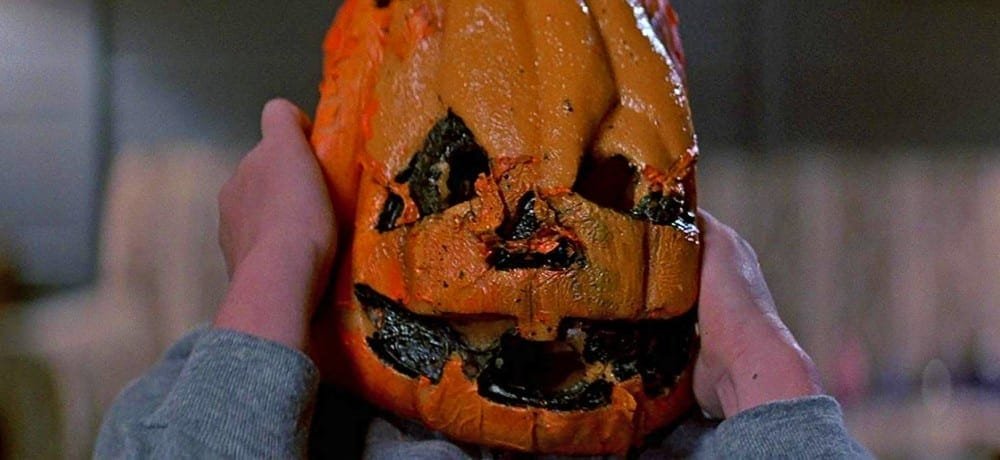
People expecting another slasher movie must have been deeply perplexed by Halloween III: Season of the Witch – and chalk up another victory for the phenomenon of misleading movie titles, because despite the involvement of John Carpenter and Debra Hill as producers, this is a standalone piece of work, a sequel only in name. Myers and his legend were nowhere to be seen; instead, we had a story of a magic-infused conspiracy, one uncovered by doctor-turned-detective Dan Challis (Tom Atkins, a man for whom all major roles seemed to involve him having a telephone clamped to his head) and Ellie Grimbridge, a young woman whose father died in mysterious circumstances, clutching a pumpkin mask and intoning, “They’re going to kill us!” Thus the mystery began, and although masks figure throughout, that mask does not. Still, for those of us who shrugged at the lack of omnipresent knife-wielding maniacs, we might just have seen a lot to love here. Halloween III has, over the past thirty years, slowly and steadily garnered a defiant following amongst cult film fans. Certainly for this fan, the omission of the omnipresent knife-wielding maniac is precisely what I found refreshing; see, slashers ain’t my thing. I can acknowledge the importance of slashers to the horror genre, especially in the case of the oft-supposed prequels to HIII, but I just don’t get any enjoyment out of them. What I do like, however, is the type of horror represented in HIII: it’s a film which is very much of its time (being bang up to date with its anxieties and concerns) but it also deals with a very ancient cause of anxiety and horror – magic.
And this nervousness about Halloween exists…this fear which is touched upon by Mr. Cochran in the quote above is still very real in some quarters. Even the Holy Father has been known to take a break from rallying against effective contraception to warn against the “anti-Christian” and “dangerous” nature of the festival, and it’s not just Catholicism which has this issue; there are plenty of other fundie nutjobs who share these concerns. But, in dismissing the no-fun brigade, it’s still worth remembering that Cochran’s correct when he says that Challis has a very limited understanding of where all of this comes from. Cochran describes “the festival of Samhain…when the hills ran red with the blood of animals and children.” Human sacrifice might be thin on the ground these days, but it’s still worthy of comment that, thousands of years after the decline of the Celts, the time of their New Year festivities is still associated with mischief, magic, chaos and horror. For many horror fans, Halloween is akin to a religious observance, and for nearly all horror buffs it’s the horror highlight of the year. Perhaps there just is something special about this time of the year – and HIII, with its story of one man capitulating to fate whilst using very modern systems to reinvigorate the old ways, spins a brilliant yarn out of this possibility, and even makes us look at the relationship between the modern and the ancient. More so than that perhaps, in his mention of the ‘Old Celtic lands’, the blatant nepotism of Santa Mira’s Irish worker community and of course the purloined Blue Stone from Stonehenge having its part to play in proceedings, we have Old World attacking New World here. There’s no mention of the Silver Shamrock masks being sold outside the US, and we’re shown quite clearly in the film that they’re being distributed widely across the whole of the United States, but not anywhere else. America is the scene for the tragedy which is about to unfold, and it’s a neat reminder that the safe familiarity of modern life can always be threatened, even by people who have a lot of shared heritage. It can always, all be undone – and of course the end of a known world followed by the birth of another has long been a solid horror theme. The film demurs about the end results of Cochran’s work – but it’s interesting to wonder at the very end about just what sort of an America would remain, after such a massive encounter with some very dark magic..?
But the Old World isn’t shy of making the most of things as they are now, either: in HIII, magic requires (and uses) the trappings of modern technology, on a devastating scale. In doing so, it hits on a lot of bang-up-to-date concerns – current when the film was made, but no less relevant now. The first of these is surveillance…
The old paranoia that ‘someone is watching you’ is no longer paranoia, really: someone very probably is watching you, thanks to an ever-growing network of CCTV cameras. In 2006, the BBC suggested that there were around 4.2 million cameras in use in the UK – roughly one camera for every fourteen people; six years on, we may have more still. Mr. Cochran would be proud. When HIII was made, the possibility of all this was starting to be understood fully. Santa Mira is a CCTV hub, fully under control and being watched 24/7: seeing is power, and from the outset, the unlikely duo of Challis and Ellie have to pit themselves against a combination of insularity and technology. Everywhere they can be seen, they can be tracked – by the ominous be-suited guardians of the town, themselves fairly high-tech…
And of course, Silver Shamrock could only ever have considered orchestrating the biggest Samhain massacre for 3,000 years thanks to the modern potential for the mass manufacture and distribution of their wares. A blend of timeless magic and corporatism is at play here, allowing Cochran to corner the market, selling huge numbers of – sure – pretty cool, but limited-in-design masks to huge numbers of children. And why are the kids so keen? Because they have been more or less brainwashed before they get to be properly brainwashed, that’s why. I don’t mean to sound like a concerned parent here (because I am neither) but HIII is also notable for the way in which it works up a nice satire of the effects of advertising…
The filmmakers may or may not have intended that the jingle they wrote for the film would work so effectively as an earworm for their viewers, but it really, really does. Like all effective jingles, all it takes is a bit of a tune and a lot of repetition – and just like that, it has power beyond its power over the kids in the film; it works on us as well. How many folk do you know who count down to Halloween using this tune? How easy do you find it to get the jingle out of your head? For me, it takes weeks and weeks, particularly when the people counting down to Halloween on Twitter with the Silver Shamrock tune effectively marry it to another earworm and wreak havoc with it (Ben Bussey, I’m looking at you here). I think it’s neat that a TV ad campaign is so integral to a malevolent ambition in the film: the advert plays with (but doesn’t destroy) anxieties about what children see, and what it could do to them. And it’s next to impossible to shield them from this stuff: Challis’s desperate attempts to get the channels shut down get thwarted in the end. It’s not hammered home, but the questions raised about TV and advertising also bring up the topic of subliminality. Maybe, just maybe, whether it’s illegal or not, we’re being manipulated by things we’re not even fully aware of…
Just as Cochran departs from the film veiled in ‘what if?’, so we never see the aftermath of what happens in this now severely-threatened world, where no one is who they seem to be. We can only guess at the horrors unleashed by Challis’s failure to get that last channel shut down, to stop that mass-appeal madness being unleashed. HIII is all about the what-ifs, and maintains a level of ambiguity which marks it even further apart from the ultraviolence of the true entrants in the Halloween franchise which preceded it, even if the misleading title wasn’t enough. There’s surprisingly little on-screen violence, even though some is certainly implied. It’s a film of well-paced atmosphere and creep, with a definite dash of fun.
That said, when I found out that the original screenwriter – the legendary Nigel Kneale – asked for his name to be taken off the credits because he was unhappy with the Carpenter/Wallace rewrites which made the movie much more ‘gory’, I’ll confess, I was intrigued. Kneale’s argument was that his original story contained far more supernatural elements and was massively bigger in scope, with a greater number of characters and a greater range of locations. The rewrite trimmed this, and also reduced the ‘Britishness’ of the original – actor Atkins also complained that the first version seemed positively anti-Irish, but – without the benefits of actually seeing this version, all of this is academic of course.
Still, as much as I’d have liked to see more of the magic in the plot, I think the end version which we have still works pretty well. There’s the intimation of dark forces, in an up-to-date setting with up-to-date trappings. It’s an engrossing story, and also something of an original. Celtic myth-making is still surprisingly underused in horror, when you consider the range of legends, beliefs and beasties it encompasses. Ultimately, playing with the notion that our festival of Halloween is really only just removed from something truly sinister is used to good effect here, especially in the way that HIII links all of this to the brave new world of technology…
The only real shame is that touched upon by Wallace (in this, his first directorial role), who said that his only regret about the movie was its title. That misleading title has probably cost the film a lot of fans who would really enjoy it, and likewise, brought a lot of people to it who were really after one guy in one mask, and didn’t appreciate the film they got instead. Well, it’s a film which has slowly found its audience nonetheless, and fans of a more subtle breed of horror might yet find lots to love right here. Enough of us already do – especially, perhaps, those of us who never got tired of the Halloween season, or the darker heart of fright and revulsion which it brings. That’s something to celebrate, as well as something this underrated movie helps to keep alive. And, guess what? It’s almost time, kids. Time to put on your masks…
I think I speak for all of us in the Brutal As Hell team who have seen this movie when I say that Some Guy Who Kills People has made a big impact on us. If there was ever proof positive that a good film can revisit familiar horror tropes and still come out being clever, engaging, funny and touching then – Some Guy Who Kills People is it. I was delighted to speak to writer Ryan Levin about his experiences with this project.
BAH: Firstly Ryan, congratulations on the movie! It was one of my favourites at the Abertoir Horror Festival last year and both Annie and Ben have enthused about it here at the site, whilst the overwhelming majority of fans/reviewers have loved it too. Has the film’s reception surprised you?
RL: Absolutely. In writing SOME GUY WHO KILLS PEOPLE, I sought to write a movie that I really wanted to see, but I had no idea if anyone else would be interested in seeing on-screen what was in my brain. Once I realized we were actually going to make the movie, I just crossed my fingers that there were a few folks out there who shared my tastes. And because this film blends numerous genres, I knew we ran the risk of alienating certain audiences. People who wanted a comedy would be put off by the horror elements; people who wanted a horror film would be put off by the father-daughter relationship that is the spine of the movie. So, it still shocks me when hardcore horror fans tell me how much they love that this film has heart. It still shocks me when people who prefer broader comedies laugh at the dark, often subtle, humor. I’m damn lucky SOME GUY WHO KILLS PEOPLE has gotten in front of so many different types of audiences, and thrilled that a wide spectrum of film-goers have embraced the film for a myriad of reasons.
BAH: How did you become involved with the project?
RL: SOME GUY WHO KILLS PEOPLE came about after I made a short film called THE FIFTH in 2007. The short was about some buddies playing poker, and one of them, Ken, is a serial killer. It was just what he did on a day-to-day basis. I loved the idea of an average Joe who lives a normal life, and also happens to kill people. So, I set about trying to write a feature based on this character and started to flesh out the Ken character and figure out who he was, why he killed people, who his friends were, etc. And, after a very long time, and what seemed like hundreds of versions, I finally realized I had a script in which I was confident. From there, it was about going out and trying to raise the money to make it. That process quickly made writing the film seem like a piece of cake.
BAH: Do you see SGWKP as having any precedents – did you draw on any influences in your writing?
RL: In the year 2012, there’s no such thing as a movie that doesn’t draw on previous films for inspiration, or films that are 100% original. As I said before, I wanted to write a movie I would love to see, so it was bound to include elements from films and other writing that I loved to watch and read. While I can’t think of another movie that shares all the same storylines as SOME GUY WHO KILLS PEOPLE, certainly each storyline in the film has been done a billion times. The characters that inhabit the world of this film all have forebears, but, hopefully, they’re also original in their execution. My exact sense of humor is mine alone, but is also one shaped by the comedies and comedians I love. That being said, here is a partial list of creators and creations that doubtlessly influenced the SOME GUY WHO KILLS PEOPLE script: Fargo, Better Off Dead, The Simpsons, Martin McDonagh’s plays, In Bruges, Christopher Guest’s films, Airplane, Naked Gun, The Office (UK), Matchstick Men, John Swartzwelder’s books and, uhhhh, Tolstoy. Yeah. Tolstoy.
BAH: Without exception, the characters in SGWKP are warm and believable – even when they’re flawed, they’re people we can relate to. Conveying this on screen evades a hell of a lot of writers! Where did these characters come from and how hard was it to bring them to life they way you did?
RL: The short answer is that it took a lot of rewriting. The characters and the plot are always intertwined, so as the story changed, so did the characters. When older versions of characters no longer worked within the new storylines, they had to be rewritten. Sometimes that meant tweaking them, sometimes that meant jettisoning them entirely and having new ones show up that needed to be there. And it worked the other way, too. It always sounds pretentious to say, but when the characters start leading you, when they start talking through you, you just have to say ‘Fuck it’, and just go with it, see where you end up. Sometimes, I found myself in places I never would have expected, hanging out with characters I never set out to construct. I only wish that the organic development of characters wasn’t such an unpredictable and fleeting experience. That’s how I’ve come to be obsessive about writing – because if inspiration is gonna strike, I wanna be damn sure I’m ready to transcribe it.
BAH: How difficult was casting?
RL: As a part of pre-production, I don’t find casting difficult because I love casting. So, even if finding the right actors for the roles is a struggle, I still enjoy the process. On this particular film, we were also blessed with having amazing actors who wanted to be in the film. Casting Karen Black, Barry Bostwick and Lucy Davis was a breeze because they came in and blew everyone away with their auditions. Even during their 5-minute auditions, they were able to take what was on the page and elevate it beyond anything I could have dreamed. We wanted Kevin Corrigan, so we went after him. Again, we were so lucky that he responded to the script and was down to do it. My biggest casting concern was finding the right girl to play Kevin Corrigan’s daughter. I knew that a) the film hinged on a believable and profound father-daughter relationship and b) that finding an actress that was around 11-years old (or could play 11-years old) was not going to be an easy task, even in Los Angeles. There are not a lot of Dakota Fannings out there, and we weren’t gonna get Chloë Moretz. Then, luck struck again in the form of Ariel Gade. She was literally the first person we saw for that part. We saw another 40 girls or so, many of them wonderful actresses, but Ariel was always our barometer, and no one ever came close. And, as solid as she was in her auditions, once that camera came on, she just cranked it up as though she’d been doing this for forty years. And those are just the main roles…
BAH: A big part of the plot draws on the after-effects of bullying on someone later on in life; I know this is something that has resonated with a lot of viewers. Was this a difficult topic to broach?
RL: I’d be lying if I said I included the bullying in the film because it was a prevalent topic, an ‘of the moment’ issue. It’s in the film because of a choice I made for the protagonist’s motivation, a choice I made before these horrible stories started becoming weekly headlines. Bullying obviously isn’t a new phenomenon – it’s human behavior that I can only imagine has been around as long as humans have. ‘Grogg want Thak’s saber-toothed meat. Thak give, or Thak get club on head.’ So, even if we had made this film five years ago, or fifty years ago, the audience would have well understood the concept of bullying, and the concept of bullying as possible motivation for revenge. Now, I’m not saying revenge is the proper response to bullying. I’m not saying it’s not the proper response. I’m saying (finally), no, it wasn’t a difficult topic to broach because I didn’t include it in the film because of its unfortunate ubiquity. It was just a creative choice. Now, that being said, I’d be overjoyed if anyone is finding even an ounce of solace or comfort on account of this film.
BAH: Were you making a deliberate point with regards Ken and the escapism he finds in his artwork? As Ben mentioned in his review, it seemed like this was a comment on how quick people can be to take horror fandom as evidence of real derangement…
RL: Yes and no. ‘Deliberate’ is a strong word, as it indicates intention. I didn’t write SOME GUY with the intention of making any points, or teaching any lessons. I simply made Ken an artist in the film because, whilst I would never refer to myself as ‘an artist’, I’m quite intimate with the idea that what someone puts down on paper, or puts up on a screen, does not define who they are as people. In fleshing out his character and his character’s history, it made sense to me that he would withdraw and lose himself in his work. That work would be his catharsis, just as writing is mine.
We’re all told not to judge a book by its cover, and for good reason. You cannot assess someone’s personality, or sanity, or value, based on what spills out of their head and into their artistic medium. The corollary is also true – you can’t define people by the art they consume. You mentioned horror fandom, and the existing perception of horror fans. Well, I gotta tell you, having had the good fortune to know and meet a lot of horror fans, one thing has become very clear – they are almost the perfect antithesis of what someone might expect them to be. Horror fans, almost as a rule, are kind, caring, sensitive, intelligent, warm and fuzzy folks. Same for the folks I’ve met who create horror films, or write horror novels or violent comic books. Art, both in its creation and consumption, is an escape. It’s part of someone’s personality, but it’s not who they are.
I love to write dark comedy, watch horror films, listen to death metal and stick almost exclusively to dark, dramatic TV shows. That’s where my tastes lie. Now, it would be foolish to deny there’s a part of my brain that is intrigued and stimulated by darker subjects than some other folks’. However, in no way does that necessarily translate to darker, let alone ‘deranged’ behavior. Jeffrey Dahmer’s shelves weren’t lined with horror films and Stephen King has never been suspected of murder.
BAH: Reflecting on the project now, what are you most proud of?
RL: First off, that we made the movie! That I did what I set out to do, despite it taking many years. Beyond that, I’m proud that the vision I had for the film, despite me not being the director and despite our limited budget, came through in the final film. Actually, thanks to the cast and crew, what came through was a better version of my vision. I’m also extremely proud that we’ve been able to show the film to so many people in so many different parts of the world. That someone, somewhere wanted to share the movie with their audience. Allow me to go negative for a moment (you can edit this out if you’d like): what I am not proud of is that, despite the incredibly hard work of the cast and crew, despite the 45 festivals the film played across the globe, despite the mostly very positive reviews, despite our modest budget, and despite the amazing fans who have championed this movie, we are left relying on corporations to tell us the truth about how the film is selling/renting, and that their level of honesty will determine the film’s financial success. That pisses me off. But, hey, it’s not like I wasn’t warned a million times. And, honestly, because this film has added to my life in so many ways (I’m being interviewed by one of my favorite websites right now!), I deem it a success, no matter what happens.
BAH: Finally, what are you planning on doing next?
RL: I’m writing a lot and hoping to do this all over again, whilst somehow ensuring my wife doesn’t leave me and my daughter doesn’t have to go to an ‘Experienced Healer’ when she gets an earache.
Damnit, you heard the man. Support Some Guy Who Kills People: it’s available now in the US and UK.
For as long as home video cameras have been around, there’s been the potential to make movies about people making movies. And, once upon a time, as hard as it is for us to believe today, this was a novel idea. You can make a strong case for Cannibal Holocaust introducing the world to the notion of found footage all the way back in 1980, when the use of the recovered documentary footage which makes up the second half of the film really did seem to bring something new and different to the table. But, perhaps because this movie took a long time to find its audience, or perhaps because Deodato didn’t make it look too easy, the framework he employed didn’t catch like wildfire at that time. The rest of the Eighties came and went, and there was no new film subgenre to contend with. But then, in the Nineties, this happened:
Yep, The Blair Witch Project. This picture of Heather Donahue filming up her own nose has to be one of the most ubiquitous (and parodied) images in modern horror. Now, cards on the table, I actually loved BWP; it was the first film of its type I’d seen (I saw it long before I saw Cannibal Holocaust), I thought it was authentically creepy, and importantly I don’t think Myrick and Sánchez had any idea of what they would spawn (or cared, probably). But, like it or not, the film’s great commercial success owed a great deal to its format. It was made on the very cheap, looked very pedestrian, and yet the returns it got were huge. Suddenly, wannabe filmmakers were pricking up their ears…could it be that all you needed to make a movie were some handheld cameras, your friends and perhaps an online campaign?
No. NO.
Sure, there are some good found footage movies – those rare, occasional flashes of brilliance, like Troll Hunter, that can overcome all the motion sickness, but they’re so few and far between that they could never compensate for the rest of the imagination-free dross we’ve had to suffer through in these dark, post-BWP days. Almost as soon as the found footage subgenre became a recognisable thing at all, we were straight into overkill, and this pervasive, lazy bullshit shows no sign of letting up yet. In fact, it now carries such a weight for many genre fans like myself that even finding out about the style it’s been shot in can seriously imperil the impact of a movie, even before I’ve seen it. And if that isn’t reason enough to reconsider, let me explain more specifically what I loathe about the found footage phenomenon; if I can reason one, just one, future filmmaker out of using this format for the sake of it, then my work here is done. And, if not, I get to rant about one of the worst trends to sneak its way into horror in recent years. Here, then, is what the hell my problem is.
The type of people who watch the world through a camera are not people I can identify with
We’ve all been stood behind someone at a gig who, rather than using his or her own brain and eyes to watch the band instead stands there, mobile phone aloft, filming the entire thing. On a bad night, you can find yourself behind a wall of these selfish arseholes, none of whom are actually looking at the band, instead staring intently at their phone display. These people do exist, so it isn’t as if filmmakers have invented them for the sake of convenience; they are out there, filming and uploading, filming and uploading, ad infinitum. But the problem with making someone who behaves like this both main star and chief cameraman of a film is that it’s then instantly impossible for me to empathise with them. When you’re expected to invest in the on-screen events and care about what happens to the soon-to-be-chased, the film’s at an immediate and huge disadvantage (see also: making every damn protagonist an irritating screechy twentysomething). To put it succinctly, the sort of person who films absolutely everything is inevitably a twat, and therefore I don’t want to spend ninety minutes observing what happens to them. But to give credit where credit’s due, in real life people seem to know how to use their own cameras; they don’t spend the entire time whirling around like drunks. In the movies, spasming camerawork seems to be the norm, even before bad things start to occur. Found footage films are far from easy viewing when this is going on; so often, the style of shooting has more of a chance of causing nausea than anything the film actually contains.
Only horror fans are expected to put up with this shit
Do we have rom-com equivalents of the found footage subgenre? Has there ever been a shakeycam Western? No, funnily enough. No one else would wear it. Find me a top paid actress who is happy to do all her own camerawork and I’ll show you a swimming giraffe. This format doesn’t seem to have taken root outside of the horror genre – or sci-fi, at a push – and accordingly horror has far and away taken more of its share. We’ve had people filming their feet as they flee a huge variety of barely-glimpsed beasts: ghosts, zombies, demonic beings, sea monsters, dinosaurs, even Bigfoot; we’ve had lots of Nasty People doing the chasing too, of course, and you can bet good money on the fact that someone, somewhere is coming up with yet another idea for a cheap moneyspinner just at this very moment. To me, the fact that we can even have a discussion about a subgenre of film which, as a matter of course, circumvents everything from music to writing an ending says a lot about how horror fans are regarded, even by (or especially by) people making movies ‘for them’. The found footage phenomenon hinges upon a belief, somewhere along the line, that horror fans will swallow anything, no matter how shabby. I strongly resent and refute that.
Found footage films legitimate crappy filmmaking
Horror movies have often been made on shoestring budgets and no doubt will continue to be; the difference between found footage and other types of formats is that the former is under significantly less pressure to make the film look great for the money. It’s supposed to look real – it doesn’t have to look good. When cash has been tight in the past, it’s led to some real ingenuity on the part of filmmakers and their teams – who would have had to think creatively to have any hope of engendering scares. I would argue that pressure just isn’t there in found footage. With a roaming camera and constant movement, why bother getting it absolutely right? There’s nothing wrong with hinting at or implying scares, of course, but sometimes this style of filming allows filmmakers to duck the bother of including them at all. Or does it? Should it? After all…
It’s not as easy as it seems
Because it really, really isn’t, even if it looks that way on paper. A filmmaker might opt to make a film of this style because they think it’ll be an easy way to get out of having to edit structure into it, but of course they inevitably have to do that anyway. There’s usually a twenty minute ‘getting to know you’ set-up before anything startling starts to happen, just as with a conventional style of film, because it seems people invariably want to film each other doing absolutely nothing for an extended and strangely similar length period before the horror happens (thus giving the filmmaker the opportunity to opt out of a lot of the considerations of pace and characterisation, leaving us to pick the bones out of all of the superfluous footage in order to do their work for ourselves). If you have chosen to frame your film by saying that the tapes have been found as-is, as so often occurs, well, the lie is usually given to this within the first couple of frames. Even adding credits can provide a real problem – with the film then occupying a weird hinterland between ‘movie’ and ‘found footage’; when this is the case, it so, so rarely works well as a movie, and it’s just one of a list of common mistakes which suggest that filmmakers don’t do themselves any favours by going down the ‘simple’ route.
To conclude this tirade, let me say that I understand that money is tighter than ever before; I know that, to get a film made, it’s a struggle of immense proportions. But invariably going for found footage is not the solution to the problem, it’s the beginning of a new set of challenges. In those rare cases where the format does work, it works because the filmmaker in question is smart enough to start where all good films start – with ideas, characters, a workable plot and a direction in mind. Bypass these things at your peril! It’s a saturated market out there, and I think I speak for many of us when I say that our patience is being severely tested by this tiresome, apathetic, tripod-lacking bandwagon. Horror fans deserve much better.
It’s the strangest thing. Somewhere along the line – perhaps around the time of the strobe-ridden, brainless Thir13en Ghosts remake – filmmakers got confused about how to tell ghost stories. Suspense and tension, with all of the skill and patience needed to accomplish them, just seemed to leave the horror movie vocabulary for a while, and in their place we got…jump cuts. Hundreds of them. Even when we were shown by filmmakers in the Far East that scary horror needed subtlety to make an impact, what happened? People like Gore Verbinski took a break from kids’ films and turned the slowly-creeping, unstoppable Sadako into a freaky gymnast called Samara. Cut! CUT! And easy on the blaring incidental music, while you’re at it.
It has been a genuine pleasure for me to see suspense and tension making a comeback, as they have in films like The Orphanage, and the cruelly-underrated Lake Mungo. And, if you prefer a shiver down the spine to being manipulated into jumping out of your skin, then I can genuinely recommend The Pact, a film which, even viewed on a laptop with lousy speakers in the middle of the afternoon, made my skin crawl on several occasions. But there’s a lot more to it than that, even. The Pact boasts a meaty plot which kept me locked into the film throughout, and I could never settle into a comfortable sense of expectation because I genuinely had no idea where it was going next. That is a rare thing indeed.
After her mother’s death, Nicole (Agnes Bruckner) arrives at her childhood home in time for the funeral. Her sister Annie (Caity Lotz) isn’t quite as forgiving, and wants nothing to do with it; we find out early on that their mother was abusive and cruel, and Annie doesn’t have any intention of paying her respects. But, Annie’s assertion that she will not set foot inside that house again is soon rendered problematic when Nicole, seemingly spooked by something, just – disappears. Annie arrives the next day, and all that’s left of Nicole is her mobile phone. Annie suspects that Nicole, an ex-addict, has just done a runner; that’s what her family does, she reasons. But when the funeral comes and goes with no Nicole, it seems there’s reason to worry after all. Plus, the house is growing increasingly sinister; things are going on that Annie can’t explain. When another family member also disappears shortly after getting inside the place, Annie seeks help to find them, and it seems that the house is about to yield up a complex array of secrets.
Think you can guess where it’s all going, based on that? Think again. This is a cleverly-wrought film, one which balances the supernatural with oh-so human mystery and it never feels like either element is an afterthought. Everything is handled very skilfully, showing that you don’t need overkill to create atmosphere and mood. Something as simple as the choice of camera work (almost never static in tense scenes, often overbearingly close to Annie as she moves around the house) creates the feeling of claustrophobia which is so integral to the movie, and the house itself is a great setting, all contrast between the twee family photos and chintz and pockets of black darkness. It’s overbearing, unsettling and very very creepy. Director/writer Nicholas McCarthy knows how the human mind works. We can all relate to that sensation of fear caused by a barely-heard noise, a glimpsed form, the what-ifs in any corner too dark to see into. He weaves these moments throughout his film, keeping high action scenes a rarity and strengthening the film as a result. And the horror is all bang up-to-date too. Ju-on made snazzy new mobile phones and CCTV frightening; The Pact features a scene involving Google Street View which made my skin crawl. It’s essentially a riff on the M R James story The Mezzotint, only recreated for the 21st Century.
The Pact does rely on a few genre staples to move things forward: for example, any on-screen haunting seems to play havoc with lightbulbs, so expect a bit of that, and it also features a blind psychic which felt oddly familiar…still, her scene reveals another layer of plot, so it’s forgiven. Speaking of Stevie, the psychic character, one thing came to mind as I watched The Pact – and that’s how unfortunate it must be for any filmmaker to start working on a project and then, at some point in the process, realise there’s another film coming out at practically the same time which is notably similar plot-wise. In this case, and I’m almost nervous of mentioning it, there’s a marked resemblance between The Pact and Cassadaga, which came out last year – and in regards far more than the appearance of a sensory-impaired psychic. This must be teeth-grindingly frustrating for any director, but in fairness there are far worse films to resemble than Cassadaga, and both movies share great strengths in atmosphere and a novel approach to storytelling. The Pact definitely has the whip hand in terms of scares, though, and draws them out in a series of original ways. At the heart of this is Annie, who balances believable fortitude with her understandable terror at the unfolding events. Dialogue-lite, The Pact relies heavily on sensations and emotions speaking for themselves, and this works well thanks to Caity Lotz’s performance.
Disturbing, gripping, and well-crafted, The Pact is one of the strongest horror movies I’ve seen this year. In Annie Riordan’s review, she said it’s one she happily revisited, simply to look out for the little intricacies of plot she missed the first time around. I’d agree with this, and I just know that, when I see this again, The Pact will still have plenty to reward me. And, just in case I haven’t waxed lyrical enough on this movie, the final thing I’ll say is that I watched most of it with my hand over my mouth, so unbearable was the tension. That’s a pretty big compliment. No film riddled with jump-cuts has ever made me do that.
The Pact will be released on DVD and Blu-Ray on October 1st 2012.
How to sum up the importance of a film like Hellraiser? I have much to say on that score, yet I must have started writing the introduction to this piece ten times before deleting it all. I started by trying to sum up what a game-changing film Hellraiser was, coming as it did during a decade which generally seemed happier adding camp humour aplenty to its horror, and then I tried to explain how the film brought monsters – genuinely terrifying monsters – back to our screens. All of the above is true, certainly. But the thing I kept coming back to, as much as I really do feel that Hellraiser revolutionised the genre, and really did make monsters scary again, was my personal response to this movie. Hey, it almost goes without saying; it’s a common theme for all of us who have been writing these retrospectives over the past year, and why I was so keen to be the staff writer to pen this one. So, here’s how I’m going to sum up the importance of Hellraiser, at least for now:
Hellraiser changed my life.
Guilty of hyperbole? Let me see if I can sum up what I mean by that statement. I knew Pinhead, as he’s come to be called, by reputation, long before I ever encountered him in the desecrated flesh – and he, his Cenobites, and the Hellraiser mythos have been a part of my life for more years than I can really remember. At this stage in my life, Hellraiser is just part of my mental landscape, and not something I ever could or would exorcise. As a kid growing up in the 80s, my awareness of the horror genre was usually refracted through the knowledge and attitudes of my friends; hearsay, and images from video covers formed the basis for scary mythologies all of their own, long before we’d seen the films themselves. And so, by the time I was around eight or nine, Pinhead had joined an army of barely-understood but nonetheless powerful characters – he was already part of a pantheon of boogeymen, joining the likes of Dracula, ‘Frankenstein’, and, interestingly, fellow 80s monster Freddy Krueger. All I knew about Pinhead for many years was how he looked, what I’d been told by other kids who had themselves probably been told by other kids, and that he was going to ‘get me’. Believe me, for some time, that was quite sufficient. I was terrified before I’d seen so much as one second of the film I came to love. It’s a testament to the strength of Hellraiser’s extraordinary visuals that this could ever have been the case. And, when I finally did see Hellraiser a few years later, that frightened fascination didn’t die away; it blossomed. I liked to test myself with movies when I was a kid, always chasing that sensation of fear – but I’d never, never seen anything like Hellraiser. It does so much more than make us feel scared. It’s one of the darkest films I’ve ever known. Dark, harrowing, and intense, it’s had a unique impact on me.
It’s oddly fitting that my devotion to the movie began in childhood; so much about the movie plays out like a dark fairy story. In children’s books, there is always another world, a world populated with at best ambivalent and sometimes downright dangerous figures who can, in certain situations, influence the affairs of mere mortals. The Cenobites could certainly cross from their domain into ours, warping and tearing the fabric of the waking world (which even Freddy couldn’t do), and what did it take to summon them? Simply a game. Playing with a puzzle box. It’s hardly an idea lost on an 80s kid. However, there is a great deal to the story of Hellraiser, and it extends beyond Pinhead and his ministers. As doubtlessly important as the Cenobites are to the movie, there is so much more to Hellraiser than these daemonic arbiters – but if we can sum up the appeal of the film simply, we could perhaps say that Hellraiser is notable for the way it destroys boundaries, jeopardises what is known, taken for granted. It does this consistently, and bloodily, literally and forcibly peeling away the layers of what is perceived as normal. And nothing is safe, not even the one thing that many of us take for granted as our base line for the Self – the body.
Oh, sure, the body had been under attack on-screen for decades before 1987 came around. Gialli and slashers had carved people up, and ‘body horror’ had long since established itself in its mission to fuck with physical parameters – but never had flesh been put under such scrutiny, punished with such cold delectation. Hellraiser arrived on the scene and presented its violence as an artform; it was systematic, it had a sense of aesthetics, and all that agony could even be the key to enlightenment. It’s easy to be glib about this now, when we live in an age when even the most pedestrian teen has gone through the process of stretching their earlobes to sizeable diameters and branding can be professionally procured in many city centres, but when I saw it for the first time (as someone very young, remember) Hellraiser’s assault on the body was shocking, and the concept of one’s body being cut, torn, punctured or stitched as a source of pleasure was utterly alien.
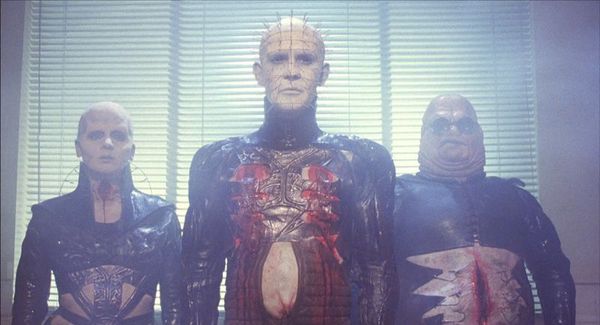
Hellraiser never shies away from any of this, and instead, glories in it, making it the fabric of its tale. Throughout, it finds delight not only in bodily torment, but in a grotesque sensuality all of its own: Hellraiser is a profoundly immersive piece of work where all senses are catered for. In rewatching the movie for the purposes of writing this article, it struck me again just how aural Hellraiser is. Of course, we tend to remember the skinless man demanding blood to put more flesh on his bones and similar striking scenes, but the visuals are balanced out by the intense sounds. From the outset, you can really hear what is happening, not just see it. The soundscape it creates balances the visceral with the musical: almost from the outset, flesh tears, maggots burrow, insects crawl – and this is all turned up to an unbearable level in the sound mix, dominating our attention, heightening the horrors on-screen. But then, the ringing of the Cenobites’ chains is almost melodious; the solemn knell which accompanies their arrival is ominous, but still a strangely appealing sound. If Hellraiser makes an artform of marrying the repulsive with the beautiful, then its sound effects form a large share of that process. It overlays these sounds onto striking colour palates; reds for Frank and Julia, cold blues for the Cenobites; and, where it cannot make us physically feel what the characters feel, or want what they want, it ups the ante by continually reminding us of what motivates the real villains of the piece – Frank (Sean Chapman) and Julia (Clare Higgins). It’s the same thing that’s behind Hellraiser’s assault on the family in what Clive Barker describes as ‘Ibsen with monsters’. It’s lust.
Ah, Frank. Frank, Frank, Frank. Frank Cotton is the first character we meet: the man with the phoenix tattoo, a true decadent whose desires for ever more sins of the flesh lead him to the sadomasochistic hell of the Cenobites via the mysterious Lament Configuration puzzle box. And then – oblivion. But even when we think Frank is a goner, his presence dominates the film. He’s being mentioned, by his brother Larry and also by Julia; when the married couple arrive at the old Cotton family home, seeing Frank’s grimy possessions and polaroids are enough to send Julia down Memory Lane as she remembers the last time anyone fucked her like they meant it. And then, Frank isn’t really a goner after all. His mortal remains are still in limbo in the house, just waiting to be found. He starts by casting a shadow over the household and eventually takes more fleshly form, defying demons and death to do so, whilst still casting a spell over Julia, skin or no skin. In fact, Frank is so hot that Julia will even take him wearing someone else’s skin. Whatever the man has, it’s damn good. (So potent is Sean Chapman’s animal magnetism in this movie that I was too coy to watch his scenes directly for the first few years of my Hellraiser infatuation; that’s Frank Cotton for you, folks.)
But, whatever Frank had done, the Cenobites had finished him – condemned him to a death-of-sorts, leaving him powerless and unable to help himself. And, whatever you can say about Frank, his motivations are always pretty transparent. Julia, on the other hand, is more complex, brooding. You can feel you know all there is to know about Frank; with Julia, you rarely feel you know much about her. She’s a character who evidently has a very complicated internal life. Played with exacting menace by the brilliant Clare Higgins, she’s really the engine behind all the havoc which unpicks the fabric of the family, because it is her deranged lust for Frank which eventually brings him back. He could not have done any of it without her. In a way, they’re a good match for one another – so single-mindedly carnal, and Frank’s able to offer Julia something which the domestic predictability of life with Larry lacks. And yet, Julia is, I think, more scary than Frank. She has all the appearance of normality, but gets to be au fait with bludgeoning rather quickly…well, she did tell Frank she’d ‘do anything’…and in that at least she was telling the truth.
Falling victim to their actions are the film’s only real innocents – father and daughter, Larry (Andrew Robinson) and Kirsty (Ashley Lawrence, in her first film role), whose relationship is straightforward, caring and, therefore, wide open to abuse. In the novella which inspired the film, ‘The Hellbound Heart’, Kirsty is a friend of the family rather than a family member, but changing this for the screenplay was, I think, a strong move: it allows a very human tragedy at the heart of the plot to manifest, as encapsulated by Kirsty’s agonised collapse when she realises that the corpse in the attic is not Frank, but that of her beloved father. It’s horrific on more than one level, grotesque, true, but sad too – not to mention adequate justification for Kirsty’s deal-making with the Cenobites. And who isn’t sad to see them back, when they come back for Frank? It’s an exhilarating moment…
There must be few monsters who have such an inverse relationship between the amount of time they spend on screen, and the strength of reputation they enjoy. I can only really think of one horror icon who is possibly on screen for less time – and that’s the Bride of Frankenstein, coincidentally enough an early example of a reconfigured, modified body. Indeed, the Cenobites are not even given a name until over forty minutes into the movie and, although we get a tantalising glimpse of them laying waste to Frank at the beginning, we have to wait until around the one-hour mark to have them back again. We want to see them again, because we’ve never seen anything quite like them. Drawing on a range of influences (from carved African fetishes all the way through to the then-developing fetish scene), the Cenobites are coldly stylish, their bodies neatly stitched and symmetrically punctured. Once human, perhaps they haven’t quite lost the notion of aesthetics, maybe even vanity. But the Cenobites are amongst the best-known on-screen monsters of the last twenty-five years for more reasons than their appearance: a major reason for this could stem from the inimitable Doug ‘Pinhead’ Bradley’s assertion that the Cenobites are, in fact, ‘not the monsters’. By this he refers, I think, to their ambiguity. They are not just savages let loose; there are rules. Whatever they do is solicited in some way, even if the unwitting person claims not to understand the process. They merely answer the call, and then proceed with their work. Likewise, they can be sent back: everything is codified, and their universe has order. They’re considered angels to some, as well as demons to others, after all. Frank and Julia behave in a far more frantic, reckless manner, and indiscriminately kill more people.
Perhaps that is it, ultimately. Hellraiser is one of those rare horror films which is able to offer a workable mythos, a world somewhere which can be accessed and, if not fully understood, then at least coherent enough to believe in and to dread. Lovecraft gifted to us the fear that we are standing on the edge of some arcane and dangerous self-knowledge, and in ‘The Hellbound Heart’ Clive Barker explored this idea further, showing us in grisly detail through Hellraiser what enlightenment could look like. Hellraiser doesn’t give us all the answers. I’ve always felt like Barker had them, but kept them back. For instance, we never find out more about the strange custodian of Lemarchand’s Box, the man who turns into a winged demon and protects the box from destruction; hell (pun intended) we don’t even find out who the Cenobites are, or were, in this movie. But not only can the film withstand these mysteries, it is stronger still for not giving us all of the answers. It adds to the film’s alienating, unsettling atmosphere. Sometimes these terrible things just are, and we are not in the privileged position of making them safe by understanding them completely.
That’s the basis of so much good horror, and, without question in my mind, Hellraiser is a brilliant horror movie. When I watch it, whenever I watch it, I’m that curious kid again, wondering what I’ll see, then half-recoiling, half-fixating on the eerie sensory overload which I get. That wonderful thrill of fear is still there too, and it’s all down to the vision of Clive Barker and his team – in a film which would, in all likelihood, never have been made in today’s more cautious, remake-happy times. We’re lucky to have Hellraiser, then, and I hope that, if you’ve read this far, then you’ll join me in celebrating twenty-five years of ‘pain and pleasure, indivisible’.
Yorkshire – it’s an awesome place, honest. I have to say, I’ve lived here for about ten years altogether simply because I like it so much. I’ve never seen any hairy pork scratchings which gave me cause for concern, never been called a ‘soft Southern shite’ (not to my face, anyway) and certainly never heard an ‘Ee by gum’ (and apologies to anyone reading in America; all of this will mean absolutely nothing to you). I’ve never been menaced by suspicious, deformed locals either, come to think of it. Still, not everyone’s so lucky, at least in the world of Inbred…a movie marking the end of a ten-year hiatus for writer/director Alex Chandon. This is rather different fare as well, seeing as his last movie was the Dani Filth-centred movie Cradle of Fear. There are no Gothic stylings here whatsoever, Inbred being pitched somewhere between a backwoods splatterfest and a horror comedy.
In both its splatterfest and horror comedy capacities, the plot here is very simple. A group of young offenders, together with their support workers, are heading from the South of England into that terrifying terrain of which Londoners in particular whisper in terror – that which is named ‘outside London’. They’re heading Oop North actually, to the ex-mining community of Mortlake for a weekend of team-building activities (including, perplexingly, railway salvage i.e. stripping all the saleable metals out of disused trains. Beats building bridges out of toilet rolls I guess.) Along on this journey are lockpick extraordinaire Zeb, arsonist Tim, quiet cute girl Sam and gang member/chief arsehole Dwight. The introduction to these characters left me in no doubt whatsoever that I was not going to be asked to invest much in these kids and, true enough, I wasn’t, not really. There’s an odd opening sequence before we come to them, though: a ‘gory film within a gory film’, initially presented to us as the film we were about to see. Not so, though; the boys are merely watching Emily Booth’s inevitable cameo on a mobile phone. That’s the end of any structural tomfoolery, though. From here on in, you can just watch the tropes roll in: mobile phones are locked away (this being horror there’d not usually be a signal anyway), the group visits the local pub, the locals are scary, the bar snacks are …unusual, and then the trouble really starts. The people of Mortlake want to be entertained…
I think Chandon knows damn well he’s not reinventing the wheel here, so he throws himself and his cast into various bloody fates with gusto. Fair play, there are some imaginatively nasty and grisly sequences throughout Inbred which gorehounds will like – although they might kvetch a bit about the ratio of CGI to more hands-on splatter, because the ambition for novel effects often means some pretty obviously digitised grue. I know, it’s an obvious genre film fan moan, but it does affect investment in a lot of key scenes, as much as you can appreciate the thought behind it. The clichés are positively slathered on too including using the ‘small town people are dangerous ingrates’ schtick in the first place, and what you make of this depends on your tolerance. I’ve seen people getting into high outrage about it, which I didn’t, but I’d definitely recommend checking your lust for originality at the door, as well as your lust for feeling outraged, as you’ll have a far more fun time here if you do.
And I did have fun, don’t get me wrong. Perhaps I’m easily pleased, but the mere presence of a porn magazine with a variety of animal heads taped over the women’s faces made me laugh out loud, as did the ending of the film (which actually breaks away from expectation and gets one last Yorkshire stereotype in there!) That brings me to the major issue I had here, though: the somewhat uneasy way the film tries to move between comedy and peril. It didn’t quite hang together as a comedy because it was way too nasty, but then it didn’t quite work as a horror film because…well, because it has a sequence where there’s a porn magazine with a variety of animal head pictures taped into it, and similar such scenes. There’s a bit too much of a divide between the two ambitions. I noticed (and I know I’m by far not alone) a lot of similarities to the horror-tinged British comedy series The League of Gentlemen throughout the film, not just in the use of blackface during a circus-type show a la Papa Lazarou but in lots of other places: The League of Gentlemen did balance humour with horror, but it probably succeeded so massively because it did so with a very subtle approach. Inbred ramps up the gore and changes the equation. Horror comedy is trickier than it seems, maybe.
Inbred does a lot of things very right though: I thought Ollie Downey’s work as the director of photography was impressive, and the long shots of the Yorkshire countryside are, to be fair, bloody beautiful (ditto the shots of the locations used). Performances in the film, despite becoming unduly shouty at several points, were generally good, and Jo Hartley as care worker Kate was great, engaging and working wonders with the role she was given. Considering you’re probably not expected to like the kids all that much, they’re convincing, and if you think troubled teenagers don’t talk and act like that – actually, they do (and care worker Jeff’s well-meaning spiel about teamwork and so on is well-realised as well.)
So, Inbred is not a perfect film, fair enough, and aside from the novel methods of dispatch, you may have seen much of what it does elsewhere. That’s understood. But there’s still skill and charm in the mix too, and when I say ‘charm’ I refer to a sort of gleeful, mean-spirited sense of humour which I haven’t seen done quite like that before. Dare I say it, when some of my co-writers here were so scathing, but – I was entertained. That said, I recognised a few of the people in it, and there’s nothing more entertaining than seeing one of your friends cavorting around on screen in a pig’s head mask…bloody Yorkshire folk and their nepotism, eh?
The upcoming DVD/Blu ray release has a stack of extras, including a director’s diary, a making of Inbred featurette, a video diary from one of the location owners, the movie trailer and two deleted scenes.
Inbred is in cinemas on September 21st and on DVD/Blu Ray on 8th October 2012.

 As Chris chides, pleads, and yells to be given his beloved pipe back, Mike – bored, feeling put upon and missing his wife – starts exploring the boonies where his friend has been living recently. It’s a strange place alright, populated almost exclusively by wackos and addicts who find themselves drawn there, to get high, to look at the stars or to check out some of the local legends. On the property itself, he finds lots of bits and pieces that have been left there by other folk passing through, all of them apparently a bit like Chris: he finds stacks of photos out back, some of them are seemingly of sinister goings-on…and then, he finds an outhouse, filled with archaic VCR equipment which he later finds out was left over from a research group working in the area. Curiosity gets the better of him, and he starts looking through some of the film reels. The evidently ancient footage and stills of unknown people’s stories begin to give way to something even more alarming: recent footage of him and Chris, shot by an unknown cameraman, sometimes from an inexplicably close vantage point. And it seems as though someone wishes them to follow some sort of trail – gradually, they’re following clues, finding more material relating to themselves, and soon, also getting hints of what might be to come.