Portraiture of tyrants from history is a curious thing indeed; so often, what we see in their paintings seems to belie what you might expect, given their recorded character traits. There are of course lots of reasons for this: painting techniques and styles, the ideals of the day, and of course issues relating to the sitting itself. You’d hardly be likely to paint Mehmet II warts and all if you thought your intestines would end up spilled all over the palace floor for your troubles, after all. Still, and even accepting that all historical sources have their limitations, it’s interesting to consider the distance between the reputations and the appearances of some of our better known despots. Vlad Tepes, the Romanian voivod, stares with purpose out of his best-known depiction, but the face hardly matches up to his known excesses. Erzsebet Bathory – the 16th Century noblewoman alleged to have bathed in the blood of young women to stave off her own ageing – has come down to us via a portrait which suggests petulance at worst, a child-like serenity at best. The incongruity between the faces and the deeds is vast.
Another such figure (and one with several similarities to Tepes, incidentally) is one of Russia’s most infamous, and yet still celebrated rulers – Ivan Grozny. The name itself is most commonly translated as ‘Ivan the Terrible’ in English, although Grozny is probably more accurately translated as ‘tempestuous’, as it has its origins in the word ‘stormy’ – perhaps similarly to how in English we might positively describe someone as a ‘whirlwind’. Regardless, Ivan the Terrible it has become. This 16th century ruler – famous for uniting the Kingdom of Russia and for dealing with the sprawling, corrupt power of his nobles – has, like many comparable figures, a legacy of brutality to balance his positive actions. His cruelty and paranoia have become legendary. And yet, as with the other figures mentioned here, contemporary portraiture shows him as a benign, passive figure, heavy with the vestments of the Russian Orthodox Church. He hardly looks like someone who could have been a living figure, let alone someone guilty of the worst crimes – including filicide.
The human animal is by nature more appalled by instances of individual cruelties than by cruelty on a mass scale. We can to an extent surpass it, but it seems like we are hardwired to respond to wickedness in the detail. This is perhaps why, even from a man who has been known down through the centuries for widespread acts of barbarism, it is the fate of his eldest son – also called Ivan – for which he is most infamous. Ivan Grozny, perhaps unsurprisingly known for having a vile temper, quarrelled with his son one day at court. As young Ivan remonstrated with his father, Grozny in a rage struck the young man on the head with a heavy walking cane – probably fracturing his skull. Young Ivan died of his injuries almost immediately, leaving Grozny without the heir he had deemed most suitable and meaning that he would be succeeded by his second son, a young man ‘mentally unfit’ for the task. In effect, this one moment’s deed deprived him of a son he loved and of any confidence he might have that his legacy would be passed on. Whatever we might know or indeed think of Grozny, we can imagine how devastating this would be, and the gut-wrenching regret he will instantly have felt.
It took three centuries before this scene was committed to canvas with the gravitas and horror it deserved. The man who proved himself able is arguably Russia’s best-known painter, certainly its best-known Realist painter. That man was Ilya Yefimovich Repin, who returned to historical painting in 1885 to complete ‘Ivan the Terrible and His Son Ivan’. It is to my mind one of the most haunting pieces of art ever created.
The differences between the Realist style used here and the idealised, unrepresentative portraiture of the day is exaggerated hugely by the savagery of this piece. Repin chose to paint the exact moment of Grozny’s revelation; the awful moment of stillness after the manslaughter of his heir. The two men, one living, one dead, are presented alone in a room whose fire-lit warmth gives the lie to the scene and its circumstances. That warmth, and its crimson finery is ironically juxtaposed with the blood on young Ivan’s head, which is the brightest red here, and the rich, geometric-patterned drapery in the background forms another contrast with Ivan’s curved, inanimate body, fading into nothingness before the grisly focus of the scene. There is evidence of a struggle; furniture is upended, and Ivan’s leg has disarrayed the silk rug beneath their feet – but now all is still. Horribly, terribly still.
However, for all of that, it is Grozny’s haunted expression which retains its capacity to shock. His wide eyes stare into nothing, he is lost in his thoughts; those eyes contrast utterly with the now unseeing eyes of his son. There is a lone tear on young Ivan’s cheek, as he is cradled in death by his now-penitent father, Grozny’s hands clasped ineffectually to the fatal wound. Even knowing the circumstances of this crime, I find Grozny’s expression deeply moving. To my mind, it seems like a Realist take on the Goya painting ‘Saturn Devouring His Son’ – the same blank expression, the same desperation, the same destruction of one’s young. It also creates something which often features in horror – sympathy for the monster, regardless of their deeds. This disturbing image has shocked many through the years; not least, in 1913, when Grozny’s face was badly slashed by a man called Abram Abramovich Balashov. Balashov was removed from the scene shouting, “Enough blood! Down with blood!”
Conventional portraiture has long been restrained, limited, concerned with mythologising rather than with representation. By reversing this process – turning a mythologised man into a human being – Repin has crafted one of the most arresting historical paintings ever. Here, we have a man bereft, appalled by his own immense and self-stifling cruelty just as we are appalled by it. It’s a moment of abject horror; Grozny will stare forever into the abyss, an emblem of the moment after the storm, the terrible understanding that one has to live forever with one’s actions. Repin has made a man out of an icon, then he has made his suffering iconic. The result is haunting in its poignancy and intensity.
People being put through their bloody paces in rural or sylvanian surroundings is certainly nothing new these days; rather, it’s a horror staple, and so to make good use of it now, you really need to do something a bit special. This is why a film like Tucker and Dale vs Evil, for instance, is such a winner – it takes a familiar premise, runs with it and makes it as funny as hell too. And even if you’re not going to go down the whole self-referential, horror comedy route, well – you probably need some sort of a twist in the tale for good measure. ‘Game’ (2013), written and directed by Josh MacDonald, goes for a little of both of those…check it out.
I have to say, I was very glad of the twist and for the pace with which it was delivered. The opening scenes were pretty ubiquitous after all, and despite the fact that this is a lavishly-shot film with an abundance of well-handled chase scenes, coming to us via a range of shots and a real sense of distance, this film needed a punchline. Happily, it got one. I don’t know what the hell a ‘weremaid’ is, but it’s a great excuse for the OTT campery which rounds things out here. It’s not a mind-blowing twist, sure, but it works for me. Great to see that the sense of humour in this calling card movie extends right through to the end of the credits, too.
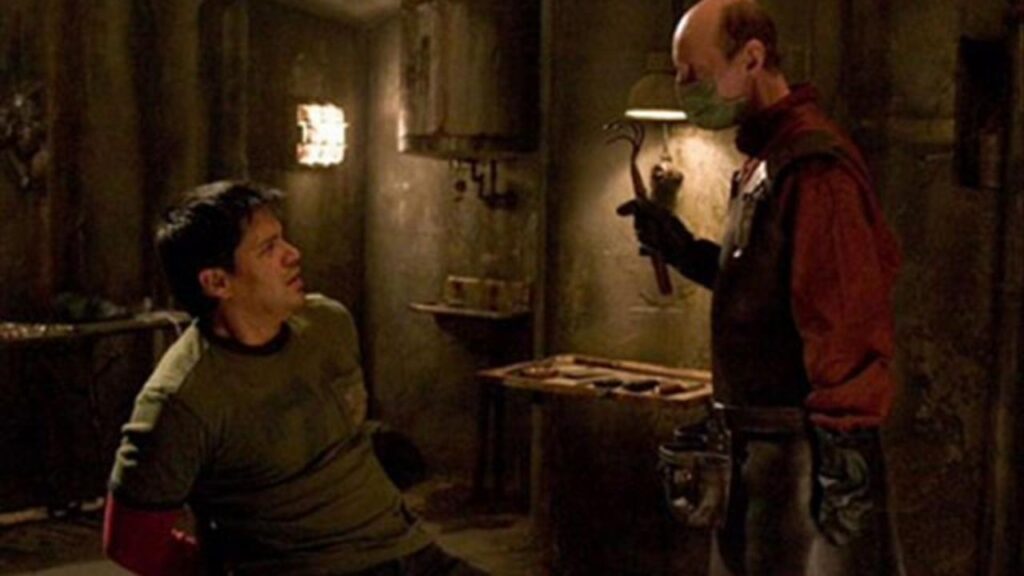
Our second film, ‘Torturous’ (2012; directed by Angus Swantee) works similarly to Game in that it starts with something well established in horror, then tweaks it into something more refreshing. For those of you who read this site often, bless you, you might have noticed how often I complain about ‘people tied to chair’ movies, so you may be able to imagine my woe when the opening scenes were of…a person tied to a chair. Before my eyeroll kicked in, however, Torturous redeemed itself – and I actually really enjoyed the results. Here, take a look for yourselves.
It’s a skit zany enough to work, isn’t it? A careers guidance guy ‘in the chair’ by mistake? Of all people, surely the army of people wielding drills against their fellow man are those most in need of re-training?
The script knows at just what pace to move along and the joke lasts the distance without being pushed too far – although, I’d say that the cock motif probably qualifies it best for a group view (don’t ask me to clarify that; it’s just the way it is). I can well appreciate why this film has done so well on the festival circuit, as it so effectively spins a torture horror yarn into a tongue-in-cheek, albeit grisly comedy.
If you like what you see here, then do follow the embedded links through to Vimeo and let the directors know. Stay tuned for more Horror in Short, too; it’s been too long!
Editor’s note: as this is a full discussion of Hostel, it does contain plot spoilers.
Whilst people being tormented is of course really nothing new in the horror genre, the advent of the Noughties did seem to bring about a change in the types of brutality we were seeing on our screens. From the hack ‘n’ slash movies of the Eighties, the hack ‘n’ slash sequels of the early Nineties and even the post-horror stylings of Scream, those under attack could, at least, run and hide from their assailants. By the time the new millennium turned around, though, we started to see a new type of horror movie take off. Sure, films like Saw (2004) and the film I’ll be discussing here, Hostel (2005) weren’t the first to implement torture on their protagonists. Far from it. But the levels of cruelty and the unwavering focus upon it certainly felt newly aggressive and confrontational, so much so that we soon had a new descriptive term…
‘Torture porn’. The phrase has come to haunt the genre over the past decade or so with more tenacity than anything supernatural. And, when it’s attributed to a film, it’s not typically intended as a compliment. Such a description (which refers, as far as I’m concerned, to that close-up, unflinching shooting style already mentioned rather than to anything sexual) usually means anything grisly, pointless and prolonged on-screen: horror as a pissing contest, nothing more, an exercise in endurance for fans, as perpetrated by crass filmmakers who want maximum bang for buck. Fuck knows I’ve complained enough about ‘tied to chairs’ movies in the past (look at my biog page here on the site, for instance) and I’ll complain again in future – where I see no evidence of plot or thought or originality – just more of the same, people being fucked up by household tools, The End. However, for reasons I’ll explain, I absolutely do not count Hostel as ‘just another torture porn movie’. In fact, I think that disparagingly referring to Hostel as a ‘torture porn’ movie at all is either wilfully misunderstanding the film, or just not getting it. Maybe it is, to an extent, judged by its legacy, and the 1,001 bad films which have tried to copy it. If so, then people need to knock that shit off and take another look. Hostel is very modern, very timely and a damn sight smarter than a lot of people are prepared to give it credit.
None of this is true by accident, either. Whatever you think of him and his work, director and writer Eli Roth understands horror’s capacity to mirror social anxieties, and the guy deserves kudos for saying as much when he was interviewed on Fox News about the ‘mysterious’ popularity of horror, during which interview he was clear about horror’s role as a safe space, a place which grants catharsis during times of trouble. Given that belief, it’s easy to see how Hostel operates as a nexus for a variety of contemporary anxieties, most of which relate to money, status and power.
At first, our main protagonists have plenty of all three, and they’re happy to say as much. Our group of travellers in Europe – two Americans, Josh and Paxton, and an Icelandic friend they’ve made during their trails, Oli – are almost from their first seconds on-screen gloriously easy to hate, the worst stereotypes of young guys abroad. We first meet them rocking up in the capital of clichéd decadence, Amsterdam (even Josh asks, as he looks around at the Eli Roth cameo during the café scene, “Are there any Dutch people in Amsterdam?”) and they seem determined to “rail chicks” from the get-go. When not debating whether it’s ‘illegal’ to fuck women in comas, throwing their weight around or having Josh declare “I’m an American, I have rights!” as they get thrown out of a club, first impressions of these guys are not great, no doubt intentionally so, but the point is – they’re behaving as countless guys of their age and wealth do. They have nothing and no one to fear. Whilst the current economic climate has lessened the effect which a wallet-full of dollars (or to a lesser extent, pounds sterling) used to grant to travellers moving around in Europe, particularly in former Eastern Bloc countries like Slovakia, it hasn’t killed it off entirely, and you do still see people abroad flashing their cash and acting like arseholes, certain that everything is going to go their way because of who they are and where they’re from.
Yet, in Hostel, it’s this belief that gets toyed with, this set of assumptions which provides the basis for the horror to follow, and it’s done well, reaching a nasty, memorable conclusion. We know this from the get-go too: we always know that some sort of comeuppance is around the corner for these guys. Before we’re invited to judge them, in fact before we see them at all, the opening credits have rolled over the interior of the torture chamber…we’ve seen sluices, blood, surgical tools, and worked out that it’s so commonplace for whoever-it-is cleaning the place that they can whistle while they work. We’ve been shown this for a reason; we just have to wait to see what will happen, and know that – somehow – that bubble is going to burst.
This type of foreshadowing goes on throughout the film, and it’s used very well. As an audience, we can pick up on clues that things may not always be peachy; if you’ve seen the film more than once, then you see more and more evidence that bad things are coming. Early in the film we get Josh thinking aloud, “Paying to go into a room to do what you want to someone ain’t exactly a turn-on.” Turns out it is. Still, their new friend Alex’s assertion that Slovak girls are ready and waiting for Americans (“They hear your accent, they fuck you”) is enough to convince the boys to head there, and their sense of entitlement ensures they believe every word Alex says. Why wouldn’t they, after all? Paxton, Josh and Oli have been humanised in our view to an extent by the time they reach their new destination: we know that they are variously not as one-dimensional as they seemed. Josh has suffered heartbreak. Paxton’s bright and, significantly, bi-lingual (more on that later) and Oli’s a father. Still, it won’t save them. They’re fatefully slow to grasp any idea of risk anyway and, when they arrive at the hostel in Slovakia itself, any doubts they might have had just melt away when they see their gorgeous, female room-mates…
Make no mistake. The women from here on in own the movie. It’s just that the guys are slow to get it, believing as they do that they’re the ones still calling the shots until it’s way too late for them. And the foreshadowing continues; when they all arrive, check out the pretty girl sitting on the tomb outside the hostel for one neat symbolic nod as to what’ll follow, and then of course Roth gets his horror geek on by allotting the guys Room 237. The beautiful women in this Room 237 might not take a supernatural turn like in The Shining, but it isn’t long before we get hints as to what they’re really doing: ever notice that it’s Willow’s Song from The Wicker Man which plays over their first seduction scene? By echoing the siren song one of horror history’s most captivating, but ultimately dangerous women, we’re left in little doubt that in some way, Natalya and Svetlana are not what they seem.
The extent to which this is true is, though, shocking to the extreme. Paxton’s pep-talk to an ever-doubtful Josh just before that poor guy’s last night on earth reminding him that they can “fuck these girls for one more night” before moving on couldn’t be more wrong. In the other sense of the word, they’re the ones being fucked. And they’re being more than played; they’re being sold by women. Oli and Josh might have realised this, or they may not have – but Paxton gets it loud and clear, when he returns to the hostel room and gets treated to the exact same routine which Natalya and Svetlana gave all three of them two days before, only performed by two different girls. The moment of revelation here is superb. Suddenly, he understands that he and his friends are part of a dangerous plot, the hostel is part of it and – those beautiful girls which they came there to exploit? They’re the ones in control, always have been.
Natalya’s parting shot to Paxton, as she finally escorts him to the ‘art exhibition’ where his friends have already been killed, is simple but hugely effective. He calls her a ‘fucking bitch’, a lazy retort often thrown at women for a multitude of reasons. Her laughing response, one pithy enough to get repeated over the end credits of the movie? “I get a lot of money for you – and that make you my bitch.” It’s an idea which, whilst of course a dramatic overextension, sums up a lot of fears held by certain types of travellers, particularly those travelling in lesser-known countries and cultures. Maybe those beautiful girls drawn to their sides don’t like them at all. Maybe they detest them, even. Maybe they’re even laughing about them in their own language, or making plans about them. Who knows? It’s also worth pointing out that men are carved up on screen more in this movie than women are. For all of their fist-bumping and over-confidence, it’s men that suffer for their assumptions in Hostel, and it’s women that exploit them.
Whilst putting its protagonists through the mill, Hostel touches upon other anxieties for travellers – other ways in which their assumed high status is threatened. A significant one of these is language. As an English-speaking person, I know all too well that I’ve come to expect people everywhere to be able to understand me when I speak. To an extent, this arrogance is borne out; a lot of people worldwide are exposed to Anglophone culture for their whole lives (TV, music and movies, for instance) and many see speaking English as a prestige form, a way to get ahead, and so they will try to learn it. Those of us who have English as a first language can therefore be seriously lackadaisical about those who don’t, and conversely, feel very uncomfortable when we’re reminded that we’re the foreigners, we’re the ones lacking.
Hostel gives us a language lesson along those lines – with bloody high stakes, of course. Our three protagonists all speak English (despite the fact that Oli is Icelandic and Paxton also speaks German) so they expect everyone else to do so too, in all situations. “How the hell are we meant to understand this without subtitles? Fucking gay,” exclaims Paxton of the foreign-language movie playing in the hostel lobby. Later, “speak English!” he demands of Natalya and Svetlana, when they lock him out of their conversation by speaking in a tongue he doesn’t understand. Here, an inability to communicate goes from being someone else’s problem, to an annoyance, to something downright dangerous. And whilst being able to speak German almost saves Paxton from the man about to hack him up at the disused factory, it doesn’t save him in the end: they just gag him, so the man no longer has to listen to his appeals for his life in a language he can understand. An inability to speak the lingo doesn’t just underline the vulnerabilities of being ‘so far from home’, though: in Hostel, it’s turned on its head and being English-speaking will effectively sign your death warrant too. The guard gets Paxton to ‘speak’: when he turns out to be American, that means they can ask the biggest bounty for him. Maybe this is an inversion of the relative newsworthiness of reported deaths abroad, according to some US news outlets, or maybe it’s just another way that the film shows that being American doesn’t always guarantee you all the power – just the opposite. Throughout, Hostel picks away at accepted power norms.
Hostel isn’t a perfect film: the last half hour is a sequence of happy (?) accidents which free up Paxton to execute his gun-ho revenge, and moments like Takashi Miike’s staccato cameo or the dangling eyeball scene feel clumsily-handled. However, I think it has been done a severe disservice by people who have dismissed it out of hand. It has been even more wrongly labelled ‘torture porn’.
This film is, after all, a great conspiracy movie. Moments of revelation in the film pack a punch because every time, they destabilise something our protagonists take for granted and which, perhaps, we would have taken for granted too. In fact, although the film is known for its gore, that gore is surprisingly low on screen-time until an hour is up. The real horror here is how three regular guys are made to realise their powerlessness, and their eventual treatment, becoming “exhibits” at an “art show” simply underlines how far they have been reduced along the way.
Sure, the ‘stranger in a strange land’ motif has been explored differently and more subtly in other films and other genres. I can accept that. Hostel doesn’t attempt to take away from that, nor does it attempt to own the idea either. What it does do, and what it does well, is to merge a modern horror movie style with an array of very modern concerns and preoccupations. As a calling-card for this particular set of anxieties and the particular time in which it was made, I maintain that Hostel deserves a great deal of credit and, although it has been emulated many times in the nearly ten years since it appeared, this should definitely not be used to dispense with it. Neither gratuitous nor aimless, Hostel has plenty to say for itself and as a bloody rap across the knuckles for a generation which may have once felt itself invincible, it’s still a clever and engaging horror story.
It’s hard to think back to a time when the phenomenon of the ‘independent movie’ was all but unknown, and even harder to think back to a time when the flesh-eating zombie as we know it didn’t exist – but one man, together with his team, was responsible for the advent of both in one fell swoop. That man was of course George Romero, and the movie in question was 1968’s Night of the Living Dead. However, this is all gospel now. Romero’s well known for his part in horror history; especially since his return to the genre with Land of the Dead in 2005, people have begun taking a serious interest in the progression of the zombie. There has been a run of excellent books on the topic; magazines like Bizarre have run extensive features on Romero and his work in the past. And, as series like The Walking Dead continue to thrive, many fans by now have a pretty solid idea of where it all came from. So do we need another examination of the zombie’s roots?
The answer to that is – maybe not, but Rob Kuhns’ labour-of-love documentary on Night of the Living Dead is definitely an enjoyable, agreeable piece of filmmaking nonetheless, one which still sheds some new light on the development of what’s really been a cultural phenomenon. It also manages to do this without seemingly having a particular axe to grind, or needing the participation of any rotten pseuds along the way: in the world of the horror movie documentary, this is worthy of note and praise on its own.
Birth of the Living Dead begins with the advent of Romero’s filmmaking career, looking at the work he did on advertisements for his early company, Latent Image, prior to the truly guerilla project that was Night of the Living Dead, alongside all of the practicalities of entering the uncharted territory of a self-financed horror film. There’s a good balance of anecdotal (with most of these anecdotes coming from the disarming figure of Romero himself) and factual here, building up an interesting account of the process, and of just how challenging it all was.
Along with this, and probably Birth of the Living Dead’s greatest strength, is the contextual material it offers. We may all have heard or read about the political content of Night.., by now; however, seeing newsreel footage of the Vietnam War, the 60s race riots and violent protest juxtaposed with several key scenes from the film really does illuminate these scenes, whilst hearing Romero describe his ambitions for his project definitely reaffirms the socio-political context for what holds up as a great, disturbing piece of film, and probably the first with such an overt political agenda. It really doesn’t seem the case that this political rationale is something that’s been dredged up with hindsight, either; everyone interviewed here seems clear and in earnest about what the film was commenting upon. There’s also some material on the advent of the zombie, or the ghoul, as-was, although oddly not too much is said on this score – still, it does provide a golden opportunity for Kuhns to interview some of those who saw the film as children, when it was mistakenly lumped in with the monster matinees which were all the rage at the time…
With regards Night… itself, throughout there are of course lots of fascinating little titbits here about the actors and the shoot. In fact, in several places it’s a ‘blink and you’ll miss it’ deal actually, with text briefly appearing on screen to tell you something intriguing about a scene or a cast member before – gone. There were also break-downs of some key scenes, helpfully explained by those in the know (crew members or other talking heads, with special mention to the brilliant Larry Fessenden for his pithy, smart contributions throughout). Evident care has gone into this film too, with some nice shots of NOTLD-inspired artwork interspersed with the other footage, adding to that feeling of high pace which keeps the film going. There is one part of the film which I don’t think particularly fits, though, and that’s the footage of the teacher using Night… as a teaching aid for his ‘promoting literacy through film’ project at his school in the Bronx, New York. Sure, it was kind of fun to see the kids recoiling at the film and then describing what they’d seen, but it felt a little bit extraneous. Still, for the most part, the film strikes a good balance between then and now, content and context.
Night of the Living Dead is not only part of the horror canon, it helped to create it; it’s even now a much-discussed piece of film, too, especially seeing as the zombie horde shows no sign of letting up in cinema or in TV. For all of that, this is a worthwhile documentary displaying aptitude and enthusiasm. It probably won’t revolutionise your appreciation of Night…, but it will no doubt add some entertaining material to it. Worth a look for sure.
Birth of the Living Dead will be released in the UK by Maven Publicity on 12th May 2014.
Earth’s oceans; vast realms, places which seem to maintain their mystique, even as outer space begins to yield its own. Beautiful, alien, incomprehensible, and brimming with mysterious life, the seas have never lost their fascination for us. They are also infested with gilled fucks, hell-bent on the destruction of Mankind come what may: this is essentially what cinema taught us in the wake (see what I did there?) of Jaws in 1975; soon, every potential aquatic foe had it in for us. Free Willy was nothing more than a glint in the director’s eye. Heck, it wasn’t just the sea, either; from bees to bears, Nature was more or less done in the 70s. Done. Sick of our cruelty, sick of our pollution, sick of our fucking haircuts.
Still, so much as a formula quickly developed as to how these angry nature movies played out, Orca: The Killer Whale is an oddity. Based on the title (which has an extraneous exclamation mark in some early press, a la 50s sci-fi and horror) and the poster art, you might expect high schlock; look at the cast list and you might think you were going to get another Moby Dick (well, okay, maybe not when you see that Bo Derek is attached to this film). The truth is that you do indeed get something in-between. If that intrigues you, then read on…
The at-first stereotypical Irishman, Captain Nolan (played by Richard Harris. Yes, Richard Harris) makes a living capturing and trading in large aquatic creatures, drugging them via harpoon so that he can get them onto his boat and then sell them to aquariums. We meet Nolan and his crew as they’re tracking a Great White shark; marine biologist Rachel Bedford (Charlotte Rampling) is diving in the area at the time too with a colleague, and they narrowly escape the shark and then Nolan’s harpoon in pretty quick succession. The shark is finally killed, though, by two killer whales – creatures which just happen to be one of Bedford’s specialisms. If her subsequent conversation with the captain is intended to make him respect the whales, however, then it doesn’t work, and Nolan soon gets the idea of capturing an orca instead. He and his crew try, but fail – harpooning and killing a pregnant female in the process. Her furious mate then sets about tracking Nolan and his boat, intending to wreak vengeance upon him…
I know, I know. It’s a funny thing: in so many of these types of films, there’s an agenda at work. An awakening conscience about animal welfare is crafted into a dramatic narrative, forms the bedrock of the plot, and tries to teach us a few things along the way. Fine. Sadly, to make the narrative dramatic enough, filmmakers end up making the animal in question into the enemy, and thus eminently killable, which somewhat undoes the animal welfare angle. That happens to an extent in Orca. The furious creature unleashes his vengeance upon Nolan in a sustained campaign of violence and intimidation until you end up feeling rather sorry for the captain; he never intended to kill the female, after all. Mixed messages, that is.
That’s just the tip of the iceberg (heh) though, isn’t it? Read what I’ve just written there again. The fact that here we have an intelligent species, sure, but one completely anthropomorphised in the film until the orca has become a kind of wicked assassin, well…it’s a bit daft, no? And yet, that’s our storyline. You may be able to take that on face value quite happily in certain types of film, but here, with it being handled in such a sober fashion, the tone of the film can get a little confusing. This is no exploitation film filled with stock footage and two-bit actors: there’s an impressive cast here, real characterisation, frequent evidence of high production values, and an Ennio Morricone score which I’d go so far as to say is bloody sumptuous. All of that, some lovely photography and a climactic end sequence which looks great on camera, and yet we’re expected to accept elements in the plot which just don’t follow.
Yep, this is a slightly schizophrenic film. Nonetheless, I was engaged by it, if only in trying to fathom it out (and I know I’m doing all of these puns by the way). There’s certainly plenty to like about Orca, for all its fundamental oddness, and for a spin on the Nature Gone Bad genre which you may not have encountered yet, it’s a decent film in its own right. Can you really argue with Charlotte Rampling in a wetsuit, anyway?
Orca: the Killer Whale is available now on Region 2 DVD from Studiocanal.
Everyone’s filming everything these days. And everyone’s footage can be used to form the bedrock of a horror film: that’s the basic take home message of The Borderlands, which features – as its main premise – the idea that even representatives of the Vatican themselves now feel the need to record ‘evidence’ on usually hand-held cameras. The evidence (or otherwise) in question is evidence of bona fide miracles as reported by members of the lay community: as this sort of thing is bread and butter to the Catholic Church, all such claims need to be checked out before they can be verified. Responsible for overseeing, collecting and collating any resultant footage is an organisation known as The Congregation.
The Congregation as we encounter them here consists of just three members: firstly, a camera whizz who isn’t a Catholic himself but definitely believes in “stuff” (Gray); a Scottish priest who fulfils the stereotype of also being a hard boozer (Deacon) and a third priest who wants things done by the book (Mark). They’ve been summoned to a small town somewhere out in the sticks in England by a Father Crellick, who is sure that his small church has bore witness to a miracle. He has footage (of course he fucking does) of a baptism where…a strange rumbling took place at the back of the church, and some other mysterious sounds too. Doesn’t sound on a par with walking on water exactly, but The Congregation set about investigating Crellick’s claims, taking a cottage in the area while they go to work. What they find ancient evil forces beyond their control terrible danger etc.
I tried. I really tried. I had heard very positive things about this film, and to an extent, I expected to like it accordingly. As the film trudged on though, I realised that whatever tricks it might have up its sleeve, it was fairly unlikely, moving swiftly to impossible, to engage me after such a long expanse of the very worst flaws of the found footage genre. Firstly, the tenuousness of the premise. Why all the Paranormal Activity style cameras in the cottage, if they were investigating the church? This footage had been collated by an outside party at some point, hence the chopping and changing between cameras – but who, and, considering the ending of the film, how? And then, if someone had edited it, why hadn’t they cut out the reams of kitchen-sink dialogue with its pregnant pauses and its non-landing jokes? If they hadn’t been arsed to do that, then why add what sounded suspiciously like incidental music over one of the sequences? Or why not clean up some of the murkiest footage? I was beyond exasperated by the mid-way point, didn’t feel I had any sense of or interest in why they were doing what they were doing, and as mildly ingenious as the ending was, it had been done with acres more panache and sweet, sweet brevity by short film The Ten Steps years before. It also chose to tack on a pagan horror theme, in a similar way to another British film with lots of suspiciously ad-lib seeming dialogue, filler, plot gaps you had to fill with a shovel and then an about-face into pagan thematics which was woefully underdeveloped. Yes, I mean Kill List, which I loathed, and so being landed with a found footage movie which had elements in common with bloody Kill List felt like adding insult to injury to me.
In the interests of balance – the film did a few things well. I did like that it understood the creep factor of effective audio, and a lot of the sound effects used were nicely handled (although, again, it reminded me of The Blair Witch Project in this and other elements, perhaps drawing a bit of inspiration from, to my mind, the undisputed modern master of terrifying sound FX, Eduardo Sanchez). It also managed a few unsettling sequences, and what was happening off camera worked best, creating the impression of a big bad world outside the handycam’s viewfinder. The settings were decent too, although falling back on the ‘creepy rural folk’ motif a bit heavily. See, that’s the frustrating thing here: there were the odd flashes of hope, but diluted so much by the film’s less successful elements that the overall impact was at best negligible, at worst as good as absent.
So, thanks to the combination of its emulatory nature (Paranormal Last Exorcist Kill List Project?) and its exasperating filming style, with all of the flaws of said style in there for good measure, I didn’t enjoy The Borderlands at all. If you’re more forgiving than me, then you might be able to see past the above and get something out of the premise. For a far more positive appraisal of this film, you might like to check out Ben’s Abertoir 2013 review. Feedback generally has been more akin to Ben’s than to mine. Me, well, as I say – I tried.
The Borderlands is out now on Region 2 DVD courtesy of Metrodome.
Over the past few years, the name Loki has stayed more times on comic geeks’ lips than the previous several decades combined. Thanks to Marvel’s huge success with the Thor and Avengers franchises, the God of Mischief has found himself basking in the spotlight (with no small contribution by the devilishly handsome Tom Hiddleston and his legions of fangirls). It is perhaps in part to the sudden interest in all things Norse, or just to mess with fans’ heads, but BOOM! Studios has released its own tale of Loki’s travels among the Midgardians. Sharply funny and filled with pop-art satire, Loki: Ragnarok and Roll pits the Trickster as the frontman of a Goth band and explores the subsequent troubles his new found fame brings him.
In this newest incarnation of Asgard, Thor and Loki are once again full brothers, living for an unnumbered series of millennia answering the demands of their father Odin. If the Marvel comics leaned in favor of Thor, this comic definitely leans in favor of Loki, making his older brother a muscle-headed punk a few fries short of a full Happy Meal. After a failed attempt at a peace talk in Jottenheim, they come back to the castle right as Odin is throwing a party for all the major gods; for you see, all the gods exist in this universe, from saints to spirits to the flying spaghetti monster, god of the Internet. Thor immediately lies to cover his ass about the Jottenheim failure and, by placing all his blame on his brother, gets Loki kicked right the fuck down to Earth. Wandering around an unknown city, Loki soon finds himself in front of a Goth club and after a few choice words and action panels later; he becomes the singer of a band. The second issue continues six months later, after he has raised the band to glorious fandom only to piss off the gods with his announcement of being an actual god. Having had enough of his actions, the collective holy group decides to take the guy down a peg, come Hel or high water.
Loki: Ragnarok and Roll is a pretty goofy comic, which is actually part of the appeal. Loki spends most of his time dissecting human reaction to celebrities and idols and the comic helps bring that around with the jealousies of real gods and their falls from grace. They read like caricatures of their mythologies and really, in our current age of sex and technology, that’s really all they are. Loki’s character realizes that and by dropping to Earth, he slowly becomes aware that the only gods left are gods like him, silver-tongued and adaptable to the lowest common dominator, something he then takes in his stride. It’s really more of a testament to our spirituality, or lack thereof: how the only ones left to worship are celebrities. You know, in retrospect, have you ever read Neil Gaiman’s American Gods? It’s a lot like that. But, if overtly obvious philosophy on our trashy society isn’t your thing, there are still some great jokes and action scenes as well, which work beautifully with this over-the-top comic. Also, if you ever wanted to watch Thor get kicked down a notch, this whole comic is about kicking Thor down a notch. I mean, what a cock, amirite?
The series is fronted by the powerhouse of Eric M. Esquivel and Jerry Gaylord (I feel like they made up their last names). Esquivel has spent a lot of his career penning indie and small print comics, which has allowed him a lot of freedom to write from a well of his own ideas. His unique take on the popular mythology does really well without turning into a Goth circle-jerk, which it could’ve very easily. The artist Jerry Gaylord, most recognized for his work on Fanboys vs Zombies, takes his quirky illustrations and blends them seamlessly with Esquivel’s words. Gaylord’s cartoony pop art makes the whole thing jump off the page, like a Saturday morning cartoon come to life.
If you ever get tired of Marvel’s Thor holier-than-thou attitude, then grab this comic and check out the view from the other side.
Nothing gets the blood rolling like a solid noir tale. Dark streets boiling with danger, fast-talking swindlers, and the ever present lady in red have flared the imagination of many an author. Now throw some ghosts and monsters into the mix and you’ve got yourself a genre that practically writes itself. After all, what is a bigger mystery than death? The strange unknown that lies beyond the pale curtain? Comics particularly have always understood the literary draw of horror noir, something especially highlighted by the success of Constantine, Criminal Macabre, and Dead Boy Detectives. Following in their ghoulish steps, Boom Studio’s newest release Dead Letters takes all the good, scary elements of its predecessors and brings them to life, from the perspective of a down on his luck criminal as he struggles to remember who he is and why no one seems to stay dead for long.
Centered on an amnesiac named Sam, whose first memory is that he remembers nothing at all, Dead Letters kicks off with a shot of a gun and a mad spree across town. As he dodges bullets and sends some in return, Sam attempts to reconstruct what he can from his dimly-lit memories; though little does he know, you can’t outrun your enemies. He soon finds himself at gunpoint in the middle of the woods (or a park?) surrounded by a very colorful, twenties-themed collection of mob bosses, who force him to choose alliances – and things just get weirder from there. A mess of hot ladies and cold men, he soon finds out that his choice has reached the highest of authorities, yeah, GOD. Tossing in ghosts, zombies, and a gun-toting angel, Sam soon finds himself on a trip of a lifetime.
Dead Letters #1 is definitely a more questions than answers kind of comic. It keeps your interest with its hints of the macabre and the divine while keeping true to the noir feel. The story does well mixing new and old mystery tropes, such as the super-Asian, long cigarette, robe-wearing Ma, who runs her cabal of murderers with an iron-snake hand, whilst Sam is portrayed as a bit more contemporary, with basketball shorts and a wicked afro. To be fair, it’s a bit hard to tell what time period the series is set in, but if you just take it in your stride, it’s easy to ignore this. There is also a lot of story crammed into the comic and it feels like it would have been better as a double issue, or perhaps could’ve used some editing, but once again, it manages to carry itself.
The author of this tale of madness is Chris Sebela, the current writer for Ghost, and he’s a bit of an old hand at the horror noir genre. Another title of his, dubbed Screamland, about the old silver screen monsters attempting to solve a murder mystery of one of their own, was released to pretty solid reception. This newest work continues on his love for penning the weird and does a great job of bringing that to the comic audience. The artist, Chris Visions, is relatively unknown to date (I think this might be first comic), but he’s starting off his career with a bang. Usually known for illustration and cover work, his foray into sequential art is surprisingly well done, creating a smooth look for this fast paced thriller. With his use of photoshop drawing in his work, I wouldn’t be surprised to see him on the forefront of digital comics soon.
So, in short, feel free to pick Dead Letters. You won’t be any worse for it.
It’s strange to think that, for many people who may be reading the likes of this site today, there has never been an alternative to the internet as a chief means of exposure to all that’s weird and wonderful in the world of cult cinema, or indeed outsider literature, art or music. In many ways, you might expect this to mean that the younger generation would be the most enlightened, liberated and open-minded individuals ever to walk the Earth. With round-the-clock access to everything and anything, surely people’s tastes should by now be incredibly diverse and equally, routinely satiated by the types of fare which would put the old cut-out-and-photocopy fanzine brigade to shame?
Funnily, this isn’t generally the case at all. Speaking for myself as someone who was just about sitting up and taking notice at the tail-end of the print ‘zine heyday (though we’re talking metal ‘zines, rather than the type of publication to be discussed here), it now seems that the more access you have to the strange and unusual, the less of a thrill it is to get your hands on it. In a way, the internet has turned into the ultimate in diminishing returns. Then there’s the odd effect whereby even those on the outside of the mainstream now seem guided more by the prominent voices to be heard there than by their own imaginations (and how a lot of those voices come to prominence in the first place is a mystery all of its own). For example, those of us who even moonlight in what has come to be known as ‘the horror community’ will no doubt have noticed that at least once per year, a certain film will somehow gain massive momentum because it gets the formula right, getting the notoriety, the ‘likes’ and the shares – which aren’t necessarily linked to its merits. Conversely, impertinent or unfashionable opinions can today bring down a tsunami of indignation on a scale which just wouldn’t have existed pre-internet.
To put it bluntly, shit has changed, and one of the absolute joys of reading Sheer Filth is that it comes from before all of this was a going concern. This isn’t, I hope, a straightforward rose-tinted spectacles moment here. Rather, the honesty, enthusiasm and enjoyment of all things sleazy and strange to be found in this collection of articles, reviews and interviews seems to stem, at least partly, from the fact that received wisdom or the Next Big Thing didn’t matter or even exist for these contributors.
For those of you unaware, Sheer Filth! was a UK-based ‘zine which appeared, as many similar ‘zines did, in the wake of the Video Nasties débâcle. As the censors hardly seemed about to hang up their scissors during those days (quelle change eh?) a host of ‘zines – ‘part of what felt like a movement’ according to Flint – kicked back against this state-savvy prudishness by championing a hell of a lot of the things deemed unsuitable or otherwise too lowbrow for the masses. Flint cites Fangoria as setting an important precedent in those days; colourful, grisly and glossy, it didn’t much care that sex and gore were considered beneath a lot of ‘proper’ film writers and publications and it featured them in spades anyway. Its rejection of received wisdom was very influential on Sheer Filth, and Flint’s insistence that his contributors never conformed to one authorial style or voice. The results are to his, and to their credit – and a lot of excellent writers cut their teeth here too (such as David Kerekes, to name but one).
This Sheer Filth collection spans all of the editions of the ‘zines themselves. Some of the highlights: an examination of the life of David F. Friedman, a chat with a very wet-behind-the-ears Buttgereit, a never-before-seen chat with British director Norman J. Warren, an interview with the doyenne of porn Annie Sprinkles, and a look at what is probably the first example of nunsploitation. You might also feast your eyes on film festival reports, educate yourselves on everything from the discordant noise stylings of Coil (who almost, almost did the soundtrack to Hellraiser) to the best of 50s surf rock, check out just what all the fuss is about when it comes to seeing De Sade on the shelves, read agog about the art-house weirdness of the movies of La Ciccolina, see some seriously renegade comics, read all about lost cinematic gems like Death Bed: The Bed That Eats and The Bride And The Beast, and also familiarise yourselves with some lively potted histories of America’s loveliest long-gone starlets, such as Jayne Mansfield and Bettie Page (back when there was far less of a Bettie cult and the lady herself was still lost to obscurity). I’m aware of the irony of this, but my Amazon Wishlist got a lot more extensive as I was reading this book…Sheer Filth is one of those tomes which can provide a great starting point for tracking down a lot of ‘new’ books, films and names.
As you might gather from the above, there is a lot of sex and nudity in this book – easily as much sexual content as there is horror, though those of course go hand in hand (ahem) a lot of the time – and it should hardly take me to say that this is therefore not going to be a book for everyone. Sheer Filth is unashamedly pro-sex and pro-porn so, as it takes issue with censorship, it of course takes similar issue with attitudes and legislation which try to limit any activities between consenting adults. So much as the book can be said to have a prevailing outlook, this is it, and so beware if this isn’t something you want to take on board. Personally, I think it’s interesting to see that we’re still seeing a lot of the same blanket statements made about, say, adult entertainers some twenty years after a lot of the interviews in these pages took place, but that’s another of the ways that this is a genuinely engaging book.
As mentioned, a lot of the content here has been around for a while now, so where Sheer Filth contains articles about those who are now no longer with us, or where the content of a feature has been changed/disproved over time (such as, ahem, a treatise on the imminent disappearance of the cumshot in modern porn, feasible perhaps in an innocent, pre-bukakke world) then a series of footnotes provided at the end provides a bit of up-to-date context on these, even giving the nod where a certain Mr Flint got it wrong about a certain Ms Linnea Quigley…This being a FAB Press book, it is also lavishly illustrated throughout and fully indexed – looking like a very happy marriage between a ‘zine and a collectible volume.
Full to bursting with meticulous, earnest and often tongue-in-cheek journalism, this book is an education as much as it is eye-opening entertainment. As an irreverent and charming trek through some lesser and better-known exploitation fare, it’s hard to imagine better. And, ultimately, this collection is shot through with optimism. The hotbed of creativity which gave rise to the ‘zines of the late 80s was after all born out of moral panics, clampdowns and public misinformation. We’re hardly shot of that sort of thing now, with increasingly prescriptive mores seemingly always around us, maybe now to an extent even from within the ‘alternative’ scene as well as without. Sheer Filth is a reminder that you can shape your own zeitgeist and kick back against restrictions by embracing taboos. Highly recommended, sleazy good fun.
Sheer Filth has an official launch part on 4th April 2014 at Nottingham’s Broadway Cinema, where there will be a special screening of the new Video Nasties documentary, Draconian Days, followed by a Q&A and an after-party. Book orders will be dispatched on 9th April: for further details, check out the FAB Press website.
Regular BAH readers may have seen a recent review of mine descend into a frothing-at-the-mouth rant about the most frustratingly common mistakes made by no-budget indie horror movies. After that, there was nothing I needed more than some firm reassurance that, now and then, indie horror can still do precisely the opposite; rather than re-tread a painfully overfamiliar trail, it can find new, hitherto unexplored routes on the treacherous map of horror conventions, and come up with something that’s genuinely surprising.
To whit – Stalled. We’re a little late to the party here as this microbudget Brit horror comedy has been out there for over a month already, but what the hell. I hadn’t heard much about it until recently, and given how my finger is so firmly on the pulse (cough, ahem, etc.), it seems fair to assume that not all readers will be aware of it either.
But first, a little preamble.
About eight years ago I saw another no-budget British horror comedy called Freak Out. Imagine the young Kevin Smith making a slasher movie and you’re not too far off the mark. I wasn’t particularly impressed with the film, but it sort of pained me to feel that way, as it was clearly the work of young, ambitious people with genuine passion, knowledge and appreciation for horror… not to put too fine a point on it, but people who didn’t seem that different from me. I haven’t revisited Freak Out since, but as memory serves it revelled in its own absurdity a little too much, trying to make something on a fairly large scale when clearly the resources were not there for the filmmakers to do so.
In case you’re wondering why I bring this up, it’s because the same core team behind Freak Out, director Christian James and writer/actor Dan Palmer, have reunited on Stalled, and they’ve quite clearly learned some lessons along the way. This time, they’ve stuck a little closer to conventional indie horror wisdom and restricted the action to a single night and single location (and, for the large part, single performer) – but fear not, this most certainly isn’t kids in a cabin version 5,318,008. This is something we genuinely haven’t experienced before. This is the zombie apocalypse – as seen from a toilet cubicle.
Palmer stars as – who else – WC, a handyman in an office building, working during the staff party on Christmas Eve. Venturing into the girls’ bogs (or, if you prefer, ‘ladies’ room’) to do a spot of routine maintenance, he darts to hide in a stall as a couple of fetching, heavily intoxicated office workers in very casual attire venture stagger in, and proceed to engage in a spot of lipstick lesbianism (tick the box marked ‘something interesting in the first 25 minutes’…) However, a little face-sucking suddenly gives way to a little face-biting, and WC realises to his horror that a zombie virus has broken out in the building. Given his location, at least he doesn’t have to worry about soiling himself; but getting out alive is a dicier prospect…
It’s an inspired premise in so many ways. Yes, of course we’re all getting a bit shit sick of the same old zombie apocalypse movies, so the only way forward is to find a different approach – and this is clearly what Stalled is gearing toward. In some respects it’s not too far removed from last year’s divisive festival hit The Battery, another claustrophobic low budget production which kept its focus squarely on a pair of mismatched survivors with the zombies largely left in the background (see Keri’s review). Many found The Battery a bit too quiet, slow and uneventful – and, as such, Stalled may be a welcome alternative, as it’s a surprisingly loud and high-energy affair. At points I was reminded of the old Ryan Reynolds in a coffin movie Buried (although, all apologies Mr Palmer, you’re not quite that dishy), inasmuch as – while the action, in this instance, is not 100% confined to a single small space – the director does find a remarkable number of ways to keep that single space visually interesting. We even have a number of action scenes of sorts occuring within that tight little box (stop sniggering at the back), with all manner of seemingly throwaway items put to unexpected good use… I’ll give nothing away, but there are more than a few genuine laugh-out-loud moments.
Still, this is not to say I didn’t have any hang-ups with Stalled whatsoever. It did come close to losing me when, maybe a third of the way in – up to which point, most of the action had played out like a silent comedy – a second character is introduced in the form of an unseen woman (Antonia Bernath) in another cubicle. Perhaps this was an inevitability, as it was always going to struggle to keep things interesting with a single guy in a single location for a full-length movie – hell, even Evil Dead 2 cut away fairly regularly to events outside. Alas, the relationship with the mystery woman rather sours Stalled for me, as it results in an abundance of over-written, Breakfast Club-esque deep and meaningful life lesson conversations, replete with yet another Manic Pixie Dreamgirl figure. To be fair, though, things do progress in a slightly different way than I had anticipated, and attempts to up the ante for genuine emotional content are by no means in vain.
Even at 80 minutes, Stalled does feel just a little overlong; beyond the John Hughesy duologues, we definitely have a few scenes which could have done with some judicious snipping (there was no need to run the full credits at the beginning and at the end, for instance, and the post-credits stinger is a bit of a let-down). But I don’t want to nit-pick. I’m not seeking perfection when I sit down to check out an indie horror: I’m seeking something fresh and gripping, a break from the norm with at least flashes of ingenuity, and above all something which you can tell right away was put together with love. Stalled ticks all those boxes, no problem – so I have absolutely no hesitation in recommending it to all horror fans, not to mention all fledgling no-budget filmmakers who want some hints as to how it should be done.
Stalled is available now on Region 2 DVD from Matchbox Films.
Damn it, I have to admit – I do love a bit of 70s glamour. Oh, sure, we have the hairpieces, the false eyelashes and the ‘fuck the natural look’ make-up in spades today, but it just doesn’t look as…charming, somehow. Perhaps that feeling is exacerbated when you sit down to watch a film like The Doll Squad whilst wearing one’s obligatory, inexplicable check pyjamas (I bet 70s gals weren’t beset by either cartoon animal-bedecked or plaid nightwear on their Xmas mornings) but whatever, get the likes of Francine York and Tura Satana into a film, and you’re bound to fondly miss the good old days, all acres of glossy, possibly synthetic hair and tans which look like the sun may have made them, something which seems as rare as hen’s teeth in our cancer-savvy times, tans these days coming as they do in dysentery beige only and through a nozzle, or not at all. All in all though, the world was a gentler place back then – ladies in hotpants, pigeons carrying microfilms, henchmen in island paradises, exploding rockets…
Yup. Director Ted. V. Mikels (better-known for his involvement with a lot of ‘B’ movie horror fare, either as director or as producer) cuts to the chase quickly here, giving us a set up which, like a lot of underground cinema, doesn’t play it shy with the stock footage. It’s launch day, and as one Senator Stockwell watches the big event on the TV in his office, all of a sudden the signal is scrambled. He’s warned by a mysterious male voice that he should have played ball – and then the rocket blows up mid-air. He evidently has an enemy with influence – but who can find and take down this enemy, within the two-week time frame available to him?
Cue the Secret Cervix…no, sorry, cue the so-named Doll Squad, a group of female secret agents led by the consummately professional Sabrina (York), a woman who when requested, immediately sets about gathering her troops to track down that mysterious voice – though quickly losing two would-be dolls early on, which all goes to show the level of influence that this bad guy, whoever he is, has. It just so happens that once Sabrina has assembled her squad, they track down an interesting lead which will take them out of the US and to a remote island off the coast of South America. Now add all of the double-crossing, spy gadgetry and peril you might imagine.
However, The Doll Squad is an odd film because although it presses a lot of buttons – more or less every scene has something variously improbable, quirky or OTT – it doesn’t really feel like it’s doing so cynically. Rather, the screenwriters seem to have done their best to make the film entertaining for its own sake, something they’d enjoy watching on its own terms as a piece of entertainment, rather than just crowbarring a lot of things in there because a jaded audience would probably expect it. Maybe audiences just plain weren’t jaded forty years ago? Anyway, this quality also gives the film an odd air of innocence: this is pre-Charlie’s Angels, remember, so the concept of an all-girl group of undercover agents is rather unusual on its own, but even though our plot follows a group of ladies who moonlight – for instance – as erotic dancers when they’re not blowing shit up, or wear midriff-revealing booby tops to the shooting range, it’s surprisingly exploitation-lite in terms of the unholy trinity of nudity, sex, and violence. I’m not sure if our American readers will know and use this adjective, but there’s not really a better one: The Doll Squad is what we might describe as ‘saucy’. It has explosions aplenty and the shortest shorts known to man, but it alludes to many things rather than showing them, and this goes for the aggression on-screen as well, which is never that bad even at its worst. As Editor-man Ben pointed out to me when he handed the screener over, this is one film 88 Films could far more realistically release as part of their ‘Grindhouse Classics’ collection – but it’s also in many ways too gentle for that tag.
Still. It doesn’t matter what you call it, really: The Doll Squad is in its way quite charming, entertaining and easy to watch, with plenty going on and that old time capsule goodness about it too. I think it’s fair to say that none of the 88 Films catalogue is likely to change your life, but here’s one of their films which allows you to laugh with it rather than at it. This is quite a nice release from them too, with an audio commentary and a ‘Making Of’ documentary included, as well as the standard array of trailers.
)
The Doll Squad will be available from 88 Films on 17th March, 2014.