Feature: Donald Cammell’s White of the Eye (1987)

By Matt Harries

An abstruse and oft-overlooked final statement from the auteur Donald Cammell, White Of The Eye tells the tale of Paul and Joan White, a couple who live in Globe, a wealthy desert community near Tucson, Arizona. Paul (David Keith) makes a living as an expert installer of high-end stereo equipment. Joan (Cathy Moriarty) looks after their young daughter, Danielle. After a series of grisly murders, detective Charles Mendoza (Art Evans) comes to suspect Paul. The film goes on to recount the tale of how Joan came to Globe and met Paul, and how she comes to discover the hidden truth about her husband of ten years.

White Of The Eye was the first film which could be truly said to have been directed by Cammell since the legendary 1970 art-house gangster flick Performance, the work which became his career’s defining work. Since Performance, Cammell had directed the strange sci-fi horror Demon Seed in 1977. However, in keeping with the fragmentary nature of his career, the story here is not so straightforward. Demon Seed was apparently intended originally to be much lighter in tone, but the ‘studio’ (a bane of Cammell’s throughout much of his career) turned it into a occasionally unsettling and frequently oddball science fiction tale about a sentient computer which attempts to breed with its deceased creator’s wife. Subsequently, 1995’s Christopher Walken vehicle Wild Side was also subject to the same battle for dominance between studio and director, a battle which the studio eventually won. Cammell was removed from directorial duties after the studio ordered a complete re-cut, performed by themselves and credited finally to one ‘Franklin Brauner’ (who did not exist). Thus, White Of The Eye is really Cammell’s only genuine piece of major direction other than Performance, and as such is a fascinating document of a man who’s talent was perhaps never fully realised.

White Of The Eye sees Cammell explore his lifelong obsessions of death, sex and identity. Set against the arid backdrop of the desert, the community of Globe contains plenty of wealth, derived from the mining and quarrying industries which dramatically shape the landscape. This wealth collects in the form of expensive, ultra modern desert homes, dotted around the otherwise barren, scarred landscape like dew in desert flowers. In one of these homes the film begins, with a wealthy woman freshly returned from an up-market department store, speaking on the phone in her conspicuously modern kitchen. The gloved hand of an intruder begins to arrange kitchen objects to some design. After putting the phone down, the woman sees her goldfish flapping and splashing in a bowl of marinating meat, and there then ensues a typically Cammell-esque scene of murder as art.

To Cammell, a talented and classically trained painter, the perfectly ordered reality of the luxurious kitchen is a blank canvas with which to paint the killing act with the kinetic abandon of a Bacon painting; the stark juxtaposition of the fish dying in a pool of meat juices; blood red wines and sauces arcing across pristine tablecloth and stone tiles. Glasses explode with balletic grace. Tulips fall to the floor in slow motion as if strewn by an appreciative audience – this is unmistakably not just a killing but an act. Cammell seems to be saying that this is not just a killer at work, but also a performer of sorts.

We soon become better acquainted with Paul White himself, first glimpsing him as he drives through the artificial ‘mountains’ of the quarrying industry, singing along to Pavarotti, almost as an affront to man’s crude approximation of nature’s landscape. Later, in another of the film’s more striking moments, we see Paul, eyes closed and poised like a conductor, producing a strange hum that resonates through his skull and throughout the room, thus enabling him to ascertain the optimal position for the speaker systems he installs. As he flashes his hands to the corners of the room where each component will go, he is pure Elvis, pure showman. Later, Mendoza discusses Paul with another detective, and much is made of Paul’s intelligence, his non-conformity. It becomes evident that Paul has somewhat of a chequered history as a troubled youth. When Mendoza’s colleague asks “what’s the matter Charles, you don’t believe in genes?”, and Mendoza himself hints at a ritual element to the killings, we begin to see that there may be external forces (the occult, genetic predestination) which may be involved with the killings, beyond the ken of man. Still, it is difficult to connect Paul to the murders, when we see him as a warm, approachable family man. A husband and devoted father. A man who has friends in the community, who runs his own business. Someone who has overcome a difficult youth. Yet are these trappings of normality merely another facet of the performance?

In many respects, White Of The Eye is an exploration of layers of reality and the forces that ultimately underpin them all. Mankind extracts wealth from the harsh terrain of the desert. He denies his true nature with the pursuit of the material, attempting to reflect the pacification of his own animal lust with the constructs of family, and of identity within the framework of community. Paul White seems, on the surface, to be a man who has conquered his demons. Yet we learn through flashback of how he came to win the hand of Joan some ten years earlier. Drifting through Globe on their way to California, Joan travelled with Mike, a brash Bronx-Italian, whose urban braggadocio seems faintly ridiculous out of its home environment. Mike, the quintessentially modern tough, is emasculated and usurped by the ferocious and predatory alpha male Paul. This exposes the emptiness behind Mike’s posturing and at the same time reveals Paul to be much more in tune with the ‘true’ nature of the world, rather than the reality humankind has interposed between itself and its origins.

The narrative strands of the film converge on a literally explosive grand finale which takes place within the arena-like setting of the copper mine. Resplendent in the finery of a warrior-hunter, and utterly unrepentant Paul hints that what drove him were the great forces of nature – destiny, black holes – but in the end he left his own mark. As the final major artistic statement of Donald Cammell’s career, White Of The Eye is a film of surprising depth, of savagery, madness and even tenderness. Cammell seems to treat the character of Paul with a fairly high degree of sympathy, and it is difficult not to see much of the auteur himself reflected in the film’s protagonist. An outsider, driven by a sense of his own destiny and with a fascination for performance, Cammell expressed through Paul that part of him which he later referred to in interview as the “uncensored Don” – that which, to borrow from Performance, crosses the line into true madness. For a man who had always envisioned his own suicide and who finally ended his life in 1996, White Of The Eye is a fitting tribute to one of cinema’s most visionary talents.

White of the Eye is available now on DVD, Blu-ray and steelbook from Arrow Video.

Film Review: Dawn of the Planet of the Apes (2014)

By Keri O’Shea

Planet of the Apes remains one of my favourite films, a post-apocalyptic movie which only reveals itself as such in its closing reels. It’s a cinematic moment which retains a hell of a lot of its original impact too, even though it’s now familiar enough for us to poke fun at (Family Guy do it brilliantly, to be fair). I also have a lot of time for the other Planet of the Apes films which followed it in the original franchise, even though you needed more patience in their case, and you had to be prepared to overlook a lot of their problems. Still, for all of my love for these films, I was initially very skeptical of the resurrection of the Apes franchise for the first of the prequels, and it took me a while to get around to seeing it. I’m not sure why that is, other than a general pessimism. I tend to expect the worst from prequels generally, and when they crop up around films I give a shit about, I always fret that they’re going to be crass, trite or Hollywood lazy – but I actually liked Rise of the Planet of the Apes a lot. It more than matched the tremendous bleakness of the original films and ramped it up for modern audiences. The second prequel continues very much in this vein, though is perhaps more of an action flick, and not quite – quite – as smart.

Dawn of the Planet of the Apes gets through a synopsis of events very quickly as its opening credits roll: it picks up directly where the last film left off, providing us with the (predictable but functional) premise that shortly after super-ape Caesar (Andy Serkis) led the rest of the apes to freedom, humanity succumbed to the deadly virus which came out of the same research facility as Caesar did. This fact meant that those who were left were forced to forget about the intelligent apes presumably still living on the outskirts of San Francisco; ten years have passed. The apes, now living in a small and functional community in the woods, assume that all the humans are dead. However, this is not the case, and when they encounter a small group of people who are looking to gain access to the nearby dam, one of their number is shot and killed.

Caesar, who grew up with humans, initially tells the humans to leave if they wish to avoid war – but tends to be conciliatory towards them, eventually allowing them into the dam so that they can try to generate the electricity they so badly need. His policy causes rifts to develop in the ape community, and the more contact they have with humans, the more the situation escalates – particularly as the once-abused Koba seems to want to pre-emptively take the conflict to Man.

At first, Dawn of the Planet of the Apes seems as though it is going to be a very black-and-white affair, truth be told: we are shown that humans are trigger-happy shits from the outset, and the apes are the bastions of tolerance. Happily, this approach doesn’t last too long and the picture becomes more complex – but what is unusual about this film is how entirely it is the apes’ movie. The film’s human characters – even the superb Gary Oldman – are more or less sidelined in favour of following Caesar and his group, and get very little screen-time. The CGI showcased in this film is now of the standard to allow this to feel not only completely natural, but completely plausible. We spend most of the time developing relationships with characters who aren’t ‘there’ in any conventional sense (which must have been a peculiar set of challenges for the actors working on this film) but not only does it work well, but it even results in some very emotive scenes. Andy Serkis’s career has been an odd one, in many ways – he’s a successful actor who is always digitised into someone or something else completely, but his stint as the green-screen guy here results in a strangely sensitive performance as Caesar, even though I don’t feel completely clear on how much of it is him and how much of it is something else. Not that it particularly matters…

The capabilities of the CGI are also used here to create a very ambitious, high action film which differs a great deal in this respect from the more studied, sober Rise (with the exception of the final scenes there, perhaps); Dawn is a different beast, if you’ll pardon the expression, with large numbers of both apes and humans, and large-scale battles featuring throughout; it opts for lengthy fight scenes, sometimes seemingly at the expense of pausing to reflect on some of the finer points in the plot. Whilst it’s definitely an enjoyable, engaging film, on occasion I wish it would slow down, but, as I think we’ve established, this film goes for a bigger/faster/more approach – it’s a summer blockbuster, really speaking, although I don’t wish to assert that in this, it’s a mindless film: it certainly is not.

Still, in sticking with that approach it makes some mistakes; my main quibble with the film is in its handling of the whole firearms thing. For starters, in places it feels like a rather heavy-handed sermon on the evils of guns; everyone who owns one or uses one is invariably a coward or a twat, and guns are quite straightforwardly represented as the One Corrupting Influence, changing things for the worse every time they come into play. Then, there’s the way in which the apes pick them up and seem able to use them perfectly well! (Maybe that’s why those parents who complained that their children saw the film’s trailer were concerned about the believability.) I was also not quite sold on the ten-year isolationism of both humans and apes. Still, such are the perils of opting to make a film in which all events seems designed to lead us up to full scale war – some things inevitably fall by the wayside.

So, Dawn of the Planet of the Apes has a different tone and focus to the previous film, true, but it does still feel like a highly successful addition to the new franchise. It’s still very engaging and yes, moving in places, and when it is showing us all-out conflict, it’s a marvel of modern technology. One thing’s for certain however – at the end of the film, it’s clearly wide open for another chapter to follow, and so the franchise seems to be back for the long haul. There’s still much to explain and explore. Though who knows what they’ll find to call it…

DVD Review: Soulmate (2013)

By Keri O’Shea

Having first seem Axelle Carolyn’s short film The Last Post at the Abertoir horror film festival a few years back, I was excited to see where her career would go next; I enjoyed The Last Post, particularly for the way it joined its themes of grief and salvation to its supernatural elements – forming a gentle, humane but also sad story. So, when I saw that Axelle’s first feature-length film Soulmate would feature similar themes, that suited me just fine. I never would have anticipated the issues which Soulmate has faced (see my editorial for my thoughts there) but, having finally caught up with the film, there’s much to admire.

Audrey (Anna Walton) is, from the outset, clearly a young woman labouring under some sort of intense emotional weight. You can see it in her face, her movements – and we first meet her heading deep into rural Wales to seek solace from whatever it is which is troubling her, having rented a village cottage. She’s greeted by the enthusiastic, somewhat overbearing caretaker of the house, Theresa (Tanya Myers), but she makes it clear as soon as she can make it clear – she really just wants her own space. It is only as we see her unpacking and attempting to compose new music on her violin that we notice she has bandages on her wrists…

However, her ability to come to terms with what we can now assume was a suicide attempt – or the reasons behind it – is curtailed, by her awareness of strange phenomena in the cottage; at first it’s all very low-level (though no less disconcerting) such as odd unaccountable noises upstairs, things glimpsed out of the corner of an eye…but, the more she is told to ignore it by the usually-affable Theresa and her husband Dr. Zellaby (Nick Brimble), or has it gently dismissed as her imagination, the more the phenomena seem to occur. Could this all be the fall-out of her own trauma, giving way to a sensitive imagination – or is there more going on here?

The answer is a neat intersection of all the above, developed in an engaging and sensitive way. Although we start off not knowing what has happened to Audrey, or being privy to just how low it has taken her, Anna Walton acts her role very well and makes Audrey a vulnerable – and as such, sometimes flawed – character. As it is slowly revealed just what has happened to her, we can understand her grief, her anger and her desire for privacy. One of the key strengths of Soulmate is that it creates a winning sense of real time: Audrey explores her new environment with care and patience, for example, and nothing is ever wafted past the camera just for the sake of getting the shot. For an example of that, there’s an early scene where Audrey carefully moves, and considers, the impact of her wrist bandages on her violin playing, this feels intimate – and never mere exposition (no doubt because it was never intended to be, but that’s by-the-by and it works well here). The back story is filled in carefully and subtly. Soulmate also benefits from its beautiful, evocative scenery (well, it is shot in Wales), which helps an effective atmosphere to develop.

And make no mistake – the film achieves some wonderfully creepy moments. Many of these are in the first half of the film, when Audrey is first becoming aware of her surroundings and their strangeness, and we too are startled by what she sees…or thinks she sees. We feel unsettled when she does, and it’s in a few of the very simplest sequences when she first starts to notice that things are going on in the cottage that I got that pleasing otherworldly shiver which so many filmmakers have stopped catering for, preferring endless jump scares (though there are a few of those here too – thankfully it’s just not the only trick used!)

There are some genuinely very interesting developments on the supernatural theme during the course of the film – indeed, it didn’t go the way I was expecting when I discovered Audrey’s back story, the way in which I’m guessing a lot of viewers expected too, and that’s something which I was grateful for – but one downside to the way the supernatural elements of the plot are explored in Soulmate is that the film does enter something of a lull at around the mid-way mark, as it pauses to develop in a different direction. For a while the film changes tack, moving from a supernatural thriller with elements of the Gothic to a domestic drama of sorts. We gather information on the other characters and how they interact, and now it’s not only Audrey’s back story which is relevant. Here the film stays, for perhaps longer than it needs, losing some momentum. However, when the conclusion arrives, the film shifts a gear once again, and it makes good use of the groundwork it has laid down.

Still, it could all have gone wrong. If a film doesn’t know how to end, or if it resorts to cliche at the last hurdle, then that can lose an entire movie for me. Thankfully, Soulmate has the courage and resilience not to do this – and it opts for a very jagged ending, one where not all of the questions are answered. Particularly in terms of Audrey’s story, she may not get the answers she was expecting, and her life may not now be poised as a happily ever after, but this for me is exactly the best way to see the credits roll. Although I had minor issues with the pace in some places, I think that by and large Soulmate is an innovative, suspenseful film which achieves some genuine moments of creep. For a first feature, let’s not forget – this is impressive work.

Soulmate will be released on DVD on 11th August 2014.

Editorial: The Problem With The Soulmate Cuts…

By Keri O’Shea

Editor’s note: this editorial discusses plot elements in detail and as such contains spoilers.

One of the last of the Brutal As Hell team to get to see Axelle Carolyn’s most recent film, the feature-length Soulmate (2013), it had been my intention to just write a straightforward review – side-stepping the censorship issues which first Nia and then Ben have already discussed, to concentrate on the film we have left in its legal-and-above-board state. I will still be doing that, but the more I try to review the cut film, the more difficult it feels. For starters, see that arresting image at the top of the screen, with lead character Audrey (Anna Walton) so desperate and alone in the wake of her bereavement that she’s attempting suicide? Well, that scene – which had been Soulmate’s opening scene – no longer appears in the film as I saw it at all. All two and a half minutes of it have been excised.

I knew about the decision to trim such a large amount from the film, although until sitting down to watch it, I didn’t realise that the attempted suicide scene was how the film should have started. The effect of this is oddly alienating; you know you are meant to have seen something more; you’re even aware of the still image and might guess at how it would look on-screen; slowly, though, you understand that the suicide attempt has already happened in this version of the story, albeit in a hush-hush way, now hidden from the audience eye. My first impressions of the film were twofold, then – on one hand, aware of the outrage over the cuts, and on the other, landed with an odd sort of absence.

I would estimate – as this is all I can do – that the complete removal of the attempted suicide scene impacts upon all of the subsequent plot developments, and it did feel that way to me: that supreme low point in Audrey’s life should have been shown, to enable the audience to appreciate her mental state, to show us why she feels so frail that even her own family are too much for her, and to justify her decision to flee everything, heading to rural Wales in the hopes that she can recuperate. In terms of the supernatural development in the plot, this, too, hinges on us understanding completely what this woman has gone through. We are meant to be shocked by suicide or attempted suicide. But by being confronted with it, this shock would have aligned us with the idea that something so extreme in Audrey’s ‘energy’ prompts Talbot’s appearance. As the film stands, this idea still comes across, but in some important respects it has had its teeth pulled – not least because in the censored Soulmate, we don’t get the same idea of the circularity of Audrey’s plight – first, she’s struggling to end her life by cutting her wrists, then she’s struggling to save it, as she bleeds from the same area and the same type of wounds. Not that we see much blood…

Mention of ‘strong violence and gore’ used in the BBFC write-up of Soulmate seems laughable, given many of the films which have sailed through the censors unharmed. Not least of which was Jörg Buttgereit’s 80s shocker Nekromantik, passed at last with flying colours in the same month a quiet supernatural thriller like Soulmate took the bullet. If the argument made is that the BBFC need to restrict access to scenes of ‘imitable behaviour’, then how does one define imitable? Isn’t corpse fucking imitable if someone really, really puts their mind to it? In fact, isn’t anything imitable within certain bounds; so long as it isn’t supernatural, or requiring means beyond most people such as an army of their very own, behaviour can be copied, can’t it? It is beyond ridiculous and wildly patronising to assume that suicide is nothing more than a sort of latent stupefied urge, one which would lie dormant unless activated by a scene in a film, or indeed that in the age of the Internet, anyone would rent a film to find out what they could Google in a moment.

In fact, in this age of the internet – when you can find out how to make a pipe bomb, or see a real person being hacked to pieces, or join a militant organisation, or bring down corporations with computer viruses – the BBFC seem even more determined to hang onto their old-school arbitrariness and protestations about the Greater Good, with their occasional ludicrous consumer surveys and politics-of-the-day-laden edicts. They come across like King Canute, but they’re not even facing the right way. The sum of this anachronistic, paternalistic nonsense is in bizarre decisions like the Soulmate cuts.

This is not to say that I didn’t enjoy Soulmate – that’s not my purpose in writing this – and I’ll review it shortly. But my heart goes out to Axelle, her cast and her crew that they have had their film offered up in this way, just so that someone, somewhere can feel they’ve kept us all safer. It’s very hard not to share that frustration, especially when you feel you have to preface a review of a good new horror film with a proviso.

Horror in Art: Harry Clarke & Edgar Allan Poe

By Keri O’Shea

For many horror fans who first came into contact with Edgar Allan Poe via an illustrated volume, it’s likely that, in their minds, Poe’s fiction is forever associated with one artist in particular. Other artists before and after the illustrator in question have turned their hand to Poe, not least the great Decadent artist Aubrey Beardsley, but the 1919 illustrated edition, masterminded by an unassuming Irishman called Harry Clarke, seems to have become irrevocably intertwined with Poe’s tales.

Clarke, a Dubliner, grew up immersed in the emergent, very modern schools of art which continued to blossom during and after the deliciously-vibrant fin de siècle years. At this time, an upsurge in experimental art, music and literature rang out the Victorian era in an effusion of lurid colour, moral questions and questionable morals. Aesthetic representation at this time in some senses seemed torn between old and new, the heady and the sparse; the crowded symmetry of the Arts and Crafts movement (think William Morris) segued into increasingly stylised human forms, meticulous detail becoming itself unrealistic.

Clarke worked tirelessly during his lengthy career within illustration and stained glass (which has to be seen to be believed – go to Dublin to do so) and during this time, he dealt with a wide range of subjects, but – like many artists who fell under the Decadent influence in their formative years – he was drawn towards literary works which focused on ‘the perverse and sinister’. To return to Beardsley, an artist who undoubtedly had an effect on the young Clarke, he is well-known for his illustrations of Oscar Wilde’s works as well as of Poe, Wilde himself being drawn to Decadent themes such as the ‘femme fatale’ and deviant psychology. When it comes to Poe, he is therefore in many ways an obvious choice for illustration, for anyone interested in such themes.

Clarke’s illustrations for Poe’s Tales of Mystery and Imagination are relentless, recognisable and still remarkable. This is not a verdict which has developed over time, either; they were instantly popular, and although their style was innovative, people took to them happily and quickly. Even in 1919, the edition was selling for a staggering 5 guineas (easily several hundred pounds in today’s money). Although the illustrations themselves do owe a debt to Beardsley’s own, utilising a similar level of fine detail and stylised nature, for example, Clarke’s own work adds more fluidity, more natural lines. Significantly, he doesn’t shy away from depicting the key moments of horror, either. In terms of unflinching focus, Clarke’s work seems to tip the hat to the sensationalist popular literature of the ‘penny dreadfuls’ of previous years in places; he isn’t afraid of peopling his pages with the more-dead-than-alive Madeleine Usher, or those in the throes of torture, or those committing murder.

There are twenty-nine illustrated tales in all, and illustrations for each. Rather than discuss them all here, I have picked three which I particularly like or find particularly significant – though, if you haven’t yet seen the full array of these brilliant pieces of artwork, I recommend you to find the rest.

The Premature Burial

The fear of being buried alive still exists, even in the modern and medicalised world – and it’s become a mainstay of modern horror on its own terms. The opening scenes of Broken (2006) depict an agonising struggle to escape a premature burial; go back beyond that, and with typical overkill, Fulci shows us that the only thing worse than waking up in a coffin is the method of rescue. Still, it isn’t a going concern for us – at least in the West – in the way that it was in Poe’s day. When Poe was writing, and for decades beyond that, people actively feared being buried before death. Primitive health care, frequent epidemics, a tendency for people to die at home and an inability to store corpses hygienically there or anywhere meant that the time between death/’death’ and burial could be very short indeed. Tales abounded of people sitting bolt upright at their own funerals; grave-robbers disclosed that on occasion, their prizes would be unearthed with their knees forced up, as if trying to kick away the coffin lid, or the coffins would bear scratch marks on the inside; you could even purchase a ‘safety coffin’, designed to allow you to alert others should you succumb to live burial. Perhaps Poe’s protagonist in ‘The Premature Burial’ isn’t so insane after all, given all of this, but yet his level of obsession with the risk that his catalepsy would mean he’d share this fate is so extreme that he cannot live his life ordinarily.

Clarke captures that moment of utter terror and panic which Poe’s character fears so much. Clarke’s is an ambiguous figure, however; the tree’s roots have passed the coffin’s lid, insinuating a length of time has passed, but the buried man (looking directly at the viewer) still appears alive; his hands look skeletal on first glance, but not on another. Clarke has effectively communicated the terror and the torpor of the character; the great space between coffin and surface emphasises the hopelessness of his fate.

The Facts in the Case of M. Valdemar

Hypnosis to us is usually the stuff of light entertainment, but when the practice of ‘magnetism’ was first pioneered by Franz Anton Mesmer in the late Eighteenth Century, it was viewed as revolutionary, a sort of mysterious half-way house between science and magic when any understanding of the workings of the mind was notional at best. Its recognised potential to fix the unfixable – health ailments, mental disorders – allowed it to cement itself into fringe health care where to an extent, it remains. Edgar Allan Poe, being Edgar Allan Poe, hyper-extends the possibilities of hypnosis to pose a devious question, a morbid ‘what if?’

Here, a man is mesmerised by his friend when on the point of dying from tubercolosis; seven months are allowed to go by with him in this condition, neither alive nor dead, with Ernest Valdemar held in a horrendous limbo. He has all the appearance of death, yet his consciousness exists – somewhere, and can be questioned, although his answers are unenlightening. He is, he communicates, both ‘alive’ and ‘dead’. Eventually, they decide to release him from this condition. Clarke has chosen the story’s gruesome conclusion for this piece of art, where Valdemar is at last released from his hypnotised trance, and suddenly dissolves, into seven months’ worth of “detestable putrescence”. His decayed form, stark against the white bedlinen, oozes and leaks as he finally sinks into death-proper. To all intents and purposes, he looks like a forerunner of our own dead-alive, zombies.

The Tell-Tale Heart

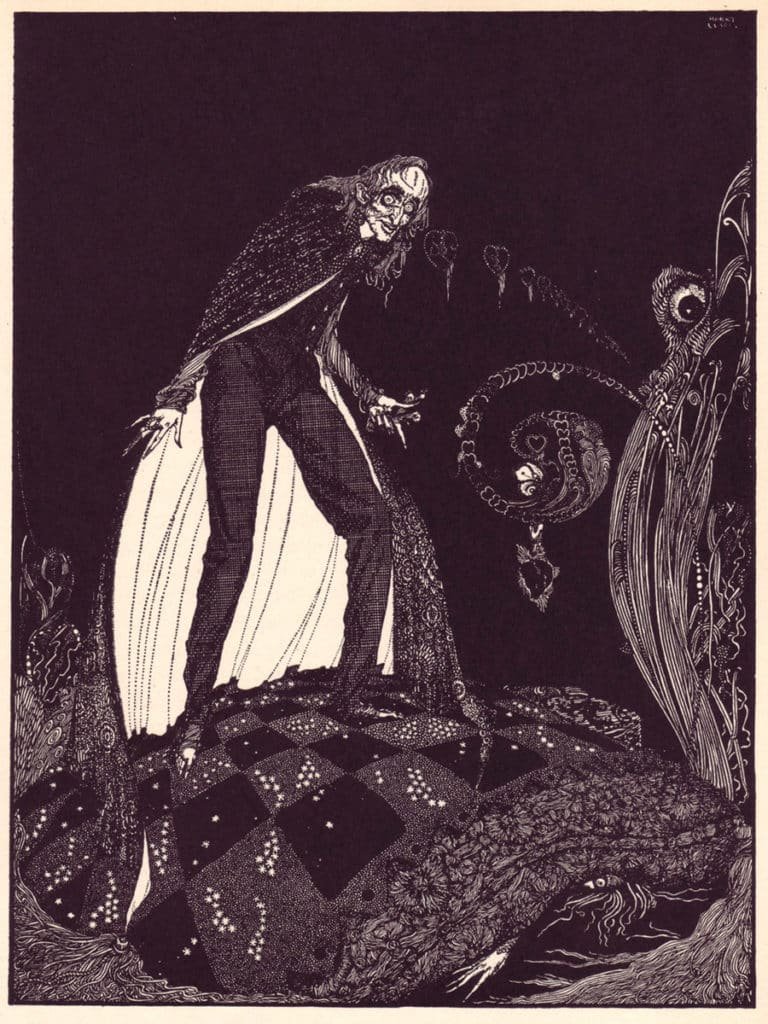
Aberrant mental states were Poe’s bread and butter and this tale – the first Poe tale I ever read – is in many ways one of his absolute cruelest. The protagonist (antagonist?) of The Tell-Tale Heart murders a defenceless, elderly neighbour on nothing more than a whim; he admits as much, conceding that the old man had never done him any harm, but he carefully plans his murder regardless. It’s a Poe story, like The Black Cat, which I find uncomfortable reading even today. And yet, in reading about his meticulous planning and cover-up (a clear influence on Poe reader and scholar Fyodor Dostoevsky in Crime and Punishment), I can still feel some grain of pity for this troubled criminal. The more he protests his sanity, the more it’s clear he’s insane.

Clarke illustrated two stages of the story, but I have chosen this one – which is after the crime itself – because I think it’s incredibly interesting, not to mention ahead of its time. Here, the certainty and focus of the young man shown as he commits the murder is gone, and Clarke shows some evidence of the fracturing of his state of mind. He stands, haunted by his perception of the old man’s beating heart from beneath the floorboards where he’s concealed. He’s half-terrified, half-transfixed.

Clarke has shown the man’s awareness of the beating of the ‘hideous heart’ in a way which foreshadows comic book art of generations to follow: a pattern of numerous human hearts is shown gracefully emanating from the floor, their tendrils reaching out to the protagonist, inescapable. It’s a novel technique and a skilled balance of the beautiful and grotesque. The whole room is distorted and unreal, with a bizarrely-curving floor and a nightmarish eye adding to the effect of persecution and paranoia.

Then, of course, there’s the figure of the dead man itself; our criminal is lost to us, looking elsewhere as he is haunted by his deeds – but the old man peeps out at us, looking straight at us, wild and reproachful. The result is a disturbing one. Just as Poe forces us to confront the murder, so does Clarke’s illustration – by giving us an idea of how this culpability feels to Poe’s character. Like all of Clarke’s work on Poe, it’s both unflinching and insightful.

“New York is filled with creatures…” Re-visiting Jacob’s Ladder (1990)

By Matt Harries

When I consider the word ‘horror’ in cinematic terms, I think almost instantly of Marlon Brando’s Colonel Kurtz in Apocalypse Now. “The horror! The horror!”, his utterance perhaps an expression of a kind of resigned revulsion at the depths of the human condition, witnessed by and yet simultaneously perpetuated by him. Regarding the connection with Jacob’s Ladder, both obviously deal with aspects of the Vietnamese war. What further unites them beyond some examination of a historical conflict though, is their investigation of what Roger Ebert described as “the dark places of the soul”. This is something that Jacob’s Ladder delves into literally – the battle for the soul of one man between forces of light and dark, the true nature of which is only revealed toward the films culmination.

Where Jacob’s Ladder really succeeds is that for much of the film, the viewer is left guessing as to what extent the nightmarish visions of Jacob Singer (Tim Robbins) are mere hallucinations, or glimpses into a very real hell that lurks tantalisingly close, behind the veil of everyday perception. From the opening frames (the ubiquitous slow motion, dawn footage of choppers in the jungles of Vietnam), to the grime and squalor of New York (rust, urban decay, the homeless), to the stale bureaucracy of the hospital reception, we are grounded in a very recognisable reality. Singer, clearly still traumatised by the memories of the Mekong Delta, begins to sense a malign presence in his life, a feeling enhanced by vivid nightmares recalling the savage final events of his military service. It isn’t hard to imagine these creatures being supernatural, otherworldly beings, but we learn that despite the tentacles and thrashing, inhuman heads, and the chattering, snapping teeth that lunge for him in waking moments, the root of these beings seems to once again be man himself. In this case that old protagonist the Scientist, represented by a “hippy chemist” Micheal (Matt Craven), recruited by the army to add a little chemically-enhanced battle-lust to the grunts on the ground back in the ‘Nam.

This facet of the film echoes the infamous Project MKUltra, the U.S government’s human research project that ran through the 50s and 60s. This controversial program was designed as an investigation into the efficacy of a wide range of drugs in the application of mind control, among them LSD and BZ (which is mentioned in the film’s closing credits). Although BZ was rumoured to have been applied to soldiers in Vietnam, there is no evidence to suggest it actually turned them into killing machines. Nonetheless, there are anecdotal references to a CIA operative who acted as a test subject, and after being dosed with LSD entered a psychotic state in which every passing car appeared to contain monsters. For Jacob, such vehicle-bound creatures almost end his life at one point in the film. Is his battle through this personal hell merely the result of clandestine human research gone badly awry?

Sadly for Singer, munching a tonne of grapefruit isn’t going to help him here. As he struggles to make sense of his decaying mental state, and becomes more and more withdrawn and paranoid, he is embattled not only by demonic hallucinations, but by his own girlfriend Jezebel (the excellent Elizabath Peña), who herself takes on some devilish qualities and who may or may not be in league with the Hellraiser-like entities that continue to encroach on Jacob’s life. When he makes contact with other survivors from his ill-fated platoon, he seems to be honing in on a truth of sorts. Aided by the redoubtable Lou (Danny Aiello), his philosophic chiropractor, Jacob stumbles toward epiphany…

To say, as the blurb on the back of the case states, that Jacob’s Ladder is both mystery, thriller and horror, would be pretty accurate. The way Adrian Lyne (Fatal Attraction, 9 ½ weeks) handles these elements is one of the film’s key strengths. Frightening though they are – the dance scene at the party is an excellent example of Jacob’s monstrous visions impacting in the most mundane of situations – the moments of ‘horror’ are kept relatively fleeting. Indeed, the director is careful to never place these creatures in the same shot as Jacob himself, thereby reinforcing his isolation.

There are some disturbing notions and scenes which have nothing to do with fell beasts, which adds to an increasingly claustrophobic and paranoid tension, The shadow of human experimentation spreads from the field of battle to the grotesque depths of a hospital where the residents resemble thalidomide victims – another indictment of science perhaps? Nonetheless, there is a supernatural element which keeps us guessing until an ending that, in lesser hands, could have slipped into mawkishness. Luckily though, Tim Robbins does a great job as the suffering Jacob, and by the end of the film it would take a wooden heart not to feel he doesn’t deserve a little peace. The somewhat scary Elizabeth Peña does a nice job in not committing completely to either side of her personality, thereby keeping the guessing game going right to the end. The supporting cast have a familiar look to them, but Danny Aiello as Lou stood out for me. Sometimes rambunctious, sometimes wise, Jacob sees this manipulator of spines as his own personal overgrown cherub. ‘Lou’ though…which biblical name does that remind you of? As Lou says himself, with his final piece of advice to Jacob –

“So, if you’re frightened of dying and… and you’re holding on, you’ll see devils tearing your life away. But if you’ve made your peace, then the devils are really angels, freeing you from the earth”.

Is Lou, Jacob’s saviour, possibly not so much Cherubim, as Lightbringer? While the exact nature of his role is never made explicit, he does illuminate a way out of the hospital, in the bowels of which Jacob faces the inquisitor-surgeons that seem to represent these dualistic devil/angels.

Although Jacob’s Ladder reveals itself to be a complex film that seems to suggest a reality torn between the earthly and the fantastical, its portrayal of the cycle of guilt that seems to anchor Jacob within his personal hell, seems strongly evocative of religious ideas of guilt, sin and repentance, of punishment and purgatory. Always, despite the Old Testament intensity of his hallucinatory foes and paranoid visions, the common thread is that mankind, in his cruelty, predisposition towards violence and affliction of suffering against his fellow man, holds both the keys to his own damnation, and at the same time his own redemption.

Leviathan Is On Its Way: Interview with Writer & Producer of The Upcoming Hellraiser Documentary

Interview by Keri O’Shea

It’s no secret round these parts that I’m a bit of a Hellraiser fan…

Regular readers might remember my love letter to the film on its twenty-fifth anniversary (or if not, by all means take a look now). You may be amazed to discover that I also have a soft spot in my heart for the in-many-ways equally warped sequel, Hellbound: Hellraiser II. Picking up with the same bleak, fantastical aesthetic which the first film used to such great effect, Hellbound saw several key characters return, offering intriguing developments in how they interacted – not least in the interplay between Frank, Kirsty, and arguably one of the finest daemonic females ever committed to celluloid – Julia Cotton.

There were new characters too, operating at opposite poles – Tiffany, the mute, innocent puzzle-solver, and her doctor, Channard, intent on solving the mysteries of the Lament Configuration box by using her skills – come what may. In many ways the most dangerous Cenobite, Channard is not governed by the regulations which control the actions of the four ‘classic’ Cenobites, who also re-emerge in this movie, albeit with the first Female Cenobite Grace Kirby being replaced here by the disarmingly baby-faced Barbie Wilde. As an extension of the Hellraiser universe, it is a superb piece of work, and (to my mind) the last of the sequels to really feel like a Hellraiser film.

If you have ever wondered about the background to both of these highly-original films, as I have then a project by the name of Leviathan may well be of interest. The project has been making good use of social media in recent weeks alongside its own Kickstarter campaign, which has – six days ahead of schedule, at the time of writing – been successful. (If you still wanted to be a part of this campaign then by all means, you can still visit and pledge). Whilst the iron was hot, though, I was keen to talk to the folk behind this intriguing documentary film, so I spoke to Gary Smart, writer and producer of the film, about the Leviathan team’s work to date, plus of course what happens next…

BAH: first up, congratulations on hitting your modest Kickstarter target almost a week ahead of schedule – you must be incredibly pleased. Were there ever any doubts in your mind about using a crowdsourcing model like the Kickstarter route to fund the film? And how have you found the experience?

GS: The initial start of the production was self-funded and funded by our executive producer; as this is an independent project, we then decided to look for support from Kickstarter and the fans themselves – and we really didn’t have any doubts about Kickstarter. We knew we had an exciting project and some amazing footage from the 30 interviews already completed.

BAH: How long has the idea for this film been in the pipeline, then?

GS: We originally started looking at making the doc about eighteen months ago, but it wasn’t until we did a screening of Hellraiser and Hellbound in Birmingham UK with Ken Cranham, Geoff Portass, Nicholas Vince and Simon Bamford, that we realised that there was a wealth of untold stories from the making of Hellraiser that were just waiting to be told.

BAH: Hellraiser – and Hellbound, the sequel – are two films which have shown a resounding fan appeal – certainly for this fan writer, and many thousands more. You obviously agree – but what, in your opinion, is behind this appeal? Why are fans still so ready to hear more about the films?

GS: The success of the first two Hellraiser films are purely down to the genius that is Clive Barker. The first two movies are really one film, one story that explore the visceral world of the Cenobites and the Lament Configuration perfectly. Most importantly, Hellraiser is a tragic love story that is a kin to Shakespeare – and this is something that we are exploring in Leviathan.

BAH: How has fan response been so far? You’ve been active on Facebook, Twitter et al…

One word – amazing. The fans have been fantastic, as well as the big and small movie and horror sites. We can’t thank the fans enough for their kind words and support so far.

BAH: Were the people now involved in Leviathan keen to talk about their experiences on both films? I’d imagine working on a project or projects as game-changing as these films would have a lasting impact. Have there been revelations along the way?

GS: The one thing that really amazed us was the love for these films from those who helped to create them – their stories are in-depth and from the heart, and of course there are a few fun, interesting stories that have been shared.

BAH: You have a wealth of footage already in the bag for this film; what’s next for you, now that you have raised the necessary funds?

GS: The first thing is booking time in LA. We have four confirmed interviews for August currently, so we will get there and interview who we can. We will then fund post-production to ensure we can get a release – we hope for November 2014. Also, legendary UK poster artist Graham Humphreys will be working on our final poster, so watch this space.

Our plans for the documentary so far? It’ll be a four-hour feature altogether, packed with bonus materials. As ever, updates will be on out Facebook, Twitter and our main site.

BAH: Thanks, Gary, and we look forward to the end result!

Leviathan: The Story of Hellraiser and Hellbound: Hellraiser II will be reviewed on Brutal as Hell on its release. Thanks to all at the Leviathan project for their time.

Interview: Indie Filmmaker Peter Dukes

Interview by Keri O’Shea

Though writer, director and producer Peter Dukes is in no ways new to the world of filmmaking, having made his first short film way back in 1999, we here at Brutal as Hell are pretty new to Peter’s work; he contacted us back last year regarding coverage in our recently-resurrected Horror in Short feature. As I’m the go-to girl for short films, I took a look – and I genuinely liked what I saw. In the first double-bill we ran, Dukes’ work demonstrated a pleasing level of variety: there was a dark tale of lycanthropy in The Beast, and then a fun horror-based comedy in Little Reaper: click on the link to take a look for yourselves. Then, yesterday we ran Dukes’ latest horror short, a film which clocks in at a mere three minutes; to reiterate what I said yesterday when we covered it, that has to be worth three minutes of your time.

After running three of his films and chatting here and there along the way, I thought it was high time Brutal as Hell got to know Peter a little better: to that purpose, he was kind enough to answer a few questions for us.

Brutal as Hell: Thanks for doing this, Peter. My first question is a bit obvious, but how did you get into filmmaking? Was it always something you wanted to do?

Peter Dukes: So long as I can remember, yes. I’ve long enjoyed crafting stories, of all kinds. Telling stories, writing stories, drawing stories, you name it. Eventually I started playing around with my parents’ VCR camcorder (did I just date myself?) and was hooked on filmmaking from that point forward.

BAH: You’ve made a number of short films over the years: some of these have been horror, some other genres altogether. Do you have a particular favourite project that you’ve worked on so far?

PB: No. There are some films I may enjoy more so than others, but each represent a certain challenge I had laid out for myself, and thus each represent growth and maturation, even if at times I’m the only one who would recognize it.

BAH: How does writing/directing horror compare to the other genres you’ve worked on? And is there a genre you’d love to turn your hand to that you haven’t yet?

I have a soft spot for horror. Always have, always will. There’s a lot of room for creative flexibility there, and I enjoy that, but let’s not forget, it’s also just plain fun! That being said, I enjoy delving into other genres as well, as long as there is an interesting and challenging story to tell. I’m always on the lookout to try something new. That was one of the main reasons I took on LITTLE REAPER, which was my first experiment in comedy. I enjoyed the experience and learned a lot from it. In terms of taking on an entirely new genre I’ve never played with before? I’d actually love to do a western!

BAH: We live in a time of things like fan sites just like BAH, a proliferation of film festivals, phenomena like Kickstarter…do these things make life easier, or harder for indie filmmakers, in your opinion?

The social media revolution, along with the explosion of online media sites/etc, can really help indie filmmakers get their work out there for a lot of people to see quickly. It’s an investment – as one needs to put in the time to build relationships with the press, but one that’s more than worth your time.

In terms of crowd funding sites, I think they are a great avenue so long as you are prepared to put in the work necessary to get the job done right. Raising money has never been nor will ever be easy, but these sites offer indie filmmakers another financial avenue to explore, and for many I’m sure it’s proven itself quite valuable. I have yet to go through a crowd funding site, as I secure my investors elsewhere, but I know others who have used it to successfully finance their pictures.

There is, however, a drawback to all these new avenues. Now ANYONE can come in, make a movie and get it out there for people to see. With this sea of indie filmmakers out there (many of whom belong, many of whom don’t) it’s become extremely difficult to really stand out and get yourself noticed by the kind of people who can take your career to the next level. There’s a massive amount of filmmakers all vying for a very limited amount of gigs, so naturally the powers that be have kind of put up the dams (so as to keep their sanity). In other words, getting your script optioned or getting your demo reel into the hands of a manager or agent is next to impossible, unless you have an “in” or a referral of some kind. Blind submissions (pretty much) don’t happen anymore.

The life of an indie filmmaker is all about facing, and overcoming, challenges. It’s an absolute necessity. So, this drawback is simply another challenge that indie filmmakers must tackle, and it CAN be tackled.

BAH: A few months back, we featured your excellent short film The Beast. I hear that you’re now working on a feature-length movie by the same title. I’d certainly welcome some new werewolf movies on the scene. How’s it going – can you tell us more about this?

Yes, I expanded my short script for THE BEAST into a feature screenplay and was fortunate enough to have it optioned by Top Ranked Pictures a few months ago. The budget will come in around six million dollars and we are busy developing it as we speak. We’ve also been able to reach out to some major name taent. Progress is coming along nicely, but only time will tell if this project will come to fruition or not.

I’ve also recently been attached to direct a multi-million dollar Yeti horror picture, to be shot in the Himalayas. That too is in the early stages of development. I’m keeping my fingers crossed that both productions will go the distance…

BAH: What’s the most challenging thing about your job, would you say?

Tough question. There are many challenges that come with doing what I do, so depending on when you ask this of me, my answer might change from time to time, ha! However, I think that one of the most challenging things is pushing yourself to always work harder, to challenge yourself, to grow, to learn, to do more more MORE, even when you think you can’t do any more, and to keep this up week after week, month after month, year after year, almost all of which will be on the side of a regular full time job. Throughout this process you’ll be constantly aware that the odds of success are astronomically against you. Pushing through all this can be a challenge, even to the most experienced indie filmmakers out there.

The bottom line: is it’s a tough (although richly rewarding) profession and it takes sincere passion and hard work, both of which must be sustained over the long haul.

BAH: Thanks for talking with us – and good luck!

For further information on Peter’s work, be sure to check out his and Aubrey Dukes’ production company: follow the link to the Dream Seekers Productions website.


Horror in Short: Daniel (2014)

By Keri O’Shea

This feature on the site is all about short horror films, but it begs a question. What’s the shortest film that would still work, still tell a story you’d want to see played out? We could get into Hemingway territory here and consider that he managed to do it on paper in six words – but I don’t honestly know what the lower limit for a film would be. However, this latest offering from director Peter Dukes (whose earlier works The Beast and Little Reaper we have already featured on the site) comes in at a mere three minutes. Yep, three minutes. See what you think. Check out Daniel below:

Sure, it’s dead simple and it has to be given its restraints – but it’s a diverting enough three minutes, isn’t it? A lot of feature-length films realise what Dukes clearly realises, that you don’t necessarily need acres of exposition when you’re introducing a would-be threat to the screen – hell, sometimes the fact that there are guys with bats is more frightening when you don’t know why they’re in a family home kicking down doors, and this is clearly linked to the first evidence of their violence we see, the dead body of a child’s mother.

But is it evidence of their violence at all? Short films work well with a twist, and Dukes has shown already that he gets this. He knows that you can be succinct, not give away every detail, and still lead your audience off in a new direction. So far, his short films – at least the horror works which I’ve seen – have provided a neat batch of calling cards, as well as being fun in their own right. Not trying to cram a feature into a short is half the battle; having decent camera work and a subtle yet effective musical score is a great support to Daniel too.

And now I’m interested to see where things go from here…

Comic Review: The Empty Man

By Svetlana Fedotov

Viruses sure are fun. Ranging from a mild cold to a full blown 28 Days Later zombie invasion, diseases are probably the only thing keeping human beings in check since we learned how to beat things with sticks. It is the great equalizer that branches across all societies, classes, professions, and wealth, and has led to some very famous horror stories; hell, it invented a whole genre: bio-horror. Adding to the growing list of all things germy and deadly, BOOM! Studios has recently released a tantalizing new tale titled The Empty Man. Cult worship and murderous blood lust rears its ugly head in this new horror, promising a world-wide epidemic that will destroy everything that we hold dear.

The comic opens up on a cult holding its services in a burned out gas station. For all intents and purposes, it looks like your standard, wacko congregation complete with healing powers, a dynamic leader, and a down-trodden flock of dismal human beings. But before you know it, its five years later, and the church has grown into a full blown religion, preaching to millions every week. Coinciding with its rise is a strange viral outbreak, simply known as The Empty Man. Scores of human being are suddenly turning violent, destroying everything that comes near before destroying themselves. Enter Special Agents Langford and Jensen, a pair of detectives assigned to contain, study, and hopefully eradicate The Empty Man Virus. After a routine investigation into another Empty Man case, this one involving a father, mother, and two missing children, things quickly begin to go weird as they nab a man who’s been following them around. Not only does this mysterious stranger know something they don’t, but brings something vile in with him.

The Empty Man is one of those comics that you just don’t see coming. It starts off like a lot of horror titles, particularly with bio-horror, where people are slaughtered left and right and no one knows what to do. You got some dude giving monologues, trying to explain the changes that are happening while everyone revs up for the Armageddon. But somewhere between the cynicism and the fantastic gore (seriously, it’s pretty on the ball), there’s a touch of realism in it that really pushes the comic forward. I’m definitely digging the X-Files type dynamic between the paranoid Agent Langford and critical Agent Jensen, giving the characters a very nice back and forth that works perfectly for a horror comic with more questions than answers. Also, the addition of a bizarre cult that’s obsessed with The Empty Man syndrome makes the whole thing entirely unsettling, addressing the idea of the plague being a welcome thing. In our current time of religious turmoil and opposing viewpoints, it’s entirely plausible that some would think that a terror of such proportions could not only be a sign of God’s wrath but a test of faith for those who believe. Perhaps it’s something we deserve.

The writer behind this ghastly tale is fan-favorite Cullen Bunn, a repeat contributor to the Marvel universe along with a couple of original series from Oni Press. His original horror works (The Sixth Gun, The Damned) had definitely prepared him for this bizarre comic and with BOOM! Studios’ commitment to creator owned books, he has been allowed to go full blown awesome on The Empty Man. As stated, the dialogue is fresh and realistic, bouncing organically between the two partners and the odd collection of human beings that they come across, and the story has a beautiful crescendo that refuses to allow the reader a chance to catch their breath. The art by Venesa R. Del Rey fits perfectly with the words, creating a dark and lurid world for the characters to get caught in. Sharp angled faces and detailed gore (for real, it’s Crossed quality) only stir the pot further as dark shadows practically bleed off the page, promising a terrifying tour of The Empty Man’s morbid reality. A great start to an epic horror read, The Empty Man #1 is currently waiting for you at your local comic shop.

Magic, Mischief and Mayhem: Celtic Folklore & Horror Part 2

By Keri O’Shea

Strange Aeons: Celtic Magic and Rational Response

(For the first part of this feature, click here).

It was not just during Samhain that the Celts believed they could communicate with the forces which lay beyond the fringes of the real. Druidic belief asserted that man could commune with the gods; the underworld itself was frequently believed as being physically accessible through pools, caves or hills, and its supernatural denizens often journeyed between the two places. The idea that these parallel domains are still there, sometimes literally below or around our rational, urbane towns and cities, and sometimes within the grasp of individuals properly-versed in the appropriate rituals – or even sometimes accidentally encountered – has long been used in horror, both in literature, from novellas such as Arthur Machen’s The Great God Pan (1890), and in cinema.

A lesser-known modern film which references a number of Celtic beliefs and derives its horror directly from the proximity of old religious sites and beliefs to modernity is Broceliande (2002). The film is set in Rennes, capital of Brittany, where a young university student named Chloe is about to join an archaeological dig in the Broceliande forest, legendary location of Merlin’s tomb. The scholarly soon meets the magical here: as Chloe’s seminars cover lessons in Samhain traditions and ritual magic, the student becomes prey to mysterious phenomena, especially after she discovers a druidic tomb during the dig. In order to suppress the age-old forces which are threatening to envelop her, Chloe has to become well-versed in druidic practice or secure the assistance of those academics who possess the right knowledge, in order to prevent the resurgence of druidic magic which will otherwise rather forcefully close the gap between old world and new.

In many ways, this is a flawed piece of cinema – it squanders its initial promise by launching into action sequences, some of which are reminiscent of Tomb Raider – but it is still an interesting film which makes abundant use of Celtic lore. Firstly, it self-consciously forges a link between Brittany and other Celtic nations: one of the professors at Rennes studied history in Dublin, as did one of the students; the druid stone which figures in the film’s plot (here a small magical artefact, rather than the more usual standing stone) has been brought to Brittany from Ireland; during lectures, ancient events in Wales are also mentioned (including the Roman campaigns against the druids, as mentioned by Tacitus in the first part of this feature). This suggests an idea of shared practices and thus heritage: Celtic magic here derives from a broad-based ‘Other’, a history which had a widespread influence in Northern Europe and therefore could mean there is more at stake should there be a resurgence of these old shared beliefs. There is a fear here of the repercussions of any new wave of hitherto lost, arcane or restricted information: through students gaining access to an understanding of druidic practice which they are able to enact, they are able to cause great upheaval to order.

The fear is, then, that there could be a long and widespread legacy of efficacious, arcane knowledge just waiting to rise again: tellingly, the film is set on the eve of Halloween – or of course, Samhain – where, as we have seen, the idea that ritual and magic could influence supernatural forces is ripe to be used as a basis for horror. The fact that the film takes place in Brittany in itself points to the powerful nature of heritage, where these modern students in the region feel such a vested and personal interest in recreating a shared past. This determination to bring back such a pagan past in itself can be a source of anxiety, regardless of how successfully this is done. It so happens that the most macabre elements of ancient Celtic practise are resurrected at the hands of the students in Broceliande: human sacrifice, ritual and spellcraft literally transforms one of the students into a monstrous being; although, even if the magic had not generated a literal monster, the treachery at the heart of the plot and a rejection of modern beliefs by a strident group would have been enough. The consequences of resurrecting the old gods and myths are manifold, but ultimately, those who do so are creating a rift in modern society and rejecting its values, and this can be monstrous indeed.

Wilfully participating in a Celtic otherworld is one thing, but worse still could be to stumble upon this proximal terrain accidentally, and to have no easy means of equipping oneself with the knowledge you need to escape. Another film which takes place in the forests of Arthurian legend – albeit taking a completely different approach stylistically – is Girl Slaves of Morgana Le Fay (Morgane et ses Nymphes) (1971). In this film, two young women names Anna and Françoise are travelling through an isolated region in France when they are forced to stop. They have to spend the night in a disused barn after getting (tellingly) lost in the forest, but when Françoise awakes, Anna is gone. Her friend looks for her in a nearby chateau, where she encounters the Morgane (Morgana Le Fay) of legend: Morgane is surrounded by beautiful women and she offers the bewildered Françoise a choice. Either she undergoes a ritual which will attach her to the chateau forever as one of her slaves, granting her eternal youth like them, or – she will rot into old age in the chateau’s dungeons.

Like Broceliande, The Girl Slaves of Morgana Le Fay uses the idea of Arthurian legend and the repercussions of magic ritual, but plays out much more after the fashion of Arthurian romance. Here, rather than a world of magic erupting into the real, Morgane’s realm is co-existent and seeks to remain at a remove from the real world entirely: Françoise wants to escape, but at first she’s not privy to the ritual knowledge which will permit her to leave this strange place. In this, the film does a pleasing job of developing a heady, fantastical atmosphere. Françoise frequently describes herself as feeling as though she is in a dream or a “fourth dimension”; this is not real-time with real characters, and our heroine rebels against that, desperately trying to leave the chateau. “I follow logic,” she protests to her glamorous captor. “That is the worst sickness,” she responds. “Here you can be cured of it. You’re already on the road to recovery.”
Eventually, Françoise cribs enough information from the other women to understand that she must seize some ritual artefacts if she is to escape. This is all complicated by her real-world concerns; not only does she baulk at the irrational prospect of magic, but she has discovered her friend is also an inmate at the chateau, and has rather more happily accepted her new lot. Anna encourages her friend to remain: “We are in the kingdom of the fairies…a place only children can find.” Françoise persists in trying to leave and escapes, but the first thing she sees – an elderly woman following a coffin – causes her to repent her decision. This horror now overshadows the horror of being a slave in Morgane’s castle: Françoise finally rejects the “cold light of reality” and willingly retreats from it back into the fantasy. Here, magic with all of its ambiguities has dominated the ordered – but ultimately finite – world without.

Fairy Folk and Wicked Tales

In both of the examples of cinema mentioned above, the consequences of revitalising – wittingly or otherwise – Celtic folklore are explored: both films play on the fear that a supernaturally-charged history is adjacent, contiguous and dangerous, whether you wish to re-energise its domains or not. Celtic lore also told that certain entities could move between the two states without the concern for protocols which are experienced by humans. The belief in faerie folk, a “multiplicity of beings” with a liminal existence, inhabiting regions of spiritual significance or moving between these and human domains, is one of the most persistent areas of Celtic folklore: “Fairies in the hills and pixies from subterranean haunts were creatures that had to be taken into account” (8). Every area of the ancient Celtic world seemed to be populated by a robust band of mischievous – sometimes murderous – sprites, beings that persisted and were adopted by later cultures. Cornwall had its piskies and its buccas – malevolent sea-dwellers who could be placated with offerings of fish; the Cornish bucca is echoed, etymologically and otherwise in the Welsh pwca and the Irish púca, and also in shape-shifters and pranksters like brownies, bogles, leprechauns and hobs, though these creatures are not as reputedly wicked as the murderous kelpies or the fearsome bugganes. These beings seem to urge a respect for nature and for important locations, meting out punishments for offenders – or sometimes simply enjoying themselves at human expense. Little wonder that the Celts and their successors were deferential to them, and the reputation of these wee folk as being “at best capricious, and at worst downright malevolent” (9) has survived modern romanticisation and entered them into the fringes of the horror lexicon. Their traits – and ambivalent attitudes to ignorant humans – lends themselves well to cautionary tale-telling, or on occasion, just lend themselves well to the sort of gleefully unpleasant treatment you might expect from beings “more likely to harm than help” (10).

In Cry of the Banshee (1970), an Elizabethan family pays the price for disbelieving in the power of the ‘old religion’ when it is visited by a vengeful sidhe, a supernatural faerie entity of Celtic descent believed to inhabit the otherworld. When magistrate Whitman (Vincent Price) imposes his conventional and rational – though bloody – judgement upon a coven of witches, he makes the mistake of sparing their leader, Oona. Oona swears revenge, conjuring the shape-shifting sidhe to dispatch the Whitman family one by one. Whitman scoffs at the superstitious villagers who recoil from the howls of what they insist is a ‘banshee’, but as his relatives begin to die in mysterious circumstances, he too becomes infected by their terror. Although the title is misleading – the banshee (or bean sidhe) was typically believed to be a female entity – the film demonstrates some pertinent fears; here is an example of effective witchcraft, and order, however brutally it is imposed, cannot repress either the power of the witch or the knowing fear of the villagers. As his world view is demolished, Whitman becomes more and more afraid, and the sidhe here manifests itself as a powerful agent of revenge.

In a neat short film, The Faeries of Blackheath Woods (2006), a child who makes the mistake of perceiving faerie-folk as being akin to their cutesy modern incarnation is punished for her transgressions in a decidedly nasty way. Little Melissa – out on a picnic with her parents – starts to chase after some ephemeral winged creatures she recognises as fairies, killing one when she puts it into a jar. Undeterred, she gives chase to others, but she’s then lured into a remote corner of the woods and reminded that these flimsy beings can defend themselves in a bloody fashion. These fairies are traditionalists, and there are certain codes of conduct to be observed. Similarly in another short film, Pwca (2009), a young girl undertaking community service in rural Wales is incredulous at her elderly employer’s descriptions of the resident ‘pwca’, who demands a meal a day – not to mention people’s respect. A lack of these gets them both into trouble, and it falls to young Hafwen to take over the burden of care when the pwca shows his nasty side. When handling these entities, it pays to be cautious…

As so many amongst these bands of faerie-folk garnered a reputation for mischief-making, it’s no surprise that there are a number of movies which treat the folklore with a sense of fun – or not, depending on your viewpoint! Out of the eighties came a horde of mystical little people in films, at least some of which delved into the idea of a fairy kingdom, and following on from Troll, the non-sequel Troll 2 (first titled Goblins) gave another mention to Stonehenge as the source of these ugly little beings’ power. The Leprechaun franchise – which starts with a demonic leprechaun who kills and maims in the pursuit of his bag of gold – has spawned five sequels, but order is usually restored when the leprechaun has his own magic turned against him. When these wicked tricksters turn up in films, there are usually magical means of banishing their influence; as with escaping from Celtic-styled otherworlds, the source of the horror lies in not knowing how, and in being terrorised by creatures that delight in this human folly. Ambiguous beings which are by turn punitive, mischievous and charged with supernatural abilities, ready to harm on a whim; it’s little wonder that faerie-folk provide a rich source for storytelling and have the potential to frighten. Little wonder, either, that nascent monotheism had its own methods and reasons for trying to dissipate these persistent old legends.

The Horror of the Old Gods

Much within horror refers to a pre- or extra-Christian world (or the equivalent predominant set of beliefs): the supernatural is a stubborn thing, and an array of vampires, ghosts, demons and monsters have never been entirely shaken by the recognised order. “Myths, like modern fiction or art in general, can be seen as a way of attempting to describe what may otherwise be inexplicable” (11) and some of the oldest myths, as we have seen, retain the strongest hold. Early Christianity was faced with a dilemma: merely supplanting the old festivals may have had an effect, but that was never going to be completely efficient on its own. Folklorist Ralph Whitlock makes an interesting point when he suggests that many old stories which take the form of ‘vs.’ stories – good against bad – show some evidence of being allegorical, telling of the “struggle which really occurred between the new religion – Christianity – and the old” (12). So, when we have tales of noble Christian knights defeating giants, dragons or the Devil himself on British soil, this could be a personification of the old religion – something fearful, monstrous, and in need of suppression. This approach was also taken with regards otherwise inexplicable natural phenomena, and also prehistoric structures which were otherwise mysterious: so for instance, the standing stones at Callanish in the Outer Hebrides are transformed by mythology into a row of giants, turned to stone by St Kieran when they refused to convert to Christianity.

These folk stories are in their own way pervasive and fun, but the thwarted devils of the stories never quite uprooted the old gods: as W. B. Yeats suggests in his Celtic Revivalist collection of writings The Celtic Twilight, “It may be that this, like the others, was not the devil at all, but some poor wood spirit whose cloven feet had got him into trouble.” In another part of the novel, an old Irish woman dismisses Hell as “an invention got up by the priest” but is a firm believer in “faeries and little leprechauns” (13). That the Celtic Revival could take place at all, restoring a folklore which was meant to have been sidelined by orthodoxy, is testament to its resilience. What then if people were to reject this orthodoxy altogether, and return to their old gods?

This fear is at the nub of British horror classic The Wicker Man (1973), where an agent of mainstream Christianity encounters an isolated Scottish island community which has wholeheartedly abandoned Christianity. “Here the old gods aren’t dead,” explains Lord Summerisle to the appalled investigating police officer, Sergeant Howie. Howie, a devout – and celibate – Christian finds himself repeatedly challenged by the licentiousness of the behaviour he observes, as well as battling against the insular secrecy of the Summerisle islanders in a classic example of the horror of secret societies. But this is not all: the rejection of Christianity has been so complete that the islanders have also resurrected the Celtic tradition of human sacrifice. The film plays nicely on the paranoia of what could happen were paganism – those ostensibly harmless folk beliefs – allowed to flourish again, showing us nonetheless a functional community which certainly boasts no more of a bloody tendency than Christianity has throughout its lifespan; the film’s ultimate message seems to be, though, that religious belief of any antiquity can be misused, or can at least do little to stem the incorrigible nature of human cruelty. In-group mentality is dangerous, and Howie’s attempt to reason with his captors (“Sometimes crops fail: if they fail again then, who next?”) falls on deaf ears. Inflexible, intractable belief is truly horrific here.

Another, similar film which plays on similar anxieties is Darklands (1996) albeit with a more Nationalistic subtext, a tale of the resurrection of druidic practises in Wales by those who feel that mainstream belief and culture has failed them, both spiritually and economically (extending a similar idea found in The Wicker Man – that the dependence on the island’s apple crop encouraged the islanders to turn to gods who might respond to their needs). In the case of Darklands, we actually see the new wave of druidic practitioners attempting to lean on a Christian community which is still around, seeking to reclaim the land on which the local church is built – a process which is already complete on Summerisle. Otherwise, and like their Scottish counterparts, the Welsh order is determined to boost their corner of the world by embracing a particularly nasty heritage…without an overarching moral order such as you might find in Christianity, it seems that the Celtic nations might reserve a tendency to revert to atavistic, Pagan savagery.

Conclusion

Celtic lore has persisted, despite the predominance of an urbane, modern culture; it has even become interwoven with all of the prevalent cultures which overlapped or displaced its tribes. People have long used stories and folklore to feel their way around accepted versions of events, and the easy relationship of fantasy and reality in the Celtic traditions has meant they are always rife for a good yarn, a creepy tale. Our Celtic ancestors used their lore to make sense of their world; they used personification, such as with faerie folk, to explain otherwise inexplicable phenomena and they devised ritual, magic and superstition in order to try and influence things beyond their control. The continued sense of proximity to this lore provides a sense of exoticism at home – we now use Celtic lore to make sense of our world through the medium of horror, privy as we are to a wealth of mysterious, often lurid glimpses of a shared past, not to mention a, co-existent supernatural which lends itself entertainingly to the horror genre.

There is a common thread which runs throughout the films discussed above, and is apparent in any study of Celtic mythology: Celtic lore is resistant to our straightforward interpretations of good and evil. A clear-cut division between the two is largely a Judeo-Christian phenomenon; this is a distinction which would have little troubled the Celtic mindset. Its festivals – like Samhain – were based around the precariousness of the natural world and the seasons, and so accommodated dualities like light and dark, birth and death, because the Celts’ daily existence contained both. In horror, the fun of Halloween is tempered again and again with reminders of the origins of the festivities: Conal Cochran perceives a ‘good joke’ in wholesale Halloween murder; the characters in Trick’r Treat are reminded again and again that the roots of the festival are bloody. Celtic mythology’s resident spirits too were, after all, neither ‘good’ nor ‘evil’: sometimes benign, often a hindrance, and sometimes murderous, in our horror films they are curtailed only by age-old formulae which properly understands what they are – and any illusions about their true natures are properly punished. Likewise, access to the supernatural world by humans could mean opulence and power, or equally it could mean slavery and harm; all of these are possible in the faerie castles of Morgana Le Fay or in the mythical depths of the Broceliande forest.

All good horror has a grain of uncertainty, and where notions of good and evil are rendered problematic through Celtic folklore, the ensuing disorientation has much potential for the horror genre. However, we shouldn’t forget that part of this potential for Celtic lore to influence horror also comes from the inherent anxiety inspired by its potential for resurgence. In The Wicker Man and Darklands, those countries which now claim a Celtic heritage once again elect to follow the old, ambiguous – and bloody – religious path of their ancestors. What greater uncertainty is there than a suspicion of your nearest neighbours? To quote Anglo-Irish author E. M. Forster – who was a contemporary of Yeats, and other important Celtic revivalists – “Paganism is infectious, more infectious than diphtheria or piety.”

References:
Opening quote: Denis Meikle, Vincent Price: the Art of Fear (Reynolds & Hearn: London, 2003), p.213.
1) Jenna Robertson, Christians and Halloween: http://www.bellaonline.com/articles/art13725.asp (accessed 28th September 2010); Richard Ames, Christians and Halloween: http://www.cogwriter.com/news/doctrine/richard-ames-christians-and-halloween/ (accessed 28th September 2010)
2) Ralph Whitlock, In Search of Lost Gods: a Guide to British Folklore (Phaidon: Oxford, 1979), introduction.
3) See for example: Gaius Julius Caesar, Commentarii de Bello Gallico.
4) Tacitus, Annals XIV, xxx
5) Bill Price, Celtic Myths (Pocket Essentials: Herts, 2008), p.1.
6) See for example: Strabo, Geography.
7) Whitlock, p.149.
8 ) Whitlock, introduction.
9) Daniel Farson, Vampires, Zombies and Monster Men (Aldus Books: London, 1975), p.88.
10) Ibid.
11) Price, p.13.
12) Whitlock, p.10.
13) W. B. Yeats, The Celtic Twilight (1902): http://www.sacred-texts.com/neu/yeats/twi/twi04.htm (accessed 28th September 2010)

Select Filmography:
Mischievous Puck (1911)
The Witch of the Welsh Mountains (1912)
The Banshee (1913)
Cry of the Banshee (1970)
The Night the Banshee Cried (1957)
Girl Slaves of Morgana Le Fay (1972)
The Wicker Man (1973)
Alison’s Birthday (1981)
Halloween III: Season of the Witch (1982)
Troll (1986)
Leprechaun (1993)
Darklands (1996)
Broceliande (2002)
Evil Breed: the Legend of Samhain (2003)
Bloodmyth (2006)
The Fairies of Blackheath Woods (2006)
Trick’r Treat (2008)
Pwca (2009)
Outcast (2010)