By Guest Contributor Marc Lissenburg
I daresay most of you reading this will have a unique personal evolution regarding your horror fandom. Born in 1972, I remember as a five year old in the mid-seventies being drawn to anything remotely to do with vampires. By my teens, driven hugely by the whole video nasty furore, EVERYTHING I watched back then was judged through ‘gore tinted spectacles’. But as I matured, and access to tapes and DVDs became more global, my horror viewing obsessions were inspired by one word – ATMOSPHERE! I distinctly remember the sole movie that marked that apparent change in my perception: Mario Bava’s classic BLACK SUNDAY. The picture remains one of my all-time favourites and ignited a passion in viewing all things Barbara Steele.
Ms Steele, if you are unaware, was born in 1937 and at the dawn of the 1960s was the leading lady in several Italian gothic horror movies. The good folk at Severin Films have duly embraced this unique period in horror history and recently released a quite wonderful Blu-ray disc centred on Mario Caino’s 1965 classic, NIGHTMARE CASTLE. Let me state at this point that this is NOT a screener I have been supplied with, but a review I felt obliged to write due to being enthralled with my wonderful, yet rather pricey, purchase. More on that later, but for now, let’s start at an obvious place. The feature itself: NIGHTMARE CASTLE…
 The somewhat strained marriage of Muriel (Barbara Steele) and Stephen Arrowsmith (Paul Muller) comes to a head after he departs on a fake business trip. Not only is Muriel having a secret affair with David the gardener (Rik Battaglia), but Arrowsmith himself is also having nefarious romantic liaisons with housemaid Solange (Helga Line). When the former get discovered romping in the opulent greenhouse, Arrrowsmith’s spite erupts and culminates in chaining the couple to a wall before giving the gardener a beating and his wife a good ole fashioned flagellating! But the shackled Muriel turns the tables by revealing she has altered her all important will to ensure her estate (obviously including the castle of the piece) all goes to her stepsister. A crude divorce of sorts follows when Arrowsmith torturously disposes of the pair. His convoluted secondary plan involves marrying his wife’s semi sibling, Jenny, who we learn has had a history of mental health problems. Merely coil her mind with some hallucinogens and voila, he will become her legal executor, thus taking control of the estate. Jenny, also played by Steele but now sporting platinum tresses as opposed to her more natural raven locks, now enters the narrative. Fans of Steele will be no strangers to this archetypal duality that almost became her trademark. It’s an absorbing performance as she drives the picture to its conclusion. With a healthy run time of 105 minutes, there is plenty of room for the tale to take many a twist and turn flitting from a sinister thriller to the supernatural suspense. The climax itself is an extravagantly satisfying one with Steele in splendid form.
The back cover of the disc duly boasts that the main feature has been “remastered and restored from the original negative”. I often wonder whether vintage restorations seem that extra bit special due to my habit of scrutinizing every frame with a little more attention than I normally would. Even so, I found the print to be truly sumptuous. Sure, there were a couple of notable flaws evident, but overall I found the transfer mightily impressive. The detail revealed in close ups in particular are remarkable while Enzo Barboni’s evocative cinematography is showcased with aplomb.
The LPCM 2.0 mono track providing the audio is a wonderful accompaniment to high calibre ocular feast. Rake through online reviews and I am sure there will be some negative annotations regarding the disc’s acoustics. But personally I found the meld of Ennio Morricone’s inaugural horror movie score along with the redubbing of Steele’s actual voice (something of a rarity with her work from that period) elevated a wonderful viewing experience to even greater heights.
I must admit to growing a little stale over the last few years in regards to sitting through feature length commentaries. But the new track mediated by film historian David Del Valle and horror’s High Priestess is a very welcome addition. I was thoroughly absorbed with the combination of Del Valle’s laid back probing and Steele’s thoughtful recollections which surpassed merely paying the horror genre respectful lip service. Her assertion that the horror roles she played were enduring due to the characters’ internalisation of dread as opposed to contemporary graphic gore is beautifully referenced throughout her reminiscences. The pair’s deliberations, however, are the mere tip if the iceberg as far as supplement material goes.
Also included is not one but two ‘bonus features of terror’ inspired by the writings of Edgar Allen Poe and naturally, starring Ms Steele. Antonio Margheriti’s 1964 picture CASTLE OF BLOOD is first on the menu. Based on Poe’s Danse Macabre novel, the movie starts with ‘Poe’ himself (Montgomery Glenn) discussing his latest idea in a tavern. When journalist Alan Foster (George Riviere) enters, Poe’s reluctance to give an interview soon turns into a bet made by the owner of the nearby castle. If Foster can survive one solitary night in the castle, he will win and be able to print an ultra rare interview with Poe. Betting aside, Foster thinks he has hit the jackpot when, within the castle’s stone walls, he runs into Elizabeth (Steele) and Julia (Margrete Robsahm). But all is not what it seems… Again this is another wonderful slice of Italian gothic that’s positively saturated with mood and ambience. Running at 1hr 22mins the version on the disc is described as the “rare US print of the movie”. With the legendary Riz Ortolani providing an exceptionally haunting score, CASTLE OF BLOOD is a wonderful second feature on the disc.
The linear notes boast of a 2k transfer. While this is undoubtedly true, it is obvious it a transfer WITHOUT restoration! The print is laden with scratches and speckles throughout. Personally I adore these little indiscretions. The crackles and pops in the soundtrack, in my humble opinion, provide the perfect paradox to HD transfers preserving organically aged celluloid reels from yesteryear. Fans with a more specific idea of what High Definition should represent may well disagree but personally I find it futile to whinge about such matters.
The second bonus feature is Massimo Pupillo’s 1965 sensationally titled TERROR CREATURES FROM THE GRAVE. Again we are given a HD transfer conspicuously free from any restoration. At times the interference is quite alarming but, as before, I prefer to retain a positive gratefulness for owning such a rare print as opposed to moaning about the its conspicuous flaws. TCFTG is another enjoyable b/w Italian gothic romp with a run time of 1hr 24min. The story itself, revolving around a mysterious will left by the late Jeronimus Hauff, is quite original and infused with occultism. Steele, playing Hauff’s widow Cleo, is the villainess of the piece from the outset exuding an ominous guise in every frame she features in. There is a notable level of gory violence throughout along with, dare I say it, unnecessary glimpses of female flesh peppering the movie. Whilst monotone celluloid from that era has its fair share of blood even I, (Mr teenage gorehound remember!) was genuinely surprised to observe a lingering shot of guts spilling out of one unfortunate victim’s stomach at one point!
The triple bill is rounded off with a few quality supplementary treats. Weighing in at a healthy 29m 30s (which just flies by) is “Barbara Steele in Conversation” which admittedly was included on a previous Severin release. It is nevertheless an enchanting recollection of her career as told by ‘Babs’ herself. In a refreshingly candid manner she recalls the start of her career and talks with genuine gratitude about her Italian Horror endeavours. “Black White and Red -An Interview with Director Mario Caiano” runs a minute shy of a quarter of an hour and basically comprises an Italian language interview with NIGHTMARE CASTLE’s director. It’s an intriguing natter conveyed via clear-cut subtitles. I couldn’t help be a little distracted in the opening minute however by the sight of Caino’s ginger cat doing its upmost to chomp the bejeezus out of the directors knuckles! “Vengeance From Beyond” (26 mins) is a fresh featurette focusing on TCFTG whereby the special effects are explained along with a brutally honest yet humorous chat with actor Riccardo Garrone, who played “Joseph Morgan”, in the picture. “A Dance of Ghosts” is a micro-documentary running a few seconds short of 17 minutes and relates to CASTLE OF BLOOD. Director Antonio Margheriti’s disclosures regarding his pseudo name in the credits is just one of the many factual morsels offered to the viewer. The mandatory inclusion of the features theatrical trailers completes a quite stunning package.
OK, so I suggested earlier to the fact my purchase, although easy on the eye, was perhaps not so amenable to my pocket. It was due to me being seduced into purchasing an inimitable option Severin Films are offering fans who are open to throwing a few extra pennies their way. Whereas all of the aforementioned material is available for $25, for an extra 20 bucks you can be the proud owner of Barbara Steele’s autograph! The signed edition has Steele’s handwritten signature liberally splashed in chunky silver ink across the front cover featuring the classic Italian movie poster artwork. In UK terms, taking this unique option and allowing for overseas shipping direct from Severin, I was £42 worse off. I yearn for the opportunity to get my BLACK SUNDAY paraphernalia signed in person should the great lady ever appear at a UK festival. But until then, the guys at Severin have given us the opportunity to purchase a genuine piece of horror folklore…
 Let’s get one thing straight before we start here: Beyond the Valley of the Dolls is absolutely ‘NOT A SEQUEL TO VALLEY OF THE DOLLS. IT IS WHOLLY ORIGINAL…’ and so continues the on-screen legend as the earliest frames of the latter movie start to roll. Are we convinced? Well, Valley of the Dolls – the Swedish original – had emerged three years previously, with identical subject matter, as well as being loosely based on the same novel. Even without doing a bit of digging on Russ Meyer’s own spin on the effects of the fame machine here, it would seem from this protest-too-much declaration that he’s either a fibber, delusional, or perhaps more likely, simultaneously making fun of his film and us even before we really get going. (Turns out that his film was intended as a straight-up parody; more on the success of this later.)
 Onto the film itself. It’s all about an all-girl band eking out a reasonable living playing live, albeit with one eye on the bright lights of LA. The LA of their dreams is represented to us, by the way, via a montage of landscapes, sheer fabrics – and boobs. Whether this really screams ‘musical success’ is by-the-by, and so Kelly (Dolly Read), Casey (Cynthia Myers) and Petronella (Marcia McBroom), together with manager Harris (David Gurian) head there, soon meeting up with Kelly’s long-lost millionairess Aunt Susan, a trusting soul who works in advertising (?) who immediately offers to give Kelly a huge share of the money, to the horror of her financial adviser – who has a point, let’s be honest. Still, Susan is a well-connected woman about town, and she offers to introduce the gang to all the best parties on the scene. News of the band’s prowess catches the attention of a key party host, Z-Man (John LaZar) and soon the re-named Carrie Nations are on for the big time, all under Z-Man’s watchful eye of course. Sadly, it can’t all be digging it and impromptu performances, even though a lot of it is: relationships suffer, greed kicks in, and the corrupting power of hedonism does its thing.
 We start with what appears to be a death scene: a young man lies, awkwardly sprawled and motionless, across a main road, having just fallen from his motorbike. Here’s the first surprise the film has to offer – he isn’t dead, but he really wanted to be. Rob (Cian Barry) has just attempted suicide in the wake of the death of his beloved girlfriend Nina, who herself died in a traffic accident. All he wanted to do was to join her; he fails, however, and eventually returns to his humdrum job at a local supermarket, where he has attracted the attention of co-worker and paramedic student Holly (Abigail Hardingham). Where most people would tiptoe around the bereaved, Holly is actively interested by what she sees as Rob’s brooding intensity and dedication to his love; she fantasises about what it would be like to fuck someone like that. Life does after all go on, Holly’s clumsy attentions are rewarded and before too long, romance blossoms for this somewhat damaged pair of people.
 A much safer way of procuring these scarcities was at film fairs up and down the country. Leisure centres nationwide would play host to these assemblages of horror devotees, looking to buy or sell macabre memorabilia. Traders would display their merchandise with a little round “BBFC 18” sticker placed on the outer cellophane of its packaging. The gesture seemed enough to give them a dubious licence to sell imports. How much knowledge Trading Standards possessed regarding the Laserdiscs country of origin was unclear, but with pirate tapes being the main focus of the odd raid, the little red dot (probably also bootlegged!) clinging to the wrapping seemed to suffice.
 Clive Barker’s classic Hellraiser got the deluxe box set treatment seven years after its theatrical debut when released by Lumivision. Limited to 2500 pressings worldwide, the double disc set offered a re-mastered transfer in its original aspect ratio of 1.85:1. With the aforementioned CLV and CAV formats cleverly employed, it meant the gruesome culmination of Frank being hooked and ripped apart could be devoured frame by frame. The concept of ‘extras’ was an innovative one at the time, so the deleted scenes, interviews and audio commentary by Mr Barker also significantly added to its appeal.
 The advancement of technology means Laserdisc players appear more redundant then ever these days. But while Dominoes Pizza et all did a roaring trade as pizza boxes were recycled as LD packaging for Ebay sales, horror fans by and large held on to the gems of their collections. How foolish it would be to part with the exclusive red pressing of the uncut Evil Dead 2? And who was heartless enough to flog their copy of Cannibal Ferox that, was not only gorgeously presented, but also had enclosed a 7 inch vinyl record containing the soundtrack and tongue in cheek ‘vomit bag’!


 So far, so familiar, but despite being another exploration of a person who is respectable enough by day yet has the sort of secret sexual mores that would get you locked up, Nekromantik 2 is quite different in the way it plays out. In the first film, we have a relationship (between Betty and Rob) which is seemingly all pinned on her aberrant tastes, and his success – or failure – to please her. It is Betty’s exit which precipitates the worst of Rob’s excesses afterwards. In the sequel however, Monika’s struggle is between her obviously unorthodox desire for the dead, and her new (living) boyfriend Mark (Mark Reeder), a man she seems rather fond of. Much of the film follows their developing romance; as things progress, Monika finds it more and more difficult to stop her nefarious activities spilling over into everyday life. It’s by no means a dialogue-heavy venture, this film, nor is it a character study in any conventional sense, but it’s definitely far more about the inner life of a young woman who seems, to all intents and purposes, respectable. There’s a broader sense of place and time here, perhaps because Buttgereit knew he’d achieved a lot of the shocks possible via the subject matter in the first film – so that it made sense to explore things differently.
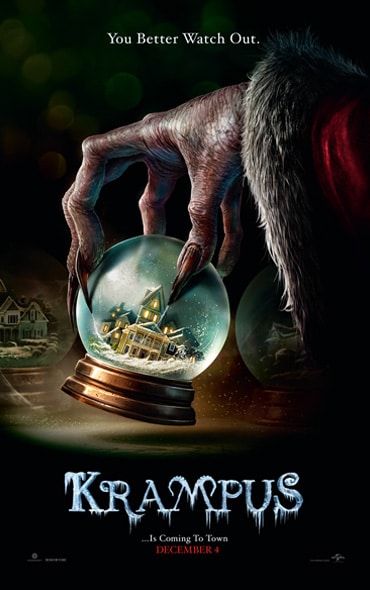 Krampus (2015) focuses on a picket-fence American nuclear family who are bracing themselves for the arrival of family for their traditional yearly attempt not to fall out with them spectacularly. Mother Sarah (Toni Collette) is anxiously ‘getting everything ready’, the children are bickering, and the only person who seems calm in the face of adversity is grandma, a woman who is signposted as GERMAN, definitely GERMAN, up to her elbows in Stollen from the moment she appears on screen and relentlessly speaking German even when people are responding to her in English (until she starts speaking English later in the film, but I digress). When Aunt Linda and the NRA-happy Uncle Howard finally rock up with their awful offspring, they’ve apparently brought the wise-cracking Aunt Dorothy with them without checking first – so there’s a houseful, and the cousins quickly settle down to mocking young Max (the phonetically-named Emjay Anthony) for his belief in Santa Claus. It’s all a bit much. In a temper, Max decides to tear up his letter to Santa and with it, all his altruistic requests for his family to just get on a bit better. No sooner has he done this, when a freak snowstorm lands, cutting off all the power to the local area. And that’s just for starters. Sucks to be the neighbours who presumably haven’t done anything to cause all of this, but it seems that supernatural forces are at work, systematically going from house to house to wreak havoc and picking off the family members one by one.