
By Keri O’Shea
(For the first part of Keri’s article on the historical basis of this film, please click here. As with Part 1, please note that you should read this article after seeing the film.)
Those observant Christians who began to arrive in New England during the middle decades of the 1600s had – as you might expect from people taking such a serious step – high hopes for their new lives. Newly unfettered from an English monarch whom religious leaders believed was fundamentally unsympathetic to their needs, the Puritan settlers were determined to establish themselves in their new land and to do things very differently there, hopefully with their example acting as a model and a beacon to those still in Europe who might also seek a truly reformed, fairly-governed commonwealth. To maintain their religious vision it was important to settlers, from the outset, to organise themselves along rigid and highly formalised lines, with clearly-understood rules, regulations and responsibilities. Patriarchal structure was largely transplanted to the New World intact and for the new colonies to stand a chance at success it was deemed necessary for convention to be promoted, including having the traditional family placed on a high pedestal. Men worked hard on the land, women were expected to extend their broods within wedlock and everyone had to work wholesale to raise up the next generation of true Christians.
As much as these new communities sought to throw off their shackles, then, they still retained those they felt were useful. A culture of legislature, social codes and punishments which hinged upon policing the behaviour of peers soon developed. It was necessary perhaps, to instill order in a harsh and unfamiliar environment which had a native population of heathens as a constant reminder that God’s path could be a precarious one, and certainly not one followed by all. In-group and out-group sentiment in amongst all of this soon became a matter of life and death.
There were those who dared defiance and many people didn’t want to simply pick up their old roles in this new haven, as they hoped for still greater reform and change. They argued with their elders, and some – notoriously – were eventually banished from the protection of their communities completely. As with being outlawed in medieval England, this was a very serious thing to face, and like the rebellious real-life female preacher Anne Hutchinson, a first-generation emigre from Lincolnshire who arrived in America at around the same time as the film’s family, the family in The Witch are excommunicated and banished from their settlement because of father William’s outspoken and socially-unacceptable version of Christian belief.
Taking his family into the wilderness as a result of this banishment, William sets about establishing his own farmstead. It is worth mentioning here that, according to the consensus among early Puritan thinkers, “overt repudiation of ministerial authority…could be interpreted as signifying a covenant with the Devil” (Karlsen, p.120). To many in a community of this kind and at this time, this type of rejection of the new order was suspicious, even damning. And as such, William’s actions could be seen as paving the road to Hell with good intentions, as the idiom goes. His real-life contemporaries certainly thought so: in any case, banishment, isolation and deprivation can do plenty to convince people that they are under otherworldly attack, particularly in such a hostile and lonely environment as New England. If what befalls the family is genuine supernatural interference, then they’ve certainly been set up well to receive it; if not, then they have been given enough very real calamity to perceive that they suffer it.
 As for the role of the witch in general in these communities, we have discussed already how Puritan society – this brave new world – had yet taken with it age-old beliefs about magic which it fell back on in its frequent times of difficulty and despair. In many respects, what communities saw as malign interference was blamed for equally age-old phenomena: blighted crops, ailing livestock, curdled milk, spoiled beer, poor weather; these are all things which could harm the progress of an agrarian society such as the Puritans had established but constituted natural, yet deeply frustrating events which could still be pinned on outsider influences. Witches were frequently blamed for such calamities, and hundreds of women (and men, and children, but primarily women) were tried and often executed for their ‘crimes’. Witches could also, we are told, cause animals to behave in uncharacteristic ways, such as being “taken with strange fits” or “behaving in a strange or affrighting manner” (Witchcraft Papers 1:94). All of these things could spell doom for farms which were meant to be completely self-sufficient.
All of these phenomena occur for the family in The Witch; they run out of food, cannot grow more, and their animals either keel over or worse, have a malign affect on the family in different ways – as that rare old beast the black goat known as ‘Black Philip’ demonstrates. Black Philip, incidentally, encapsulates lots of old ideas of devils as goats or he-goats – more than could be feasibly included here; the goat has biblical-era ties to Satanic mischief (see Revelations for mentions of the ‘lambs’ gathered on the right-hand side of Jesus and the ‘goats’ on the left). Black Philip, at first a regular farm animal, helps to sow the seeds of doubt in William’s mind regarding his much-loved eldest daughter Thomasin – after the younger children begin to claim they’ve been talking with the creature and he’s accused Thomasin of being ‘wicked’. He’s a striking creature whose influence on the family feels utterly believable, even as the narrative moves forward and his role transforms.
 With regards to the prevalence of witches in New England, there are still further reasons why the ideas of enemies-within began to take hold there. One interpretation is that witchcraft accusations became prevalent where a widow, wife or daughter stood to inherit large amounts of land and property. Whether the intentions were overt or not, naming a woman as a witch made for an easy way to grab and distribute material wealth from ‘unorthodox’ families which had subverted the preferred order of things, in a society where means were still limited. Whilst not a direct factor in The Witch, true, it’s yet more evidence of the precarious, often ruthless society in which their real-life contemporaries existed. Add sex, sexuality and sexual jealousy to this kind of mix, and it isn’t difficult to see how and why women often lived particularly risky lives in 17th Century America; in danger of plausible accusations by well-respected members of communities, in danger when ostensibly in a position of financial gain, in danger of sexual attention, life was hardly straightforward for many. By the same token, for those who really believed they had sealed a covenant with Satan (and I believe many did think this) then who can blame them for wanting it? The promise of ease and fulfillment away from their mundane world of toil and threat must have seemed a welcome proposal for many, whatever the cause.
Before any such covenant could be signed, however, it was common for Satan to tempt and to wear down prospective signatories via the phenomenon of possession.
 Today, most of us would see this in rational terms, as a body and mind worn down with mistreatment and stifling social roles finding an hysterical outlet which would have seemed, to witnesses, something completely unnatural. Add hearsay to fright and voila, you have something recordable, transmittable and imitable, but no doubt exaggerated, hence so many possession yarns which fit the same bill down through the centuries which can still be used in a 21st Century setting to scare modern audiences.
The Puritans did not view possession as evidence of witchcraft in and of itself, though; rather, this was a step initiated by the Devil (or his witches) to lure their prey, to break the spirits of the pious and to eventually gain new recruits. The Witch uses this idea; whilst the possessed child is young (although the youngest person accused of witchcraft at this time was around seven) it happens as a direct consequence of his encounter with a beautiful lone female living in the woods – a warning sign if ever there was one that something is deeply wrong. His attempts to repel whatever-it-is which is nagging at him causes physical symptoms which chime with those described across numerous accounts of possession in Puritan New England; he repels the evil in the end, but at great cost. In this, he has much in common with those real-life figures who underwent the tortures of possession: observers spoke of them being subjected to “thousands of cruel pinches,” “visited with strange Fits”, “sometimes weeping, sometimes laughing, sometimes roaring hideously” (Karlsen, p.11). Many were unable to find their way back to God; many died, either of their own physical symptoms or via the interventions of the well-meaning. This is certainly the case for Thomasin’s unhappy younger brother.
 Ultimately, however, it’s Thomasin who is the prize. Everything which befalls her family leads up to her final temptation, whilst also leading to the film’s striking final scenes. Contemporary figures for Thomasin in the 1630s are rather fewer than you might expect however, and this was generally the case. The main demographic group for accusations of witchcraft was women of maturer years, around forty as a general rule of thumb, and possibly due to the factor mentioned above – inheritance issues. A reasonable number of younger women are on record, though there are not many of them. There was, however, a young girl called Elizabeth Knapp who could conceivably be a source of inspiration for the character of Thomasin…
Knapp was just sixteen in the 1670s – albeit the generation after the film is set – when she first exhibited signs that something was seriously awry. The eldest child of her parents, from being a normal and normally-pious indentured servant in a reasonable affluent Puritan household, she at first began showing signs that she was possessed, speaking out against the system in which she lived. Knapp at first began “bursting into extravagant laughter” and complaining of the kinds of painful physical symptoms mentioned above; she explained her afflictions by saying that none other than the Devil – in the shape of various neighbours – was tormenting her.
Her fears were dismissed at first, largely because the woman she initially identified was well-protected and respected in the community (it’s always who you know), but what’s interesting here is that Knapp soon described her temptations by the Devil as overtly sensuous in nature. Knapp said:
“‘The Devil had appeared to her many times over the previous three years, that he offered to make her
a witch, and that he proffered to her ‘money, silks, fine clothes, ease from labor, to show her the whole
world…'”(Karlsen p.236)
Whilst far from the only woman to be teased away from the humdrum world by promises of comfort, and there are other possible individual inspirations for Thomasin’s character, Knapp’s assertions about what she had been offered give a strong reminder of Thomasin’s late words to the Devil, or to her ‘Black Philip’; after undergoing every horror, every loss, Thomasin wants immediate relief, sustenance, fine things to wear. Black Philip is keen to oblige, with the film’s strongest line of dialogue occurring as he finally leads her to give way with some simple, poignant words as he asks if she would prefer to ‘live deliciously’ Elsewhere, Knapp had talked of giving herself ‘body and soul’ to the Devil; this is as close as a young woman would dare to allude to sexuality in those stern, punitive times, but allude to it she does, I believe; Black Philip’s instruction to Thomasin to ‘remove her shift’ before calling her to the coven certainly does the same.
At the end of The Witch, as with the real-life contemporary figures who craved release from Puritan hardship, it’s hard to begrudge the character of Thomasin taking steps to gain her wishes; if the ensuing scenes are all just the death-gasp of a girl’s failing intellect, well, in many ways that feels like a shame. Somehow it’s hard not to find yourself on the side of the coven which has presumably thrown off hardship of its own at some cost, when it could finally accommodate a girl who is done with privation. But whatever you make of the glorious ambiguities of the ending of The Witch – whether this is indeed a supernatural film, or a tale of very human responses to an extreme situation – what we certainly have is a devotedly religious, loving family whose earnest prayers repeatedly fall on deaf ears; be it their nonconformity, their rebellious streak, their plain poor luck, or that they’ve been forsaken by God, their slow unravelling against an unforgiving backdrop makes for a startling piece of cinema.
Are there witches? Were there ever witches? That there are so many verifiable links to real historical accounts and to phenomena which people believed in so deeply (and died for) only adds to this film’s immense and deserved gravitas, and forever keeps us at arm’s length, doubting everything we see – just like Thomasin and her family.
“Handmaidens of the Lord should go so as to distinguish themselves from Handmaidens of the Devil.” (Cotton Mather, Ornaments for the Daughters of Zion, 1692).
Select Bibliography
Malleus Maleficarum by Heinrich Kramer & James Sprenger, trans. by Montague Summers (1928). Accessed online via http://www.malleusmaleficarum.org/shop/the-malleus-maleficarum-pdf/
The Devil in the Shape of a Woman: Witchcraft in Colonial New England by Carol F. Karlsen (1987).
Entertaining Satan: Witchcraft and the Culture of Early New England by John Putnam Demos (1982).

 We shouldn’t underestimate how important something like the Malleus Maleficarum was; it set the bar for the treatment of witches for all of the subsequent ‘witch crazes’ which followed, and its words on what witches did (and why they did it) can certainly be seen in 17th Century New England. For instance, the book relates the words of an alleged witch and child murderer, who told her accuser “with our spells we kill them in their cradles or even when they are sleeping by their parents’ side…then we secretly take them from their graves, and cook them in a cauldron, until the whole flesh comes away from the bones to make a soup which may easily be drunk. Of the more solid matter we make an unguent which is of virtue to help us in our arts and pleasures and our transportations.” This unguent, then, was applied to the broomsticks of legend (the same witch also mentions enchanting chairs in the same way) and used for flight. It’s an idea about witchcraft which has lasted over five hundred years so far, so we shouldn’t be surprised that it makes sense within the remit of Puritan society too, and is referenced shortly after the baby disappears in our film. The Devil and his followers couldn’t create matter (only God had that power) but he could certainly help his practitioners to break the rules of the natural world, and – in keeping with a subtext of witchcraft belief that witches abhorred conventional gender roles, including motherhood and child-rearing – dispatching an infant would have been little concern to them, but monstrous to mainstream society.
 Likewise, witches were believed to have the ability to shape-shift, taking on animal form; they were also frequently linked with ‘familiars’, animals which usually lived with the witches and worked on their behalf for the fee of suckling from them (and there’s that monstrous spin on motherhood again, folks). In The Witch, the family first hunt a hare which seems to have some sort of supernatural significance; they fail to catch it, and it lures father and son deeper into the unfamiliar woods near which they have settled, whilst also later re-appearing near the farmstead, inevitably a portent of far worse things to come. An association between witches and creatures such as rats, cats and hares (as well as alleged hybrid species, unrecognisable to witnesses) has been of longer duration, and the Malleus Maleficarum describes “a workman [who] was one day chopping some wood to burn in his house. A large cat suddenly appeared and began to attack him, and when he was driving it off, another even larger one came and attacked him with the first more fiercely. And when he again tried to drive them away, behold, three of them together attacked him, jumping up at his face, and biting and scratching his legs. In great fright and, as he said, more panic-stricken than he had ever been, he crossed himself and, leaving his work, fell upon the cats, which were swarming over the wood and again leaping at his face and throat, and with difficulty drove them away by beating one on the head, another on the legs, and another on the back. After the space of an hour, while he was again engaged upon his task, two servants of the town magistrates came and took him as a malefactor and led him into the presence of the bailiff or judge…the judge broke into these words: ‘You most wicked of men, how can you not acknowledge your crime? At such a time on such a day you beat three respected matrons of this town, so that they lie in their beds unable to rise or to move!'” Eventually, the hapless man is able to prove that the ‘respected matrons’ and the animals are one and the same. Ideas about animal familiars certainly persist into the Hopkins days in England, and cross the Atlantic too (as late as the 19th Century, the infamous story of the Bell Witch hauntings tell of a strange, large hare on his property which farmer John Bell initially attempted to shoot. This creature seemed to herald a widespread array of supernatural phenomena at the Bell family home, much of which later centred upon alleged visitations by a malign witch, often called ‘Kate’.)
 JLH: Totally. I didn’t want to go full ‘Bill & Ted’ metalbro. Instead I wanted to show that, despite the clothes and tastes in extreme music, metalheads are just normal people. I was definitely coming from a fan’s point of view. It’s weird, I keep finding subconscious metal references in the film, not things I intended. After Lemmy passed, someone said ‘Great you had that Motörhead joke in the film’. I didn’t know what they were talking about – then they pointed out that a character dies after getting an engine dropped on his skull. I had no idea.
 It’s not long before Birdemic begins to reveal its noteworthiness in other respects: the opening credits misspell ‘Cast’ as ‘Casts’, for starters, and then with no further ado we’re treated to an excruciating diner scene in which we are introduced to key players Rod (Alan Bagh) and Nathalie (Whitney Moore, who apparently doubled up her role to become make-up artist after the first two make-up artists quit). The film’s first shock revelation now becomes apparent: director James Nguyen only has one camera. This variously means that the same scene has to be stopped and repeated to get a modicum of footage together for editing, which goes some way towards excusing the casts for seeming so pained and awkward. This lack of kit really comes into its own during a scene intended to represent a high-powered business meeting, but more on that later: the point for the time being is, Rod likes Nathalie, and in the universe of Birdemic this makes it acceptable to terrifyingly try to chat her up, eventually wearing her down with glassy eye-contact and an inability to read a menu in a normal human way. Some by-the-by commentary on a TV introduces the theme of the environment going awry, which is as far as we get with context, but, whatever; Rod is having a good day otherwise. He has scared Nathalie into a date, secured a million-dollar deal at his telesales job and chatted to a man about getting a solar panel fitted to his house. It doesn’t get any better than this. It’s the American Dream. A ‘love scene’ ensues where everyone stays clothed, but at least it gets the main characters into a room so that we’re ready for the birds to attack first thing in the morning.
 The somewhat strained marriage of Muriel (Barbara Steele) and Stephen Arrowsmith (Paul Muller) comes to a head after he departs on a fake business trip. Not only is Muriel having a secret affair with David the gardener (Rik Battaglia), but Arrowsmith himself is also having nefarious romantic liaisons with housemaid Solange (Helga Line). When the former get discovered romping in the opulent greenhouse, Arrrowsmith’s spite erupts and culminates in chaining the couple to a wall before giving the gardener a beating and his wife a good ole fashioned flagellating! But the shackled Muriel turns the tables by revealing she has altered her all important will to ensure her estate (obviously including the castle of the piece) all goes to her stepsister. A crude divorce of sorts follows when Arrowsmith torturously disposes of the pair. His convoluted secondary plan involves marrying his wife’s semi sibling, Jenny, who we learn has had a history of mental health problems. Merely coil her mind with some hallucinogens and voila, he will become her legal executor, thus taking control of the estate. Jenny, also played by Steele but now sporting platinum tresses as opposed to her more natural raven locks, now enters the narrative. Fans of Steele will be no strangers to this archetypal duality that almost became her trademark. It’s an absorbing performance as she drives the picture to its conclusion. With a healthy run time of 105 minutes, there is plenty of room for the tale to take many a twist and turn flitting from a sinister thriller to the supernatural suspense. The climax itself is an extravagantly satisfying one with Steele in splendid form.
 Let’s get one thing straight before we start here: Beyond the Valley of the Dolls is absolutely ‘NOT A SEQUEL TO VALLEY OF THE DOLLS. IT IS WHOLLY ORIGINAL…’ and so continues the on-screen legend as the earliest frames of the latter movie start to roll. Are we convinced? Well, Valley of the Dolls – the Swedish original – had emerged three years previously, with identical subject matter, as well as being loosely based on the same novel. Even without doing a bit of digging on Russ Meyer’s own spin on the effects of the fame machine here, it would seem from this protest-too-much declaration that he’s either a fibber, delusional, or perhaps more likely, simultaneously making fun of his film and us even before we really get going. (Turns out that his film was intended as a straight-up parody; more on the success of this later.)
 Onto the film itself. It’s all about an all-girl band eking out a reasonable living playing live, albeit with one eye on the bright lights of LA. The LA of their dreams is represented to us, by the way, via a montage of landscapes, sheer fabrics – and boobs. Whether this really screams ‘musical success’ is by-the-by, and so Kelly (Dolly Read), Casey (Cynthia Myers) and Petronella (Marcia McBroom), together with manager Harris (David Gurian) head there, soon meeting up with Kelly’s long-lost millionairess Aunt Susan, a trusting soul who works in advertising (?) who immediately offers to give Kelly a huge share of the money, to the horror of her financial adviser – who has a point, let’s be honest. Still, Susan is a well-connected woman about town, and she offers to introduce the gang to all the best parties on the scene. News of the band’s prowess catches the attention of a key party host, Z-Man (John LaZar) and soon the re-named Carrie Nations are on for the big time, all under Z-Man’s watchful eye of course. Sadly, it can’t all be digging it and impromptu performances, even though a lot of it is: relationships suffer, greed kicks in, and the corrupting power of hedonism does its thing.
 We start with what appears to be a death scene: a young man lies, awkwardly sprawled and motionless, across a main road, having just fallen from his motorbike. Here’s the first surprise the film has to offer – he isn’t dead, but he really wanted to be. Rob (Cian Barry) has just attempted suicide in the wake of the death of his beloved girlfriend Nina, who herself died in a traffic accident. All he wanted to do was to join her; he fails, however, and eventually returns to his humdrum job at a local supermarket, where he has attracted the attention of co-worker and paramedic student Holly (Abigail Hardingham). Where most people would tiptoe around the bereaved, Holly is actively interested by what she sees as Rob’s brooding intensity and dedication to his love; she fantasises about what it would be like to fuck someone like that. Life does after all go on, Holly’s clumsy attentions are rewarded and before too long, romance blossoms for this somewhat damaged pair of people.
 A much safer way of procuring these scarcities was at film fairs up and down the country. Leisure centres nationwide would play host to these assemblages of horror devotees, looking to buy or sell macabre memorabilia. Traders would display their merchandise with a little round “BBFC 18” sticker placed on the outer cellophane of its packaging. The gesture seemed enough to give them a dubious licence to sell imports. How much knowledge Trading Standards possessed regarding the Laserdiscs country of origin was unclear, but with pirate tapes being the main focus of the odd raid, the little red dot (probably also bootlegged!) clinging to the wrapping seemed to suffice.
 Clive Barker’s classic Hellraiser got the deluxe box set treatment seven years after its theatrical debut when released by Lumivision. Limited to 2500 pressings worldwide, the double disc set offered a re-mastered transfer in its original aspect ratio of 1.85:1. With the aforementioned CLV and CAV formats cleverly employed, it meant the gruesome culmination of Frank being hooked and ripped apart could be devoured frame by frame. The concept of ‘extras’ was an innovative one at the time, so the deleted scenes, interviews and audio commentary by Mr Barker also significantly added to its appeal.
 The advancement of technology means Laserdisc players appear more redundant then ever these days. But while Dominoes Pizza et all did a roaring trade as pizza boxes were recycled as LD packaging for Ebay sales, horror fans by and large held on to the gems of their collections. How foolish it would be to part with the exclusive red pressing of the uncut Evil Dead 2? And who was heartless enough to flog their copy of Cannibal Ferox that, was not only gorgeously presented, but also had enclosed a 7 inch vinyl record containing the soundtrack and tongue in cheek ‘vomit bag’!


 So far, so familiar, but despite being another exploration of a person who is respectable enough by day yet has the sort of secret sexual mores that would get you locked up, Nekromantik 2 is quite different in the way it plays out. In the first film, we have a relationship (between Betty and Rob) which is seemingly all pinned on her aberrant tastes, and his success – or failure – to please her. It is Betty’s exit which precipitates the worst of Rob’s excesses afterwards. In the sequel however, Monika’s struggle is between her obviously unorthodox desire for the dead, and her new (living) boyfriend Mark (Mark Reeder), a man she seems rather fond of. Much of the film follows their developing romance; as things progress, Monika finds it more and more difficult to stop her nefarious activities spilling over into everyday life. It’s by no means a dialogue-heavy venture, this film, nor is it a character study in any conventional sense, but it’s definitely far more about the inner life of a young woman who seems, to all intents and purposes, respectable. There’s a broader sense of place and time here, perhaps because Buttgereit knew he’d achieved a lot of the shocks possible via the subject matter in the first film – so that it made sense to explore things differently.
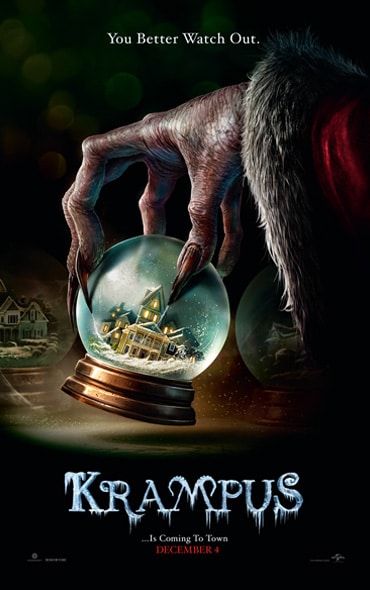 Krampus (2015) focuses on a picket-fence American nuclear family who are bracing themselves for the arrival of family for their traditional yearly attempt not to fall out with them spectacularly. Mother Sarah (Toni Collette) is anxiously ‘getting everything ready’, the children are bickering, and the only person who seems calm in the face of adversity is grandma, a woman who is signposted as GERMAN, definitely GERMAN, up to her elbows in Stollen from the moment she appears on screen and relentlessly speaking German even when people are responding to her in English (until she starts speaking English later in the film, but I digress). When Aunt Linda and the NRA-happy Uncle Howard finally rock up with their awful offspring, they’ve apparently brought the wise-cracking Aunt Dorothy with them without checking first – so there’s a houseful, and the cousins quickly settle down to mocking young Max (the phonetically-named Emjay Anthony) for his belief in Santa Claus. It’s all a bit much. In a temper, Max decides to tear up his letter to Santa and with it, all his altruistic requests for his family to just get on a bit better. No sooner has he done this, when a freak snowstorm lands, cutting off all the power to the local area. And that’s just for starters. Sucks to be the neighbours who presumably haven’t done anything to cause all of this, but it seems that supernatural forces are at work, systematically going from house to house to wreak havoc and picking off the family members one by one.