
By Keri O’Shea
Editor’s note: this article discusses The Witch in detail, and as such contains some spoilers. Please read it after you’ve seen the film. For a spoiler-free review, click here.
One of the most unusual and atmospheric films to hit the festival circuit late last year, The Witch – a claustrophobic tale of isolation, privation and the possibility of malignant supernatural forces in the New World – is about to get its general release. There’s been a sizeable promotional campaign behind the film so far, and it seems that the distributors have high hopes that it will make something of a breakthrough into the mainstream. We’ve already commented that we think some of the choices behind this promotion have been questionable and may even risk misrepresenting the film to a potential audience who expect something different; I certainly hope that isn’t the case, and that those who go and see it properly appreciate this rather understated historical thriller. Misleading poster campaigns are, after all, par-for-the-course these days; that isn’t really the topic of discussion here. Rather more relevantly, many hundreds of films have boasted that they are ‘based on true events’, and The Witch is fascinating because it, too, declares that it is based on a number of alleged real-life accounts from the 17th Century – it’s the nature of those accounts which gives this film both a unique perspective and an otherworldliness which reaches right back to the real New World settlers of the time.
“If ever there were witches, men and women in covenant with the Devil, here are multitudes in New England.”
The Rev. Samuel Parris (1692)
Those who set off from England seeking to build their ‘City on the Hill’ – their Christian utopia, unfettered by what they saw as the corruption of Europe – nonetheless took with them many of the anxieties which had plagued them in the Old World. Frequently, these anxieties concerned witchcraft. In making the claim, therefore, that The Witch is uniquely closely based on the accounts of settlers who found themselves threatened by magic in their new communities, these ‘true-life events’ are poised at an intriguing intersection between real and unreal, natural and supernatural, Christianity and its dark, persistent underbelly. Names, places, dates, ages – many of these things were meticulously recorded by the Puritans and are verifiably true; they just happen to occur in these meticulous narratives alongside descriptions of malevolent curses, plagues, blights, possessions, shape-shifting and unholy covenants with the Devil. Many early American settlers adamantly believed in the phenomena which scares Thomasin, her parents and siblings, and adjudicated against it accordingly. This article takes a closer look at some of the accounts which may have influenced the filmmakers, showing how they intersect with a sensitive and accurate exploration of these themes in the film and how The Witch captures this (to us) incongruous state very well, forcing us to peer between the lines of its narrative and wonder just what, if any, evil influence is holding sway over the family.
THE HAMMER OF THE WITCHES
In order to look at the society of the 17th Century, however, we need to look back further and to understand more about the belief in witchcraft which the Puritans first inherited, then exported. Times of unrest have long given way to periods of panic and unreason, and despite the Renaissance being known for great leaps forward in science and the arts, throughout the Late Medieval and Renaissance years various calamities were more and more often explained away as malignant interference caused by witchcraft. Whilst certainly not the only word on the subject, one book in particular encapsulated much of the paranoia about witches, whilst also exerting a surprising amount of influence in Europe (as well as taking advantage of new technology such as the Gutenberg Press, thus neatly representing how the shock of the new doesn’t necessarily dispense with the old). This strange nexus of officialdom and folk belief, peppered with unsubstantiated anecdote and meticulous rule of law, was a tome entitled the Malleus Maleficarum (‘Hammer of the Witches’) which appeared in the late 1480s and came to act as something of a ‘witch-hunter’s manual’, repetitively dismissing all cynicism on the subject in order to advise on how to detect, arrest, try and punish witches. Gaining credence and influence in the following decades, the MM thereafter turned up in the royal courts of Europe and the higher strata of the law, excusing and bestowing jurisdiction on the subject of witchcraft.
 We shouldn’t underestimate how important something like the Malleus Maleficarum was; it set the bar for the treatment of witches for all of the subsequent ‘witch crazes’ which followed, and its words on what witches did (and why they did it) can certainly be seen in 17th Century New England. For instance, the book relates the words of an alleged witch and child murderer, who told her accuser “with our spells we kill them in their cradles or even when they are sleeping by their parents’ side…then we secretly take them from their graves, and cook them in a cauldron, until the whole flesh comes away from the bones to make a soup which may easily be drunk. Of the more solid matter we make an unguent which is of virtue to help us in our arts and pleasures and our transportations.” This unguent, then, was applied to the broomsticks of legend (the same witch also mentions enchanting chairs in the same way) and used for flight. It’s an idea about witchcraft which has lasted over five hundred years so far, so we shouldn’t be surprised that it makes sense within the remit of Puritan society too, and is referenced shortly after the baby disappears in our film. The Devil and his followers couldn’t create matter (only God had that power) but he could certainly help his practitioners to break the rules of the natural world, and – in keeping with a subtext of witchcraft belief that witches abhorred conventional gender roles, including motherhood and child-rearing – dispatching an infant would have been little concern to them, but monstrous to mainstream society.
 Likewise, witches were believed to have the ability to shape-shift, taking on animal form; they were also frequently linked with ‘familiars’, animals which usually lived with the witches and worked on their behalf for the fee of suckling from them (and there’s that monstrous spin on motherhood again, folks). In The Witch, the family first hunt a hare which seems to have some sort of supernatural significance; they fail to catch it, and it lures father and son deeper into the unfamiliar woods near which they have settled, whilst also later re-appearing near the farmstead, inevitably a portent of far worse things to come. An association between witches and creatures such as rats, cats and hares (as well as alleged hybrid species, unrecognisable to witnesses) has been of longer duration, and the Malleus Maleficarum describes “a workman [who] was one day chopping some wood to burn in his house. A large cat suddenly appeared and began to attack him, and when he was driving it off, another even larger one came and attacked him with the first more fiercely. And when he again tried to drive them away, behold, three of them together attacked him, jumping up at his face, and biting and scratching his legs. In great fright and, as he said, more panic-stricken than he had ever been, he crossed himself and, leaving his work, fell upon the cats, which were swarming over the wood and again leaping at his face and throat, and with difficulty drove them away by beating one on the head, another on the legs, and another on the back. After the space of an hour, while he was again engaged upon his task, two servants of the town magistrates came and took him as a malefactor and led him into the presence of the bailiff or judge…the judge broke into these words: ‘You most wicked of men, how can you not acknowledge your crime? At such a time on such a day you beat three respected matrons of this town, so that they lie in their beds unable to rise or to move!'” Eventually, the hapless man is able to prove that the ‘respected matrons’ and the animals are one and the same. Ideas about animal familiars certainly persist into the Hopkins days in England, and cross the Atlantic too (as late as the 19th Century, the infamous story of the Bell Witch hauntings tell of a strange, large hare on his property which farmer John Bell initially attempted to shoot. This creature seemed to herald a widespread array of supernatural phenomena at the Bell family home, much of which later centred upon alleged visitations by a malign witch, often called ‘Kate’.)
So, from the time of the Hammer of the Witches and beyond, a rich seam of fear and accusation had frequently placed women in particular under suspicion of covert attempts to subvert and destroy Christian society via magic. It’s little surprise that, labouring under the dual weights of expectation and persecution which drove them to seek the New World in the first place, the Puritans would end up taking the old and deep-rooted belief in witchcraft with them, where it often became intensely magnified and distorted by their extraordinary, often challenging circumstances.
In the second part of Decoding The Witch, I’ll look more closely at contemporary accounts of witchcraft in 17th Century America, identifying further aspects which overlap with the narrative of the movie: assaults on crops, livestock, children – and the particular enticements offered by Old Scratch. To quote the Malleus Maleficarum one last time, we’ll look at the ways “witches can with the help of the devil bring harm upon men and their affairs in all the ways in which the devil alone can injure or deceive, namely, in their affairs, their reputation, their body, their reason, and their life” – a definite focus for the events in the film, not forgetting that level of uncertainty it’s able to maintain.
Click here for Part 2…

 JLH: Totally. I didn’t want to go full ‘Bill & Ted’ metalbro. Instead I wanted to show that, despite the clothes and tastes in extreme music, metalheads are just normal people. I was definitely coming from a fan’s point of view. It’s weird, I keep finding subconscious metal references in the film, not things I intended. After Lemmy passed, someone said ‘Great you had that Motörhead joke in the film’. I didn’t know what they were talking about – then they pointed out that a character dies after getting an engine dropped on his skull. I had no idea.
 It’s not long before Birdemic begins to reveal its noteworthiness in other respects: the opening credits misspell ‘Cast’ as ‘Casts’, for starters, and then with no further ado we’re treated to an excruciating diner scene in which we are introduced to key players Rod (Alan Bagh) and Nathalie (Whitney Moore, who apparently doubled up her role to become make-up artist after the first two make-up artists quit). The film’s first shock revelation now becomes apparent: director James Nguyen only has one camera. This variously means that the same scene has to be stopped and repeated to get a modicum of footage together for editing, which goes some way towards excusing the casts for seeming so pained and awkward. This lack of kit really comes into its own during a scene intended to represent a high-powered business meeting, but more on that later: the point for the time being is, Rod likes Nathalie, and in the universe of Birdemic this makes it acceptable to terrifyingly try to chat her up, eventually wearing her down with glassy eye-contact and an inability to read a menu in a normal human way. Some by-the-by commentary on a TV introduces the theme of the environment going awry, which is as far as we get with context, but, whatever; Rod is having a good day otherwise. He has scared Nathalie into a date, secured a million-dollar deal at his telesales job and chatted to a man about getting a solar panel fitted to his house. It doesn’t get any better than this. It’s the American Dream. A ‘love scene’ ensues where everyone stays clothed, but at least it gets the main characters into a room so that we’re ready for the birds to attack first thing in the morning.
 The somewhat strained marriage of Muriel (Barbara Steele) and Stephen Arrowsmith (Paul Muller) comes to a head after he departs on a fake business trip. Not only is Muriel having a secret affair with David the gardener (Rik Battaglia), but Arrowsmith himself is also having nefarious romantic liaisons with housemaid Solange (Helga Line). When the former get discovered romping in the opulent greenhouse, Arrrowsmith’s spite erupts and culminates in chaining the couple to a wall before giving the gardener a beating and his wife a good ole fashioned flagellating! But the shackled Muriel turns the tables by revealing she has altered her all important will to ensure her estate (obviously including the castle of the piece) all goes to her stepsister. A crude divorce of sorts follows when Arrowsmith torturously disposes of the pair. His convoluted secondary plan involves marrying his wife’s semi sibling, Jenny, who we learn has had a history of mental health problems. Merely coil her mind with some hallucinogens and voila, he will become her legal executor, thus taking control of the estate. Jenny, also played by Steele but now sporting platinum tresses as opposed to her more natural raven locks, now enters the narrative. Fans of Steele will be no strangers to this archetypal duality that almost became her trademark. It’s an absorbing performance as she drives the picture to its conclusion. With a healthy run time of 105 minutes, there is plenty of room for the tale to take many a twist and turn flitting from a sinister thriller to the supernatural suspense. The climax itself is an extravagantly satisfying one with Steele in splendid form.
 Let’s get one thing straight before we start here: Beyond the Valley of the Dolls is absolutely ‘NOT A SEQUEL TO VALLEY OF THE DOLLS. IT IS WHOLLY ORIGINAL…’ and so continues the on-screen legend as the earliest frames of the latter movie start to roll. Are we convinced? Well, Valley of the Dolls – the Swedish original – had emerged three years previously, with identical subject matter, as well as being loosely based on the same novel. Even without doing a bit of digging on Russ Meyer’s own spin on the effects of the fame machine here, it would seem from this protest-too-much declaration that he’s either a fibber, delusional, or perhaps more likely, simultaneously making fun of his film and us even before we really get going. (Turns out that his film was intended as a straight-up parody; more on the success of this later.)
 Onto the film itself. It’s all about an all-girl band eking out a reasonable living playing live, albeit with one eye on the bright lights of LA. The LA of their dreams is represented to us, by the way, via a montage of landscapes, sheer fabrics – and boobs. Whether this really screams ‘musical success’ is by-the-by, and so Kelly (Dolly Read), Casey (Cynthia Myers) and Petronella (Marcia McBroom), together with manager Harris (David Gurian) head there, soon meeting up with Kelly’s long-lost millionairess Aunt Susan, a trusting soul who works in advertising (?) who immediately offers to give Kelly a huge share of the money, to the horror of her financial adviser – who has a point, let’s be honest. Still, Susan is a well-connected woman about town, and she offers to introduce the gang to all the best parties on the scene. News of the band’s prowess catches the attention of a key party host, Z-Man (John LaZar) and soon the re-named Carrie Nations are on for the big time, all under Z-Man’s watchful eye of course. Sadly, it can’t all be digging it and impromptu performances, even though a lot of it is: relationships suffer, greed kicks in, and the corrupting power of hedonism does its thing.
 We start with what appears to be a death scene: a young man lies, awkwardly sprawled and motionless, across a main road, having just fallen from his motorbike. Here’s the first surprise the film has to offer – he isn’t dead, but he really wanted to be. Rob (Cian Barry) has just attempted suicide in the wake of the death of his beloved girlfriend Nina, who herself died in a traffic accident. All he wanted to do was to join her; he fails, however, and eventually returns to his humdrum job at a local supermarket, where he has attracted the attention of co-worker and paramedic student Holly (Abigail Hardingham). Where most people would tiptoe around the bereaved, Holly is actively interested by what she sees as Rob’s brooding intensity and dedication to his love; she fantasises about what it would be like to fuck someone like that. Life does after all go on, Holly’s clumsy attentions are rewarded and before too long, romance blossoms for this somewhat damaged pair of people.
 A much safer way of procuring these scarcities was at film fairs up and down the country. Leisure centres nationwide would play host to these assemblages of horror devotees, looking to buy or sell macabre memorabilia. Traders would display their merchandise with a little round “BBFC 18” sticker placed on the outer cellophane of its packaging. The gesture seemed enough to give them a dubious licence to sell imports. How much knowledge Trading Standards possessed regarding the Laserdiscs country of origin was unclear, but with pirate tapes being the main focus of the odd raid, the little red dot (probably also bootlegged!) clinging to the wrapping seemed to suffice.
 Clive Barker’s classic Hellraiser got the deluxe box set treatment seven years after its theatrical debut when released by Lumivision. Limited to 2500 pressings worldwide, the double disc set offered a re-mastered transfer in its original aspect ratio of 1.85:1. With the aforementioned CLV and CAV formats cleverly employed, it meant the gruesome culmination of Frank being hooked and ripped apart could be devoured frame by frame. The concept of ‘extras’ was an innovative one at the time, so the deleted scenes, interviews and audio commentary by Mr Barker also significantly added to its appeal.
 The advancement of technology means Laserdisc players appear more redundant then ever these days. But while Dominoes Pizza et all did a roaring trade as pizza boxes were recycled as LD packaging for Ebay sales, horror fans by and large held on to the gems of their collections. How foolish it would be to part with the exclusive red pressing of the uncut Evil Dead 2? And who was heartless enough to flog their copy of Cannibal Ferox that, was not only gorgeously presented, but also had enclosed a 7 inch vinyl record containing the soundtrack and tongue in cheek ‘vomit bag’!


 So far, so familiar, but despite being another exploration of a person who is respectable enough by day yet has the sort of secret sexual mores that would get you locked up, Nekromantik 2 is quite different in the way it plays out. In the first film, we have a relationship (between Betty and Rob) which is seemingly all pinned on her aberrant tastes, and his success – or failure – to please her. It is Betty’s exit which precipitates the worst of Rob’s excesses afterwards. In the sequel however, Monika’s struggle is between her obviously unorthodox desire for the dead, and her new (living) boyfriend Mark (Mark Reeder), a man she seems rather fond of. Much of the film follows their developing romance; as things progress, Monika finds it more and more difficult to stop her nefarious activities spilling over into everyday life. It’s by no means a dialogue-heavy venture, this film, nor is it a character study in any conventional sense, but it’s definitely far more about the inner life of a young woman who seems, to all intents and purposes, respectable. There’s a broader sense of place and time here, perhaps because Buttgereit knew he’d achieved a lot of the shocks possible via the subject matter in the first film – so that it made sense to explore things differently.
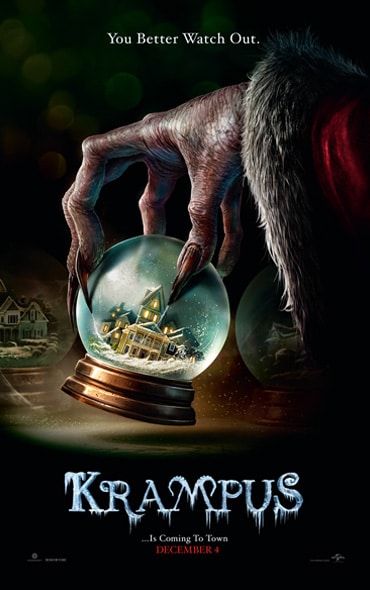 Krampus (2015) focuses on a picket-fence American nuclear family who are bracing themselves for the arrival of family for their traditional yearly attempt not to fall out with them spectacularly. Mother Sarah (Toni Collette) is anxiously ‘getting everything ready’, the children are bickering, and the only person who seems calm in the face of adversity is grandma, a woman who is signposted as GERMAN, definitely GERMAN, up to her elbows in Stollen from the moment she appears on screen and relentlessly speaking German even when people are responding to her in English (until she starts speaking English later in the film, but I digress). When Aunt Linda and the NRA-happy Uncle Howard finally rock up with their awful offspring, they’ve apparently brought the wise-cracking Aunt Dorothy with them without checking first – so there’s a houseful, and the cousins quickly settle down to mocking young Max (the phonetically-named Emjay Anthony) for his belief in Santa Claus. It’s all a bit much. In a temper, Max decides to tear up his letter to Santa and with it, all his altruistic requests for his family to just get on a bit better. No sooner has he done this, when a freak snowstorm lands, cutting off all the power to the local area. And that’s just for starters. Sucks to be the neighbours who presumably haven’t done anything to cause all of this, but it seems that supernatural forces are at work, systematically going from house to house to wreak havoc and picking off the family members one by one.
