DVD Review: Nina Forever (2015)

vlcsnap-2016-01-12-18h01m28s220

By Keri O’Shea

if genre film has taught us anything (and I think you’ll agree, it has) then we know that death needn’t be the end for that whole boy-meets-girl thing. It’s happened for years on our screens in a variety of different ways, from Return of the Living Dead III through to the rather flawed Burying the Ex and onto the subtle joys of Life After Beth. (Oddly, off the top of my head I can’t think of any films where the male love interest comes back from the dead, with his old character intact, to revisit a female partner, but I digress). Point here is, the basic premise behind Nina Forever was already familiar to many viewers before directors Ben and Chris Blaine decided to put their own spin on the idea. Happily, the story they weave out of these elements is anything but tried-and-tested, and a curious, sometimes challenging film emerges.

ninaWe start with what appears to be a death scene: a young man lies, awkwardly sprawled and motionless, across a main road, having just fallen from his motorbike. Here’s the first surprise the film has to offer – he isn’t dead, but he really wanted to be. Rob (Cian Barry) has just attempted suicide in the wake of the death of his beloved girlfriend Nina, who herself died in a traffic accident. All he wanted to do was to join her; he fails, however, and eventually returns to his humdrum job at a local supermarket, where he has attracted the attention of co-worker and paramedic student Holly (Abigail Hardingham). Where most people would tiptoe around the bereaved, Holly is actively interested by what she sees as Rob’s brooding intensity and dedication to his love; she fantasises about what it would be like to fuck someone like that. Life does after all go on, Holly’s clumsy attentions are rewarded and before too long, romance blossoms for this somewhat damaged pair of people.

At first, Holly finds Rob just as intense, but also sweet and self-conscious, as she seems to have hoped. It all seems to be going well and, like most new couples, they can’t keep their hands off each other. Sadly for them, that’s where things start getting …less rosy. See, no sooner are Holly and Rob finally going at it, but the deceased Nina – bloodied, broken, but unmistakably she – re-appears, tearing out of their conjugal bed to look decidedly unimpressed with this new state of affairs. Fully aware of her condition, Nina is quick to play with semantics and pointedly reminds Rob and Holly that she will, for all time, have an unassailable position: never really an ex, never really gone either. Sex seems to be the catalyst – as well generating as an early relationship obstacle par excellence – but with Nina turning up to bleed all over the sheets every time the couple get close, can they work out how to stop it?

It’s possible that you could watch this film and just take it on face value, accepting that a jealous revenant rocks up every time her boyfriend and his new squeeze get together and that this causes some decidedly British ‘difficult moments’. However, I think you’d have to talk yourself out of appreciating many of the film’s more charming and interesting aspects to do this, because for all the sex and gore (and these are pretty abundant, to be fair) it’s very difficult not to see the film on a much more symbolic level, and as such to see it as a much more clever film. Symbolism is definitely in there from the get-go, from the first time the couple share a quiet moment together and wind up sharing a pomegranate (Greek myths and legends anyone?) right through to the film’s brilliant, subtle verbal exchanges, albeit exchanges which chiefly occur between the two women.

And this is something which strikes me about the film – it’s very female-dominated. Whatever Rob’s initial appeal to Holly, his frisson of notoriety dissipates as the story progresses; it turns out he’s not all that brooding or unattainable, not really, whereas Nina is a truly unknown quantity, a woman – dead or alive – with power over the situation and its key players. The battle of wills between her and Holly goes a hell of a lot further than straightforward feminine jealousy, too. Nina Forever has hit upon a novel way to illustrate some fundamental human anxieties, giving the idea of the spectre of the ex-partner a very literal, ghastly form, but also placing it at an intersection, using it equally to explore the weight of grief upon people and how they act as a result. Nina embodies a great deal, and her continued presence stands in for different things at different times, a task which O’Shaughnessy shows herself more than equal to. However, Abigail Hardingham deserves much credit for her performance here: Holly is naive, young, but what’s going on in her head belies her exterior, and she grows ever more interesting as she clearly comes to terms with the implications of her own inferiority issues. So, hey, add a coming-of-age aspect to the list of themes on offer.

A film which contains such a mass of different aspects is always going to struggle in places, and indeed the way in which Holly and Rob initially deal with the appearance of a twisted corpse in their bed is a little more accepting than you might expect, but then again, these sequences have perversely funny aspects to them, too. A sharp, ascerbic comedy runs through the film like a seam, coming to the surface is some unexpected places. Add to all this impressive aesthetics, high production values and, to top things off, a thought-provoking conclusion, and it’s fair to say that the positives far outweigh anything else here.

I started this review by saying that mixing boy-meets-girl with macabre elements is nothing new, and perhaps it isn’t. Thankfully, however, Nina Forever shows that when filmmakers challenge themselves to do something different, they can see this through in some style – and remind us that grisly content never needs to get in the way of a compelling narrative, even if the grisly content is an integral part of the film.

Nina Forever is released on February 22nd 2016.

“Are They Records?” Horror Fandom and the Laserdisc Phenomenon

laserdisc

By Guest Contributor Marc Lissenburg

The above exasperating question was often put to horror fans around 20 years ago, when proudly displaying the latest additions to their film collections. The query arose due to less informed peers confusing analogue vinyl music (‘records’ as they were commonly known) with a groundbreaking digital development in domestic movie collecting. Sandwiched between the VHS tape boom of the 80s and the birth of DVD in the ‘noughties’, was a medium that was born, and effectively killed off, in the same decade. I am talking, of course, about the LASERDISC.

Laserdiscs, or LDs as they were commonly known, created a furore of excitement for film fans in the mid 1990s. The 12 inch, mirrored platters were notably superior in quality to their magnetic tape predecessors. The infamous VHS blur and hiss were superseded by, at the time, unprecedented pristine pictures and digital sound. ‘Home Cinema’ had started to evolve in 1995, and Dolby Surround Sound was all the rage. While all film enthusiasts benefited from this leap in technology, it was the UK horror community who had a few special reasons to embrace it…

With the BBFC keeping UK domestic horror releases on a short leash in the early 90s, the main source of owning uncut copies of gory epics were European video tapes. More often than not though, the tapes in circulation were copies, several generations old. Fuzzy ‘pan & scan’ reproductions, hard-coded Dutch subtitles and a muffled soundtrack was the tithe for owning that elusive uncut version. But LDs changed all of that. The swift side step of the censor’s scissors with internationally-imported discs meant horror fans didn’t have to fret over the BBFC’s frigid attitude.

Although their picture quality nowadays leans ironically more toward VHS, they were a significant stepping stone toward the cutting edge Blu-Ray discs that horror fans have grown accustomed to today. Gone was the mere bleary insinuation of blood-drenched special effects. Tom Savini’s amazing work on William Lustig’s Maniac with his ‘shot gun blast to the head scene’ was vicious enough on hazy videotape. But, when watched digitally, the clarity of blood, skull and brain drifting across the screen had a supreme lucidity about it that had never been witnessed domestically before. This was just one example of how new life had been infused into depraved scenes of death. And it wasn’t simply the improved visual quality that endeared LDs to horror aficionados. It was the accurate presentation as well. Anamorphic, letterboxed prints in the director’s original aspect ratio that are taken for granted today, gave purists the opportunity to watch organic renditions of movies delivered from the silver screen onto the cathode tube for the first time.

Lest not forget the impact that the sonic improvements of LDs made either. The irritating hum of videotape that impeded a movie’s ambience as was finally overcome. The squelch and crack as intestines were munched on and skulls were crushed, suddenly had a newfound intelligibility about them. Never before had the award-winning resonance of Regan’s demonic aural onslaught in ‘The Exorcist’ sounded so disturbing. As the possessed child’s churlish blasphemy flitted from speaker to speaker, wallpaper nationwide would almost peel in fear!

Whilst the multitude of benefits to owning LDs was obvious, the means of obtaining them were not. Before the dawn of e-purchases had broken, acquiring these much sought-after treasures was far more complicated than simply clicking your computer’s mouse a few times. One method was through specialist mail order companies. Companies, such as the France-based Laser Enterprises, would use airmail instead of email to get their latest catalogue to you. An austere black and white photocopied document contained typed descriptions of their wares. It ultimately meant you rarely got to see the cover artwork of the LD until it actually arrived.

Although a good source for uncensored discs, the arrangement was not without its obstacles. Shipping costs were high due to the fragility of the items. The perilous journey via airlines and courier vans meant there was always a chance the condition of your LD could be compromised before it even reached the confines of your laserdisc player. Then, the lurking threat of UK Customs and Excise seizing a foreign disc once on these shores was yet another complication. True, the area of law concerning importing laserdiscs was a grey one, but with overseas editions retailing in excess of £50, buying from abroad was still a little risky.

Who could forget the tension we had to endure of waiting for our airmailed package to arrive? It was almost on a par with Argento’s finest moments on celluloid! Even if you were fortunate enough to be home when the disc eventually got there, a further haggle usually transpired at your front door. Trying to assess any damage to the package before signing for it, pitted against the courier’s reluctance to hand it to you before ascertaining your signature, was all part of the ‘fun’!

bbfcA much safer way of procuring these scarcities was at film fairs up and down the country. Leisure centres nationwide would play host to these assemblages of horror devotees, looking to buy or sell macabre memorabilia. Traders would display their merchandise with a little round “BBFC 18” sticker placed on the outer cellophane of its packaging. The gesture seemed enough to give them a dubious licence to sell imports. How much knowledge Trading Standards possessed regarding the Laserdiscs country of origin was unclear, but with pirate tapes being the main focus of the odd raid, the little red dot (probably also bootlegged!) clinging to the wrapping seemed to suffice.

An obvious advantage of film fairs was being able to actually see what you were purchasing. The cost of this convenience, however, was, well… the price. Discs at fairs would start at £60 and spiral upwards, depending on the rarity. At a time when internet fan forums were not yet in vogue, and a feedback system was unheard of, there was an utter reliance upon the scruples of the seller. A dear friend paid £140 for the Japanese uncut LD of Flesh for Frankenstein: upon getting it home, he was given a harsh lesson in Japan’s attitude to pubic hair on film. Although no cuts were made to the movie, it was, in effect, censored with the offending furry regions blurred out.

Those unfamiliar with laserdiscs may be interested to know that, regardless of the generous surface area, the actual playing time per side was limited to around 60 minutes in CLV (Constant Linear Velocity) format. This meant the cumbersome platter had to be flipped over manually every hour or so. While the awkward nature of LDs didn’t help with the atmospheric continuity of a film, it did allow for some extravagant packaging. Glossy, full colour covers dwarfed the paper VHS counterparts, allowing for more macabre artwork to be displayed. These soon evolved into lavish gatefold sleeves which doubled its canvas even further. The EC Entertainment release of Fulci’s CITY OF THE LIVING DEAD, for example, unfolded to reveal a vibrant photo of Giovanni Lombardo Radice’s Bob character meeting his classic demise courtesy of the infamous ‘drill through the temple’ scene in all its gory glory. The decorative casing still remains a major factor for LDs retaining their place in many a horror enthusiast’s collections.

We take for granted the ability of being able to pause a movie and step it forward frame by frame. But with LD technology, this was only possible if it was a standard play CAV (Constant Angular Velocity) disc. You could still pause a CLV disc, but instead of a frozen picture, the viewer was left with a blank gaudy blue screen. The technological advantages of CAV were counterbalanced by the fact it was limited to a paltry 30 minutes per side. With this multiple disc quandary in mind, distributors soon slashed a new niche into the LD market – luxurious collector edition box sets.

hellraiser laserdiscClive Barker’s classic Hellraiser got the deluxe box set treatment seven years after its theatrical debut when released by Lumivision. Limited to 2500 pressings worldwide, the double disc set offered a re-mastered transfer in its original aspect ratio of 1.85:1. With the aforementioned CLV and CAV formats cleverly employed, it meant the gruesome culmination of Frank being hooked and ripped apart could be devoured frame by frame. The concept of ‘extras’ was an innovative one at the time, so the deleted scenes, interviews and audio commentary by Mr Barker also significantly added to its appeal.

The discs were housed in a sumptuous gatefold sleeve, which naturally had Doug Bradley’s Pinhead sinisterly gracing the cover. Opening the plush sleeve revealed some opulent rare art of the demonic Cenobites adorning its inner fold. Remove the exuberant sleeve from its plastic casing and a bound original screenplay, signed by Clive Barker himself, was revealed. The whole ensemble was contained in a sable, 2 inch wide, vinyl coated box. Its façade had an indented depiction of Pinhead, uncoloured but for the silver pins protruding from his skull, along with the movie title emblazoned across the top in lustrous red lettering. Although retailing at a staggering £90 upon release, it remains an arduous task trying to prove this morbid assemblage is not worth every penny!

evil dead laserdiscThe advancement of technology means Laserdisc players appear more redundant then ever these days. But while Dominoes Pizza et all did a roaring trade as pizza boxes were recycled as LD packaging for Ebay sales, horror fans by and large held on to the gems of their collections. How foolish it would be to part with the exclusive red pressing of the uncut Evil Dead 2? And who was heartless enough to flog their copy of Cannibal Ferox that, was not only gorgeously presented, but also had enclosed a 7 inch vinyl record containing the soundtrack and tongue in cheek ‘vomit bag’!

Gimmicks aside, there were some features that even to this day are exclusive to their LD formats. The Italian based Cult Epics release of Deodato’s infamous Cannibal Holocaust, for example, had an isolated analogue soundtrack, which retained all the music but was devoid of any dialogue. Regardless of the numerous DVD editions that have materialized over the years, the isolated soundtrack has never featured on any of them. The special edition of George Romero’s masterpiece Dawn of the Dead is another instance. It contains a rare director’s audio commentary that, again, has failed to appear in any of its recent releases.

Despite all the advancements of deathly digital delights from the aforementioned era, decomposing corpses were interestingly not the most frightening thing about preserved LD collections. The threat of ‘laser rot’, due to poor quality adhesive being used in manufacturing older discs, looms over fans’ precious compilations to this day.

Given the ongoing innovations in technology continually revitalizing cherished classic horror films, it is highly debatable as to whether anyone actually watches their old LD wares or simply delves into them to admire the sumptuous artwork. A distinct retro romanticism surrounds the VHS tape, however, with Laserdiscs perceived as more ‘old hat’ then Freddie Kruger’s Fedora. But just think forward a few years. When we are enjoying a Fulci classic play out in the centre of our living room in its new holographic format, will our children ask of a Blu-ray disc, “Is it a drinks coaster?”

2015 in Film: Keri’s Pick of the Bunch

deathgasmm

By Keri O’Shea

My god, this year has flown by, and once again I find myself pondering what I most and least liked in the year which is death-rattling as I type – with the usual proviso that I haven’t even seen all of the films I was most interested to see, for the usual reasons (buy me a beer and let me bore you to death with my tales of a 50 hour working week; ah go on. It’s Christmas.)

Still, I’m not sure how useful a regular Top 10 or even a Top 5 would be, from my point of view, so I’m not going to write one in a conventional sense this year. Truth be told, I only ever cast my eye over other people’s film lists, of which there are always so many by now, so my engagement with them is limited at best; if a writer has named a movie I haven’t yet seen, I feel like I have to skip their rundown because I don’t want to have the entire film summed up beforehand; if they’ve overlapped with a film I also loved, then great, but it smacks of preaching to the choir; if they’ve listed a film I hated, or just merely gone through the rinse, repeat of (as a relevant example this year) ‘Mad Max: Fury Road/feminist statement/high time’ then I’ve already read those articles, and worse still, seen the memes; I quite liked the film, but I don’t need to see any more, thanks.

For all that preamble, you’ve guessed it – I am now going to segue into my, albeit rather arbitrary pick of the bunch. But I’ve gone for noteable features of the films in question, rather than rehashing reviews I or others on the team may have written already (though links to these will be added). I’ve also endeavoured to do this without – and here comes that word – spoilering the films, either, as although the online reactions to seeing plot details revealed can be …excessive, it is also bloody annoying, and is best avoided if possible.

Here goes…

Best performance – Henry Rollins – HE NEVER DIED

rollins-never-died

I had the real privilege of going into this film knowing nothing whatsoever about it except that Rollins was in it; no clues on the plot, or the genre, or anything. But, as Ben noted at the time in his Celluloid Screams review seeing the name ‘Henry Rollins’ attached to a project doesn’t instantly make you think that you are going to get a sterling performance, as his roles up until this point have been variable to say the least. Still, whilst I don’t always agree with Rollins on a personal level, I am a fan of his music and his stand-up; the perfect role for him could still be out there, I thought. Well, it was, and turns out it’s this one.

Admittedly, one of the reasons could be that – as when Courtney Love played Althea Leasure – the role wasn’t a massive stretch, at least at the outset. Rollins plays Jack, a somewhat grizzled, middle-age man who tends towards the terse; not only does he not suffer fools gladly, but he seems to swat other humans away, barely engaging with them at all beyond what is strictly necessary. He has his life, his apartment, his isolation, his…bingo; nothing else seems to move him. However, as the film progresses, Jack is forced to re-integrate himself into humanity thanks to a drama which has the audacity to begin playing out around him, and for reasons close to home. Jack is one of those great characters in film which simultaneously hold you at arm’s length, yet convince you of a fascinating inner life – and when this is finally revealed, it’s a real tour de force, a credit to director Jason Krawczyk and to the excellent casting choice he made in Rollins. I know, I know I said I wasn’t going to do this, but were I to nominate my film of the year, this’d be it.

Most (Un-)Pleasant Surprise: The Interior

TheInterior

It’s a sad fact that, when you write about film on a regular basis, what starts out as a fun hobby can begin to feel like a chore. I’m sure we’ve all felt it. Whilst it’s decent of filmmakers and distribution companies to keep on proffering new releases to humble websites like ours, it’s still the case that, once you’ve spent several weeks sitting through what essentially feels like the same found footage movie (deja-vu is an occupational hazard), it takes the shine off. So, when I sat down to watch The Interior, to be honest I’d been through a run of screeners which weren’t to my tastes, and my initial impression was that The Interior was going to be a slightly jarring attempt at black comedy, and not to my taste either. True enough, there is some errant humour in the early scenes, but then the film manages so successfully to break away from this, crafting something completely different, that it’s hard to reconcile the two approaches. I say this, I hope, in a complimentary way.

This film manages to take a symbolic approach to its subject matter without carving it in foot-high letters, achieves frankly horrific scares without the obligatory jump-cuts, and weaves a very claustrophobic, uncanny tale out of elements you can be forgiven for supposing would be turned to different, less successful uses. In essence, this turns out to be a truly unsettling, unconventional horror tale; finding films like The Interior is, in a nutshell, exactly why I go on reviewing. You can check out my full review here.

Most Laughs: Deathgasm

deathgasm-1024x636

The more I reflect on it, the more I think Deathgasm is one of the most successfully funny films I’ve seen since Tucker and Dale vs. Evil. I used to give horror comedies a hard time, and rightfully so in many instances, but it’s often good to be proved wrong and there have been some really good films along in the past few years. Deathgasm is simply glorious: as I commented in my full review, it doesn’t come across as a sneering outsider picking a non-mainstream culture and getting the gags wrong because the basic premise is all off; it’s got a bit of love for metal, rather, and it’s that which makes it funny, as it goes from ‘plausible kids’ through to ‘long-rumoured occult links made flesh’ before threatening the end of mankind via copious blood splatter and dildos as deadly weapons. I mean, do I really need to say anything else here? I laughed out loud throughout this film, and you’ll be hard-pressed not to yourselves. Roll on the sequel.

Best atmosphere: The Witch

Witch

Ah, a completely different take on occult horror, then. I will have far more to say on The Witch in the weeks to come; for now, I think it’s a noteworthy film in several of its aspects, not least of which how it boasts of its meticulously-researched basis in the real-life accounts and trials of alleged witches, from the time in which the film is set and earlier. The way it combines this kind of attention to detail with such a slow-burn tale, careful characterisation and a remarkably ambiguous, and thus effective spin on the occultism possibly at play in the New World makes it one of the stand-out films of 2015. These very qualities, sadly, will probably make it a tough sell for the mainstream market, which is exactly where the makers/distributors seem to want it to thrive. For reasons such as this, you get decisions like the disastrous, misleading poster art which Ben discussed earlier in the week – promising titillation, where you’d be hard-pressed to find any. I suppose we should be grateful we don’t see Thomasin re-cast as a thirty year old being dragged backwards down a subway by Black Philip.

Still, let them reap what they sow, if they can grow it at all. The rest of us can appreciate the sheer dread which permeates each frame of this film, that sense of the inescapable, crowding out what is essentially a loving family trying to make their way in a harsh new environment. I think it’s important that the family do care about one another here, and try to resist the series of misfortunes which slowly blight their home and their land; it makes the events which ensue all the more awful, and by degrees strips the potency out of the religion they adhere to. After all, where’s the interest in seeing the already corrupt, corrupted? Ultimately a psychological horror which deserves better than to collapse under the weight of expectations now attached to it, The Witch is absolutely gripping, and you should check out Ben’s words on it before doing your best to see it early, when it gets a full release in February 2016.

Blu-ray Review: Nekromantik 2 (1991)

nekromantik-2

By Keri O’Shea

It’s perhaps something of a surprise that there’s a sequel to one of the most notorious horror flicks of the 80s, but nonetheless, after a hiatus of a few years, during which interim director Jörg Buttgereit made Der Todesking (another deeply morbid piece of work), Nekromantik got a second chapter. In fact, we start where we left off, with the anguished main character of the first film, Rob, in his death throes – with the film flitting from a sombre black and white right back into lurid colour as he dies on screen, again. So much for him, you might think, but it ain’t over yet. After all – what could be more fitting, for a man of Rob’s tastes, than to be dug back up and given the same treatment he and his erstwhile girlfriend Betty gave to the dead? Before we see that she’s armed with the tools for the job, we might be able to guess that the young woman entering the cemetery (Monika M.) isn’t just there to leave flowers. She digs Rob up, and – somehow – takes him back to her own apartment. There’s no wire around the bed this time, but nurse Monika’s unusual predilections are quite clear, given her decor…

nekromantik2So far, so familiar, but despite being another exploration of a person who is respectable enough by day yet has the sort of secret sexual mores that would get you locked up, Nekromantik 2 is quite different in the way it plays out. In the first film, we have a relationship (between Betty and Rob) which is seemingly all pinned on her aberrant tastes, and his success – or failure – to please her. It is Betty’s exit which precipitates the worst of Rob’s excesses afterwards. In the sequel however, Monika’s struggle is between her obviously unorthodox desire for the dead, and her new (living) boyfriend Mark (Mark Reeder), a man she seems rather fond of. Much of the film follows their developing romance; as things progress, Monika finds it more and more difficult to stop her nefarious activities spilling over into everyday life. It’s by no means a dialogue-heavy venture, this film, nor is it a character study in any conventional sense, but it’s definitely far more about the inner life of a young woman who seems, to all intents and purposes, respectable. There’s a broader sense of place and time here, perhaps because Buttgereit knew he’d achieved a lot of the shocks possible via the subject matter in the first film – so that it made sense to explore things differently.
Of course, this is still a film about necrophilia, and it’s still a Buttgereit movie. We have ample material which repels and disturbs here, perhaps even more so in places than in the first film. As such, these films are never going to be for everybody, and I’d add that they’ll not be to the tastes of most horror fans either (I commented during my review of Nekromantik that I have no wish to see real-life footage of animal slaughter in horror cinema and that is equally true here, where it occurs again – even if I understand why it’s there). This certainly isn’t Weekend at Bernies with some boobs thrown in. That unseemly vibe from the first film is definitely present and correct here, then, alongside the lo-fi appearance which looks part illicit footage, part home movie, and practical effects which are simple, but very good: Rob ‘past his best’ is a horrible thing to look at, for example, and yet a lot of that is via the simple fact of the flesh appearing wet, clammy. Many of the scenes in Nekromantik 2 are grisly, unconventional and protracted along these lines; the soundscape is hectic and the overall feel of the film is unpleasant. Add to that some exceedingly outré sequences, such as the art film which consists of naked people talking ornithology, and you may find yourself asking a few questions at the end. As I say, these films are never going to appeal to everyone; it would be a strange world if they did.

For all that, I did find Nekromantik 2 a compelling watch and in many ways, it’s a striking piece of indie cinema, very much part of a scene where you made up your own rules and found your own ways of achieving what you wanted to achieve. I probably wouldn’t put it on if I wanted to feel better about the world, but it’s a worthwhile continuation of a strange, challenging sequence of films nonetheless. This Arrow release is loaded with extra features, too, many of which shed new light on the making of the film and would certainly be of interest to the more dedicated viewer…

Nekromantik 2 is available from Arrow Films now.

Film Review: Krampus (2015)

By Keri O’Shea

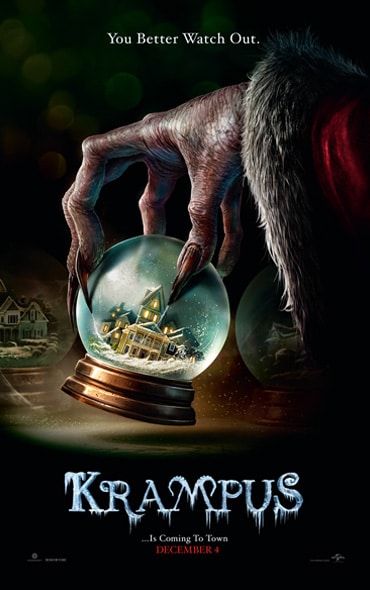
Whilst horror films which centre around Xmas time are nothing new, in the past few years more and more filmmakers have started to pay attention to Xmas folklore: films such as Rare Exports (2010) had fun playing with the idea that Santa isn’t necessarily the sanitised, commercialised figure we now consider him to be; ditto the Dutch spin on Saint Nick as a bit of a bad ‘un, Sint (‘Saint’) which came out in the same year. It was surely only a matter of time before the figure of the Krampus got his own stint on our screens; after all, if you’re going to the trouble of representing the good guy as a bad guy, then why not use source material which has the bad guy already good to go? The Krampus is a scary looking figure: probably harking back to pre-Christian times in some way, shape or form, Germanic traditions pitch him as a cloven-footed, nasty piece of work who punishes wicked children (and young women, particularly – some of his incarnations are a little sexual in nature). Over the years he came to be associated with Christmas and Saint Nicholas, operating as the bad cop to his good cop; where the good children receive presents, bad children may end up faced with the Krampus instead, and varying accounts have him offering a piece of coal in lieu of a gift, thrashing the offending kids or even spiriting them away. Whatever it takes to get the entitled little shits to behave, quite frankly, but you have to admit the Krampus has an arresting image; of late, a fair few filmmakers have agreed, not least of which is Trick ‘r Treat director Michael Dougherty. I didn’t cotton on to this connection until I was on my way to see the film, quite honestly, but having loved Trick ‘r Treat I was quietly hopeful.

Krampus (2015) focuses on a picket-fence American nuclear family who are bracing themselves for the arrival of family for their traditional yearly attempt not to fall out with them spectacularly. Mother Sarah (Toni Collette) is anxiously ‘getting everything ready’, the children are bickering, and the only person who seems calm in the face of adversity is grandma, a woman who is signposted as GERMAN, definitely GERMAN, up to her elbows in Stollen from the moment she appears on screen and relentlessly speaking German even when people are responding to her in English (until she starts speaking English later in the film, but I digress). When Aunt Linda and the NRA-happy Uncle Howard finally rock up with their awful offspring, they’ve apparently brought the wise-cracking Aunt Dorothy with them without checking first – so there’s a houseful, and the cousins quickly settle down to mocking young Max (the phonetically-named Emjay Anthony) for his belief in Santa Claus. It’s all a bit much. In a temper, Max decides to tear up his letter to Santa and with it, all his altruistic requests for his family to just get on a bit better. No sooner has he done this, when a freak snowstorm lands, cutting off all the power to the local area. And that’s just for starters. Sucks to be the neighbours who presumably haven’t done anything to cause all of this, but it seems that supernatural forces are at work, systematically going from house to house to wreak havoc and picking off the family members one by one.

There is some good stuff going on here, with the early glimpses of the Krampus itself amongst the film’s strongest moments (less is definitely more) but by and large, Krampus is tonally all over the place. Kicking off along the lines of a National Lampoon style farce with a slow-mo fight at the local sales, the comedy approach dips when we get indoors and bear witness to the deeply awkward family exchanges, then it picks up again, then gives way to some pretty saccharin moments where an earnest little boy ponders the true spirit of Christmas. So far, so patchy. From here, the film tries to shift into what the BBFC would probably call ‘scenes of peril’; it starts reasonably well with this, with the alluded-to early scene as a high point, but then it seems like it wants to segue into the sort of camp, grisly fare beloved of films like Gremlins.

Still, though, it can’t quite commit itself to that either. The barrage of nasty gingerbread men and evil toys which provide nearly all of the ‘scenes of peril’ throughout the film – a strange choice, all told, given the title – are omnipotent in some cases and not much more than a bit of a nuisance in others, and the characters react to them differently every time (with some members of the family simply standing there as onlookers in some scenes). Then the film is bloodless enough to make it as a kiddie horror film, but lacks other elements which would qualify – but it’s just too kitsch and simplistic to really stand up as a horror film, or indeed a film which would appeal to an audience of adults. Hmm. And then there’s the figure of the Krampus himself. Having picked up on the association of the Krampus with Santa as Santa’s ‘dark half’, Dougherty has simply represented him as a dark Santa, which was a little underwhelming – especially as when the end credits roll, we’re treated to a plethora of old images of the Krampus, all of which would have made for more engrossing versions of the figure than the one we get.

For all of that, despite the issues, I did laugh a fair few times during this film. Any film which keeps up the momentum in terms of throwing silly creatures at you stands a good chance of being engaging, and the creature effects themselves are pretty good fun. For a Saturday night movie which raises questions that it doesn’t really matter go unanswered, Krampus fits the bill just fine, and it certainly looks the part as a festive film. However, given that the tone and the storytelling is rather lacking, I’d say a really good Krampus movie remains to be made, which is a shame, given the proven calibre of this film’s director.

Krampus (2015) is in UK cinemas now.

Film Review: Deathgasm (2015)


By Keri O’Shea

Although it’s hardly the first musical genre to bear the association, you have to admit that the relationship between heavy metal and black magic is a strong one. Forget your Stryper and your POD; we all know that these bands are basically aberrations in a pleasingly-familiar landscape of devils, witches and caco-daemons. What else would you want from a genre that’s so beloved out of outsiders? Bizarrely, though, despite the fact that more bands than you can count will quite openly pay homage to Old Scratch in their lyrics, merchandise, imagery and interviews, metal has always been dogged by the sort of people who overlook all of this to look for hidden messages of evil. It’s the obvious thing to do, after all; never mind what the lyrics say when you play them forwards – let’s focus on what they clearly don’t say when you play ’em backwards! This idea of covert Satanism has jogged alongside the musical genre since the 1980s, and along the way it’s given us some fun horror cinema. Perhaps most notably to my mind, 1986’s Trick or Treat neatly combined paranoia about metal musicians, strands of the occult and a boy coming of age under extreme duress. It’s an obvious comparison to make to this year’s terrific Deathgasm (2015), but I think for me the newer film has the clear edge, simply because it has the nerve to play out so joyously. It sends metal up as only someone who really gets metal could do – namely by laughing with metal, not at metal.

deathgasm-posterTeenager Brodie (Milo Cawthorne) is a metalhead; he’s also just had to move in with his very sour, very religious aunt and uncle, and his obnoxious bully of a cousin after his mother got herself…in trouble, shall we say. For him it’s so far, so bad; adding to this, he gets a hard time at school and gets forced to play D&D with his only friends Dion and Giles at lunchtime. It’s only when he meets Zakk (spelled with two Ks, of course) at the local record shop that things begin to turn around for him. Zakk (James Blake) is a confirmed dickhead, but his musical tastes are impeccable and he offers the rest of the guys the opportunity to form a band at last – the eponymous Deathgasm of the title, and only one of the list of suggested band names mentioned during this film which both a) made me laugh out loud and b) sounded precisely as if I probably already own them. Deathgasm could have gone on as a garage band from this point onwards and caused no harm to anyone, then; Brodie could have pined for the lovely Medina (Kimberley Crossman) and life could have rolled on. It could have, were it not for the fact that Zakk finds out, via a local ‘zine, that one of their mutual heroes from a band called Hexensword has actually resurfaced – as luck would have it, very near to where they live. The best course of action? A fan letter? Hanging around, hoping for a sighting? Nah. Instead Zakk encourages Brodie to join him in breaking into the home of the erstwhile Rikki Daggers (yes, two Ks again) before attempting to steal a rare slab of Hexensword vinyl from his grasp; they fail somewhat, but escape with a strange collection of antique pages – pages which contain music, music which is seemingly being sought by a strange group of occultists, who have been trying to trace Daggers for years. In the meantime, however, Deathgasm of course play the music they’ve discovered…

Doing just enough to craft believable, funny characters with a spot-on script and great pace before pitching them into a maelstrom of blood splatter and demonic possession, not to mention making succinct fun of the association between metal and the occult, this is the most fun I’ve had with a film in a long while. I’d hazard a guess that this is because director Jason Lei Howden and his team had at least as much fun making it. The whole project just beams, every time it gets away with yet another savage SFX take or a deadpan line (or quite often, both in one fell swoop). Howden has some serious credentials as a filmmaking professional, but this is his first feature-length movie, and even as a complete stranger I can almost hear that thought process which goes ‘This is my film, and I’m going to do all the things I’ve been itching to do for years’. Speaking of those SFX skills, Deathgasm will certainly win favour with many genre fans who love to see practical effects rather than a lot of CGI-by-default; I think there’s room for a little of the latter, personally, but the film certainly looks good in red.

There do seem to be some clear inspirations for the film. To name just a notable couple, the possessions here – jerky movements, shrill voices, rapid physical decay – are strongly reminiscent of Sam Raimi at his best (ahem, Evil Dead II) and the sheer levels of gore involved remind me of Peter Jackson, back before he made that mind-boggling leap from lo-fi vomit-drinking to red carpets and Oscars. All in all, though, despite its lineage, Deathgasm is very much its own film too. It always feels affectionate towards the music it’s sending up; this is vital. Metal fans have never minded a laugh and we will readily laugh at one another (by the way, nice homage to an Immortal video in the Deathgasm promo!) but I think, generally, we don’t want to be mocked by someone who has no knowledge or interest in metal, because the jokes are always hackneyed and shit. A real sense of warmth prevents that from being the case here, and helps allow for a balance between human interest – yes, really – and high action, so even if you don’t laugh at the Manowar reference, then you’ll find plenty else to laugh about.

Abertoir 2015 Review: Fatal Frame (2014)

fatal-frame-the-movie

By Keri O’Shea

It’s so often the case that, when I sit down to watch a Japanese film, I find that it’s based on an extensive manga and/or gaming series of which I have no knowledge whatsoever. It’s been the case with filmmakers I know reasonably well – such as Takashi Miike (or at least as well as Western audiences can keep up with the extent of what he’s up to, anyway) – and also with filmmakers whose work is unfamiliar to me altogether, such as the director of Fatal Frame, Mari Asato. Whilst Mari made the possibly-recognisable Ju-on: Black Ghost five years prior to Fatal Frame, I confess it never appealed. The original Ju-on is a masterpiece of its kind, but many of its elements – along with those of the Ring movies – quickly set the precedent for pastiche, with long-haired girl ghosts soon losing their capacity to shock.

Fatal Frame is, first and foremost, a pleasant surprise in that it’s a supernatural movie, but it altogether omits the dreaded long-haired children leaping out on its protagonists. In fact, this film’s spin on the supernatural is mysterious throughout, as it appears to all intents and purposes that one of the living is somehow haunting the living (though this turns out to be the basis for a twist in the tale). This film is also well-constructed enough to present its – admittedly gentle – terrors with ne’er a jump scare nor a hideous-sudden-violin-screech necessary, making it a pleasantly subtle little yarn, avoiding many of the pitfalls which seem to be on the must-do checklist for so many directors in the East and the West. So far, so welcome – and there are other commendable aspects, too.

For one, if I said that the film is set in a Catholic all girl’s school, a school run by nuns no less, and that the girls at the school are mysteriously afflicted by haunting and disappearance via a lesbian crush followed by a kiss, then you’d probably raise an eyebrow and assume that this is nothing more than exploitation fare. Whilst Japan has in the past certainly managed to merge highbrow aesthetics with exploitation elements (see School of the Holy Beast for a stunning example of this), Fatal Frame never crosses into exploitation at all – which is something rather extraordinary, really. In fact, it’s all oddly innocent and – here’s a word I rarely say – sweet, with blossoming crushes between the girls more about coming of age and the delineation of friendship from romance than about sex. And there’s another positive aspect – a film about young girls, from their perspective, in which they are not vixens, victims or dupes. Imagine that!

fatal-frame-movie-posterThe plot took a while to settle with me (perhaps because it references a fictional world I never encountered until the film itself) but in a nutshell, the oddly Ophelia-fixated girls’ school attended by Michi (Aoi Morikawa) and her peers is turned upside down by the increasing withdrawal, and then disappearance of the popular but enigmatic Aya (Ayami Nakajô). Aya hasn’t left the school, though, only closed herself off – locking herself in her room and refusing to come out. We the audience know that a disturbing dream is behind her behaviour, but the other girls don’t, not yet. However, they begin to see what appears to be Aya, stalking quietly through the corridors, or occasionally speaking to them, imploring them to ‘lift her curse’. Rumours soon abound that, as in years past, the school is now indeed subject to a curse which affects only girls, a curse linked to a kiss – and as many of the girls seem to have been in love with Aya, they begin to fear her spectral influence, her efforts to draw them close to a photograph of her, and the evidence that bestowing a kiss on it will lead to their disappearance.

Michi, as her friends begin to vanish one by one, strives to get to the bottom of the mystery. Meanwhile Aya – finally compelled to leave her room – joins with Michi, and they learn that Aya’s dream, the photograph and the curse are all closely linked.

Whilst the plot exposition which then takes place can be congratulated in many ways for maintaining the steady, slow-burn approach that characterises the hauntings throughout Fatal Frame, it’s probably safe to say that the final elements of the story could have been reined in – particularly in the last half an hour or so, in which things tend towards the ponderous. So, some of the momentum is lost in the end; that said, considering the fact that the film tries so diligently to build then to maintain atmosphere, advancing anything else at this late stage could have been problematic.

For the most part, this is actually an engaging story which kept me intrigued. Aya and Michi’s burgeoning friendship is underpinned by risk and fear, sure, but it is their believability which makes all of this work rather well. The performances are solid and sensitive by turns, and my word, does Mari Asato have an eye for framing a beautiful shot: the scene with the pond full of water-lilies is amazing, for example, but then there’s an abundance of more conventionally creepy locations too. Essentially, there’s evidence of crafting here, and it all makes you feel as if you’re in the company of someone who gets the horror tradition without being a slave to the norm.

So – a ghost story which doesn’t follow convention, a range of female characters who don’t either, shot against an aesthetically-pleasing array of backgrounds and interiors, with noteworthy sound design and moments of deft originality. Yes, there are a few plodding moments at the end, but overall Fatal Frame is an impressive piece of work. I may not be familiar with the novel which inspired the game which created the franchise which led to this film, but it doesn’t seem to matter, nor to take away from the pleasant surprise which Fatal Frame offers.

Celluloid Screams 2015 Review: These Final Hours (2013)

By Keri O’Shea

The question ‘what would you do if you only had hours to live?’ is one that we’ve probably all considered at some point; of course, the world ends for individuals all the time, but in terms of some grand event, whether it’s the four-minute warning (alright, that’s shorter still), the biblical apocalypse or that ol’ favourite the zombie outbreak – whatever the imagined cause might be, however likely it might be, people often like to ponder how they’d behave. These Final Hours doesn’t, actually, opt for any of the above potential reasons for the planet as a whole to check out, but it spends its time on that question nonetheless. Whilst the outcome for the main protagonists doesn’t go in for shocks, neither does the film amble down a Hollywood blockbuster route which has set outcomes and box-ticking, which makes for an altogether more engaging story. I suppose you could say that this film does exactly what it says on the tin, albeit crafting a story and characters that are never boring, whilst showing some flair and ingenuity in its (just) pre-apocalyptic vision along the way too.

The sight of an asteroid roaring down to Earth in the opening scenes tells us all we need to know about the oncoming disaster overtaking the planet. Via a droll, matter-of-fact radio commentator (who acts like a voiceover in some respects) we learn that in just twelve hours, Australia will be destroyed – like most of the rest of the world has already. No possibilities of being saved, no governmental procedure, no evacuation plans, nothing – only a planet which is about to be, as a character later has it, ‘peeled’ when the resultant wall of fire hits. In one of the film’s best decisions, however, this hasn’t led to absolute anarchy on the streets. Certainly, things are strange. The religious folk cluster in small groups awaiting Heaven, those who can’t face what is coming have taken their lives and the decadent are doing whatever they want, but what you mostly notice about the streets is that they’re eerily quiet – which makes the odd, unexpected incursion more shocking.

About to navigate these strange streets is James (Nathan Phillips of Wolf Creek). Refusing to stay put with his girlfriend and await what’s coming, his big plan’s to see out the end of the world at a massive party being hosted by some friends. She wants to enjoy the view of flames rolling over the sea; he fears his inevitable death will be painful, and yearns for something to take the edge off. In the end, and as many might in his situation, James puts himself first, getting into his car and driving away. The journey’s a nightmare; whilst there aren’t crowds to contend with, it only takes one unhinged guy with a weapon to put a crimp in your day, so James can’t take the direct route – and along the road he ends up on, he sees a group of men kidnapping a little girl. Hedonist he may be, but James can’t let this happen and rescues her from what seems to be pair of paedophiles getting their last kicks now that the world has looked the other way for the last time. The girl, Rose (Angourie Rice) is disorientated and scared, but pleads with James to help her find her dad, as they’d gotten separated but swore to one another that they’d be together at the end. James’s conscience gets the better of him. They leave together.

In the wrong hands, this could have been the recipe for a cloying, tedious tale of boundless sentimentality; that whole idea of a child bringing out the best in someone during a crisis has of course been done and done horribly on screen, repulsing any hope of veracity or emotional realism simply to ‘aahhhhh’ at a kid, before landing us with a contrived happy ending because nothing bad is allowed to happen to children in filmland. Full credit to director Zak Hilditch for avoiding these pitfalls. Firstly, James as a character isn’t transformed as if by magic by the presence of a little girl, and he actively rails against his new role as a protector in ways which feel legit and understandable, given that we as an audience are first being asked to accept him as a certain type of person. Secondly, the casting of Angourie Rice is spot on; at no point does she turn out to be saccharin; she acts her part believably and grows as a character rather than being a plot device and nothing more complex. Her relationship with the man who has saved her from who only knows what agony, at least in the short term, is an organic one and you can appreciate them each growing to depend on the other as the story progresses. Thirdly, and perhaps most importantly, because Rose is permitted to be a proper character, we have so much more invested in our main characters as a whole. That lack of sentimentality is rewarded.

In keeping with this, Hilditch’s boldness in sticking to his guns is rewarded with a tale which is at times hard to watch, though ultimately redemptive; that isn’t because it ducks out of its plot line to save the great and the good, but rather the opposite. The bunker scene, for instance, is used brilliantly to reject what would otherwise be an orthodox get-out-clause for the plot. By this stage in the game, James laughs at his friends’ stupidity; he’s growing and changing as a person. Whilst you can’t blame those who have found their own solutions to their fears, be they mindless drug binges or the ‘sure and certain hope of the Resurrection’, James is always interesting to watch because of the subtle way he alters during the course of the narrative – and it’s a pleasure to see Nathan Phillips showing how well he can act in this challenging role which does a lot more for him than some of his recent work. At times, his and Rose’s trip together can feel repetitive because a lot of people have found the same way out (cue lots of instances of people turning up already dead) but what happens to them matters, which make the closing scenes of this film – and each of their scenes – absolutely standalone.

These Final Hours may not really be a horror film but it’s undeniably bleak, accomplished and well-made. End of the world movies are nothing new, sure, but this is a very polished example indeed, with good performances and the courage of its convictions, a film where the apocalypse itself is the context for considering some very human questions and needs against a striking backdrop of burgeoning chaos. Again, perhaps that’s been done before too, but These Final Hours still has much to say in a style of its own. This is one of those films, frankly, that I didn’t realise I’d enjoyed as much as I had until I sat down to write it up. From that, you can tell that it does enough to stay with you, long after the credits roll.

These Final Hours gets a UK release on 22nd January 2016.

Trick or Treat: Horror Masks and Halloween at the Movies

By Keri O’Shea

Over the years, the festival of Halloween and the horror movie industry have become almost symbiotic, extensions of one another, with one feeding the other. Take Scream, for instance: I remember the exact model of mask used in the film being around way before the franchise came into being; it was another mass-produced piece of merchandise which was in all likelihood chosen because it was so generic rather than because it was special or remarkable in any way. And yet now, the same mask is commonly known as ‘the Scream mask’, not a common-or-garden Grim Reaper mask (although whether makers today say so on the packaging is another, potentially copyright-threatening matter). This has been going on for a long time. The whole host of werewolves, mummies and vampires which have their likenesses strung with elastic for children to wear whilst Trick or Treating owe the way they look to the most famous incarnations of movie monsters, most notably the Universal monsters – creatures which appeared on screens for the first time before today’s kids’ grandparents were cinema-goers, but such is the power of an image, once it gets out into the mainstream. Of course, it works the other way too: for example, old anxieties about witchcraft (which may date back significantly further than cinema) have given us an archetype of the dangerous crone, with her warty, hook nose, sharp chin and malevolent brow; this image has joined the ranks of the Halloween masks, and has been influential in its own way too, appearing in horror films in its own right. Ditto the Jack O’Lantern, another striking visual now associated with both Halloween and the silver screen.

Considering this close relationship, it’s little wonder that a number of horror movies have been set on Halloween itself, and even less of a wonder that the common Western tradition of mask-wearing at this time of year has figured in these films’ plots. Now, a proviso: I decided early on whilst planning this piece that enough has already been said about John Carpenter’s Halloween (1978) to last us a lifetime; that is not to denigrate the massive influence which said film’s own mask-wearing character has had, but rather to acknowledge it (and why yes, to go back to my earlier point, you can purchase ‘Michael Myers masks’ to this day, though I couldn’t find any William Shatner ones, albeit based on a very cursory online search). Anyway, with regards Halloween, I don’t know if I can add a great deal, and as I’ve confessed enough times, I am just not a fan of slasher movies: Halloween is one of the best-known and seminal examples of this genre, but as a classic of its kind, I feel like there are other films, also set on October 31st and also featuring mask-wearing characters, that are perhaps fresher to discuss (or just more within my remit). So, Mr. Myers, this one isn’t for you.

Here are just some films, then, which feature Halloween and Halloween masks, and weave something wonderfully entertaining out of them. There are many more, but I’ve aimed to pick out either lesser-known films, or else films which are Halloween-noteworthy for a variety of reasons.

Satan’s Little Helper (2004)

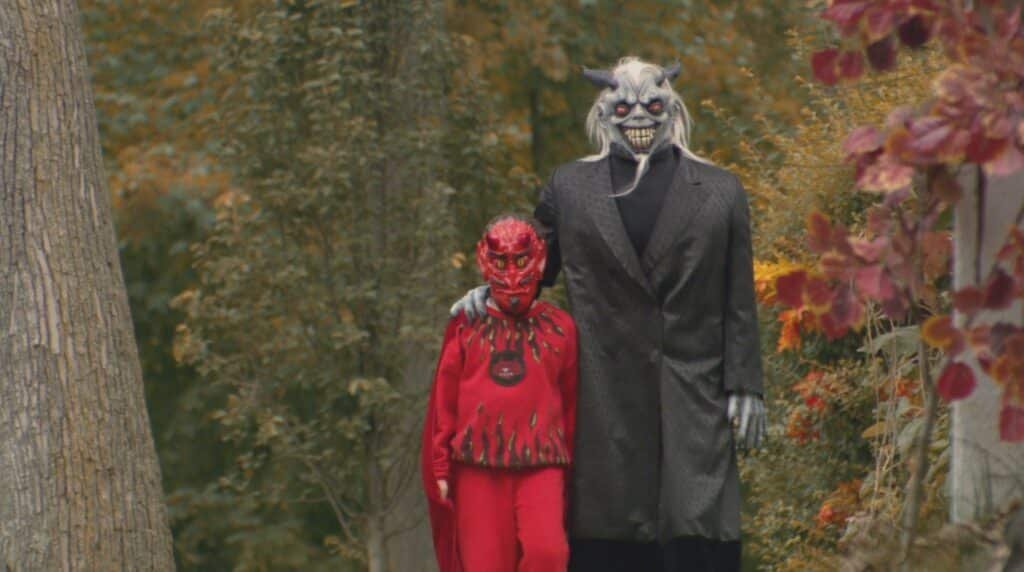
I remember this one heavily doing the rounds on the UK-based Horror Channel some years ago; I also remember it popping up in some of the £1 shops on the high street at around the same time, and ours not to reason why some films find their way there, as there seems to be little rhyme or reason to it (I’ve found Barbara Steele films in Poundstretcher, for pity’s sake, though hey – bargain). The important thing, though, is that Satan’s Little Helper is rather a witty little film which spins a yarn about a gaming-mad child who elects to dress as a Satanic minion to go Trick or Treating (hence the title, both of the film and the game). Dougie, the kid in question, is a suitably malicious little shit at the start, so it’s entirely fitting that he gets his way on his choice of costume; he’s angry at his family and in a riff on the whole ‘media makes monsters’ idea, his preferred video game has apparently made him this way, plotting against his sister’s boyfriend and rather impressed when he sees someone, also clad in a mask, behaving in a suitably deranged way. Bingo, Dougie thinks. He decides to join forces with this guy dressed as Satan, not realising he’s wearing his mask because he is in fact an escaped serial killer. Kid and killer join forces, and grisly, fairly snappy hilarity ensues. Mistaken identities, topical issues, family dynamics – all these intersect on a Halloween evening like no other, especially considering Amanda Plummer is the mother in this. Oh, and Katheryn Winnick, now famous for being the hot shield maiden Lagertha in Vikings.

Lady in White (1988)

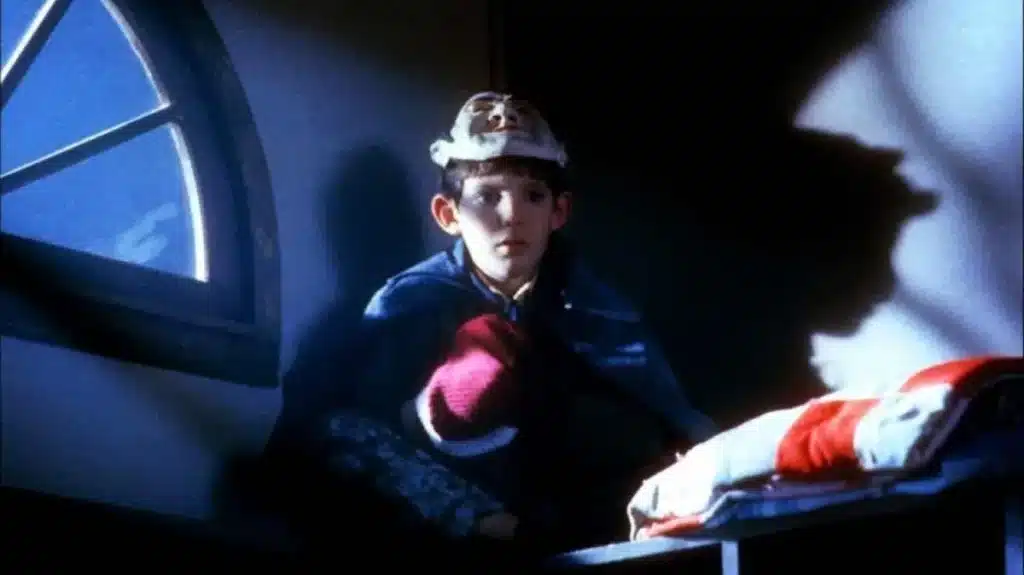
From a child wearing a mask because they want to channel some serious aggression to a kid who’s wearing a mask, but ends up on the receiving end of a supernatural visitation, we have Lady in White, an understated little ghost story with an almost Stone Tape-style, repetitive haunting which is genuinely creepy (and is apparently based on a local legend, according to some Rochester, NY residents). When little Frankie (Lucas Haas) gets locked inside his school one Halloween night (more trick than treat, thanks to some of the other kids), he’s the one who ends up scared, mask or otherwise. He witnesses an apparition, in which a little girl his own age gets murdered. From the ghostly to the fleshly, the already terrified Frankie is then attacked and partially strangled by an unseen assailant, though not before seeing the ghost again – this time, she begs him for help. Thus commences a chain of events which follow Frankie into adulthood, enmeshing the otherworldly and the physical along the way. Is there is a significance to the initial event happening on Halloween? Well, aside from the obvious factor of it being a night when children are (or were) traditionally left to their own devices, the old beliefs about Halloween – and indeed, its predecessor Samhain – tell us that on this night the divide between the land of the living and the ‘land of the dead’ is particularly thin…an engaging, touching film in any case, Lady in White consolidates an intriguing local ghost story with an atmospheric treatment. (Note also, if you will, Frankie’s trad vampire Halloween mask.)

Halloween III: Season of the Witch (1982)

To be honest, it still pains me that this film has been misidentified as part of the Halloween film franchise via the title, because of course – as most of us are aware – it’s not actually related to the slasher films and is in no way a ‘part three’. However, although I have already talked at length about this underrated film, it absolutely needs a mention in this feature too.

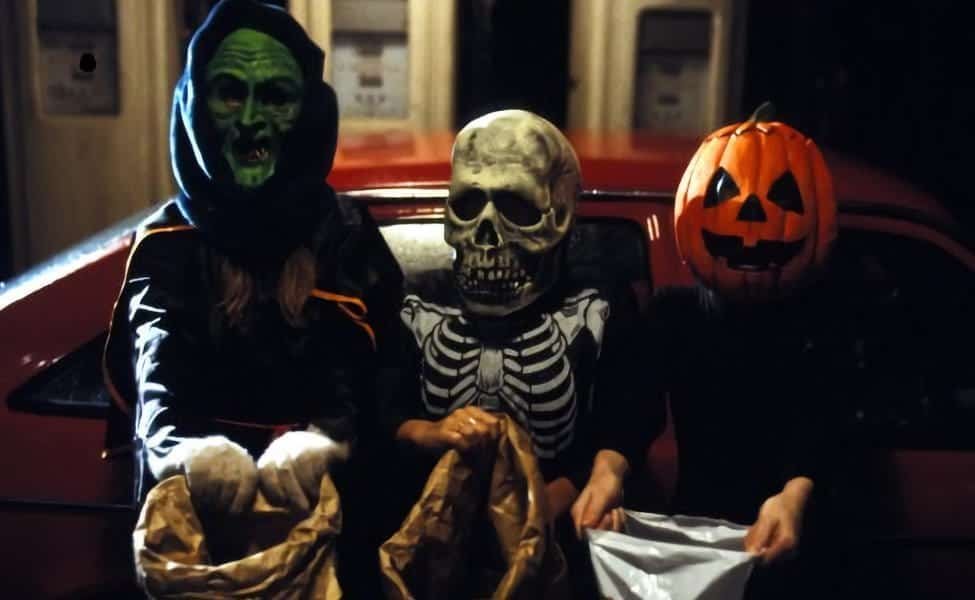
In Season of the Witch, the commercial Halloween we know and love erupts into the old horror of the Halloween festival’s antecedent of Samhain. And how does it do this? It does this via selling a very particular kind of horror mask, one which actually threatens to harm its wearer, rather than its wearer appear scary – though harmless – to others. It’s also a very modern spin on an ancient set of anxieties; one namely that the Celtic tradition isn’t all about cheeky scalliwags and songs about the ‘auld country’, and they might just be the ‘other’ which modern culture ought to fear (and some do fear, given the yearly hand-wringing about Halloween’s pagan origins). The Silver Shamrock empire might be bang up to date then, and it may have a catchy jingle, but it’s all just a front. A witty, pithy film all in all, Halloween III: Season of the Witch turns the harmless practise of trick-or-treating back on itself, links it to ancient traditions of slaughter and sacrifice, and achieves it all via a sneering, yet humorous look at the power of mass marketing, TV and TV advertising. It’s a unique film which deserves its slowly, still building reputation and respect.

Trick’r Treat (2007)

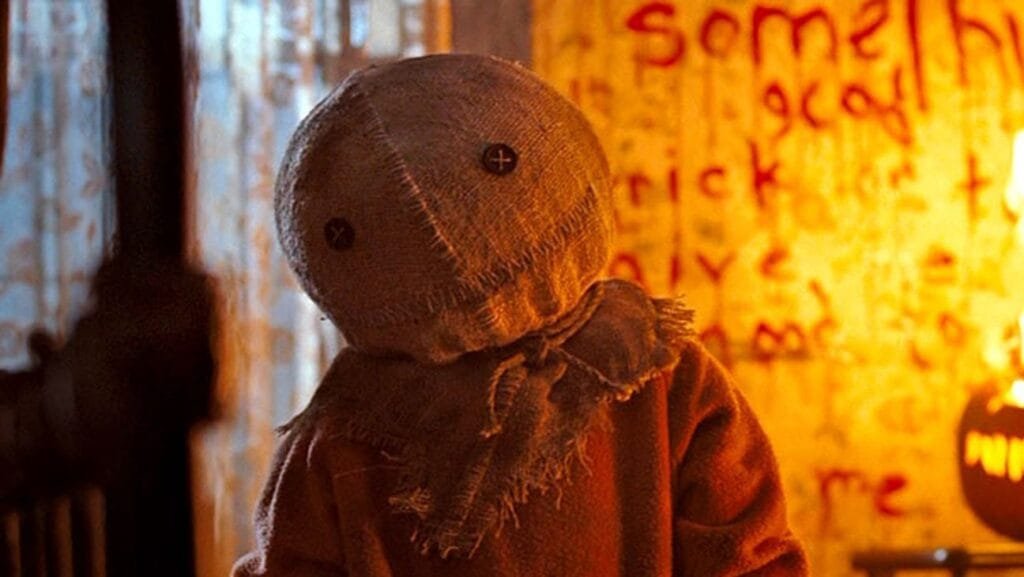
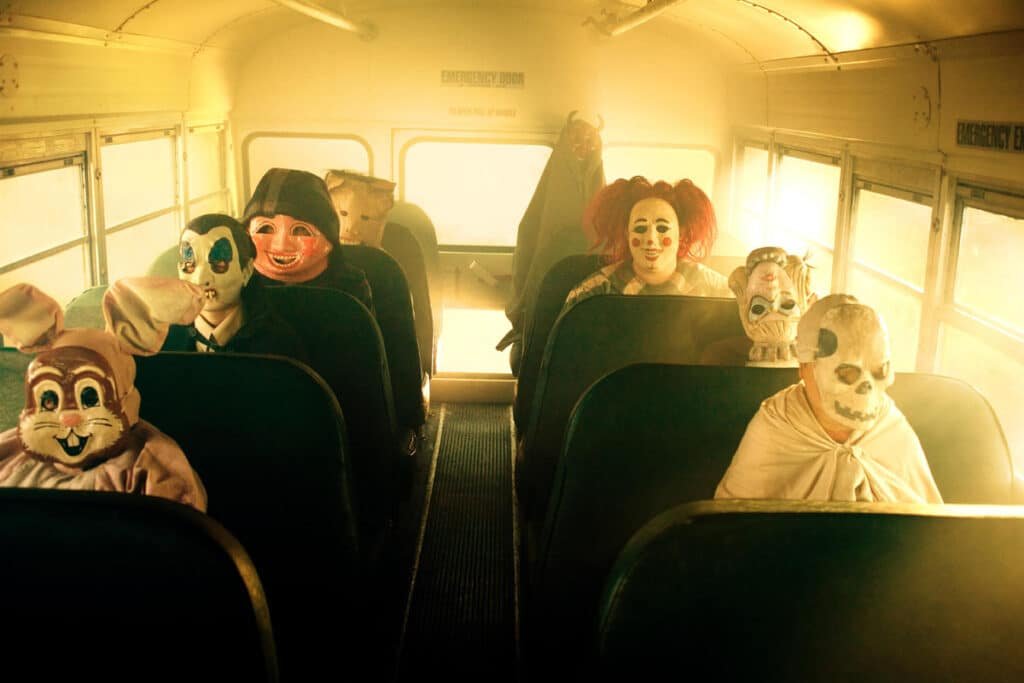
For our last film, I of course need to talk about Trick’r Treat; it’s hard, mind, to believe that Trick’r Treat is already eight years old, but then again, it did so well with what it set out to do that it’s already become a classic of its kind. Whether it’s the way in which the film craftily resurrected the anthology format (which had been undergoing something of a lull for many years, though now seems on the up once again) or used its Halloween setting to give us back that most traditional of ideas, creepy seasonal storytelling which channels urban legends, or even its subtle introduction of our sinister little Sam, the silent common factor of all the tales told, it’s certainly a film which genre fans wholeheartedly – and almost instantaneously – embraced like an old friend. All the stories which make up the whole are excellent, but for my purposes here, I’m going to go with the School Bus Massacre story-arc: in itself horrific, it details the attempted murder and eventual deaths of a group of children, thirty years before the Halloween night featured in the film, whereby a group of friends tell the urban myth of the schoolbus to an ever more scared character called Rhonda.

Of course, the story turns out to be true, and with it being their anniversary, the drowned children return – firstly, they don’t seem to approve of the prank which the others have played on Rhonda, and this initiates their revenge on her tormentors, though they have others they wish to see before the night is out. We never see the children’s faces, and in this case the masks they wear really do keep at us arm’s length as to just who, or what, has come back. These kids are definitely bloodthirsty and strong, though, so it seems as though their masks have seen them through their complete powerlessness and victimhood to their omnipotence – even if that omnipotence is for one night only.

But then, that’s Halloween at the movies; by taking up the oddities of our Halloween traditions, trick or treating, mask wearing and stories have offered a range of possible avenues for the urban myths and storytelling so beloved of horror cinema in its far broader sense. Halloween masks on-screen can hide identity, confuse identity, place characters in situations they wouldn’t ordinarily be in, endanger characters, even convey something genuinely supernatural, but however they’re used, they’re a rich source of entertainment which really can work wonders.

Celluloid Screams 2015 Review: Excess Flesh (2015)

excessflesh

By Keri O’Shea

At its best, horror has a great deal of power to question and probe aspects of modern life. By turning a uniquely distorting eye on social and cultural norms, it can make us reconsider them – or see them in such grotesque and new ways that we can’t thereafter see them as we did formerly. Even if the attempt to do this on-screen isn’t perfect, there is a lot we can pick up along the way; for instance, last year’s Starry Eyes managed an effective, grisly pastiche of the desire for fame and fortune, even if it did so by being literal and visceral rather than subtle or necessarily original. And then there’s Excess Flesh (2015), hailed by many as being ‘this year’s Starry Eyes’, doing for female body image what the earlier film did for the hunger of the Hollywood machine and the people who get consumed along the way. Oh, my. I usually make it a point not to read reviews before writing one of my own because this can unintentionally skew your own thoughts and feelings, but curiosity got the better of me with regards Excess Flesh; I just had to see what others had made of it. I’m therefore surprised to see the majority of viewers hailing it as incisive and much-needed exploration of the body image issue, because in my book, it doesn’t do this successfully at all.

excess-flesh-poster-01Jennifer (Mary Loveless) and Jill (Bethany Orr) live as flatmates, but they couldn’t be more different. Jennifer is tall, attractive, abrasive and self-centred, pinballing from her glamorous day job in fashion to wild nights out via casual sex and overindulgence. Jill on the other hand is an altogether unlikely friend – mousey, a little overweight, self-reproachful and with a wildly unhealthy attitude to food. She seems to be bulimic, but then sometimes her technicolour yawning seems stress-induced, so it’s not completely clear what’s going on – but suffice to say, she’s clearly unravelling and Jennifer isn’t exactly sympathetic. The tense living situation seems to come to a head where Jennifer promises to keep her hands off a guy called Rob (Wes McGee) for the sake of her friend’s interest in him, but fails to keep her word. Binge-eating macaroni cheese only goes so far, and so an irate Jill flips out and chains Jen to a wall where she (guess what!) torments and tortures her, whilst rejecting the world outside the apartment altogether.

The following paragraph contains a spoiler…

Because, folks, there’s a twist in the tale. I say twist, yet because director Patrick Kennelly decides to do things such as going left-field, ‘breaking the fourth wall’ by showing the Excess Flesh cameras on-screen and then filming trippy interludes which contribute little, it took some serious reflection to even connect the dots and appreciate this fact (and I’m going to take it as a given from here on in, although the fact that some reviewers didn’t seem to get it either would suggest that it’s not just me). Yep, stopping short of the old ‘it was just a dream’ cop-out, Excess Flesh does the other thing, and goes for the ‘it was all in her mind’ cop-out – two bloody tedious, hackneyed ways to wind a film down. Jill and Jen are not in fact two characters but one, see, meaning that everything which happens – all the histrionics, all the relationship drama, all the underwear scenes, even all the bags of Doritos – matter naught. As far as this sort of thing goes, it’s hardly Fight Club, and I feel that Excess Flesh is a particularly weak example of all-in-the-head filmmaking, because the film elects for body (image) horror first and foremost, omitting any further convincing characterisation or subtleties which would make this plot device work. I almost missed it altogether, because I was beaten back by yet another film where someone gets tied to a chair/wall etc. and I found my attention wandering. The all-in-head motif also renders all of the hysterical drama which precedes it null and void because it doesn’t really take place anyway, so the overall sensation I felt was one of being ….yeah, scammed.

As for body image, I thought the film was gearing up to turn its guns on the fashion industry, considering its beginning – how it focuses on a young woman who works in the industry, and with its early scene of a cluster of young women (whom we later find out to be models) discussing issues relating to weight and vanity, but this doesn’t really go very far beyond that. Jennifer’s job role is more or less a moot point, seeing as we only see her within the confines of the apartment. The bar conversation where the models discuss their diets et al is simply an aside which has no bearing on the plot either (except to helpfully point out that thin women are of course evil bitches who hate everyone). In fact, any opportunity to really get beneath the skin of the issues isn’t followed up. What we get instead is a simplistic exploration of eating disorders and dysmorphia via turning food into something repellent. Every mouthful of food consumed during the film is rendered repulsive, and to be fair this is something which is done effectively on its own account, but it’s overused and all in all, a very simple way to approach the topic of eating disorders, when there was adequate space and time to do so much more. In places, I felt angry that we were asked to see a woman who had been through an intense trauma represented again and again as simultaneously volatile, needy and nasty. An eating disorder is so much more than making food ugly, and negative body image is so much more than the sort of shrieking repugnant behaviour we see here.

Some of the criticism I have seen of this film has focused on the fact that it was co-written and directed by a man, and how could a man really get what it’s like for women etc. but I honestly don’t think that’s the issue. It shouldn’t need explaining that men are perfectly capable of writing about/directing films about women, whether on their own or as part of a team, and in innumerable examples within cinema over the past eighty years or so they’ve done so sensitively and cleverly. My problem with Excess Flesh is really more that it’s a wasted opportunity. It opts for an unconvincing narrative before pulling the rug from under our feet altogether. Starry Eyes this ain’t. All in all, Excess Flesh feels it has to push the shock factor to make its points, when its actual point could more than have delivered on the shock factor, had it been explored more elegantly.

DVD Review- Insidious: Chapter 3

insidious3

By Keri O’Shea

So here’s the thing: I was all set to start this review by saying I’d volunteered to review Insidious 3 on a bit of a whim, as I hadn’t seen the second Insidious and wasn’t sure how the films would relate either to each other, or to the first one. Well, Ben had to remind me that I have, in fact, seen Insidious 2 – and he knows this, because we went to the cinema together to see it. This is a worry. Either the amount of alcohol I ingested beforehand obliterated all memory of the film we went to watch (possible, and preferable) or my memory is now so piecemeal that it’s decided to dropkick the entire experience, because I can remember nothing whatsoever about the first sequel.

I needn’t have been concerned. In fact, I’m quietly encouraged. Having seen Insidious 3, I now rather feel that my memory is an intelligent storage system, one which simply jettisons anything it deems unnecessary. I’m crossing my fingers that it does the same thing for this most recent offering, too.

insidiousdvdThe set-up here is via that popular means of reusing elements of a story that may have vaguely worked – The Prequel. So, we start off with a girl called Quinn Brenner (Stefanie Scott) rocking up at the door of erstwhile Insidious character Elise (Lin Shaye); Elise’s reputation as a psychic precedes her, and Quinn wants to make contact with her deceased mother, believing that her mother also wants to make contact with her. Elise’s initial plot-stalling refusals to participate soon give way, though she can’t actually reach Quinn’s mother, but of course there are other entities all willing to step forward as soon as a young girl attempts anything of this sort – and Quinn is warned as much.

She ignores this, obviously, in-between trying to be an actress without successfully learning any lines, hating her (living) family, and showing utter indifference to the Green Cross Code, getting run over and landing herself two of the most unconvincing broken limbs ever to grace our screens. One further downside of the accident is that Quinn momentarily ends up in that dream-zone where the dead do their own thing – the place known as The Further – and some generic spindly-limbed entity decides to follow her back, or possibly was already in the land of the living but needed a signal boost, or something. Who cares? Elise, you’re up.

Elise’s help is required, but she doesn’t actually fully reprise her Candlelit Seance Operative role until the film has been underway for the best part of an hour – which is a shame, as – overblown or not – Lin Shaye is at least an entertaining actress with a pedigree for this kind of thing. But no; in his ineffable wisdom, director Leigh ‘Saw’ Whannell spends most of the film vainly trying to make us interested in the oh-so woebegone family at this particular ghost story’s core, and he fails. The family dynamic, as shown, is unconvincing at best and nothing short of awful at its worst. I mean, I honestly never know in many modern big-budget horrors whether I’m genuinely supposed to empathise with the main characters presented to me or not, but I rarely do. This is hugely damaging when they’re on screen nearly all the time and we’re meant to invest something in what happens next, so the annoying kid brother, the American Apparel heroine who is bizarrely, unconvincingly represented to us as a bit ‘alternative’ and the single parent father who actually has lines talking about his different facial expressions but has none – all of this comes across as filler, just something to labour through in the vague hopes that some sparky, well thought out, creepy moments happen eventually.

They don’t, though. Whilst ‘The Further’ is an idea with some creepy potential which manages a few moments of interest in the first Insidious film, here it’s not explored any differently or used any more creatively than you’ll have seen already. All of the scenes feel identikit – they worked once, ergo they’ll work again: we have the same use of technology, the same characters, living and dead, a family in peril, a brave team of psychics, and any signposting which has been chucked in (in terms of how this film relates to the others) is so heavy-handedly done that you might as well have a klaxon going off every time it occurs, which that generic shrieking sound which gets overlaid over everything essentially is anyway. Oh, there are a few new aspects woven into all the ‘why are you doing that?’ moments, mainly concerning the slightly dodgy obsession here with a helpless nubile teenager in her pants being repeatedly wrestled by a demon who has no concept of personal space, but raising an eyebrow is hardly the same as recoiling in fear. The most creative aspect of this film, really, is in the use of the word ‘prequel’.

Accordingly, have we now seen the end of the Insidious saga? To this I’d answer – do ghosts unfathomably hate electric light? Seeing as Elise’s back-story here really isn’t a back-story at all, rather another version of what we’ve already seen, there’s certainly enough scope to scrape another installment, and if enough punters part with their cash for this, then next Halloween could grant us another case of deja-vu. Personally, the way in which Insidious 3 compounds its many faults and omissions with a sentimental ending so saccharin that I could taste it would lead me to give it a wide berth, and if you love supernatural horror, I’d recommend you to do the same to this one. The buck should stop here. That much I will remember.

Insidious: Chapter 3 is out on DVD and Blu-ray on October 12th 2015.