Celluloid Screams 2015 Review: These Final Hours (2013)

By Keri O’Shea

The question ‘what would you do if you only had hours to live?’ is one that we’ve probably all considered at some point; of course, the world ends for individuals all the time, but in terms of some grand event, whether it’s the four-minute warning (alright, that’s shorter still), the biblical apocalypse or that ol’ favourite the zombie outbreak – whatever the imagined cause might be, however likely it might be, people often like to ponder how they’d behave. These Final Hours doesn’t, actually, opt for any of the above potential reasons for the planet as a whole to check out, but it spends its time on that question nonetheless. Whilst the outcome for the main protagonists doesn’t go in for shocks, neither does the film amble down a Hollywood blockbuster route which has set outcomes and box-ticking, which makes for an altogether more engaging story. I suppose you could say that this film does exactly what it says on the tin, albeit crafting a story and characters that are never boring, whilst showing some flair and ingenuity in its (just) pre-apocalyptic vision along the way too.

The sight of an asteroid roaring down to Earth in the opening scenes tells us all we need to know about the oncoming disaster overtaking the planet. Via a droll, matter-of-fact radio commentator (who acts like a voiceover in some respects) we learn that in just twelve hours, Australia will be destroyed – like most of the rest of the world has already. No possibilities of being saved, no governmental procedure, no evacuation plans, nothing – only a planet which is about to be, as a character later has it, ‘peeled’ when the resultant wall of fire hits. In one of the film’s best decisions, however, this hasn’t led to absolute anarchy on the streets. Certainly, things are strange. The religious folk cluster in small groups awaiting Heaven, those who can’t face what is coming have taken their lives and the decadent are doing whatever they want, but what you mostly notice about the streets is that they’re eerily quiet – which makes the odd, unexpected incursion more shocking.

About to navigate these strange streets is James (Nathan Phillips of Wolf Creek). Refusing to stay put with his girlfriend and await what’s coming, his big plan’s to see out the end of the world at a massive party being hosted by some friends. She wants to enjoy the view of flames rolling over the sea; he fears his inevitable death will be painful, and yearns for something to take the edge off. In the end, and as many might in his situation, James puts himself first, getting into his car and driving away. The journey’s a nightmare; whilst there aren’t crowds to contend with, it only takes one unhinged guy with a weapon to put a crimp in your day, so James can’t take the direct route – and along the road he ends up on, he sees a group of men kidnapping a little girl. Hedonist he may be, but James can’t let this happen and rescues her from what seems to be pair of paedophiles getting their last kicks now that the world has looked the other way for the last time. The girl, Rose (Angourie Rice) is disorientated and scared, but pleads with James to help her find her dad, as they’d gotten separated but swore to one another that they’d be together at the end. James’s conscience gets the better of him. They leave together.

In the wrong hands, this could have been the recipe for a cloying, tedious tale of boundless sentimentality; that whole idea of a child bringing out the best in someone during a crisis has of course been done and done horribly on screen, repulsing any hope of veracity or emotional realism simply to ‘aahhhhh’ at a kid, before landing us with a contrived happy ending because nothing bad is allowed to happen to children in filmland. Full credit to director Zak Hilditch for avoiding these pitfalls. Firstly, James as a character isn’t transformed as if by magic by the presence of a little girl, and he actively rails against his new role as a protector in ways which feel legit and understandable, given that we as an audience are first being asked to accept him as a certain type of person. Secondly, the casting of Angourie Rice is spot on; at no point does she turn out to be saccharin; she acts her part believably and grows as a character rather than being a plot device and nothing more complex. Her relationship with the man who has saved her from who only knows what agony, at least in the short term, is an organic one and you can appreciate them each growing to depend on the other as the story progresses. Thirdly, and perhaps most importantly, because Rose is permitted to be a proper character, we have so much more invested in our main characters as a whole. That lack of sentimentality is rewarded.

In keeping with this, Hilditch’s boldness in sticking to his guns is rewarded with a tale which is at times hard to watch, though ultimately redemptive; that isn’t because it ducks out of its plot line to save the great and the good, but rather the opposite. The bunker scene, for instance, is used brilliantly to reject what would otherwise be an orthodox get-out-clause for the plot. By this stage in the game, James laughs at his friends’ stupidity; he’s growing and changing as a person. Whilst you can’t blame those who have found their own solutions to their fears, be they mindless drug binges or the ‘sure and certain hope of the Resurrection’, James is always interesting to watch because of the subtle way he alters during the course of the narrative – and it’s a pleasure to see Nathan Phillips showing how well he can act in this challenging role which does a lot more for him than some of his recent work. At times, his and Rose’s trip together can feel repetitive because a lot of people have found the same way out (cue lots of instances of people turning up already dead) but what happens to them matters, which make the closing scenes of this film – and each of their scenes – absolutely standalone.

These Final Hours may not really be a horror film but it’s undeniably bleak, accomplished and well-made. End of the world movies are nothing new, sure, but this is a very polished example indeed, with good performances and the courage of its convictions, a film where the apocalypse itself is the context for considering some very human questions and needs against a striking backdrop of burgeoning chaos. Again, perhaps that’s been done before too, but These Final Hours still has much to say in a style of its own. This is one of those films, frankly, that I didn’t realise I’d enjoyed as much as I had until I sat down to write it up. From that, you can tell that it does enough to stay with you, long after the credits roll.

These Final Hours gets a UK release on 22nd January 2016.

Trick or Treat: Horror Masks and Halloween at the Movies

By Keri O’Shea

Over the years, the festival of Halloween and the horror movie industry have become almost symbiotic, extensions of one another, with one feeding the other. Take Scream, for instance: I remember the exact model of mask used in the film being around way before the franchise came into being; it was another mass-produced piece of merchandise which was in all likelihood chosen because it was so generic rather than because it was special or remarkable in any way. And yet now, the same mask is commonly known as ‘the Scream mask’, not a common-or-garden Grim Reaper mask (although whether makers today say so on the packaging is another, potentially copyright-threatening matter). This has been going on for a long time. The whole host of werewolves, mummies and vampires which have their likenesses strung with elastic for children to wear whilst Trick or Treating owe the way they look to the most famous incarnations of movie monsters, most notably the Universal monsters – creatures which appeared on screens for the first time before today’s kids’ grandparents were cinema-goers, but such is the power of an image, once it gets out into the mainstream. Of course, it works the other way too: for example, old anxieties about witchcraft (which may date back significantly further than cinema) have given us an archetype of the dangerous crone, with her warty, hook nose, sharp chin and malevolent brow; this image has joined the ranks of the Halloween masks, and has been influential in its own way too, appearing in horror films in its own right. Ditto the Jack O’Lantern, another striking visual now associated with both Halloween and the silver screen.

Considering this close relationship, it’s little wonder that a number of horror movies have been set on Halloween itself, and even less of a wonder that the common Western tradition of mask-wearing at this time of year has figured in these films’ plots. Now, a proviso: I decided early on whilst planning this piece that enough has already been said about John Carpenter’s Halloween (1978) to last us a lifetime; that is not to denigrate the massive influence which said film’s own mask-wearing character has had, but rather to acknowledge it (and why yes, to go back to my earlier point, you can purchase ‘Michael Myers masks’ to this day, though I couldn’t find any William Shatner ones, albeit based on a very cursory online search). Anyway, with regards Halloween, I don’t know if I can add a great deal, and as I’ve confessed enough times, I am just not a fan of slasher movies: Halloween is one of the best-known and seminal examples of this genre, but as a classic of its kind, I feel like there are other films, also set on October 31st and also featuring mask-wearing characters, that are perhaps fresher to discuss (or just more within my remit). So, Mr. Myers, this one isn’t for you.

Here are just some films, then, which feature Halloween and Halloween masks, and weave something wonderfully entertaining out of them. There are many more, but I’ve aimed to pick out either lesser-known films, or else films which are Halloween-noteworthy for a variety of reasons.

Satan’s Little Helper (2004)

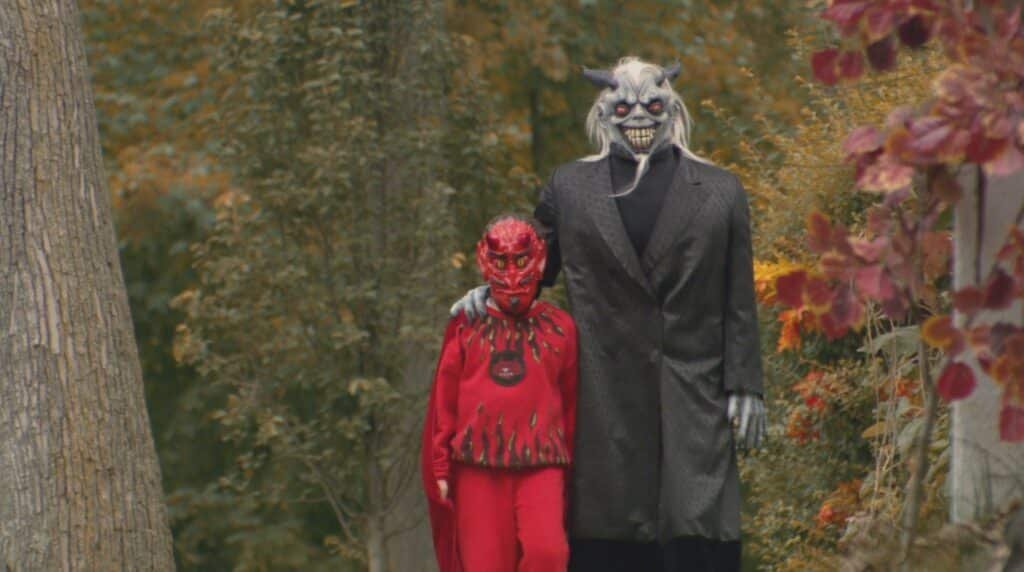
I remember this one heavily doing the rounds on the UK-based Horror Channel some years ago; I also remember it popping up in some of the £1 shops on the high street at around the same time, and ours not to reason why some films find their way there, as there seems to be little rhyme or reason to it (I’ve found Barbara Steele films in Poundstretcher, for pity’s sake, though hey – bargain). The important thing, though, is that Satan’s Little Helper is rather a witty little film which spins a yarn about a gaming-mad child who elects to dress as a Satanic minion to go Trick or Treating (hence the title, both of the film and the game). Dougie, the kid in question, is a suitably malicious little shit at the start, so it’s entirely fitting that he gets his way on his choice of costume; he’s angry at his family and in a riff on the whole ‘media makes monsters’ idea, his preferred video game has apparently made him this way, plotting against his sister’s boyfriend and rather impressed when he sees someone, also clad in a mask, behaving in a suitably deranged way. Bingo, Dougie thinks. He decides to join forces with this guy dressed as Satan, not realising he’s wearing his mask because he is in fact an escaped serial killer. Kid and killer join forces, and grisly, fairly snappy hilarity ensues. Mistaken identities, topical issues, family dynamics – all these intersect on a Halloween evening like no other, especially considering Amanda Plummer is the mother in this. Oh, and Katheryn Winnick, now famous for being the hot shield maiden Lagertha in Vikings.

Lady in White (1988)

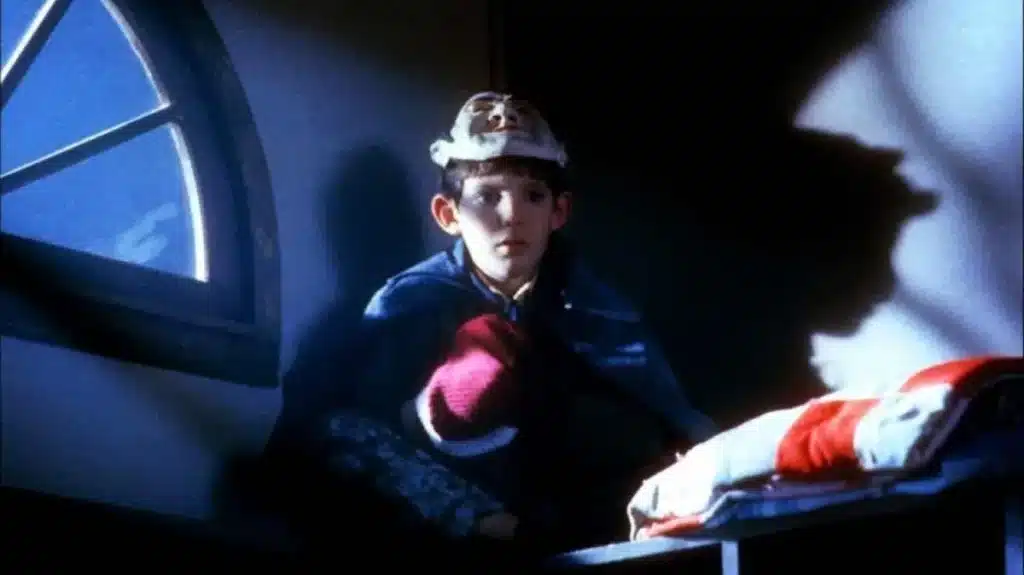
From a child wearing a mask because they want to channel some serious aggression to a kid who’s wearing a mask, but ends up on the receiving end of a supernatural visitation, we have Lady in White, an understated little ghost story with an almost Stone Tape-style, repetitive haunting which is genuinely creepy (and is apparently based on a local legend, according to some Rochester, NY residents). When little Frankie (Lucas Haas) gets locked inside his school one Halloween night (more trick than treat, thanks to some of the other kids), he’s the one who ends up scared, mask or otherwise. He witnesses an apparition, in which a little girl his own age gets murdered. From the ghostly to the fleshly, the already terrified Frankie is then attacked and partially strangled by an unseen assailant, though not before seeing the ghost again – this time, she begs him for help. Thus commences a chain of events which follow Frankie into adulthood, enmeshing the otherworldly and the physical along the way. Is there is a significance to the initial event happening on Halloween? Well, aside from the obvious factor of it being a night when children are (or were) traditionally left to their own devices, the old beliefs about Halloween – and indeed, its predecessor Samhain – tell us that on this night the divide between the land of the living and the ‘land of the dead’ is particularly thin…an engaging, touching film in any case, Lady in White consolidates an intriguing local ghost story with an atmospheric treatment. (Note also, if you will, Frankie’s trad vampire Halloween mask.)

Halloween III: Season of the Witch (1982)

To be honest, it still pains me that this film has been misidentified as part of the Halloween film franchise via the title, because of course – as most of us are aware – it’s not actually related to the slasher films and is in no way a ‘part three’. However, although I have already talked at length about this underrated film, it absolutely needs a mention in this feature too.

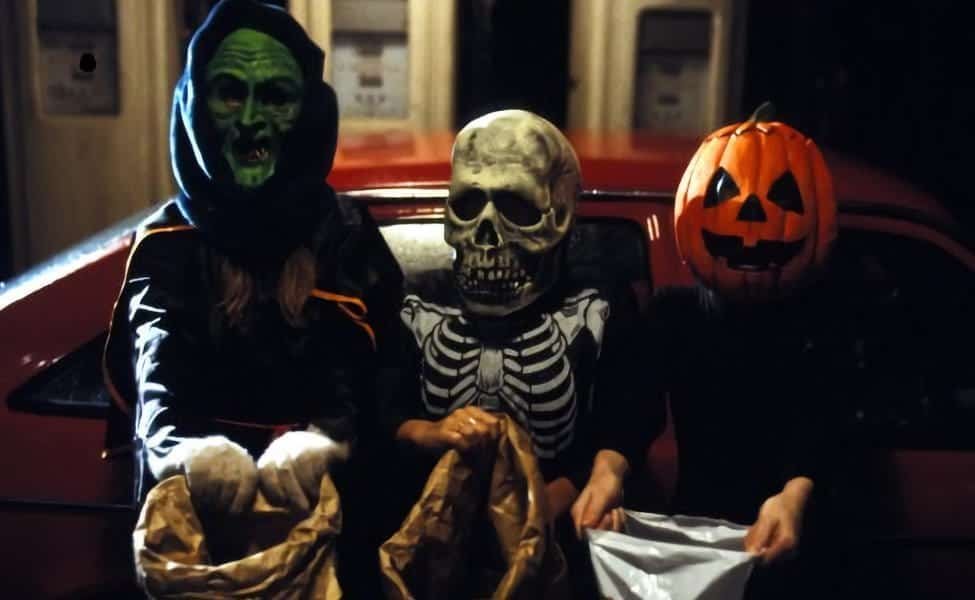
In Season of the Witch, the commercial Halloween we know and love erupts into the old horror of the Halloween festival’s antecedent of Samhain. And how does it do this? It does this via selling a very particular kind of horror mask, one which actually threatens to harm its wearer, rather than its wearer appear scary – though harmless – to others. It’s also a very modern spin on an ancient set of anxieties; one namely that the Celtic tradition isn’t all about cheeky scalliwags and songs about the ‘auld country’, and they might just be the ‘other’ which modern culture ought to fear (and some do fear, given the yearly hand-wringing about Halloween’s pagan origins). The Silver Shamrock empire might be bang up to date then, and it may have a catchy jingle, but it’s all just a front. A witty, pithy film all in all, Halloween III: Season of the Witch turns the harmless practise of trick-or-treating back on itself, links it to ancient traditions of slaughter and sacrifice, and achieves it all via a sneering, yet humorous look at the power of mass marketing, TV and TV advertising. It’s a unique film which deserves its slowly, still building reputation and respect.

Trick’r Treat (2007)

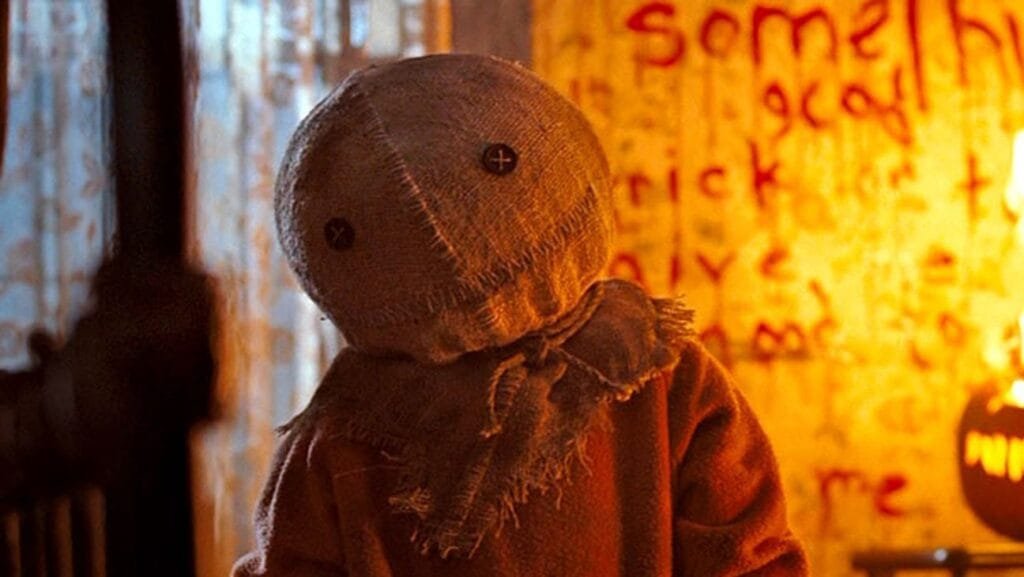
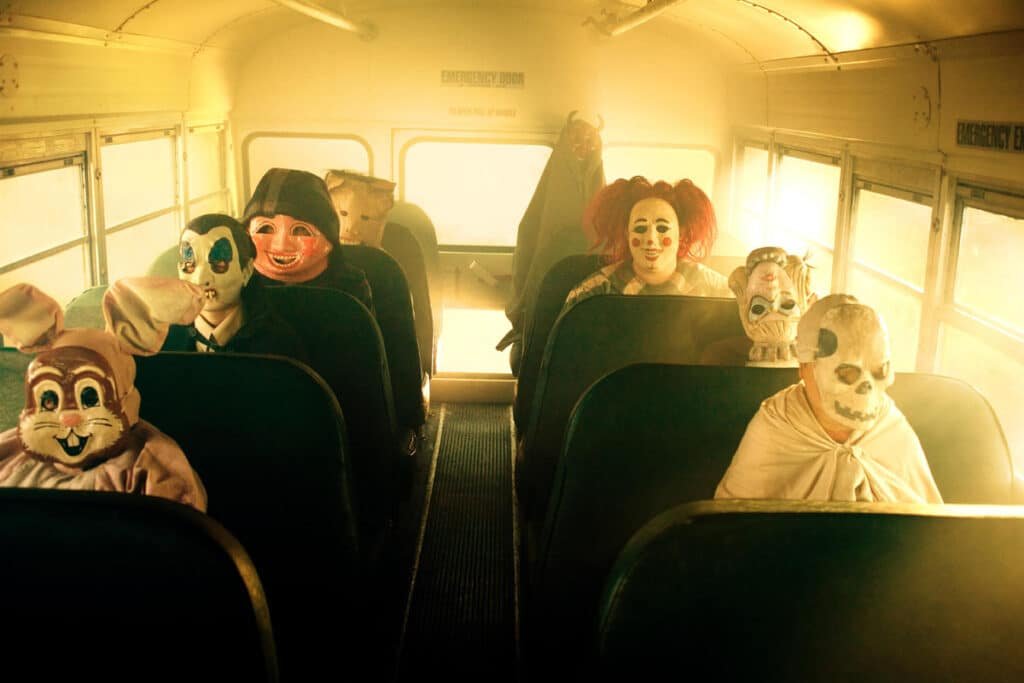
For our last film, I of course need to talk about Trick’r Treat; it’s hard, mind, to believe that Trick’r Treat is already eight years old, but then again, it did so well with what it set out to do that it’s already become a classic of its kind. Whether it’s the way in which the film craftily resurrected the anthology format (which had been undergoing something of a lull for many years, though now seems on the up once again) or used its Halloween setting to give us back that most traditional of ideas, creepy seasonal storytelling which channels urban legends, or even its subtle introduction of our sinister little Sam, the silent common factor of all the tales told, it’s certainly a film which genre fans wholeheartedly – and almost instantaneously – embraced like an old friend. All the stories which make up the whole are excellent, but for my purposes here, I’m going to go with the School Bus Massacre story-arc: in itself horrific, it details the attempted murder and eventual deaths of a group of children, thirty years before the Halloween night featured in the film, whereby a group of friends tell the urban myth of the schoolbus to an ever more scared character called Rhonda.

Of course, the story turns out to be true, and with it being their anniversary, the drowned children return – firstly, they don’t seem to approve of the prank which the others have played on Rhonda, and this initiates their revenge on her tormentors, though they have others they wish to see before the night is out. We never see the children’s faces, and in this case the masks they wear really do keep at us arm’s length as to just who, or what, has come back. These kids are definitely bloodthirsty and strong, though, so it seems as though their masks have seen them through their complete powerlessness and victimhood to their omnipotence – even if that omnipotence is for one night only.

But then, that’s Halloween at the movies; by taking up the oddities of our Halloween traditions, trick or treating, mask wearing and stories have offered a range of possible avenues for the urban myths and storytelling so beloved of horror cinema in its far broader sense. Halloween masks on-screen can hide identity, confuse identity, place characters in situations they wouldn’t ordinarily be in, endanger characters, even convey something genuinely supernatural, but however they’re used, they’re a rich source of entertainment which really can work wonders.

Celluloid Screams 2015 Review: Excess Flesh (2015)

excessflesh

By Keri O’Shea

At its best, horror has a great deal of power to question and probe aspects of modern life. By turning a uniquely distorting eye on social and cultural norms, it can make us reconsider them – or see them in such grotesque and new ways that we can’t thereafter see them as we did formerly. Even if the attempt to do this on-screen isn’t perfect, there is a lot we can pick up along the way; for instance, last year’s Starry Eyes managed an effective, grisly pastiche of the desire for fame and fortune, even if it did so by being literal and visceral rather than subtle or necessarily original. And then there’s Excess Flesh (2015), hailed by many as being ‘this year’s Starry Eyes’, doing for female body image what the earlier film did for the hunger of the Hollywood machine and the people who get consumed along the way. Oh, my. I usually make it a point not to read reviews before writing one of my own because this can unintentionally skew your own thoughts and feelings, but curiosity got the better of me with regards Excess Flesh; I just had to see what others had made of it. I’m therefore surprised to see the majority of viewers hailing it as incisive and much-needed exploration of the body image issue, because in my book, it doesn’t do this successfully at all.

excess-flesh-poster-01Jennifer (Mary Loveless) and Jill (Bethany Orr) live as flatmates, but they couldn’t be more different. Jennifer is tall, attractive, abrasive and self-centred, pinballing from her glamorous day job in fashion to wild nights out via casual sex and overindulgence. Jill on the other hand is an altogether unlikely friend – mousey, a little overweight, self-reproachful and with a wildly unhealthy attitude to food. She seems to be bulimic, but then sometimes her technicolour yawning seems stress-induced, so it’s not completely clear what’s going on – but suffice to say, she’s clearly unravelling and Jennifer isn’t exactly sympathetic. The tense living situation seems to come to a head where Jennifer promises to keep her hands off a guy called Rob (Wes McGee) for the sake of her friend’s interest in him, but fails to keep her word. Binge-eating macaroni cheese only goes so far, and so an irate Jill flips out and chains Jen to a wall where she (guess what!) torments and tortures her, whilst rejecting the world outside the apartment altogether.

The following paragraph contains a spoiler…

Because, folks, there’s a twist in the tale. I say twist, yet because director Patrick Kennelly decides to do things such as going left-field, ‘breaking the fourth wall’ by showing the Excess Flesh cameras on-screen and then filming trippy interludes which contribute little, it took some serious reflection to even connect the dots and appreciate this fact (and I’m going to take it as a given from here on in, although the fact that some reviewers didn’t seem to get it either would suggest that it’s not just me). Yep, stopping short of the old ‘it was just a dream’ cop-out, Excess Flesh does the other thing, and goes for the ‘it was all in her mind’ cop-out – two bloody tedious, hackneyed ways to wind a film down. Jill and Jen are not in fact two characters but one, see, meaning that everything which happens – all the histrionics, all the relationship drama, all the underwear scenes, even all the bags of Doritos – matter naught. As far as this sort of thing goes, it’s hardly Fight Club, and I feel that Excess Flesh is a particularly weak example of all-in-the-head filmmaking, because the film elects for body (image) horror first and foremost, omitting any further convincing characterisation or subtleties which would make this plot device work. I almost missed it altogether, because I was beaten back by yet another film where someone gets tied to a chair/wall etc. and I found my attention wandering. The all-in-head motif also renders all of the hysterical drama which precedes it null and void because it doesn’t really take place anyway, so the overall sensation I felt was one of being ….yeah, scammed.

As for body image, I thought the film was gearing up to turn its guns on the fashion industry, considering its beginning – how it focuses on a young woman who works in the industry, and with its early scene of a cluster of young women (whom we later find out to be models) discussing issues relating to weight and vanity, but this doesn’t really go very far beyond that. Jennifer’s job role is more or less a moot point, seeing as we only see her within the confines of the apartment. The bar conversation where the models discuss their diets et al is simply an aside which has no bearing on the plot either (except to helpfully point out that thin women are of course evil bitches who hate everyone). In fact, any opportunity to really get beneath the skin of the issues isn’t followed up. What we get instead is a simplistic exploration of eating disorders and dysmorphia via turning food into something repellent. Every mouthful of food consumed during the film is rendered repulsive, and to be fair this is something which is done effectively on its own account, but it’s overused and all in all, a very simple way to approach the topic of eating disorders, when there was adequate space and time to do so much more. In places, I felt angry that we were asked to see a woman who had been through an intense trauma represented again and again as simultaneously volatile, needy and nasty. An eating disorder is so much more than making food ugly, and negative body image is so much more than the sort of shrieking repugnant behaviour we see here.

Some of the criticism I have seen of this film has focused on the fact that it was co-written and directed by a man, and how could a man really get what it’s like for women etc. but I honestly don’t think that’s the issue. It shouldn’t need explaining that men are perfectly capable of writing about/directing films about women, whether on their own or as part of a team, and in innumerable examples within cinema over the past eighty years or so they’ve done so sensitively and cleverly. My problem with Excess Flesh is really more that it’s a wasted opportunity. It opts for an unconvincing narrative before pulling the rug from under our feet altogether. Starry Eyes this ain’t. All in all, Excess Flesh feels it has to push the shock factor to make its points, when its actual point could more than have delivered on the shock factor, had it been explored more elegantly.

DVD Review- Insidious: Chapter 3

insidious3

By Keri O’Shea

So here’s the thing: I was all set to start this review by saying I’d volunteered to review Insidious 3 on a bit of a whim, as I hadn’t seen the second Insidious and wasn’t sure how the films would relate either to each other, or to the first one. Well, Ben had to remind me that I have, in fact, seen Insidious 2 – and he knows this, because we went to the cinema together to see it. This is a worry. Either the amount of alcohol I ingested beforehand obliterated all memory of the film we went to watch (possible, and preferable) or my memory is now so piecemeal that it’s decided to dropkick the entire experience, because I can remember nothing whatsoever about the first sequel.

I needn’t have been concerned. In fact, I’m quietly encouraged. Having seen Insidious 3, I now rather feel that my memory is an intelligent storage system, one which simply jettisons anything it deems unnecessary. I’m crossing my fingers that it does the same thing for this most recent offering, too.

insidiousdvdThe set-up here is via that popular means of reusing elements of a story that may have vaguely worked – The Prequel. So, we start off with a girl called Quinn Brenner (Stefanie Scott) rocking up at the door of erstwhile Insidious character Elise (Lin Shaye); Elise’s reputation as a psychic precedes her, and Quinn wants to make contact with her deceased mother, believing that her mother also wants to make contact with her. Elise’s initial plot-stalling refusals to participate soon give way, though she can’t actually reach Quinn’s mother, but of course there are other entities all willing to step forward as soon as a young girl attempts anything of this sort – and Quinn is warned as much.

She ignores this, obviously, in-between trying to be an actress without successfully learning any lines, hating her (living) family, and showing utter indifference to the Green Cross Code, getting run over and landing herself two of the most unconvincing broken limbs ever to grace our screens. One further downside of the accident is that Quinn momentarily ends up in that dream-zone where the dead do their own thing – the place known as The Further – and some generic spindly-limbed entity decides to follow her back, or possibly was already in the land of the living but needed a signal boost, or something. Who cares? Elise, you’re up.

Elise’s help is required, but she doesn’t actually fully reprise her Candlelit Seance Operative role until the film has been underway for the best part of an hour – which is a shame, as – overblown or not – Lin Shaye is at least an entertaining actress with a pedigree for this kind of thing. But no; in his ineffable wisdom, director Leigh ‘Saw’ Whannell spends most of the film vainly trying to make us interested in the oh-so woebegone family at this particular ghost story’s core, and he fails. The family dynamic, as shown, is unconvincing at best and nothing short of awful at its worst. I mean, I honestly never know in many modern big-budget horrors whether I’m genuinely supposed to empathise with the main characters presented to me or not, but I rarely do. This is hugely damaging when they’re on screen nearly all the time and we’re meant to invest something in what happens next, so the annoying kid brother, the American Apparel heroine who is bizarrely, unconvincingly represented to us as a bit ‘alternative’ and the single parent father who actually has lines talking about his different facial expressions but has none – all of this comes across as filler, just something to labour through in the vague hopes that some sparky, well thought out, creepy moments happen eventually.

They don’t, though. Whilst ‘The Further’ is an idea with some creepy potential which manages a few moments of interest in the first Insidious film, here it’s not explored any differently or used any more creatively than you’ll have seen already. All of the scenes feel identikit – they worked once, ergo they’ll work again: we have the same use of technology, the same characters, living and dead, a family in peril, a brave team of psychics, and any signposting which has been chucked in (in terms of how this film relates to the others) is so heavy-handedly done that you might as well have a klaxon going off every time it occurs, which that generic shrieking sound which gets overlaid over everything essentially is anyway. Oh, there are a few new aspects woven into all the ‘why are you doing that?’ moments, mainly concerning the slightly dodgy obsession here with a helpless nubile teenager in her pants being repeatedly wrestled by a demon who has no concept of personal space, but raising an eyebrow is hardly the same as recoiling in fear. The most creative aspect of this film, really, is in the use of the word ‘prequel’.

Accordingly, have we now seen the end of the Insidious saga? To this I’d answer – do ghosts unfathomably hate electric light? Seeing as Elise’s back-story here really isn’t a back-story at all, rather another version of what we’ve already seen, there’s certainly enough scope to scrape another installment, and if enough punters part with their cash for this, then next Halloween could grant us another case of deja-vu. Personally, the way in which Insidious 3 compounds its many faults and omissions with a sentimental ending so saccharin that I could taste it would lead me to give it a wide berth, and if you love supernatural horror, I’d recommend you to do the same to this one. The buck should stop here. That much I will remember.

Insidious: Chapter 3 is out on DVD and Blu-ray on October 12th 2015.

Film Review: La Entidad (The Entity) (2015)

entity

By Keri O’Shea

I suppose I shouldn’t be amazed that the found footage phenomenon is still rolling jerkily onwards, nor that countries not usually associated with a horror tradition are now having a go themselves; take Peru, for instance, the country which has brought us La Entidad. My knowledge of any relationship between Peru and horror is hazy, I admit, but if it has any significant links to the genre at all for the average Western viewer, it seems more usually when the country is visited by outsiders. Ahem, take Eli Roth, for instance, whose most recent offering, The Green Inferno (2013) was partly filmed in the Peruvian Amazon. La Entidad is, of course, a far cry away from that, but by the same token, it doesn’t deviate from the found footage formula we know and ‘love’ in any significant ways either, regardless of its ostensibly unconventional setting.

entityposterLet me demonstrate. After some short, unedited clips of people screaming and running around in the dark gives way on-screen text talking of the deep web legend of a ‘creature’ appearing on several people’s footage, our story proper begins in film school – where a group of young, impetuous wannabe documentary filmmakers are striving for a new angle. Enter Carla (Daniella Mendoza), a peer who is rather more resourceful than the boys; she offers to set them up with a new project – filming ‘reaction videos’ – where you observe people watching strong footage which itself is never revealed, only the facial contortions of the people who do see it. Basically, it’s like Gogglebox, only for torture porn. And it’s very ‘now’. The guys – Benjamin, Joshua and Lucas, agree that this is a superb idea and are delighted when Carla procures some examples. (She does this by breaking into a camera room at the college, where you’d think people would be freaked out that old, dusty, analogue cameras all seem to be fully charged and functional. But anyway.)

After the gang have all watched the footage, Carla reveals that she actually recognises someone on the film. His name is Sergio, so why not go around to his house to find out more? Well, you’ve guessed it – there’s a good reason why he isn’t coming out to play, so step up Santiago, his older brother, who offers to talk to the group about what happened. Thus is the film poised to motor through as many other features of found footage as it can fit in to eighty minutes – a chain curse, a local legend, some torture, and yes, an entity.

If it sounds as if I’m being unduly negative, well – I am, to an extent. Although La Entidad makes some use of a specifically Peruvian-flavoured legend, it doesn’t really have the confidence to do much else which marks it out, meaning you get a hell of a sense of deja-vu here – that cumulative deja-vu you get when you watch a lot of horror films, crossed with that thing where you waste your own time by guessing all the twists by twenty minutes in, and believe me, that isn’t a tacit way for me to say I’m especially knowledgeable – it simply comes from so many filmmakers feeling unable to deviate from the blueprint. I’ve mentioned the miraculous ever-ready camera locked deep in storage; you can also tick off the people frequently asking ‘why are you filming?’ (oh alright, in Spanish); the way that even digital cameras make that weird analogue static-clunk in-between takes, which they just do not do in real life; the running-and-filming-one’s-feet motif; the way all found footage creatures seem to make the same tinny screeching noise; the way all found footage creatures economically fail to appear on camera unless in some sort of interference, or a flash which occurs almost off-camera; it’s all in there, and the film doesn’t benefit by it.

It’s not all bad news, though, and whilst the film has the sense to move along at a reasonably quick pace, it’s also shot in some aesthetically-pleasing locations. I did like the cemetery where a lot of key scenes happen, and wished I could see more of it than what we get via a flashlight and no tripod. La Entidad also makes an effort to join up several plot elements which are, in practical terms, different from one another, and so it juggles some decently done make-up effects with a dash of CGI. These are never around very long, but it actually works out well and looks good on-screen, showing that some effort has been made to lift the film up beyond the lowest-common-denominator ordinary. Dare I say it, but in its simplest, most low-key moments, the film manages to be authentically quite creepy. And then there’s the performances, which – considering that all of the cast are completely new to acting – aren’t bad at all, and definitely help to add an element of interest to proceedings.

I’d honestly love to know what brought director/writer/producer Eduardo Schuldt to this project, I really would. So far, he’s made a few family-friendly animations, which have no bearing on this film whatsoever: there’s certainly nothing in his filmography to suggest even a passing interest in the horror genre. Perhaps a change is as good as a rest; who knows? With what he’s given us here, though, we have a blend of frustratingly formulaic and frustratingly promising moments – the former hold sway, quite honestly, but there’s something here which suggests that Schuldt could go places with this career move, if he only gets the confidence to forget what’s bleedin’ obvious and branch out on his own somewhere. La Entidad is by no means a dire film; it just quickly falls into a rut which isn’t of its own making.

La Entidad (2015) is released in the UK on the 5th October 2015.

Film Review: Perdurabo (Where is Aleister Crowley?) (2003)

perdurabo

By Keri O’Shea

The Great Beast – English occultist Aleister Crowley – has for many years enjoyed an uneasy flirtation with popular culture. He’s appeared on the cover of a Beatles album, which ought to suffice to substantiate the first sentence – he’s inspired numerous homages in poetry and literature, but being such a problematic figure, his relationship with the mediums he’s inspired has long been equally problematic, with cinema no exception. I suppose we shouldn’t be surprised. Crowley was many things to many people; a mutable, volatile persona who still does not lend himself well to linear narratives or neat endings. He was, quite literally, a Law unto himself, and this has caused headaches for many directors who have wanted to represent some aspect of him, without tripping over all the other aspects which contradict the first.

Director Carlos Atanes (see what he did there?) has hit on a novel way to illustrate Crowley’s life story in his 40 minute film, Perdurabo; he’s excised him altogether. In so doing, he’s rid himself of a lot of the risks, whilst still being able – despite a low budget – to bring together an interesting curiosity, a snapshot of life at the so-called Abbey of Thelema in Cefalu, Sicily, the base of Crowley’s personal religion. Atanes has also managed, without spoon-feeding or sentamentalising, to explore the Abbey from the perspective of its position in place and time. Whilst the Order was crafting and performing its rituals for power, Europe was after all in flux, about to lurch into the Second World War.

Indeed, the film starts with two of Mussolini’s blackshirts, thuggish sticklers, who arbitrarily beat a passing man almost to death for the heinous crime of not carrying the appropriate papers. The man, Joseph, does not die, but he is gravely injured; thankfully, a woman discovers him, dresses his wounds (bandaging his eyes until he is sightless) and tells him he has been ‘expected’. He is then taken to the Abbey – which, unless Atanes has one hell of a set-builder, is the authentic Cefalu site, and hell alone knows how they managed to film there without interference…

perdurabo2

Joseph asks again and again for Crowley, for it seems he has come there to pay homage to him, but he is not there. The Master has gone on a journey, the other inmates tell him, and he will return only when he is ready. In the meantime, the Work proceeds, the Scarlet Woman continues to record all subsequent events in her magickal diaries, but death and disease threaten the Order, with the sole male, Raoul Loveday, on the verge of giving up the ghost altogether (with a helpful death prophecy left to him by the Master before he headed off, which will have been a comfort). Although Crowley’s followers have their orders, they are becoming fractious, disorientated and unpredictable. Joseph stays, but without their leader, it seems as though Thelema is unravelling.

A low budget rings through this short film as clear as a bell, and there’s been some artistic licence throughout (not least with the use of Spanish language), but a few rookie errors and minor issues matter impressively little in the overall scheme of things here; Perdurabo exercises some creative decision-making throughout – not least by electing to film a story about Crowley without him in it, a gutsy decision which pays dividends. It’s also able to achieve an impressive amount of atmosphere, and the filmmaker’s knowledge of the key events and players is impressive. Parts of the dialogue are verbatim Thelemic ritual, and to hear them actually being spoken in the Cefalu farmhouse is actually very eerie; I’ll say it again, I don’t know how they managed to film there without at least some opposition from the Italian authorities, but let’s just say that Crowley’s grotesque painted frescos pay no respect to the fourth wall, and the overall effect is unsettling.

Plot is not a priority here, duh, and the sensory aspects to the film are mental rather than carnal, whilst Perdurabo is unashamedly art-house through and through. It probably wouldn’t win any converts to an interest in the history of Crowley’s nefarious career, but for those of you with more than a passing knowledge or interest from the outset, you may well be interested in this one. Perdurabo’s a film with an intriguingly tangled back-story of its own (originally being shelved after shooting at the director’s behest), but it’s good that it’s now seen the light of day – and how good to see a film about Thelema which manages to capture something of that manic strangeness you can usually only glean via the printed page.

Perdurabo (Where is Aleister Crowley?) is now available to watch for free online. You can find it here.

So long from Svetlana: a goodbye to Brutal as Hell

me!

By Svetlana Fedotov

It’s with a heavy heart and a tear in my eye that I announce that I am leaving Brutal as Hell. I have been offered a writing gig with Shock ‘til You Drop and will start writing for them, along with my weekly contribution to Fangoria’s website. I’ve had an unbelievable blast writing for Brutal these past three and a half years and I honestly never thought there would come a time when I would leave. I figured I’d write for you till the day I die (and probably after that), but here we are, parting ways.

When I first started writing for Brutal as Hell, I had never written more than a short story in my life, let alone a review or an article. All I knew was comic books and a site that didn’t have comic coverage. I learned everything about journalism, research, passion, and a witty turn of phrase live on the site and my excellent editors allowed me to grow into the writer I am today. I am forever grateful for their patience and guidance and will always carry with me everything they have taught me. Thank you for taking a chance on me.

Anyway, this has gotten all gross and sentimental. If you’re ever looking for good comic suggestions or just want to drop me a line, come check out my Facebook author page. I’ll keep you updated on all the good spooky happenings and what’s going on with my fiction work (currently, lots of smoke, no fire…yet).

And remember, I love you.

Goodbye and thanks for all the fish.


DVD Review: The Killage (2011)

the_killage

By Keri O’Shea

If I’m honest, when I got offered the chance to review a film called ‘The Killage’, a certain amount of devilment made it seem like a good idea. Devilment, and who knows – maybe even a little bit of optimism. We get a lot of DVD screeners sent through to us, many with frankly uninspired titles (particularly if an otherwise decent title has been changed by a distribution company which thinks its target audience in the UK are morons) so I suppose I hoped The Killage – as one of the absolute worst names I’d heard in a while – would be absurd enough to really own a title like that. It could have done. It could have been bold, and ready to poke fun at itself because it had real ideas. It could have, and incidentally, since watching it I’ve remembered that optimism is a frankly arse-backwards philosophical standpoint which lays itself wide open to disappointment and takes no account of the world as it stands.

killageWhat to say about this film? I mean, it starts with the obligatory modern horror trope of a person-tied-to-chair surrounded by menacing DIY tools, which never helps, before ditching that particular blaring plot marker to take us somewhere in suburban Australia to meet a gang of people somewhere in the 18-25 age bracket, all about to go off to – camp, silly, for some sort of team building exercise. Perhaps in some execrable attempts at being ‘meta’ (a lofty if now common cinematic aim which this film NEVER achieves) we have the standard array of stereotypes – an apparent goth who looks more ill-at-ease in black lipstick than even goth themselves do, a ‘jock’ called Jock (geddit?) who is meant to be the buff sporty one but looks suspiciously like he wouldn’t know a dumbbell if it was labelled and then of course, the others – the bimbo, the bitch, the flamboyant gay man, the one who you know is going to be the ‘final girl’ from the minute she arrives…the slightly geeky ones, the stoner one – ah, you get the idea.

As they head off to the back of beyond for camp, you have plenty of time to sift through your early impressions of these people as they enjoy the incomprehensible urge to yell their godawful lines at one another, and you’ll be able to wonder just how much the film is sending itself up. As the jokes start whistling past your head, if you’ve any standards at all then you’ll decide that no, the film isn’t genuinely sending anything up, because it isn’t smart enough to do so. You can’t just cherry-pick the most inane elements of a frankly mostly boring genre, add in a few more dick jokes and turn up the volume an obnoxious amount to get a film. Well, you can – but why would you?

Anyway, once at the camp, we go though the usual whodunnit formula for a few murders via some CGI which looks like it’s been done on a Sega Megadrive, all until one character is left. Poor writing, bad acting (with the exception of final girl Rita Artmann, who deserves better) and loathsome characterisation means it’s very hard to care.

Ah, but aren’t I just missing the point? Let me see. I never read other reviews before watching a film myself, but curiosity got the better of me – so I bit the bullet and went through a few. It’s a funny thing: in a couple of cases, I read the word ‘satire’ as applicable to this film. I certainly saw the word ‘spoof’ attached to it, too. To start with the word satire, I don’t feel like The Killage was really removed enough to hold anything meaningfully up to ridicule; it isn’t smart enough for irony, and dodged sarcasm to call a character Dickman. You want a satire on the slasher genre? Try Behind the Mask. As for the word ‘spoof’, despite there being overlap with satire this is usually used now as a get-out clause, a means of accusing anyone being critical of lacking humour. ‘It’s a spoof, you’re not meant to take it seriously!’ Right, because taking issue with a spoof cannot be done. It’s immune. And to call a film out on its obnoxious, crass depictions of, say, a gay man (‘twist’ in the tale be damned) means you just haven’t got your head around it. To which I say, bollocks – you want to write that lazily, then expect some people to have good reasons to dismiss your work. You can’t hide behind the ‘joke’ defence forever (especially if the film isn’t actually funny). This film is not a satire, or a spoof – it’s a lame, cynical attempt to turn a quick buck, a cheap trek through everything which has been done better elsewhere.

I usually try to make it a point that I never write anything about a film that I wouldn’t say in person to the filmmaker(s) – I’m not generally into polemic for the sake of it, and I don’t think manners hurt. But seriously, if I could talk to Joe Bauer, it would be to ask him why he thought anything here was a good idea. From its opening bars of canned music, The Killage is childish, glib and deeply stupid. It’s not excessive enough to be OTT (the lack of practical effects contributes here), has no twists nor makes any comment that adds anything to the genre, and no finesse at any stage to make it appear competent. Made in 2011, it’s apparently been in stasis since then – and it should have stayed there. The only claim The Killage can really make is that it’s actually worse than the title suggests.

The Killage will be released by Monster Pictures on 26th October 2015.

Horror in Short: What Jack Built (2015)

jackbuilt

By Keri O’Shea

As horror fans, we’re aware of the fact that any wooden structure even vaguely cabin-like in nature will necessarily be a dangerous place, prone to occult infestations, malevolent locals and of course killers – so it’s hard not to assume that whatever Jack is making in his workshop, it’ll be for no good purpose. But What Jack Built doesn’t go down this path at all in the end – and it keeps its cards close to its chest throughout.

Jack’s hard at work, see: hammering, sawing and using bits and pieces of whatever he can find to make a…well, we never find out, but whatever it is, it’s conquering all of the guy’s attention so it must be damned important. Bit by bit, Jack’s project seems to be approaching fruition. He begins to transport it outside into the woods – where he begins observing what happens to it by night, via the use of cameras he’s also rigged up.

A film with no dialogue and just one actor (Timothy J. Cox), I must confess that I felt the film’s main content – an endless gamut of minor construction work – was stretched at eleven minutes, and could easily have been cut back a little as much of the footage contributes little. However, it kept me watching, and by the end I was keen to see how things were eventually going to conclude…however, it’s fair to say, the film asks more questions than it answers. In fact, I’m not sure it answers any of the posers it plays around with, and you could probably see the ending in one of two ways: an interesting cliff-hanger, or a cop-out. You can check out the film below for yourselves, and see which of those fits the bill for you.

What Jack Built from Ross Mahler on Vimeo.

Comic Review: Head Lopper

HeadLopper_01-1(1)

By Svetlana Fedotov

Boy, do I sure love me some sword fantasy! Over the top monsters, bare-chested swordsmen, forged and broken alliances, and more wolves than you can shake a stick at. Head Lopper has all that in spades! Image Comics’ newest fantasy release, Head Lopper follows the traditional manly man of barbarian tropes and pits him against, well, monsters bigger and larger than him. Alright, it’s not super original, but it’s a fun, solid read that creates its own mythology and has no qualms about splattering the pages in blood and really, isn’t that what’s best in life?

The comic begins on the Isle of Barra, a small fishing town that is over-run with monsters. Enter the Head Lopper (though ‘Norgal will do just fine, thanks’), a shirtless warrior who immediately jumps in to the fray with a sea monster intent on tearing the tiny town apart. Following a thorough head lopping, Norgal continues on his way through town, the whole while arguing with a witches head he carry’s in a sack over his shoulder. Little does he know that his arrival has set off a series of events that mostly include very large monster’s and double crossings of the highest order! When he is asked to help rid of the monsters leader, The Sorcerer of the Black Bog, by the queen of the city, he agrees to the mission but is quickly sucked into something much more nefarious.

I am absolutely digging this comic. As stated, it’s not really original, but it feels less like something I’ve already read and more of an homage to old fantasy works. There’s a very distinct feel of a person who knew what they wanted to do and pay proper tribute versus, say, someone who just wanted to make a quick buck by rehashing old ideas. And what tribute it is! The characters are fun and distinct, embracing everything from the evil witch to the stoic queen to the double cross, shady looking motherfucker. The dialogue has a great flow to it and doesn’t get stuck on keeping a ton of ‘thous and thees’ which sounds like an odd compliment, but it really works in the favor of Head Lopper’s quick paced action. And the action! Boy oh boy, is the action excellent. Plenty of heads get tossed the fuck off!

Head Lopper is the long time work of indie artist Andrew Maclean. His distinct art style (a bit like early Mignola) set the work apart from others and has amassed a steady following of those in the know. After floating around the small press market for a while, it found a big publishing home with Image comics and has been reprinted in a whopping double-sized first issue and in full color! Issues will be released every three months in the same 50-60 page mass format. Though the price is a bit steep at $6, you get a pretty neat-o pin-up gallery and a sassy end note from the creator. Also, you get a TON of comic. It’s totally worth it, you should buy it.

“I Am The Doorway” on its way

doorway

By Keri O’Shea

It’s always good to be able to share good news here, so finding out that one of my favourite short movie directors is about to bring us an official Stephen King adaptation is definitely something worth sharing. Some years ago, the talented Czech director Robin Kašpařík made a short occult horror film called Seance; I was lucky enough to see it, and then as part of our Horror in Short section Robin very gamely allowed us to feature it here (though a link won’t be forthcoming right now, sorry folks, as the video has since been moved. Well, we are going back a few years…)

So far, the official channels for the film say very little about the film itself, but we do know at least that the film will be in the sci fi/horror genre. Indeed, the King story on which the film will be based – which appeared in the highly-regarded Night Shift collection which was first published in the late 70s – takes place in outer space, where it follows the horrific fate of Arthur, an astronaut exposed to a mutagen during a voyage to Venus, and his subsequent fate – becoming a distorted mirror, his skin grotesquely becoming covered in tiny eyeballs, via which an alien species can see into our world (where they don’t exactly like what they see). There’s certainly plenty of scope there for a tantalising type of body horror, and I’m interested to see what Kašpařík has done with the source material, as it seems to be that there are various aspects which could be played up.

The film is currently in post-production, and some encouraging, minimalist stills/images have now begun to surface on the official Facebook page. All considered, I Am The Doorway should be with us soon and as soon as possible, we’ll be giving it a look. Good Stephen King adaptations have become few and far between in recent years, so fingers crossed here’s a film to buck the trend.