Film Review: Don’t Breathe (2016)

By Keri O’Shea

If ever you felt cordially invited to loathe a set of characters within the first few minutes of a film, then Don’t Breathe seems to offer it; we’re shown, from the outset, a group of three young housebreakers who use their ill-begotten insider info to get in to well-to-do homes, take as many expensive personal items as they can carry and then flee, though not without deliberately breaking a few things and pissing on the floor. This, combined with the fact that the film elects to use for its very first scene some stark evidence that all is not going to go well for these people, would seem to suggest that Don’t Breathe is rather too ready to offer these thieves up as human sacrifices, and that the film will be the same sort of exercise in futile cruelty as the chronically-pointless Evil Dead remake.

I’m happy to report that this isn’t the case: Fede Alvarez’s more recent venture is a far superior film to Evil Dead, and although he almost can’t help himself but to initially signpost plot devices in a way which suggests he fears the audience are idiots, he soon surpasses this (or at least forgets about it,) providing a tightly-wound home invasion movie which has very few flaws.

Our gang of miscreants – the straightforwardly-loathsome wannabe gangster Money (Daniel Zovatto), his girlfriend and single mother Rocky (Jane Levy) and the guy whose dad conveniently runs a home security firm and thus enables the whole thing, Alex (Dylan Minnette) – have been doing their research, and they’ve happened upon a job that they believe could be the last they ever need to do. Turns out, in a barely-populated area of their city of Detroit, there’s a house possibly filled to the brim with compensation awarded to an elderly veteran after the death of his only daughter in a road accident. Although they’re not certain the money is in there, they convince Alex to bring the keys anyway; discovering that the man (Stephen Lang) is blind gives them some slight pause, but hey, filthy lucre drives them onwards – and we know from one of those klaxon plot development moments that Rocky in particular isn’t simply cruel, she’s desperate, and needs the money to start a new life with her little girl.

All of this rattles along at a good pace, and again, although Alvarez didn’t need to more or less shout at us ‘Hey guys! Look! Household tools!’ or ‘Looky! I’m zooming in on the weapon here, so you know where it is later, okay?’ the interior of the house, where the greatest part of the film takes place, is used to good effect. It’s reminiscent of the ‘old dark house’ idea – a space which conceals more than it reveals, with a wealth of liminal space as well as many dangers for those not in the know. But perhaps what Don’t Breathe excels at is its representation of ‘the man’ who inhabits this space.

The intruders are at first very assured, and to counterbalance this, the man is portrayed as very vulnerable, a father in mourning, and someone with a quality-of-life-limiting disability. We first see him in bed, after all, listening to old videos of his daughter as a child – and if there are any difficulties in finding empathy for the three amigos, then the first scenes with Lang make it seem much more clear to find it for him. In a few deft moves however, the man is no longer simply frail, which is testament to Lang’s excellent performance here; as the housebreakers begin to make their inevitable mistakes, he switches to being a much more ambiguous figure before, ultimately, going beyond this understandable resourcefulness as someone still capable of defending his home, turning increasingly violent and fixated. At his furthest reaches as a character, the man becomes almost supernatural, his damaged eyes made to appear monstrous on-screen, and his abilities to feel his way around in the dark setting him above the young intruders in terms of physical threat. All of this keeps the film fresh and interesting; as the cat-and-mouse turns more grisly, inter-character relationships are entertainingly fluid.

I suspect perhaps that Alvarez was somewhat drunk on the capacity for the film to allow for such dramatic shifts, or else as a modern horror director he felt honour-bound to weave just one more commonplace sub-genre into the narrative, but quite honestly – there’s one plot lurch here which is just not needed, and which catapults ‘the man’ out of the realms of ambiguity and into far more sinister terrain. Of course I’m not going to name and shame it, but it seems to me that this entire sequence needed to hit the cutting room floor, not least because it showcases some notions about human fertility and family planning which are almost charming in their naivety. (Thought speaking of naive – I thought that during this particular scene, the man was making a cup of tea with milk he couldn’t tell was off because, duh, he’s blind! When you see the film, and you’ll know the bit I mean, think of that, and also the fact that I’d be happy to believe a dangerous individual would pause to make a brew halfway through proceedings. The truth of this scene is only scarcely less unlikely, mind.)

Alvarez is, really speaking, a new kid on the block in the horror scene; this is only his second feature after all. Sure, I wasn’t a fan of his first one, but if Evil Dead has done anything beyond itself, then it seems at least to have allowed him to let loose with a story of his own here, albeit one which draws influence from existing films. But drawing influence from existing films is fine, it’s a world away from a re-do, and you can see here that he’s developing his own, rapid-fire, well-realised style. It’s all very encouraging, and Don’t Breathe is a huge step up. If Alvarez can just learn to trust us a little more, as well as remembering that you needn’t crowd your story with material which is too jarring, then I think we could see better and better, equally-entertaining films ahead. I certainly hope that’s the case.

Don’t Breathe is on general release now.

DVD Review: The Wave (2015)

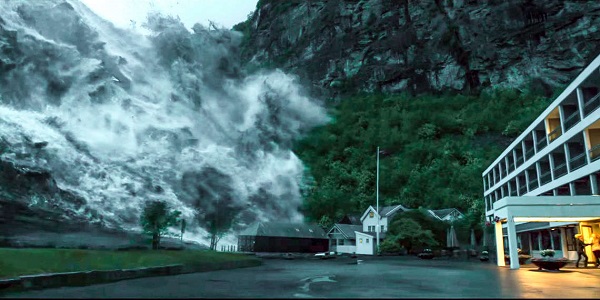
the-wave-CopyA lot of the films we cover on the site relate to the great ‘what if?’, the playing out of fantastical scenarios, some more realistic, many supernatural and many fairly impossible if not utterly so – but a genre we rarely get asked to cover is the disaster movie. It’s strange that so very few good disaster movies cross our paths, really, because if we’re fascinated with ‘what ifs’, then surely there’s plenty of horror and drama to derive from the ‘not ifs, whens’. This is the precise set-up for The Wave (aka Bølgen), a Norwegian-language disaster film which starts with some real-life footage of a twentieth-century rockslide which obliterated a Norwegian village called Geiranger. We’re told that this kind of rockslide will inevitably happen again in future, and that a site called the Åkernes Crevice is at especial risk of further widening, which when – not if – it does, will send a massive amount of debris into the fjord beneath, creating a tsunami likely to wipe out all of the picturesque homes on the fjord’s shores. It’s something you can’t help but bear in mind as you watch the film unfold, and whilst The Wave carries with it some tried-and-tested disaster movie plot devices, it’s already one step up in terms of engagement. Continue reading “DVD Review: The Wave (2015)”

Blu-ray Review: The Bloodstained Butterfly (1971)

bloodstained-butterfly

By Keri O’Shea

When is a giallo not a giallo? Sure, the cinematic tradition is expected to deliver crime drama as per the print publications which gave us the term ‘giallo’ in the first place, but the expectation is also there of a certain aesthetic on our screens, usually invoking sexuality as well as criminality; perhaps a good giallo understands that the lurid set-pieces are just as important as the crime itself, or at least, that a certain amount of spectacle will compensate for the often nonsensical solutions to those mysteries meant to form the heart of the plot.

bloodstained dvdThe Bloodstained Butterfly starts off with some understanding of this: a beautiful French student is found, dead, in the woods – wearing the bloodstained butterfly of the title around her neck, we assume (and the follow-up scene is of course of some amorous lovers, thus splicing death with sex, as is traditional.) Clearly there’s a maniac at large, or we wouldn’t be watching this story – but the heavy rain at the time of the killing has watched away the forensic evidence, and the killer managed to evade the dragnet which attempts to close in as soon as the alarm is raised. All that’s known about him, at this point, is that he’s clad in a beige raincoat. The hunt is on. Or, rather, we then see a slow succession of lab processes and meticulous ‘going over the evidence’ in order to close in on the possible culprit. When a witness comes forward to say she knows who the killer is, the case takes a turn: it seems, then, that the girl’s lover, a TV presenter, was the man responsible. Others corroborate, and soon the erstwhile TV star, Allesandro Marchi, is hauled into court on seemingly damning evidence of his involvement. Things are, however, rarely this straightforward. As the case is debated – at length – other factors are revealed, and it seems that Marchi might not be the maniac after all. A philanderer, yes, but perhaps not the murderer…

Considering the gaudiness of the title, this is a rather drab film beyond the initial impact of the opening scenes, which is certainly not something I expected. The rain, the mud, the dull clothes, the grey rooms and buildings, the largely understated dialogue, and the sense that the plot is being prolonged by a kind of mad attention to realistic criminal law did little to engage me as a viewer. The film’s tendency to go over and over footage from earlier on in the proceedings as the court considers it is, frankly, bloody boring too, and although it might be deemed necessary, it looks suspiciously like filler.

Perhaps this is the wrong term to use when describing a genre of films which almost always feature grisly murders, but The Bloodstained Butterfly just isn’t as much fun as you’d expect from even a passing awareness of its peer group. I mean, it’s nicely shot from a technical level, with a variety of locations, angles, shooting styles and the like, and there’s ever the possibility that it’s been misrepresented, somewhere along the line, which will often lead to disappointment – but there simply isn’t enough going on here, and when the film tries to add interest by delving into slightly more fantastical content, or even more salacious content, it jars. When you work so hard to go with realism, then you can’t really do much else. In fact, I felt so beaten down with the courtroom proceedings, that I found it quite difficult to get a handle on any of the characters thereafter – a shame, really, as there are some interesting cast members here (such as Salon Kitty’s Helmut Berger).

Whilst there are some elements here which can be applauded – the soundtrack is interesting, the time-capsule effect is abundant, the cinematography shows some skill, and above all there are attempts to render a gripping crime drama – I wouldn’t automatically peg this one as an obvious choice for a remaster and re-release by Arrow, as much as they’ve done a decent job on it. Still, if you’re a completist who loves vintage Italiana, then have at it, and take note of the fact that there are a few extras on offer too – namely an audio commentary by Alan Jones and Kim Newman, new interviews with Helmut Berger, Evelyn Stewart and Lorella de Luca – who speaks about her husband, director Duccio Tessari. There’s the usual gamut of trailers and still images, too.

The Bloodstained Butterfly will be released by Arrow Video on 22nd August, 2016.

Review: The Shallows (2016)

Isn’t it well past time that sharks became truly scary again? Beyond the original Jaws, it’s debatable any film has ever presented those formidable sea dwellers as true objects of terror, and in recent years it’s pretty much a given that any film which features the creatures in the title is going to be an utterly stupid, cut-price, SyFy Channel pantomime: Sharknado, Sharktopus, Mega Shark Vs Giant Octopus… and so it goes. It’s hugely encouraging then, to see a major Hollywood studio prepared to put some real weight (not to mention budget) behind a comparatively grounded tale of a lone surfer who inadvertently winds up caught in the middle of a great white’s feeding ground, and must fend off injury, exhaustion and overwhelming odds to stay alive. Whether the film in question winds up any more accurate a portrayal of real shark behaviour than any of the aforementioned direct-to-DVD schlockbusters is another story, but to a certain extent that’s hardly the point. You’ve got innumerable National Geographic documentaries out there if you want to see the truth about sharks; but if you want a gripping, tense survivalist thriller with a liberal dash of monster movie stirred in, The Shallows may be just what you’re after.

In many respects, The Shallows feels like a throwback to the intimate trapped-in-one-place shockers which sprang up a few years back – 127 Hours, Buried, Adam Green’s Frozen – but in concept and execution, I’m most reminded of the underrated Burning Bright (Brianna Evigan trapped in a house with a ravenous tiger? Forget about it).

Blake Lively takes the lead as Nancy, a Texan surfer and medical student who we’re told has recently dropped out of school, and gone on something of a personal pilgrimage to a secret beach somewhere in Mexico; so secret, she doesn’t even know the name of the place. However, it’s a place Nancy feels a deep connection to, as her recently deceased mother, also a surfer, rode the waves there whilst pregnant with her. Clearly Nancy’s got a bit of that classic surfer free spirit thing going on (or at least, that’s how surfers always are in the movies, I don’t know any in real life), but she also doesn’t seem that good at planning ahead; having got a ride through expansive woodland to a beach she doesn’t know the name of, she’s made zero arrangements to get back later, and misses her one chance at a ride when the two other surfers she meets there head off home while she’s still on the waves. And of course, it’s only once those guys are as good as gone that the shit hits the fan, as Nancy finds the ravaged carcass of a humpback whale floating nearby – the meal ticket of the dreaded Carcharodon Carcharias. But it would seem the whale meat hasn’t satisfied this big boy, as he proceeds to go straight after Nancy, who soon has a nasty bite in her leg, and only three possible places of refuge: the whale carcass, a patch of reef, and a rusty old buoy. And so the stand-off begins.

Originally entitled In The Deep – not the most appropriate title given it takes place 200 yards off shore* – Anthony Jaswinski’s script was named on the 2014 Black List, an annual Hollywood poll of the best un-produced screenplays on the market. It’s not hard to see how this was deemed a no-brainer with the studios: it provides a juicy role for an up-and-coming young actress, completely justifies keeping her in a bikini for more or less the duration, and combines an exotic sun-drenched setting with the mother of all nature’s terrors. However, while it works as a high-concept spectacle, it also manages to be a surprisingly intimate and understated affair, keeping things character-based without drowning (no pun intended) in gratuitous flashbacks and exposition. All this being the case, in some ways it is a surprise they cast Blake Lively – an actress who, despite having been in the business for some time, remains comparatively anonymous in the popular consciousness (she’s best known for being married to Ryan Reynolds, or to some of us for being the niece of Night of the Creeps star Jason Lively). Happily, this may be one of those roles they like to call ‘star-making.’ Lively’s relative anonymity works in her favour, and she proves more than up to the challenge of holding our attention with minimal dialogue. And yes, of course, it doesn’t hurt that she fills her skimpy bikini very well.

As for the other key attraction; director Jaume Collet-Serra adheres to the wisdom of Spielberg and keeps the shark mostly unseen, building tension through editing, suggestive camerawork and brief glimpses of the formidable antagonist. When we do see the big bad, it’s naturally all CGI, and that’s one place where The Shallows does slip up a little. While it is a studio production, it wasn’t exactly made on a blockbuster budget (IMDb lists its budget as $17 million), and it’s the FX that make this most evident. Sure, it’s more impressive than the rubbery sharks of the Jaws movies or the video game graphics of all those SyFy productions, but it’s hardly the most convincing CGI ever; this extends beyond the shark to a number of other sea creatures which make an appearance, as well as Lively’s face being digitally transposed onto her surfing double. These moments don’t ruin the film, but they do tend to take you out of the moment somewhat.

That having been said, the obvious CGI isn’t necessarily a problem if we think of The Shallows as a monster movie – and, all verisimilitude aside, that’s ultimately just what it is. I’m no shark expert, but it’s well established that they very rarely attack humans, so for one to so relentlessly stalk one the way this bad boy does – particularly once the inevitably melodramatic final act kicks in – pretty much beggars belief. But again, this isn’t a nature documentary; it’s a bit of crash-bang-wallop entertainment, and very effective at that. It’s truly tense throughout, and boasts more than a couple of old-fashioned jump scares which I’m not ashamed to admit got me. Obviously it’s not about to dethrone Jaws, but as a movie custom designed to make you afraid to go back in the water, The Shallows gets the job done better than many mainstream efforts in recent memory.

The Shallows is in cinemas now, from Sony.

*Just to further confuse matters, the upcoming Johannes Roberts shark movie 47 Meters Down was briefly set to be released as In The Deep.


Blu-Ray Review: Female Prisoner Scorpion – The Complete Collection

sasori

By Keri O’Shea

Imagine a sequence of films, emanating from Japan over forty years ago, which melded – literally – riotously strong female characters with insurrection, violence, sexuality and even the odd dash of social commentary. ‘Women in prison’ films (for the most part) like no other, the Female Convict movies (or ‘Female Prisoner’, in the translation being used by Arrow) are completely unique in 70s cult cinema – a well-crafted, artistic foray into the genre which soon superseded it, with the various films looking one minute like an arthouse project, the next a pure exploitation venture, and the next, something Sergio Leone would have been proud to call his own. Ambitious, beautifully well-made – but only available piecemeal until now, in a handful of releases in the US and Europe over the past ten to fifteen years, give or take. Perhaps in part because lead actress Meiko Kaji has resurfaced in cult film consciousness via her influence on, and singing on (!) in Kill Bill (say what you like about Quentin Tarantino, but he has introduced a lot of people to interesting films via his own fandom and references in his work) and of course thanks to the efforts of Arrow, who have already released some of Meiko’s early work, such as Blind Woman’s Curse, an appetite has developed for these films to be released in one definitive version – which, with this four-film box set, Arrow have delivered.

Because of the extraordinary type of these movies, made during a frenetic period of activity between just 1972-74, I’m going to avoid a lengthy review of each. For one thing, with four films in all, this would turn into a fairly lengthy, probably tedious read. Instead, save for a quick discussion of the barest details of each movie, I’m going to explain why these films are more than worthy of your time, in the hopes that if you haven’t encountered these films, you will. Slight bias? You betcha. These films are an absolute feast.

The first film, Female Prisoner #701: Scorpion (1972) quickly introduces us to Matsu, sometimes Nami (Meiko), a notorious convict making an attempted escape alongside one companion – the only person in the prison she seems to not disregard or loathe completely. This attempt fails and Matsu is punished horribly, spending a large share of the film hogtied…and utterly, utterly silent, whatever is being done to her. The corrupt cop who fitted her up is still worried about the implacable Matsu, however, and wants her assassinated inside the prison. Matsu fights for survival, a victim of unprecedented brutality by the guards, still quietly driven by her own desire for revenge – and the circumstances which arise from her treatment allows a few changes to take place…

Made later the same year, Female Prisoner Scorpion: Jailhouse 41 (1972) has many of the same plot devices, with Matsu now being openly referred to by her nickname – ‘Sasori’ (Scorpion) – and when we meet again, she has spent a whole year in isolation. She gets a short reprieve due to the arrival of an official who wishes to see all the inmates, and she of course takes her chances to escape again – though not before her rage and indignity is increased sevenfold by a ‘correctional’ rape. Alongside a new clutch of, in my opinion, a more fearsome group of convicts, including the incomparable Ôba, they and Sasori flee across and incredibly beautiful, if desolate landscape, back to civilisation – where the havoc of their lives and that which brought them to their current state turns out to be a deeply unsettling prospect for those they encounter, be they pursuing wardens, those once close to them, or members of the public.

Female Prisoner Scorpion: Beast Stable (1973) is the first film to differ from the ‘women in prison’ genre, turning instead into something of a yakuza thriller, with the renegade Sasori trying to live incognito, albeit that the opening scene rather blows her cover in a spectacularly grisly and almost comic way. This, our first protracted glimpse of life beyond the jailhouse walls, lacks the pace of the first two films, but the by-now characteristic flashes of ultraviolence and exploitation still link arms effectively with artistic shots and content. Another interesting aspect of the film is in its glimpses of urban sprawl and poverty, factors which eventually justify Nami’s ongoing and quenchless pursuit of vengeance for wrongs.

With the departure at this point of director Shunya Itô, I feel that the series could easily have wound to a close. However, there was one more part yet to come: Female Prisoner Scorpion #701: Grudge Song (1974). Here, the character of Sasori probably undergoes the biggest changes to date, saying more (which breaks a spell, of sorts) and committing a range of crimes which seem to show her as amoral or even immoral, rather than an agent of justice – which she has plausibly been until this point. Still, the symbolism is there for the asking, and the ongoing theme of police brutality is given free rein here. There are many strengths in the film, and so to an extent to call it the weakest of the four is not to damn it too much with faint praise. Considering the issues of a directorial swap mid-way through a series, this is still an accomplished movie which looks brilliant.

So, how to sum this set of films up…

scorpion 3

Under the incredibly skilled hand of director Shunya Itô – who was at the helm for the first three of the films, before handing over to Yasuharu Hasebe for Grudge Song (himself a talented fella who had previously directed Meiko Kaji in the Stray Cat Rock films, though had a rather different style) – these movies are the very embodiment of the ‘broiling pot’ which encapsulates so many women in prison films, all frustrated sexuality, rivalry, high emotions and violence as an ever-present force. But – and with the greatest of respect to the many WIP films which have all of those elements and use them very well – it’s never, ever been handled in such a painterly, exploratory way as the Female Prisoner Scorpion films.

These films certainly use exploitation elements, and don’t shy away from what can be described in no other way than reprehensible plot lines – rape, beatings, psychological torment, humiliation – but these interludes are balanced against an almost delicate understanding of colour, camera angle, choreography and photography – particularly, I feel, in the first two films. And it all works together so seamlessly. For example, in the second film: a hijacked vehicle scene permits some catharsis for the women, straight after the passengers – men who had fought in World War II – have finished boasting of their rapes of Chinese women. The tables are turned, the men are being singularly tormented for the women’s pleasure, and yet ten seconds later, Sasori, simply looking out of the window as they pass through a tunnel, is transported into a dreamscape – one where primary colours light tableaux of the women’s initial crimes being performed, and act as foreshadowing, showing her internal life in a very different way than her largely mute, if still completely striking, performance (she actually speaks just a handful of words during this entire film, and none until almost the close, without missing a beat in terms of strong characterisation.)

These are, throughout, very physical women, demonic instead of demure, where scenes of their prostration (such as rape) make the men look endlessly like clowns and caricatures, but simply send the women inwards – where they wait, Sasori and the others, ready to explode into violence. Meiko Kaji is, throughout the first three films, almost otherworldly. Indeed, the trials this actress went through for the part (such as being drenched with freezing water in the second film – warm water would have created steam and destroyed the effect, see) combine with her taciturn, cold presence and make her seem more like a supernatural force than a woman. Yet for all her single-minded cruelty, it’s impossible (for me at least) not to like her a great deal, perhaps Grudge Song notwithstanding. It all works, perhaps also because of the expected fragility of such a petite young woman, particularly in the Japanese culture of the day.

And as for Japan, whilst the films don’t hammer home any political messages per se, you may be pleasantly surprised to pick up on some of the layers of symbolism therein: the Japanese flag becomes a dab of blood on occasions, or forms the backdrop to a hurled blade in the first movie; the women in the prison rose garden in the first film accidentally give themselves Geisha-painted lips as they discuss their frustrated sex drives; there are teasing references to Japanese kabuki theatre or traditional music throughout the films. So – this all leads us to one of the most iconic Japanese actresses ever to grace our screens, in a unique and strongly-drawn role, amongst a whole host of agents of feminine strength and cruelty, filmed by visually-creative artists who have made films sharp enough to accommodate a whole wealth of styles and subtle symbols, too.

scorpion arrow boxThe Arrow release is, as I have suggested, the definitive deal, containing all of the films in their entirety: the prints look good, though the third film retains a rather grainy veneer, and the audio is solid throughout. This all brings me, however, to a rare smattering of criticisms. Firstly – the main cover art for this is rather lacklustre. No personal disrespect intended towards the artist, but this isn’t the usual calibre for an Arrow release, neither clearly in keeping with the manga style to my eye (which I dislike actually, but would tie in with the films’ origins) nor showing the draftsmanship I’ve come to expect. It surely takes some doing to make Meiko Kaji look ugly. Sorry. However, I haven’t seen the fold-outs or other materials, so these may be another story altogether.

Then we come to the now obligatory plethora of extras on the discs, and I’ll be the first to admit my heart tends to sink when I get a review disc packed with ‘special features’ because for the most part, I find special features rather unnecessary and laboursome. Were I not reviewing the release, I’d very likely not watch them at all; a quick straw poll on Twitter shows that many people disagree with me, mind you, but this is my own proviso for what follows. So, here, we have the usual trailers and chapters, some interesting input, such as from the art director Tadayuki Kuwana and director Shunya Itô, but also something called ‘appreciations’, half an hour or so apiece, which mean fans/critics talking you back through the film you’ve just seen – something I can’t see the point of, honestly. It would have been amazing to have had some new footage with Meiko Kaji, but sadly this hasn’t come to pass; ultimately I would say that, of all the special features, it’s the archive extras which lend the greatest insight, which suggests to me that the rush to add one’s own extras to a remastered release may reflect more what viewers expect than what they want, and extras may now also be a key consideration to justify the purchase price, when the films chosen for release should justify that in and of themselves.

Happily, here, the films do justify it in spades, and I have no hesitation in recommending these movies. They really are extraordinary pieces of work and you will not find their like anywhere else.

Female Prisoner Scorpion: The Complete Collection will be released as a limited edition by Arrow Video on August 8th 2016.

Blu-ray Review: Return of the Killer Tomatoes (1988)

killertomsprof

By Keri O’Shea

Well, here’s a blast from the past: if I remember correctly, and that’s a big ‘if’, Return of the Killer Tomatoes was one of the ragtag assemblage of films which seemed to play regularly on my dad’s illegal cable film channel back in the mid-to-late eighties. Between this film, Adventures in Babysitting, Howard the Duck and (spot the odd one out) Enemy Mine, I felt like I’d remember every word of this film when I got sent the screener for the recent Arrow re-release, so often was the film on in the background when I was a kid. Well, to cut a long story short, I didn’t – I’d forgotten vast swathes of it, and as far as I remembered, the word ‘tomatoes’ was even pronounced ‘tom-AH-toes’ in the title song, so before I really start worrying about my memory, I’d best talk about the film as it actually is.

killertomsAnd here’s the first thing I’d forgotten: the film-within-a-film framework which kicks things off, where a TV show called One Dollar Movie introduces the film alongside a very silly lottery for its viewers. Cue a FULL 80S beach scene, with lots of aimless bikini dancing to a ghetto blaster – wait, that’s the wrong film, so that’s exchanged, and then we’re into the intended film, which starts in a FULL 80S laboratory scene. You know an 80s laboratory – I’ve mentioned them at length before. Bright green liquids, pink and blue lighting, and a lab assistant who looks as if she’s dressed more to co-host on The Price is Right than work in STEM. Still – this, it seems, is illegal laboratory work, and the head of operations, Professor Gangreen, is performing gene-splicing experiments to transform tomatoes into humanoids – thus side-stepping the ban on all things tomato which has been in place since the Great Tomato War of some years hence. What does he hope to achieve by this? It’s not completely clear…something about taking over the world, probably. What we do discover is that Tara (Karen Mistal), the hot lab assistant, is actually crafted out of a tomato herself, and the Prof’s cruel treatment of her much-more tomatoey sibling, Fuzzy Tomato (FT for short) drives her to run away.

Tara seeks solace in the arms of her pizza delivery guy, Chad (Anthony Starke) on the grounds that he’s the only other person she knows. Any port in a storm – though, via a sequence of old newspaper front pages, we glean that Chad actually works for the old hero of the Tomato War, a man smart enough to thwart that threat but not to open a pizza restaurant, a foodstuff which relies quite heavily on tomatoes, all told. But can Chad, and his co-worker/roommate Matt (George Clooney!) help to stop the mad scientist and his machinations before the post-Tomato War peace is broken for good?

Return of the Killer Tomatoes was made some years after the 1970s prequel, and probably comes at the beginning of a sort of jaded, if well-intentioned self-awareness in genre film which we’re all too used to now. From the self-deprecating title song, to the handling on the back story, to the deliberate (and openly alluded to) filler in the form of clips from the first film, ROTKT knows it’s silly and makes this silliness part of the plot from the very beginning. It seems to be trying to emulate Airplane! in several respects, especially in terms of how very quickly the film cliches are thrown into the mix and in the amount of physical skits used, and although it’s not in the same league as the earlier, and more successful comedy, its attempts to channel that kind of humour carry it to a certain extent. That’s not to say it doesn’t overstay its welcome, though – for a film which promises killer tomatoes, there’s a lot of rather aimless human (or humanoid, at least) drama and that can be wearisome, and perhaps the earlier scenes in the laboratory, not least the film’s own title, promise a kind of madcap sci-fi movie that doesn’t really arrive. Part of the problem could be that Return of the Killer Tomatoes is possibly skewering a B-movie sci-fi tradition which could have been lost on the twentysomething target audience of the day who wouldn’t have known it very well, and for viewers now, with greater access to older films via DVD, Blu-ray and the internet, it’s not as lively as the films it parodies. Still, it’s got its moments, it never acts as though it’s better than it is, and it has sense enough to wrap things up after a reasonable duration. If nothing else, you can bask in the appearance of a youthful A-Lister George Clooney in a film about genetically-modified tomatoes – though to be fair to the guy, his filmography has always made it clear that he’s not afraid to take a punt in the dark. I hope we soon see Kevin Costner acknowledging his early appearances in Troma, in a similar vein…

As usual, this 80s time-capsule is a well-presented release from Arrow which comes with a modest array of special features, including an up-to-date interview with star Anthony Starke, some stills, a trailer and a TV spot.

Return of the Killer Tomatoes is available now from Arrow Films.

DVD Review: Captive (2015)

captive

By Keri O’Shea

Saw has a lot to answer for, doesn’t it? Since it appeared a little over a decade ago, it’s had a long-lasting and far-reaching impact on horror – for good, and for ill. Saw showed us that a horror story could be effective and gripping whilst being incredibly economical with characters and settings; by the by, and this is something that the team behind Saw can’t have predicted and shouldn’t be blamed for, it has convinced an army of low-budget filmmakers that they can do the same – that a horror story can unfold in a single room, with a small number of characters, and if Saw can do it – so can they! Here’s the rub – that confidence is often very, very misplaced. Which brings us to Captive (2015). Captive’s DVD release is proudly emblazoned with an (unattributed) cover quote which describes the film as a “cult gem in the same vein as Saw”. I don’t know who said that and I’d like to ask them a few things, but it would be more accurate to say that Captive is a brazen and mystifying attempt to re-frame Saw on a shoestring budget, and one which fails on every single score.

captivedvdThe plot hardly needs describing, given the above, but I’ll give it a whirl: we start with a room full of dead bodies, though with a couple of people left alive who are communicating with a mysterious someone via mobile phone (sound familiar?). They’ve decided to disguise their voice so thoroughly you can barely make out what they’re saying, which could have put a crimp in the plot, but basically it’s something about the people who are left having to follow commands to kill one another, which perhaps clues you in to why there are so many corpses in this particular dimly-lit room. You know where we’re going from here – yes, back in time, where we see some folks in HAZMAT gear dragging the inmates into the room, where they duly wake up and start wondering why they’re there. Whoever has put them there wants them to work out why they’ve been chosen, as well as spicing things up by getting them to bump one another off from time to time.

Oh, and there’s another element to the plot, too: apparently this is set in the future, a future where people are still using analogue alarm clocks and wearing clothes which are utterly in keeping with the current times, but yeah, this is the future, and the inmates have a virus. A virus! This manifestly contributes no originality to the film as a whole, but allows some very limited SFX at least, because viruses in these films always justify contact lenses/colouring in the eyes during post-production.

I don’t honestly enjoy tearing a film to shreds: I’d much prefer to be able to find something good to say about a film if someone’s bothered to get it made in the first place, but I can honestly think of nothing complimentary to say about Captive other than that the cast seem to be genuinely trying to inject some life into the film – even to the point of near-parodic scenery-chewing – and might have got somewhere, had they been given a script which didn’t ask them to repeatedly yell “We have to get out of here!” and other such ‘no shit, Sherlock’ moments throughout. The camera-work is dire (laughably filming through a HAZMAT mask to represent the point-of-view of the mysterious experimenters; using a zoom shot which then goes out of focus), the actors are not adequately miked up (everything echoes throughout) and the editing is a series of clunky physical jerks which can’t hide the fact that this plot is far, far too thin for a feature-length, especially considering it’s already been done more than once, and properly.

Indie cinema can be superb. It can be a space for resilient and resourceful filmmakers to tell stories without any of the pressures of big studios who demand tried-and-tested cinematic conventions; it can be innovative, refreshing and life-affirming. Or, it can be a cheap and nasty waste of time stemming from incomprehensible motivation and, in the case of the horror genre, startlingly cynical laziness – and it seems director and writer Stephen Patrick Kenny has form in this respect. There is nothing about Captive I can possibly recommend to anyone who enjoys film.

Captive is available on DVD now.

Film Review: Model Hunger (2016)

modelhunger

By Keri O’Shea

Most horror fans who have delved beyond the physical jerk-invoking shitfests being screened every Halloween will probably have an idea who Debbie Rochon is; add in a soft spot for low budget indie cinema, and chances are you’ll have seen more than a few offerings from her very extensive CV, especially if you’ve ever sat through a Troma movie or two. As of yet, however, despite many years in the business, she hasn’t been on the other side of the camera. Model Hunger (2016) is Rochon’s directorial debut, then – and it’s not more than a few frames before you can safely say that the apple doesn’t fall too far from the tree…

In that rather Troma-esque, overblown but twee style, all over-pronounced lines and omnipresent musical score, we start off with a troupe (correct plural?) of cheerleaders at practice, working hard to conceal the fact that they’re all actually and as-standard in their twenties. At the end of their session, their head honcho sends them out to ‘raise more money than last year’ for their charity of choice. The neighbourhood they head to is not much cop: the first guy to open his door seems to be hard of hearing, ha ha, but then they try a door down the street and meet Ginny (Lynn Lowry).

modelhungerposterAt first Ginny seems sweet, if the rather unlikely ‘little old lady’ that she’s apparently meant to present: t’isn’t long, though, before we can hear her inner thoughts (a staple of this film) and they are none too complimentary to the young ladies sat in her lounge now laughing at her ‘favourite show’, one of the film’s most baffling inclusions and something which features throughout – a shopping channel show where scream queen Suzi Lorraine, wearing a fat suit, rails against the indignities heaped upon ‘real women’ and tries to sell plus size clothes via a glamorous model, or rather an obese man in drag – an obese man who continually eats, as does Suzi, obviously. Hmm. Anyway, come some internal monologue about the shallowness of youth and beauty, it’s then time for the girls to be drugged, kidnapped and very soon afterwards hacked up for chow. As all of this happens in the first few minutes, I think I’m safe on the spoilers front: the film very much shows its trump hand early, albeit it then making us wait for anything much else in terms of plot.

However, another familiar indie horror face is moving into the area – step up one Deb (Tiffany Shepis) and her husband Sal (Carmine Capobianco), who have just taken a house on the street. Debbie is depressed and, after a fashion, recuperating – mainly by calling her husband an asshole repeatedly, and having traumatic dreams of family, though beyond this, very little context for Deb’s character is offered – a waste, and the reason for something of an imbalance between the two female leads.

Where Shepis is kept on the down-low, with very little to do for large parts of the film, there’s an attempt made to position Lowry as many things all at once. Whilst Ginny as a character definitely has some entertainingly deranged, sneering moments, though some of this may be due to recalling her understated performance in arguably one of her best-known roles in Shivers, overall her role in Model Hunger is confused, alternating between dear old lady (both being called this by others, and calling herself such), then hey presto! She’s a bat-wielding maniac, and then also an increasingly irate mouthpiece for the indignities of the beauty industry. Oh, and she has a sexy lingerie scene too. These latter elements, I think, would all have been easier to believe if we weren’t first asked to see Ginnie as an infirm old dear, which, despite being nearly seventy in real life, she doesn’t appear to be, whatever chintz she’s given to wear here.

As for the press release’s feted showdown between Shepis and Lowry, this largely consists of Deb growing ever more suspicious of her prim-and-proper neighbour, especially when people seem to be forever going into Ginny’s house but never resurfacing, before later – much, much later – deciding to investigate. If the film has a central core, it seems to be Ginny, trying to come to terms with her former life as a model and the fact that her body shape was just slightly too curvy for the fashion of the day. This translates to a hatred of other women, it seems, though the cannibal element is never explained. Presumably we’re entitled, even invited to join the dots and see it as a literal representation of how adverse beauty norms chew us women up and spit us out, or something – and certainly, other reviewers have praised the film for its commentary on the ‘male gaze’ and ‘unrealistic body expectations’, maybe because they don’t feel confident to contradict it. Well, all I’ll say is that this is an effective a critique of Western beauty standards as Redneck Zombies is of the North/South divide in modern America. There’s a lot here I can’t buy, basically, something which comes from the risk indie horror takes when it pays lip service to a serious theme like body image.

Your best bet, should you find yourself watching Model Hunger, is to leave any expectations of social commentary at the door. To focus on the positives: the SFX are practical, with plenty here for those who come out in a cold sweat at the thought of CGI; there’s some splatter, some flesh-eating, some recognisable indie movie faces, and that rough-and-ready feel which will be just as recognisable and familiar to plenty of viewers. Beyond that, however, like the body type being rejected over and over in the movie, this is all just a bit thin.

Model Hunger is available from July 12th 2016.

DVD Review: i-Lived (2015)

i-lived pic

By Keri O’Shea

‘Based on an idea by Franck Khalfoun’: these are surely words to warm the heart for many horror fans, albeit based on rather little. But his remake of Maniac in 2012 was stylish and redemptive, and his subsequent absence from what I’m reluctant to call ‘the scene’ has no doubt been noted. So here we are, several years later, with a new offering – i-Lived – a film he also directed and edited. So far, so good.

i-Lived dvdIt’s very early indeed in the film that we’re able to work out that Khalfoun has a talent for representing rather unlikable young men on our screens: oh, I know that’s based on an unrepresentative sample, but if you can make Elijah Wood into a terrifying creep, then you’ve clearly got form. With that in mind, we meet Josh (comedian Jeremiah Watkins), a young man whose personality is an unpalatable blend of dude-bro, frustrated geek and infantile Gen-Xer: when him and his friends aren’t wondering aloud how they can bang hot bitches, Josh hosts an online video channel, where his focus is reviewing phone apps. He lives for his follower count: this rather gets in the way of him paying his rent, pleasing his parents (who paid a lot of money to see him through college) or holding down a relationship, but for Josh, that’s always a set of issues for the next day. Well, one day he reviews an app called ‘i-Lived’. It’s meant to be a motivational application which helps you towards your life goals – Josh chooses ‘getting a six pack’ so he can attract women – but it falls flat, so he pans it online and thinks no more about it. That is, until the app kicks back into life while he’s at a party and, in a roundabout way, gets him a girl he thinks is out of his league.

Based on that small victory, Josh decides to keep on following the app’s advice, getting what he wants in return for uploading video ‘proof’ of his progress to the app’s website. From a country mile you could probably guess that the app’s requests would get sinister, and this duly happens. Whilst finding time for irrelevant sex scenes with a character-free girlfriend because boobs still sell, the plot thickens…

Well, to an extent. I like the idea of linking supernatural goings-on to modern technology, really I do – Unfriended was better than I ever expected – but i-Lived really does fail in what it tries to do here, i.e. to bring us a very modern spin on a parable of greed, with all the otherworldly fallout you’d possibly expect. The film badly lacks polish, and no small part of the fault must be laid at the door of the script, which could have used a lot more crafting to really make these characters work. When you have a sequence consisting of nothing much more than ‘Calm down!’ ‘No, YOU calm down!’ then what you have on screen is wasted time. I also felt like I was having the plot spelled out to me very, very carefully in places – as if I’d been given a bunch of tranquilisers and then asked to land a plane. Genre fans don’t need this, they’ve seen a thousand horror films and they can fathom what’s going on without the letters being writ ten feet high (read also: the big reveal ‘hidden’ in the app’s name. For shame.)

Adding to that, there are some surprisingly clumsy oversights during the film which, in their way, also detract from any sense of dread which may have been allowed to build. One of the app’s instructions to Josh makes little grammatical sense (oh I know, it’s pedantry, but would you obey a malign entity which couldn’t even master the lingo? I bloody wouldn’t.) – Josh gets a new tattoo when the app tells him to ‘be a rebel’, but it’s clearly not a new tattoo; the lights keep going out as a kind of convenient and cost-effective short-cut for ‘bad things going on’, and the whole ‘just a dream’ shtick seems to be used several times to pad the film out, which is pretty unforgivable. Yes, the film warms up somewhat, but it’s rather too little too late to redeem a plot which comes across as cartoon strip, so the gusto of the last few minutes is wasted, even if they’re some of the most attractive scenes in the film.

I think that i-Lived sets out to weave a horror story from the way that, yeah, many people live and die by their online presence these days – possibly thinking that it wouldn’t be too much of a leap to link this phenomenon to something of more standard horror fare. Sadly, i-Lived isn’t the indictment of how we live now which it might have been, and nor is it quite the update to an age-old yarn which Khalfoun might’ve imagined or hoped. This is a shame. Khalfoun is clearly capable of good things, far better things than this, and so ultimately it’s still the success of Maniac which could draw me towards his upcoming Amityville project – but goodwill and good memories can only carry a director so far.

i-Lived will be available to download on 27th June 2016, and available to buy on DVD on 11th July. The i-Lived app, which syncs with the film, will also be available to buy from iTunes and Google.

DVD Review: Intruders (2015)

140812ShutIn

By Keri O’Shea

Casting an eye over the upcoming cover art for Intruders, I found myself thinking two things: firstly, oh god, that Cabin in the Woods artwork has a lot to answer for, and secondly, hmm – there are a lot of household tools being showcased here; please don’t let this home invasion movie turn out to be yet another showreel for B&Q. Happily, although the odd trusty hammer does show up along the way, Intruders does rather different things with its subject matter overall and as such, raises itself high above the worst offenders of this sub-genre. In fact it often steps outside the sub-genre altogether, though without departing from ‘home’ as a source of horror, and this, too, is very much to its credit.

From the very first instance, our female lead, Anna (Beth Riesgraf) is depicted as a vulnerable, contested character – and hardly surprisingly is this the case, as she’s been nursing her terminally ill brother Conrad, whilst also battling with the double-whammy of severe agoraphobia. Whatever’s plagued them both in their lives, it’s clearly serious, and it leaves Anna wide open to additional trauma when her beloved brother’s expected, but still hard-hitting death occurs. Hey, and I should add that all of this happens before the opening credits roll.

intrudersFor all this – a tour through torment which could have come off feeling brusque and insincere – I felt a lot of immediate sympathy for Anna. Whether the subtle style of acting which Riesgraf brings to these events, or else the unflinching portrayal of disease and death we’re shown (platitudes about Conrad ‘going to a better place’ are either not forthcoming at all or are rendered implausible) the film makes itself instantly engaging. You also can’t help but feel from the get-go that this environment, the white-picket fence homestead which is nonetheless cluttered and littered with the detritus of defiantly not coping for ten years, is a powder keg, and one which may explode in ways other than the instantly obvious (because the film’s promo materials are pretty obvious about the fact that someone’s coming in…)

Sure enough, expecting Anna to be at her brother’s funeral (clue: she ain’t) here come some guys looking to find the hard cash they’ve heard is hidden in the ramshackle property somewhere. And the film’s plus points continue with these new players: rather than some amalgamous, super-human whole, the intruders are also characters, from your more standard issue, nogoodnik hick through to a pair of brothers who seem to think better of the whole thing a few moments after getting through the door. I mean, how would anyone feel when faced with a woman who’s desperate not to escape? Some sense of a lull ensues as the film takes us through a few back stories, sure, and there are some weaker moments in the plot as Anna plays multiple games of hide-and-seek in order to showcase her insider knowledge of the old place, but all of this winds up feeling necessary as it all gives way to what feels like a very different film altogether. There are also lots of interesting developments of the sets being used – some of which reminded me of The Seasoning House in aspects – and the possible context of all these surprising spaces isn’t any more seemly, either, although not the same by any stretch.

Intruders effectively changes tack throughout, ending up a long way from where it starts and yeah, in some ways which won’t be to everyone’s tastes, but what the film does very effectively is to keep the victim/villain dynamic shifting. It does this within the confines of the characters we have in front of us, and also by reaching out beyond the narrative itself, calling into question the behaviour of people who aren’t participating in the events on screen. That’s no small thing. Even if some aspects of the ending are a little frilly (though thinking of a way to wrap this up were always going to be tricky) then what you can definitely say here is that the film is an interesting look at those messy human impulses which people have, but rationalise differently – be this the desire for money, the desire for vengeance, guilt, lust, or even to make the world a better place; it all goes way beyond your traditional invasion movie, kept me gripped, and deserves credit as such. Kudos also to the stylish photography and editing throughout the film, and a foreboding musical score which fits the bill very well indeed.

Intruders is available via Studiocanal on 6th June 2016.

DVD Review: Cherry Tree (2015)

cherrytree

By Keri O’Shea

You’d think God and Satan wouldn’t have a great deal in common, what with being timeless adversaries and all, but they do: they each seem to have an unreasonable obsession with human fertility. One side thinks Onanism is a sin because it wants arses on pews and the other, well – most of Old Scratch’s plans for taking over the earth seem to involve getting women pregnant. It’s now something of an assumption, in horror cinema, that if you see a coven, there’ll be some edict about a ‘special child’ on its way soon after.

When you read the back story to Cherry Tree (2015), you won’t see much deviation from this. We’re told that, back in the day, the town of Orchard had a coven which believed that if a woman could bear a child to Satan, then they could use this to become all powerful. One witch tried to best Beelzebub at this time and the coven was destroyed – hence, a legend was born, a legend of the Orchard Coven and its association with a mysterious cherry tree…

cherrytreedvdAfter telling us this on-screen, kudos to the film for then getting a lesbian kiss into proceedings before much more than ten seconds of modern-day footage pass by. After snogging Sissy (Anna Walton), an old pal gets all embarrassed and beats a hasty retreat from the bar where they’d met – running smack bang into a horde of hood-wearing occultists, who spirit her away for some ritualistic goings-on near what we can assume is the self-same tree mentioned earlier. Unless there’s an orchard in Orchard, but that would probably be silly. Actually, we then segue to a classroom presentation about the legend of the tree, allowing us to combine these two different worlds in one fell swoop. Sissy has just become the hockey coach at this school; one member of the school hockey team is a troubled teen called Faith (Naomi Battrick – who in true cinematic tradition is more like twenty-five) and it soon becomes clear that this is our key character. Faith’s father is very ill, and when his prognosis worsens, she finds it very difficult to bear. Luckily, the soporific hockey mistress is there to be a shoulder to cry on, after a fashion at least. Faith is offered a deal, one which draws her in to a world of malign magic and – bingo! – pregnancy. Why aren’t women ever given anything else to do in demonology than have babies or trick other women into having them? #EverydaySexism

I am, after having watched (and slyly enjoyed) Cherry Tree, still not quite sure just how much we are supposed to take the film seriously; I’m not even really sure how seriously the writer and director are taking this: certainly, director David Keating also brought us Wake Wood, and certain similarities between the plots of both films can be gleaned, but it’s fair to say that the tone is rather different here, and it’s not a good idea to come to a viewing of the newer film expecting the atmospheres to be comparable. This is where I think the blurb will work against the film, as throwing around well-beloved titles like ‘Rosemary’s Baby’ as comparisons will, in my opinion, lead to disappointment. But, look, if you go in for lowest common denominator character and place names, then people will chuckle, rather than get a sense of dark forces at work, bringing all people and things together (‘Faith’? The ‘evil tree’ town called Orchard? And don’t get me started on that literal cherry-taking during the sex scene.) Cherry Tree also seems to be channeling Lord of Salem in some places, meaning that the film can sway from realistically-lit urban scenes to flashing unnatural lights during its occult shenanigans – again, whilst this can feel tonally odd, it perhaps underlines in my mind that this is an occult-lite take on the subject matter and that we’re meant to be diverted, but not necessarily ever scared. Of course, I could be way out on all of this, in which case I’ve seen humour where there isn’t any. That’s all rather worse as an outcome for the filmmakers, I guess…

And then, the film seems to court controversy in some areas, whilst covering its own back in others. Firstly, although the girls at the school are probably all well over the age of consent, they’re represented to us as fifteen year olds, so throwing the shower scene in there might raise an eyebrow – this sort of thing is a red rag to the BBFC bull, and speaking of them, what’s all this with having Anna Walton slitting her wrist on screen again, after all that furore about her doing the same thing in Soulmate? Perhaps it’s okay when it’s to do with raising Satan because this is less likely to be emulated by us weaker vessels, but the fact that they’ve used this very image in the press release, again, seems designed to cause a stir. But, after doing this, it then makes damn sure to declare that Faith is (just) over sixteen before anything sexual is permitted; it also excuses the old ‘pregnancy test which works the day after sex’ because occult. It’s pushing the envelope on one hand, and well aware of the limits on the other.

Ultimately, whatever the thinking behind what’s going on here, what you’ll get out of this film is entirely dependent on what you expect. If you’re hoping for a subtle, brooding folk horror then forget it, folks, you won’t be best pleased. However, if you accept this as pacy, piecemeal but entertaining occult schlock, then it’ll all wash over you nicely. Ultimately, Cherry Tree is far more comic book than grimoire.

Cherry Tree is available from Studiocanal now.