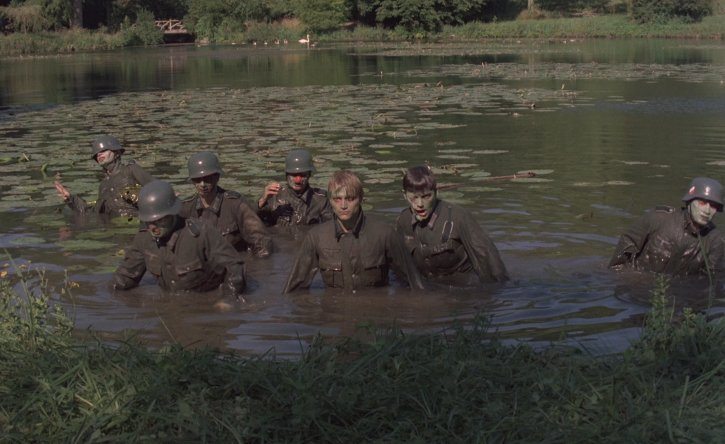
 Zombie Lake opens with a bit of a fib: there is no director by the name of ‘J.A. Laser’, and the pseudonym conceals the fact that the film was actually directed by Jean Rollin, who is of course better known for rather more artistic fare. It turns out that Zombie Lake had a bit of a troubled birth, with the original director, Jess Franco, quitting the project before it began. It then fell to Rollin to take up the reins, but by all accounts he was so mortified by the script that he decided to disguise the fact that he’d had anything to do with it. To be fair, though, misgivings about the script don’t excuse some of the ridiculous errors that occur throughout on Rollin’s watch, but somehow, this is all part of the full Zombie Lake experience.
Archive: Author: Keri O'Shea
DVD Review – Helga: She-Wolf of Stilberg (1978)
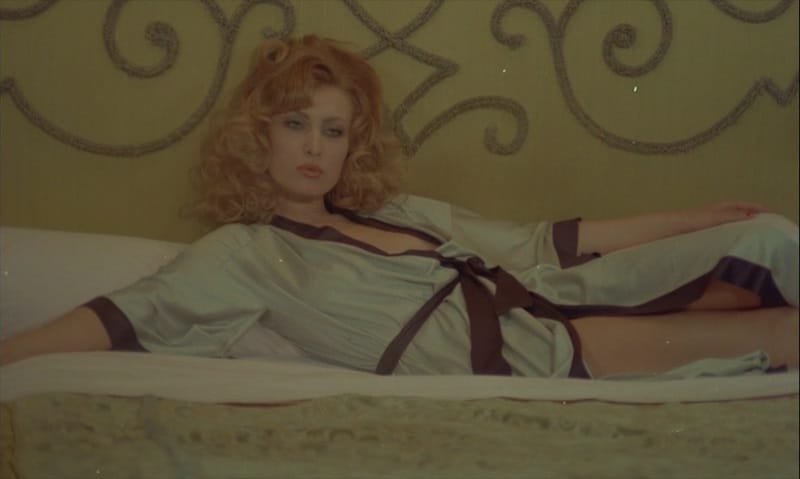 The first thing which hit me when I settled to watch Helga: She-Wolf of Stilberg – apart from the Lidl-like almost-familiar name (what exploitation classic could they possibly have had in mind when they named this one?) – was a feeling of profound disorientation. Surely, with a title like this, we were in store for a piece of mildly-derivative Nazisploitation? Well – yes; and no. But mainly no. Perhaps, I dunno, there was a bit of mild concern about making a film which openly referenced the Nazis, in France, so relatively soon after World War II? I suspect this may have been part of it, but from the very offset, this film feels a bit like the Exploitation Movie which Dare Not Speak Its Name. We’re apparently in some sort of politically-unstable version of France (?) where the soldiers wear striking red armbands bearing a distinctive symbol which IS NOT a swastika, and don’t you dare confuse the two; the blonde lady present at the argumentative interim-governmental meeting at the beginning of the film (Malisa Longo, who has form) is indeed a tyrannical nympho who gets sent off to a remote outpost to govern over female prisoners, but honestly, I don’t know why this would make you think of a certain other film…
Continue reading “DVD Review – Helga: She-Wolf of Stilberg (1978)”
“The Dead Don’t Sing” – TV Series Review: Taboo
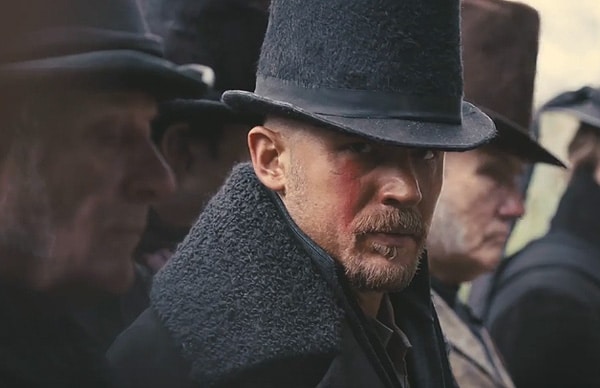 In many respects, my first reaction to seeing that actor Tom Hardy had thrown body, mind and soul – and a lot of income – into a BBC period drama was one of complete surprise. I mean, coming fresh off the success of Mad Max: Fury Road, then swapping the big rigs for horse-drawn carriages is a sizable shift; why would he, alongside his father and co-creator ‘Chips’ Hardy, take such a strange turn, or risk such a big gamble? Critics have also raised the question: The Guardian was quick to sneer at Taboo, dismissing it as “silly”, but having watched – and enjoyed – the first series, I think I get it. Although (presumably) hundreds of years and miles apart from Hardy’s most recent success on-screen as ‘Max’, Taboo builds on what Hardy now clearly knows he does very well. He’s bloody good at being dark and ambiguous and he’s equally good as a vital underpin to a story, though, as it turns out, both men are dependent on a number of other miscreants in order to properly rally against powerful forces which do far worse things than they, in terms of scale and magnitude. James Kaziah Delaney and Max have been spat out by the machine and they have done dreadful things along their route back to freedom; this makes them problematic, but perhaps all the more engaging for it.
Continue reading ““The Dead Don’t Sing” – TV Series Review: Taboo”
DVD Review: Army of One (2016)
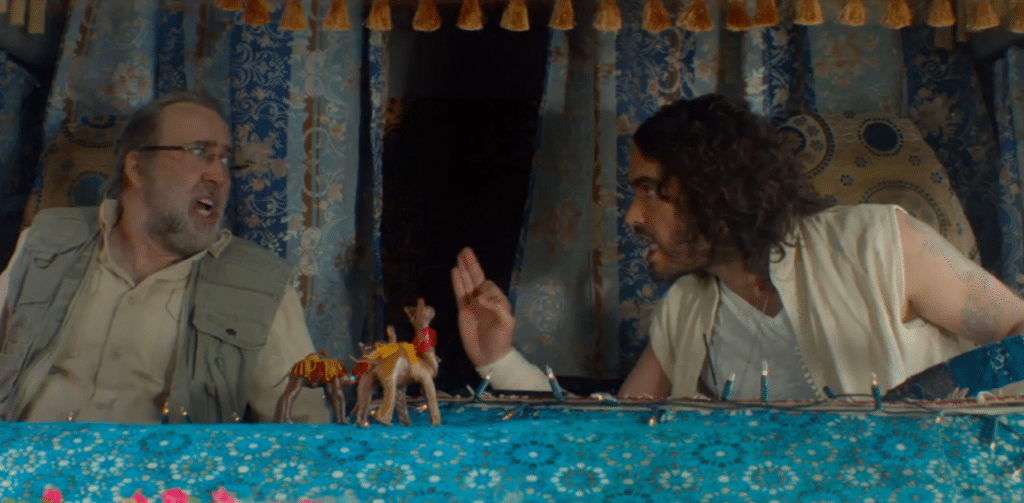 We’ve been saying since we launched Warped Perspective that we’d be covering a fairly broad selection of what could be termed ‘genre’ cinema, but it’s taken me until now to really put this into action. And, it has to be said, I elected to watch a film which was always going to pose certain issues for me. See, the star of the ‘based on a true story’ comedy, Army of One, is none other than Nicholas Cage. I have respect for Cage, as he’s been acting for a long time, and to be fair, he’s been in some films which I very much like – usually when his character is having the worst time of his life, now I think of it, such as in Leaving Las Vegas. However, in other roles, I find Cage’s jittery, manic stylings incredibly challenging to watch. It’s too intense; it saps the life out of the rest of the film (his performance in Vampire’s Kiss still hurts my mind). But if I veer between grudging admiration and utter exasperation when I watch Cage on screen, then it’s nothing compared to my feelings about Russell Brand, who also features here – as none other than God, a role Brand may well have felt very comfortable playing. So, a challenging cast, and a divisive director (Larry Charles, who gave us Borat). Army of One was sizing up to be a challenging prospect…
Blu Ray Review: The Stewardesses 3D (1969)
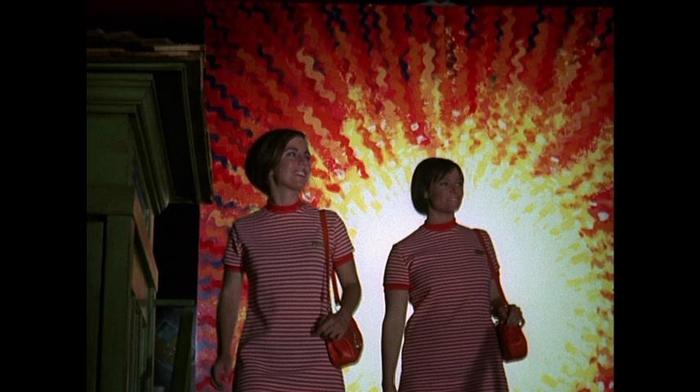 3D cinema may have undergone a bit of a resurgence in recent years, but it’s important to remember that – although we now have an array of new-fangled technology to enjoy it and a whole host of new films to go alongside – the phenomenon isn’t exactly new. Hence this brilliant little factoid on the cover of the Salvation Films Blu ray release of The Stewardesses: apparently, prior to Avatar (!) this was the highest-grossing 3D film of all time. Now if that’s a piece of the much-vaunted ‘fake news’ we’re currently hearing so much about, then it’s the kind I think we can approve of. But who knows? It could well be true. Before audiences wanted to be immersed into fictional universes, perhaps they wanted to be immersed into something rather more, shall we say, earthy…
Continue reading “Blu Ray Review: The Stewardesses 3D (1969)”
Film Review: Split (2016)
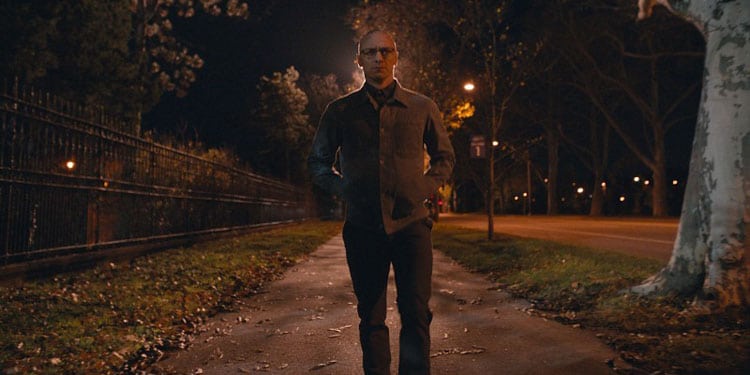 I think it’s fair to say that director M. Night Shyamalan has had a variable track record to date. After his big break, The Sixth Sense, made a new sport out of guessing-the-twist, he seemed to have landed straight at the top and seemed likely to stay there – but subsequent films saw this influence wane, with offerings such as Lady in the Water dividing fans and more recent efforts, namely The Last Airbender, uniting them again – mostly in derision. (I’ll admit I haven’t seen The Last Airbender, though whenever faced with Shyamalan’s most twee efforts, I always feel like Michael Jackson’s Earth Song is about to break out.) So, this brings us to his new film, the recently-released Split (2016), which features no spooks, no mysterious realms and no crop circles. On paper, it certainly seems like a concerted effort has been made to head in a new direction – but just how complete, and successful, is this departure?
Classic Film Review: Viy a.k.a. Spirit of Evil (1967)
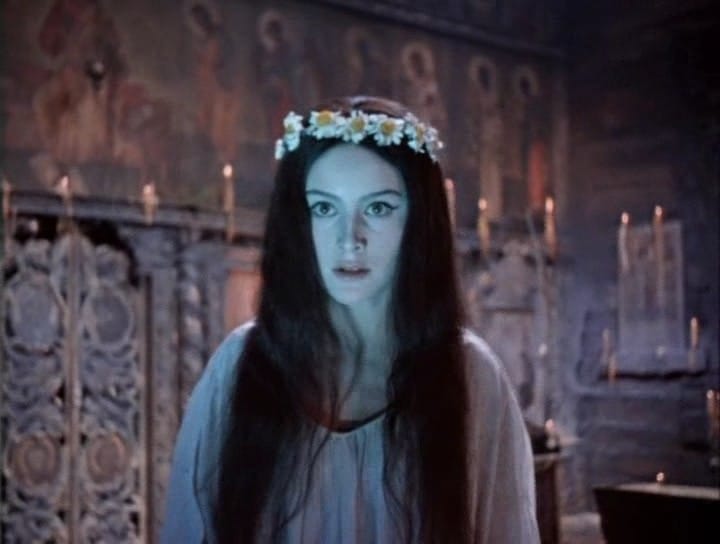
I’ve always thought it’s a crying shame that we generally know very little about Russian cinema; although many fine examples have made it across to the West, we can be sure that many have not, and even those which have are often very under-appreciated. And so it is that it has taken me around a decade from the point of seeing some intriguing stills in print from Viy (1967) to actually seeing the film itself. However, this omission has meant that I’ve just been able to see a film, which is now a staggering half a century old, as one amongst the most innovative supernatural yarns I’ve ever enjoyed to date. That is the magic of cinema. The best of it not only doesn’t have a best-before date; it actively gathers extra appeal from the intervening years, adding the charm of the time capsule effect to its other merits. Add Russian folklore into the mix and you also get that strange, but not displeasing distance, too – where the tales are similar, yet different; the predominant religion is unique, but also recognisable – and the threat of the otherworldly is so very Russian (or Ukrainian) in many ways, yet feels as though it’s interlaced with themes and ideas akin to many European stories.
Continue reading “Classic Film Review: Viy a.k.a. Spirit of Evil (1967)”
Magazine Review: The Reprobate Transmission #1
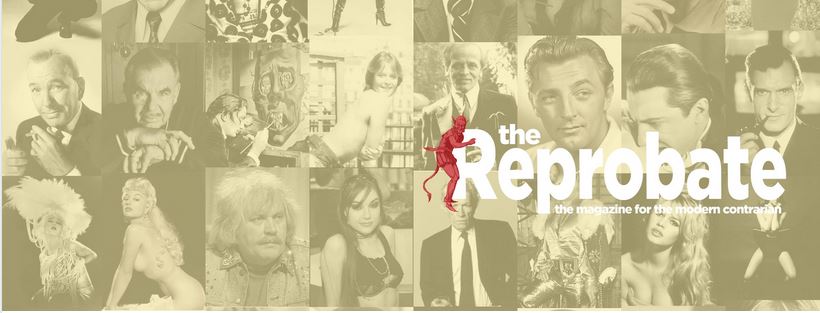
There seems to have been something of a resurgence in print media – alongside many other pre-internet media – in recent years; titles which had quietly slipped off the radar are back, and the indie press, which many folk had anticipated would have disintegrated by now, is ticking along rather nicely. Even we (that is, our previous incarnation, Brutal as Hell) have been at it, and a very enjoyable thing it is to do. I have to admit, there is just something compelling about the physical product; it calls to mind the old excitement of ordering, awaiting and then enjoying a magazine or fanzine – an excitement which is simply missing in the immediacy of the online world. And this isn’t simply blithe nostalgia, believe me; these labours of love tend to bring together disparate, but interesting voices. Such is the case with the new print project, The Reprobate.
Continue reading “Magazine Review: The Reprobate Transmission #1”
Editorial: The Lousy Lot of the Fan Writer?
 An email was sent out recently by a well-established website who are seeking new writers to help them keep on top of the relentless flow of tidbits and news which fans might like to read. People applied to find out more, and received the following reply from the site in question – and I’m not going to play coy here, the site in question was HeyUGuys:
‘At the moment we’re looking for news writers to help us with the day to day running of the site. We don’t want to be churning out news to cover everything and anything but we are keen to get news to become a bit more prominent on the website. We don’t have huge amounts of cash to play with but we’re looking at paying around £1 per article. We hope that over the course of a month if we can do 2 or 3 per day it may add up to a tidy sum.’
Now, pick the bones out of that one. £1 per news item: two or three news items per day (probably around half an hour to an hour a pop, going on my own pace of writing) which could potentially lead to a whopping £20 or more per week. A tidy sum, indeed. Not only is the amount of money being offered here insulting and unliveable for anyone trying to sustain themselves professionally as a writer, I’m not even sure you could get away with it legally. Even if you were in the unfortunate position of having to supplement your existing wages in this way, it would hardly be worth the time and trouble. However, this email neatly encapsulates, for me, some of the issues facing fan writers in these times. Namely – should you write for free? Write for a pittance? Or hold out for better things?
Continue reading “Editorial: The Lousy Lot of the Fan Writer?”
Book Review: Satanic Panic – Pop-Cultural Paranoia in the 1980s
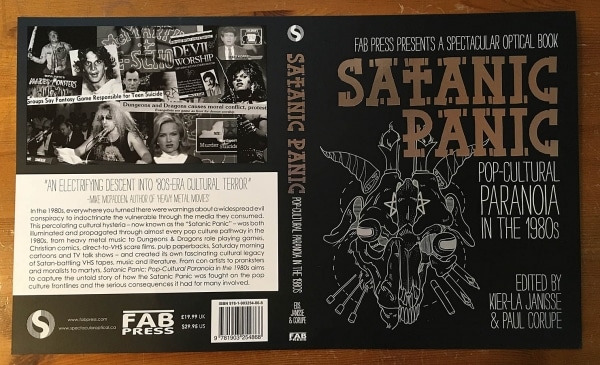 The so-called ‘Satanic Panic’ of the Eighties (with some fallout in the following decade) is a curious phenomenon – one born out of a collision of new media, psychiatry, pop-psychiatry and pop culture. It’s one of those things which could – and did – run and run, borne aloft by its ‘hidden’ status (how do you disprove a secret?) and of course its seductive promise of illicit sex, cult activity, crime and murder – all available for concerned parties to enjoy, whilst simultaneously fretting and disdaining it all, of course. Various theses and books on the subject have appeared piecemeal over the years, but never before has there been such an exhaustive examination of the phenomenon as offered by the recent FAB Press release Satanic Panic – a book which brings together a number of commentators and invites them to offer their expertise on the topic in their own particular styles and from their own perspectives.
Continue reading “Book Review: Satanic Panic – Pop-Cultural Paranoia in the 1980s”
Welcome to our Warped Perspective!
 Hello, Happy New Year, and welcome to our new project, Warped Perspective…
For those of you who have followed us over from our previous site, Brutal as Hell, then you may already see how and why we’ve chosen the new site name. Truth be told, it was co-founder and co-editor Ben Bussey who came up with it very early on in the process of finding a new name which we felt encapsulated what we already do (and what we’re planning to do here). On several occasions, over the many years that our team has now been writing together, we’ve jokingly said that Brutal as Hell should rightly be re-named ‘Contrary as Fuck’ – because it’s often felt as if we’re at odds with so many consensus opinions on genre film: not through deliberately being bloody-minded, but because first and foremost we’ve always approached our writing from our point of view as fans, not in anyone’s pay or employ, not trying to shower directors with hyperbole to get their attention and certainly not being motivated by the (for some) tantalising prospect of cover quotes or bogus thumbs-ups for diluted or downright dishonest opinions. Our perspective has always been very much our own; once Ben had come up with the now-current title, we felt it was a good fit. But there’s more to it than that…