Blu-Ray Review: 247°F


Review by Stephanie Scaife

We are all aware that horror is an immensely popular and profitable genre, hence the number of straight-to-video releases that line the shelves on a weekly basis. This has resulted in the horror genre being viewed as a quick cash-in for many studios and these cheaply made, fast-turnover movies have seen the increase of two particular subgenres: the oft-maligned found footage film (Paranormal Activity, REC, Grave Encounters etc.) and the trapped-in-a-single-location film (Frozen, Buried, Open Water etc.) and, with a few exceptions, you can generally assume that these films will be predictable and generally pretty tedious. 247°F falls into the latter category and even up against its barrel-scraping counterparts this is a pitifully dull film.

247°F opens with a car crash where Jenna (Scout Taylor-Compton) loses her boyfriend; I guess this is to explain as to why she’s so moody and withdrawn as it serves very little function as to the rest of the narrative, which soon moves us forward 3 years where we catch up with Jenna and three friends as they head out to spend the weekend at a lakeside cabin. Jenna is obviously still recovering from her accident and her friend Renee (Christina Ulloa) has decided it would do her good to get away and rather unsubtly be set up with her boyfriend Michael’s (Michael Copon) sporting buddy Ian (Travis Van Winkle). The cabin belongs to Ian’s mildly creepy uncle Wade (Tyler Mane) and is suitably secluded and remote, as you’d expect from such a film. The question is, what is awaiting our irritating young co-eds? Is it rednecks? Chainsaw wielding maniacs? Nope, it’s a sauna. This film is about getting trapped in a sauna. Now just think about that for a second… bored yet? Well, imagine 90 minutes of it and you’re not even close to how mind-numbing this film is.

For a while we get some inane banter whilst Jenna and company have a few beers, get into the sauna, go swimming, get back into the sauna, go swimming again, then finally get back into the sauna yet again. Michael ends up getting wasted and inadvertently locking the other three in. We then have a very long period of time where everyone is fairly hysterical and shouting and whatnot, but there is absolutely zero tension and even less scares. What is most frustrating, however, is just how fucking ridiculous and unfeasible the whole thing is. Obviously suspension of disbelief is at the core of being an appreciator of the horror genre, but there’s only so much you can take before you completely switch off and start wondering what to make for dinner, or hell, even if watching paint dry would be more entertaining. Even a host of nubile young stars in nothing but their skivvies wears thin after about two seconds as they spout inane dialogue and generally get on your last nerve. What’s even worse is that there aren’t even any grizzly deaths to break up the inanity; I don’t want to give too much of a spoiler (not that anyone gives a shit) but barely any of the characters die! 247°F is a giant steaming turd of a film that is as dull as it is forgettable. One to avoid at all costs.

247°F is released to DVD and Blu-ray in the UK on 18th March, from Anchor Bay.

DVD Review: Ray Harryhausen: Special Effects Titan (2013)

Review by Ben Bussey

Early on in this documentary, John Landis reiterates something he’s said many times about Ray Harryhausen over the years, explaining why he thinks the stop-motion master occupies a truly unique position in film history: this is the fact that he is the only notable case of technician as auteur. Really, would anyone dispute this? Sure, there are notable special effects guys that may have become household names, in particularly genre-savvy households at least – the likes of Stan Winston, Rick Baker, Dennis Muren, Phil Tippet – but even their most ardent admirers would surely concede that their efforts are at best collaborations with the director, facilitating the vision of Spielberg, Cameron et al. However, Ray Harryhausen is something else entirely, and each one of the aforementioned men (the dearly departed Winston aside) profess as much in Gilles Penso’s film.

Harryhausen never directed a feature film, never wrote a screenplay, never played the leading man, and yet we immediately identify the films on which he worked as his films. As is oft remarked here, few people recall who directed The Beast from 20,000 Fathoms, Jason and the Argonauts, Clash of the Titans, or any of the Sinbad movies, nor do we necessarily remember who the principle actors were (Raquel Welch in One Million Years BC notwithstanding), but we all know the name of the man who brought the films to life with his still-amazing stop-motion animation; and, as this film persausively argues, Harryhausen’s personality shines through his extraordinary creations in such a way that, although we never saw him in front of the camera, he really was the star of the show.

This, of course, is a pretty popular point of view, which I’ve no doubt most knowledgable film fans will have heard many times. Indeed, there really isn’t a great deal in Ray Harryhausen: Special Effects Titan that existing fans of the man and his work will not have seen, heard or read elsewhere. In addition, the widely available Columbia/Tri-Star DVD of Jason and the Argonauts features full-length documentary The Harryhausen Chronicles (narrated by Leonard Nimoy, no less) and a short video of Landis interviewing Harryhausen, between which they cover near enough the exact same ground that is covered here, some anecdotes recounted almost identically word for word.

Still, as anyone who’s ever made a remake will tell us, if a story’s worth telling, it’s usually worth telling more than once. In a Q&A included on the extras disc, director Penso and producers Alexandre Poncet and Tony Dalton emphasise that a large part of their intent here was to educate a new generation of potential Harryhausen fans who might not necessarily appreciate the man’s singular significance. To this end they’ve grabbed interviews with every big name in contemporary genre filmmaking they could get hold of, including Spielberg, Cameron, Peter Jackson, Guillermo del Toro, Tim Burton, John Lasseter and more besides, as well as a wide range of special effects designers from many a modern blockbuster, and in a cute touch each interviewee’s name caption is topped with an icon from their most recognised work: a Millenium Falcon for Dennis Muren, Avatar’s Neytiri for James Cameron, and Sinbad’s Cyclops for the man himself (see below). Seasoned fans might find it a little patronising how the film sees the need to assume such ignorance on the part of the viewer, and draw so heavily on the iconography of films that Harryhausen was not involved in (why use the Indiana Jones font for the title, for instance?), but given that the intent is to underline the role Harryhausen played in forging the spectacle-based blockbuster cinema with which we have long since grown accustomed, these are minor sins.

Ray Harryhausen: Special Effects Titan also addresses questions on how things have changed since CGI took over. It’s curious to note (even though, to my recollection, no one in the documentary does) that only a year after Harryhausen bowed out with Clash of the Titans (1981), CGI first broke through in Tron (1982). Opinions vary amongst the interview subjects as to the relative merits of different special effects forms; Jim Cameron speculates that if Harryhausen were a young man working today he would be using CGI, but almost no one else sees it that way, emphasising the personal touch that’s so important to Ray’s work which can only really be found in stop-motion, not to mention its inherent dreamlike quality; the photorealism that Cameron aspires to was never what Harryhausen was going for. Personally, I’ve often pondered whether he was a little premature in his retirement, given that stop-motion was still around in the 1980s: take the skeletal Terminator, ED-209, or the big battlin’ bots of Robot Jox. Not that it’s easy to imagine Harryhausen working on such violent films, given how resolutely family-friendly his work tended to be. Perhaps this also indicates part of why he retired when he did; not only was his brand of special effects dying out, but also the overall tone of fantasy film was shifting into something harsher and darker, with an underlying cynicism that’s worlds apart from the wide-eyed wonder of Ray’s films.

So no, it doesn’t provide an especially new perspective on its subject matter, and in terms of production values it leaves a bit to be desired (the sound and lighting are pretty sub-par in many of the interviews), but even so Ray Harryhausen: Special Effects Titan has value as a time capsule of a unique artist and his legacy. It is a little disconcerting to hear someone who’s still alive spoken of in such a eulogistic manner, even though the man’s into his 90s, but it’s also quite refreshing and inspiring to see that someone who has been retired for most of my lifetime is still around and perhaps even more influential now than he was in his active years. And, given the wealth of clips, stills and behind the scenes snippets in the film itself, plus the deluge of bonus material on the second disc including extended interviews, deleted scenes, Q&A footage from festival screenings and plenty more, die-hard Ray Harryhausen fans will surely find this a worthwhile purchase, even if it doesn’t tell them much which they don’t already know.

Ray Harryhausen – Special Effects Titan is available now on Region 2 DVD and Blu-Ray, from Arrow Films.

DVD Review: The Fallow Field


Review by Kit Rathenar

I wasn’t sure what to expect from British retro indie horror The Fallow Field, the feature-length debut of director Leigh Dovey, but let me say at once that I ended up being pleasantly surprised by it. Steve Garry stars here as Matt Sadler, a man having a very bad life. When you wake up lying in a field somewhere in Surrey with a week missing from your memory and stagger home only to be dumped by both your missus and your mistress with a mere couple of hours between the two, you’d think life couldn’t get much worse, but Matt’s only at the beginning of the downhill slide. Unconsciously seeking to retrace the steps he took in his missing week, he finds himself wandering through the countryside, where he ends up at a farm run by an old loner named Calham. It quickly becomes clear that he’s in way over his head… and, despite the gaps in Matt’s memories, that this isn’t the first time he’s been caught up in Calham’s psychotic games.

It’s an interesting premise, but the film opens shakily. The opening scenes feel like something from one of those rural soap operas that I remember my older relatives watching in the eighties. The direction is workmanlike with minimal flair, the camerawork, lighting and overall production values are of a quality I can best describe as somewhere between seventies low-budget and classic BBC, and Michael Dacre’s Calham initially presents as the English stereotyping equivalent of calling a character Billy-Bob and having him say “y’all” every fourth word. And for the first third or so of the film, that’s really all we get. The dialogue repeatedly veers into cliche (to the point where I could lipsync some lines word for word despite never having seen the movie before) and there’s a constant sense of frustration that we share with Matt as he tries to work out exactly what the hell is wrong with Calham to make him do the (usual, run-of-the-mill) terrible things he does to innocent passers-by. It all seems very much like we’ve seen it before.

But then, abruptly, it picks up. The plot takes a twist as the unique nature of Calham’s murderous setup is revealed (I won’t spoiler, but it wasn’t what I was expecting and took the film straight out of the purely mundane) and suddenly the story finds its feet and comes to life, in more senses than one. To the point where by the final scenes I was yelling at the screen in excitement, because The Fallow Field managed to give me something that I truly love in horror and a lot of films these days don’t offer me: a hero with a backbone. I grew up on the likes of Nancy from Nightmare on Elm Street, Kirsty from Hellraiser, Ash from Evil Dead – the kind of protagonists who may scream and run when the situation demands it, but are never helpless lambs to the slaughter. And that’s when facing true supernatural evil, at that. I’m nauseated by the modern penchant for merely-human psychos whose sick little schemes are made to seem godlike purely by having the supposed heroes behave like so many lengths of intellectually-challenged wet string. Calham is one of those human psychos; despite having found possibly the ultimate way to get away with his crimes, he is, at heart, still just an overgrown schoolboy sociopath pulling the wings off human flies in the privacy of his own tiny little world. He hasn’t got the stomach for a fair fight, or the self-awareness to cope with anything other than a helpless victim who follows his script to the letter.

And as such, I despised him wholeheartedly – and when he finally pushes Matt too far, I found the consequences not only satisfying but outright inspirational to watch. Steve Garry’s performance as Matt is the highlight of the movie for me, indeed, as he balances the character believably between weakness and strength while keeping him convincingly relatable throughout. Matt isn’t perfect, he’s no square-jawed superman, just a regular guy. But he’s a basically decent human being, with an inner force of will that, you get the impression, surprises even him when he finally discovers it. I never lost my sympathy or liking for him and I actually cared whether he lived or died, and I’ll always give any horror movie props for achieving that.

The Fallow Field probably won’t appeal to everyone. If you do like the aforesaid helplessness-porn school of slasher/psycho movies you may not appreciate the ballsiness it shows in its handling of character, and it’s not a gorehound’s movie simply because it’s oddly shy about showing any significant brutality – fades to black are the order of the day whenever it seems on the verge of going into a torture scene. But if you’re a fan of unsettling, slow-burn, character-driven films as per the likes of The Wicker Man, you might enjoy the damaged, skewed and yet still oddly uplifting sense of humanity that The Fallow Field has to offer. From a faltering start to a great finale, this is a movie that’s worth giving a chance to show its quality.

The Fallow Field is out now on Region 2 DVD, from Monster Pictures.

DVD Review: Stitches (2012)

Review by Tristan Bishop

If you’re a horror fan advancing in years you may remember the dark days of the early-to-mid nineties, where genre product was at its lowest ebb since the late 1940s. The late 80s comedy horror craze had run its course, and before (love it or hate it) Wes Craven’s Scream revitalised horror with big budgets, teen superstars and a soupçon of intelligence, we were forced to contend with the absolute dregs – with films such as Dr Giggles and the godawful British Funnyman (surely a career low for Christopher Lee?) being the only choices in the new releases.

Oddly enough when I first read the synopsis for Stitches, a brand new Irish attempt at comedy horror, somewhere in the long-forgotten depths of my memory a Stygian bell began to sound and I wondered why I was experiencing such dread – of course, the plot reminded me a lot of the aforementioned Funnyman. But, I reasoned, we are twenty years on now, those days are (hopefully) gone forever, and, well, after the torture porn epidemic and with ongoing global austerity, maybe we could do with a few laughs anyway?

Stitches sees the comedian Ross Noble in his first screen role in this Irish production as the titular character: a grubby, offensive clown who has sex in full costume and lives in a grotty caravan. He has been booked to play at a ten year old’s birthday party, but it doesn’t go very well – in fact the kids are so unamused that they turn the tables on Stitches, culminating in a shoelace-tying prank that goes horribly wrong, ending with an extremely dead clown with a kitchen knife through his face (he’ll need more than ‘stitches’ after that, lemme tell ya). Tom is understandably a little disturbed by these proceedings, and even more so when, spying through a telescope in his tree house, he observes not only the sparsely attended clown’s funeral, but also a late night creepy ritual by the ‘clown society’ which appears to involve some kind of black magic…

We flash forward 6 years – Tom is now a nervous teenager about to celebrate his 17th birthday in a quiet manner, but, in true horror tradition, with the ‘help’ of his enthusiastic friends it turns into a massive, messy teen party. But amongst all the drinking, snogging and drama, someone has come back to take his revenge on the kids who killed him…

So you will by now have realised that Stitches isn’t going to win any awards for originality. Nor will it be winning any awards for subtlety – Stitches is a film which is crude, tasteless and doesn’t really care. Although some attempt is made at engaging our sympathies with the lead character and the girl he has always had a crush on, all the teen drama is really just filler until Stitches the zombie clown goes on his killing spree – and what a spree it is! In fact, this homage to the 80s slasher showcases some of the more inventive gore effects I have seen in recent years (and most of them physical too, aside from a couple of instances of dodgy CGI); I will admit that, although unmoved and unamused when the clown was off-screen, these sequences made me laugh like a drain. I could have done without the wisecracks after the kills however, which almost always fall flat (although in a way this adds to the retro charm).

Speaking of which, I found Ross Noble a more than slightly odd bit of casting – I’ve been lucky enough to catch a few of the man’s live shows, in which he more often than not jettisons any prepared material and riffs off of the crowd, often to hilariously surreal effect, so it’s odd to see him a role without that much dialogue or energy. He does look convincingly grimy, bulky and threatening, however, and is the best thing amongst a capable but rather dull young cast (who at least genuinely look teenage – unlike the 30-something school kids of the 80s slashers). The film does have a couple of other areas of charm too – The whole bit about painted eggs embodying a clown’s soul (which is what enables Stitches to return from the grave) is a wonderful piece of hokum, and, surprisingly, comes from a real life custom (although in reality the eggs are smashed when a clown dies). The music is also very impressive, with some songs with an almost 60s psychedelic feel providing a breath of fresh air from the usual identikit emo that filmmakers associate with teens.

Stitches, then, is not big or clever (or even remotely scary, unless you really really don’t like clowns), but it pitches itself perfectly as a post-pub movie with some great sick laughs; it’s a film that you could watch with a bunch of talkative friends without missing any major plot points.

Stitches is available now on Region 2 DVD and Blu-Ray from Kaleidoscope Home Entertainment. It comes to Region 1 on April 2nd, from Dark Sky Films.


Review: Hansel & Gretel: Witch Hunters (2013)

Review by Ben Bussey

Once upon a time a young brother and sister were lost in the woods, happened upon a house made of gingerbread, got lured inside by its luscious goodies and wound up prisoners of an evil witch who wanted to eat them, until the kiddies turned the tables and shoved the old hag into her own flaming oven. That part we all know, of course. But once you’ve seen the dark places that lie off the beaten path, how do you get back home again? Maybe you don’t. Maybe instead you stay lost in the woods and spend your life hunting down witches, using strangely 20th century-looking weapons and speaking in American accents.

Sounds silly? Good. That’s because it is. I know it, you know it, and I daresay everyone involved in the production of Hansel & Gretel: Witch Hunters knows it too. Really, that isn’t even the issue here. Obviously the movie is absurd; the real question we should be asking is whether it’s absurd enough. And we might not get the answer we’re hoping for, I’m afraid.

I’ve had the feeling for some time that I was one of the only people genuinely excited about this film, which is not to say I don’t understand the reasons for the widespread disdain it has been met with. What with the recent, feeble takes on Alice in Wonderland and Snow White (both of them), and the upcoming, less-than-stellar looking Jack the Giant Slayer and Oz the Great and Powerful, a lot of us are getting tired of Hollywood dishing up all these overpriced revisionist fairy tale movies, up to their bloodshot eyeballs in CGI and (as it is here) gratuitous, ticket-price boosting 3D. On top of which, big-budget studio takes on supernatural horror don’t have the best track record this past decade or so (The Wolfman, anyone?). All this considered, it’s understandable that many of us feared Hansel & Gretel: Witch Hunters was just going to be some midway point between Van Helsing and Underworld. Don’t worry – it’s not that bad. It doesn’t take itself anywhere near as seriously as either of those films, and – most importantly by comparison with the atrocious Van Helsing – it doesn’t outstay its welcome. With so many bloated studio movies these days going on longer than two bloody hours, Hansel & Gretel is a most welcome change of pace, coming in at less than 90 minutes including credits. No simple popcorn movie should need to be any longer. More of it, I say.

Sadly, running time is not the only thing Hansel & Gretel runs a little short on. The key problem is, though this is a film that puts the emphasis firmly on fun, it just isn’t that funny. With the deliberately anachronistic accents, weapons and gizmos, there was clearly great potential for laughs aplenty, but we’re sorely lacking in great one-liners or inventive set pieces here. As well as directing, Tommy Wirkola holds solo writing credit – and as much as I hate to say it, if this script was indeed his work alone (Hollywood script doctors often go uncredited, after all), it definitely could have done with some extensive rewriting. The dialogue for the most part is pretty dull, and low on wit – just throwing in a “fuck” every now and then won’t cut it, I’m afraid – and the story structure is pretty sloppy too, with an abundance of plot strands that either don’t go anywhere or are not resolved very well. None of it feels as sharp as it needs to be, which perhaps unsurprisingly can also be said of the inevitable deluge of CG – which, alas, appears to cover the bulk of the gore. Still, practical make-up would seem to account for at least some of the witches, as well as one of the film’s most entertaining creations: the troll portrayed by Derek Mears. I’m not going to tell you his name, as it gives the film one of its few genuine laugh-out-loud moments.

So no, it doesn’t have the most laughs, or the best gore, or a particularly good story. But you know what? It’s still fun. Given you’re in and out of there so quick, the chances of boredom setting in are so much slimmer. There’s just about enough bang for buck here to keep the less discerning viewer entertained. And let’s not be coy, it doesn’t hurt that it has a very pretty cast. Honestly, they had me at Gemma Arteton in a leather corset; add Famke Jannsen (in an enjoyably pantomime turn as the big bad) and there was no going back. Then along comes Finnish actress Pihla Viitala as Hansel’s love interest and (as the trailers have already given away) provider of nudity, and fans of the female form are spoilt rotten. For the other half, Jeremy Renner does spend a bit of time with his shirt off too.

When all is said and done, though, it’s hard not to view Hansel & Gretel: Witch Hunters as something of a missed opportunity. It just doesn’t have that unfettered, anarchic sensibility which made Wirkola’s breakthrough movie Dead Snow so much fun; all those belly laughs and ‘what-the-fuck’ moments are notable by their absence here. We can’t help suspecting that Hollywood politics may have come into play, and that Wirkola may have been strongarmed into neutering his vision under studio pressure; or if he simply felt a fish out of water in charge of such a larger scale production. Either way, the resulting film is simply too workmanlike to be anywhere near as memorable or iconic as it had the potential to be, which is a real shame. But even so, as undemanding mainstream fare goes, we’ve all seen plenty worse. In other words – this gingerbread house is rather underbaked, and it crumbles to dust when you pick at it, but it still tastes pretty sweet on the way down.

Hansel & Gretel: Witch Hunters is in cinemas all over the place right now, from Paramount, MGM and MTV Films.


DVD Review: Slasher House (2012)

Review by Ben Bussey

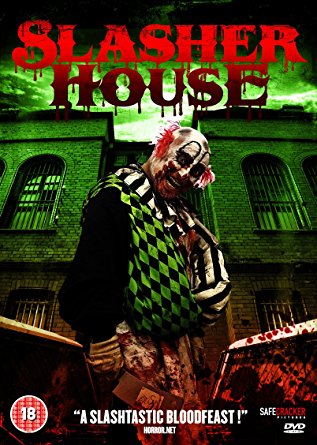
Remember that time-honoured and rather fuddy-duddy-ish maxim, ‘red and green should never be seen’? Well, I think it’s safe to assume writer-director MJ Dixon doesn’t, or if he does he’s made a concerted effort to thumb his nose at that particular convention of good taste. This alone demonstrates the debt his first film owes to the golden age of 80s horror, in which lurid neon lighting was very much the order of the day; if it seems a bit tacky, I daresay that’s probably not an accident. From beginning to end, Slasher House hums with an almost radioactive red and green glow, revelling in the contrast of those tones, from the central protagonist’s pillar-box hair to the pallid, pissy tones of the walls in the mysterious, crumbling prison in which our heroine wakes up, stark bollock naked, to find herself incarcerated, with no memory of how she wound up there or why – or even who she is. As for how she’ll escape, what answers she will find, and what will happen in the interim – well, given the trashy 80s horror vibe, we can obviously expect a bit of the old ultraviolence.

As I’ve blathered on about at length before, there are many pros and cons to microbudget horror. As viewers, we are immediately required to enter into a specific mindset, and accept certain inevitabilities: it will look a bit like a home movie, the sound quality will be variable as will the performances, and the make-up effects and whatnot will demand a tad more suspension of disbelief than usual. Slasher House does not avoid any of those major pitfalls, and as such the temptation will be great to dismiss it offhand as bargain basement crap. However, as bargain hunting professionals will assure you, sometimes you find some good stuff hidden at the bottom of the barrel. Such is the case here. If you can get past the fact that it wears its microbudget status on its sleeve, you may find Slasher House to be a perfectly enjoyable bit of colourful, comic book-flavoured fun.

From the trailer I sensed a strong comic book vibe to Slasher House – vaguely reminiscent (not that I’m in any way suggesting it’s a rip-off) of Tim Seeley’s Hack/Slash – and this is every bit as much in evidence in the final film. Again, it’s a factor that requires a particular approach on the part of the viewer, as the action and the physicality of the characters will invariably have an exaggerated quality, and there will be a stilted, somewhat unnatural feel to the dialogue (watch the extras on the Blade 2 DVD – Guillermo del Toro explains it way better than I can). As we follow the enigmatic ‘Red’ (Eleanor James) through the quiet, mysterious house of horror and gradually get a sense of what’s going on, we have plenty of moments where it wouldn’t seem out of place for an exclamation mark or the words “WHAT THE -?”  to suddenly pop up in a thought bubble over her head. Things only get more comic book-ish as we go on, once we meet a verbose psycho (the wonderfully named Wellington Grosvenor), a drooling killer clown (cover boy Andrew M. Greenwood), and a ruddy great wrestler type in a skull mask equipped with improbably oversized machetes (Alex Grimshaw). In case you hadn’t gathered yet, realism is not especially high on the agenda here.

However, whilst suspending disbelief may go some way to excusing certain quibbles, there were always going to be bigger issues with realising such a potentially cool high concept on a microbudget. When the central conceit is an abandoned prison populated with a small bunch of serial killing supervillains who must battle to the death, some great fight scenes and gore FX wouldn’t go amiss. Unfortunately, Slasher House does come up a bit short on these. While Dixon’s camerawork and editing capture the action just fine, what action there is a bit lacking in punch. Proceedings are also thrown off course every so often by a few rather gratuitous flashback cutaways, briefly taking us out of the prison to show the killers at work, none of which serves much purpose beyond boosting the running time and the body count. And even if we accept that performances in films of this nature will always be a bit stilted, Wellington Grosvenor’s over-talkative turn as Hannibal Lecter in a hunting cap is just a bit too stiff for my liking, whilst Adam Williams’ seemingly innocent and ineffectual Nathan also comes off just a little too feeble. (Credit where it’s due though – while it’s immediately apparent there must be more to that character than meets the eye, I must admit I didn’t see what was coming.)

Still, Eleanor James makes for a fairly charismatic lead. Her line delivery may again have that stiffness about it, but Dixon the screenwriter serves her quite well with some fairly witty one-liners. We might question the need for her to be nude when we meet her, given all the males are conspicuously clothed in their first appearances, but to be fair the scene is played more for sly comedy value than sleazy voyeurism, with strategically placed objects obscuring her naughty bits in much the style of Austin Powers. Either way, fans of the female bottom will have nothing to complain about. Nor, for that matter, will fans of 80s-style horror soundtracks, as the pulsating guitar and synth-fuelled score by Paul William Swindells is really quite something; honestly, it wouldn’t sound out of place in a big budget movie, and contributes immeasurably to the overall atmosphere. It’s another element that lifts Slasher House above the average for microbudget horror. Fans of the cheap, cheerful and cartoonish, dive on in; just remember my earlier words about entering the correct mindset.

Slasher House is released to Region 2 DVD on 29th April, from Safecracker Pictures.

Review: The ABCs of Death (2012)


Review by Tristan Bishop

The horror anthology film has a long and chequered history – from the rightly-lauded Ealing Studios curveball Dead Of Night (1945) through the 60s/70s Amicus boom (which brought us classics like 1965’s Dr Terror’s House Of Horrors and 1974’s From Beyond The Grave, but also climaxed in one of the worst films ever committed to celluloid, Roy Ward Baker’s 1981 abomination The Monster Club) and to 80s triumphs like Creepshow, and the more recent Trick’r Treat. The ABCs Of Death is the latest in that lineage, but is rather more extreme. Not in terms of graphic content (although some of the segments certainly go way beyond anything found in the aforementioned films), but in sheer scope, as what we are presented with here are 26 short films in just over two hours (the end credits take up a generous amount of running time!)

The mathematically-minded amongst you have probably already gone “What? An average of 4 minutes per film? Surely that’s a ludicrously short amount of time to tell a story in?” And yes, it is. In contrast to the aforementioned anthologies – in which the segments were generally around 20 minutes, and were usually tied up with some kind of wraparound segment which had stories being told by one or more characters – ABCs goes straight in and presents a film for each letter of the alphabet which corresponds to the death(s) on screen: from A for Apocalypse, to Z for Zetsemetsu. What’s more, each of the segments is directed by a different director from around the world, each of whom had to make their segment with $5000 given to them by producer Ant Timpson.

This makes ABCs both a difficult and very easy film to review. Difficult because of the sheer scope of subject material and tone on display here – the films range from gore fests to arty vignettes to all-out comedies. And very easy because I’m sure you’re already aware from the above that ABCs is an intriguing, often-fascinating, often-pointless and almost hilariously uneven watch.

One very impressive aspect is the amount of talent on display here – such genre names as Ben Wheatley, Xavier Gens, Srdjan Spasojevic, Ti West and Noboru Iguchi. One would be forgiven for thinking this is a snapshot of the state of the horror scene at the moment, but as the directors are given free rein and tight budgets/times the results tend to be a little different when freed from the usual commercially-imposed constraints of the horror genre.

I will now give a quick run-down of the best and worst/most interesting segments here (taking care to avoid any spoilers, which is tough considering the length of some of these):

Dogfight by Marcel Sarmiento (co-director of Deadgirl, a film I have avoided due to the unpleasant subject matter and reception) is possibly my favourite of the bunch. A beautifully filmed revenge tale without dialogue set in an underground world where men fight dogs for money. Dogfight impresses with very clever editing and cinematography, and makes me want to keep an eye on Sarmiento’s future work.
Exterminate by Angela Bettis is one of the most disappointing segments here, especially as I am a big fan of Bettis’ acting work with Lucky McKee. Here she phones in a well-known urban myth without humour or flair.
Fart by Noboru Iguchi seems to be one of the more unpopular segments here, but I guess Iguchi’s blend of punk rock attitude, disgusting subject matter and twisted sweetness as evidenced in films such as Dead Sushi and Mutant Girls Squad are an acquired taste. Personally I laughed like a drain at this one (and also felt a bit queasy).
Hydro-Electric Diffusion by Thomas Malling (previous credit : Norwegian Ninja!) is one of the oddest in the bunch, and comes across as a live action WWII Tex Avery cartoon as played by furries. Your enjoyment of this one probably depends on your tolerance for silliness and/or amount of drugs consumed in your lifetime. I thought it was awesome.
Libido by Timo Tjahjanto (Macabre) is one of the nastiest pieces in the film, and brought to mind A Serbian Film with its mix of violence and sex. Unlike A Serbian Film however, any type of political element is unclear and it ends up being shocking for the sake of shock. That said, it is an effective entry, and certainly serves to keep the viewer awake.
Miscarriage by Ti West is very short, nasty, offensive and pointless and only adds to further mystify me to the enduring popularity of West. Possibly the weakest episode here, even worse as I suspect we are meant to find it amusing.
Orgasm by Bruno Forzani and Héléne Catte, the creators of the divisive Amer, is the most abstract of the bunch. If you enjoyed Amer then this blend of pop-art and kink should be right up your street. If not, you’ll shrug it off.
Quack by Adam Wingard and Simon Barrett is an amusing and self-referential entry (one of two here, alongside the execrable WTF) and contains some of the bigger laughs in the film.
Removed by Srdjan Spasojevic (of Serbian Film infamy) is an interesting, bloody but very arty piece about the nature of film making. Some arresting imagery here, but bound to disappoint those looking for the savagery of his earlier work.
Toilet by Lee Hardcastle is included here as the result of a competition held to find the 26th segment for the film, and it turns out to be one of the most entertaining here – a claymation childhood nightmare which delivers a perfect mixture of laughs and gore.

WTF by Jon Schnepp is just horrible – what I can only assume is the wet dream of a 13 year old boy who has been trapped inside a Commodore Amiga.
XXL by Xavier Gens is a something of a feminist comment on society’s attitude to imperfect bodies. Commendable but lacks the punch it should have had.

In summing up – if you’ve ever sat through a short film selection at a film festival you’ll have exactly the right idea what to expect from ABCs Of Death. You certainly won’t come away feeling overly satisfied, but that’s the nature of the beast. However if you are interested in the short film form as an artwork in itself then this is essential viewing. Just be warned, it’s a very uneven ride indeed.

Monster Pictures release The ABCs of Death to 26 cinemas around the UK from 26th April (full details here), before releasing it to Region 2 DVD and Blu-ray on 3rd June.

Blu-ray Review: From Beyond (1986)

Review by Stephanie Scaife

I can clearly picture the artwork of the From Beyond VHS, as it was burned into my retinas as a child, peering at the lurid titles in the horror section of my local video store. So I’m genuinely shocked that it’s taken me approximately 20 years to actually get around to watching this, especially as I’m a massive fan of Stuart Gordon’s Re-Animator (1985) – and boy, it most certainly didn’t disappoint! I’ll admit to having a particular soft spot for body horror and From Beyond provides all that and more, giving us a no holds barred exercise in all things degenerate and disgusting.

What there is of a plot is loosely based on the H.P. Lovecraft short story of the same name. As the story is only about seven pages long most of it happens before the opening credits even roll, not that it doesn’t retain the spirit of Lovecraft throughout its lurid and now fully restored duration. From Beyond centres around the experiments of your typical mad scientist by the name of Dr. Pretorious who has created a machine called a Resonator which stimulates the pineal gland, allowing you to perceive alternate realities. Aided by his assistant Crawford Tillinghast (Jeffrey Combs) they activate the machine, letting some icky monsters in from a parallel universe. Pretorious is bitten by one of these beasties and in his crazed state refuses to turn off the machine, leading to all hell breaking loose in the lab. Tillinghast manages to escape, only to find himself arrested for the murder of Pretorious – the cops not really buying his story about monsters and what not – and he is soon committed to a psychiatric hospital. This is where he meets Dr. McMichaels (Barbara Crampton) who does buy into his story, and bails him out into her custody. They then return to the house along with the homicide detective investigating the case, the rather awesomely named Detective Bubba Brownlee (Ken Foree). Of course, by activating the Resonator once again, yet more monsters are unleashed along with a now severely deformed Dr. Pretorious who essentially goes about terrorising our trio in a host of disgusting and slimy ways.

Now, although this isn’t quite up there with Re-Animator it’s still pretty fucking awesome! What I love about Stuart Gordon, and of a lot of the body horror that came out of the 1980s, was the desire to create genuine horror and depravity, and From Beyond has lashings of both. I mean, is it really integral to the plot for Dr. Pretorious to also have a sex dungeon in his mansion along with his science lab? No, but it means there’s a good excuse to get Barbara Crampton dressed in some bondage gear before fighting some giant toothy worms. On top of this we also get a few genuinely icky moments, particularly when Tillinghast’s engorged pineal gland forms an antennae that protrudes directly from his forehead and turns him into a crazed psychopath that wants to eat human brains, by sucking them directly out of his victim’s eye socket. Yes this film really is as crazy as it sounds.

From Beyond really is a lot of fun, the special effects are something to behold proving yet again that in-camera effects and stop motion will always be better than CGI. In the words of Carolyn Purdy-Gordon, who stars in the film and in real life is married to director Stuart Gordon, From Beyond is aimed at the kind of people who “blow their nose then examine the contents of the tissue afterwards”. In other words, if you have a high tolerance for ick and a natural curiosity for the obscene then you’ll find much here to appreciate. There is so much slime (which they thought would get around the MPAA’s aversion to blood, only to discover they found it even more offensive!) and some really creative effects work that is discussed at length in some of the many extensive special features this fantastic Blu-ray has to offer. Speaking of which, this disc comes with a fantastic set of special features, including: Stuart Gordon on From Beyond; Gothic Adaptation – an interview with writer Dennis Paoli; The Doctor is in – an interview with Barbara Crampton; Monsters & Slime – the FX of From Beyond; The Editing Room – Lost and Found; and Commentary with Stuart Gordon, Brian Yuzna and Jeffrey Combs, plus much more. All of which makes this lovingly restored film a must have for any horror fan.

From Beyond is out now on Region 2 DVD and Blu-ray, from Second Sight.


DVD Review: I Didn’t Come Here To Die

Review by Ben Bussey

Towards the end of this film, one of the few surviving characters asks another whether or not fate, destiny or whatever might have played a role in the preceding events, to which the other succinctly replies, “I think shit happens, and then you die.” In a way, this exchange quite neatly sums up I Didn’t Come Here To Die. Far from the painfully formulaic slasher which you might expect based on the official artwork (in particular the god-awful hack job used in the US), Bradley Scott Sullivan’s debut feature is a fun, witty and inventive twist on the stereotypical backwoods horror, managing to subvert expectation even whilst adhering to that most fundamental horror movie principle: everything that can go wrong will go wrong.

A ragtag bunch of mismatched, college-age kids head out into an ultra-remote location in the wilderness, about fifty miles from civilisation with – wait for it – no cellphone reception whatsoever. As part of a brilliantly-named volunteer group (I won’t ruin the gag here), the six of them are there to build a camp where disadvantaged youngsters can come for one of those once-in-a-lifetime great outdoors experience things. All very noble. Of course, guidelines dictate no alcohol, hanky panky or any other such naughty behaviour. Naturally, our young protagonists aren’t ones to toe the line too closely, in particular the wild-haired, muscle-shirted Chris (cover boy Niko Red Star). And we all know how it goes: as soon as you break the rules, bad things happen. Given they’re out in the middle of nowhere, equipped with axes and chainsaws they only just about know how to use, how could things not go wrong? Still, the threat here isn’t so simple as a power tool-wielding maniac. It’s more a string of accidents and mistakes that sees things go from bad, to worse, to much worse. So, is it just a case of shit happening, or is it something more? Well, if it is something more, it would seem fate definitely does have a cruel sense of humour.

In a recent interview at Ain’t It Cool News, Sullivan confessed to being a little anxious as to how his film – which first screened in festivals almost two years ago – would hold up in the aftermath of the comedic horror films that have come since, in particular Tucker and Dale Versus Evil, which runs a similar line in accidental death played as much for laughs as shocks. His concerns are not entirely unfounded, but overall I Didn’t Come Here To Die is a pretty different kettle of fish. Where Tucker and Dale was ultimately a broad comedy with added gore (not a criticism), this is a more even balance of humour, drama and viscera. As is also noted at AICN, there’s a certain similarity to The Cabin in the Woods in that, while it doesn’t directly make reference to specific films like all those damn 90s slashers did, I Didn’t Come Here To Die does knowingly play on genre convention and audience expectation.  We’re well aware that death is coming for most if not all of these young scallywags, we just don’t quite know how or in what order, or indeed why. Obviously it’s tricky to discuss further without venturing into Spoilerville, but in I Didn’t Come Here To Die the very pointlessness of it all does rather seem to be the point. It’s not exactly an exercise in outright nihilism, as there is a clear logic to what’s going on, which might imply something supernatural at work. It isn’t that fate/God/the universe/whatever is indifferent to these people – it’s actively working against them. That description probably makes it all sound a bit Final Destination, but that’s not quite the vibe of this film either. It really is its own thing.

Clearly a very low budget affair, the film uses its limited resources to far better effect than many. The DV photography has a nicely grainy effect, and the sound quality is very good considering it was all shot on location; there’s none of that persistent background hiss we often get from the microbudgets. That said, the use of digital trickery in the night scenes (it appears they shot day-for-night and digitally darkened the image in post-production) is obvious and a little jarring, and there are instances of the now near-obligatory Grindhouse shaky projector effects which – while thankfully sporadic – also feel a tad overfamiliar (surely another disadvantage of the film having sat on the shelf for two years).

However, one element of the film which is definitely above average for its level is the cast, all of whom turn in good performances. The UK cover art sells Niko Red Star as the central attraction, and fair enough, as his somewhat Jack Nicholson-esque turn does come close to stealing the movie, although it does feel like he’s showboating a bit much at times. As befits the whole playing-with-convention angle, the characters broadly fit existing archetypes without pandering to them; Jeremy Vandermause’s Steve is the dim one without being a complete village idiot, whilst Emmy Robbin’s Sophia is the sexy one without being a bimbo, and so on and so forth. Relationships develop in interesting and unexpected ways as successive characters are taken out of the loop, and the fun lies in never quite knowing how things will proceed, until the final scene brings it all full circle quite beautifully. And of course, most vitally for a film of this nature, the gore gags are brilliantly conceived, staged and executed, with tremendous timing.

This is not to suggest I Didn’t Come Here To Die is necessarily any kind of trailblazing masterwork, however. You may have noticed the review quotes on the cover and in the trailer excitedly likening Sullivan’s film to Evil Dead and Texas Chainsaw, but I really don’t think it’s in quite that league; Cabin Fever may be a more apt point of reference, and not only for its slasher-without-actual-killer angle. It’s a fun concept, but it’s hardly going to redefine the genre, nor is it ever particularly scary. It also feels a bit meandering at times; even though it clocks in at barely 75 minutes there are a few moments which feel like they belong in the deleted scenes, in particular a lengthy dialogue exchange in the final minutes. Even so, I Didn’t Come Here To Die definitely marks out Bradley Scott Sullivan as a director of considerable potential. Clearly this is a filmmaker who knows, loves and understands the genre, and we’ve seen directors who have gone on to tremendous success from less impressive débuts than this.

In short – no, I Didn’t Come Here To Die doesn’t completely rewrite the rulebook, but it’s making notable efforts to do something different whilst delivering everything we expect from a good backwoods splatter movie. It might not change the game, but it’s well worth your time, and its writer-director is most definitely one to watch out for.

I Didn’t Come Here To Die is out now on Region 1 DVD and VOD via Millenium Entertainment, and comes to Region 2 DVD on 15th April from Second Sight Entertainment.

NOTE: Since this review came online, the official cover art has changed again. Sigh…

Review: Goodbye, Little Betty (2013)

Review by Annie Riordan

“Little Betty’s sleeping in the graveyard, living there in burgundy and white.
Dead babies can’t take care of themselves, dead babies can’t take things off the shelf.
Well, we didn’t love you anyway.
Goodbye, Little Betty…”
~ Alice Cooper

Wow, what a pretentious piece of shit this film is. Overlong, tedious, derivative… jeez, this makes A Serbian Film look like a masterpiece of sublime subtlety. Oh if only this movie could have been drowned in the tub like an unwanted kitten. Please, for the love of God, somebody nuke Sweden before it can produce another flaming bag of runny feces like this one.

I’m totally kidding,of course. This is the fourth film by Ronny Carlsson that I’ve had the honor of watching/reviewing, and – given his masochistic penchant for demanding truth, even if it means an abysmally negative review – I thought I’d finally give him what he’s been half-expecting and sort of asking for all these years.

Goodbye, Little Betty is – in Carlsson’s own words – an attempt to return to a more “spontaneous, experimental side of filmmaking that isn’t as present in a more planned and budgeted film like Dust Box,” Carlsson’s previous full-length dramatic feature due to be released on DVD later this year. Filmed entirely on a camera phone, Betty is the woefully bleak tale of a girl, as silent and beautiful as the frozen Swedish landscape she wanders through. Seemingly oblivious to the beauty of winter around her, “Betty” (poetess and collaborator Daniela Melin – a gorgeous, raven-haired waif) is drawn to electrical wire, able to find it embedded in the floorboards of abandoned houses or hidden in the thick forest undergrowth. Every length of cord she finds goes into her backpack and then she’s off again, crossing icy creeks and crunching through the snow like a carefree child. Like a crow, Betty’s eye is drawn to anything and everything that is shiny and metallic, all of which is added to her scavenger’s collection. But as her journey continues and no clear destination makes itself known, Betty’s utter aloneness becomes increasingly more apparent and the silence grows deafening. Is she wandering through a post-apocalyptic world? Or is she trapped in her own world, isolated by her addiction to technology and inability to “connect” with the real world?

Several years ago, I came across a photo on some image sharing site or another. It depicted a group of teenagers walking together on a bright, Spring day. But rather than conversing amongst themselves, every single one of them held a cell phone in their hand and stared silently down as they walked, lost in their own little worlds and seemingly oblivious of everything, and everyone, around them. It perfectly captured the reality of the mass disconnect that our society is drowning in, and reinforcing the truth of the matter: that we have willingly jumped into the deep end without a life preserver. Goodbye, Little Betty is the moving version of that photograph: stark, hopeless and unforgivingly honest. In its own way, it’s a new take on the Eco-Horror genre: what happens when we step out from behind our avatars and back into the real world? We’ve literally lost our connection. There’s nothing left to discuss that can’t be found on Google, nothing left to see that hasn’t been uploaded to Pinterest. We’re cyber-cattle, grazing in a field of instant gratification, and when the plug is suddenly pulled, we’re lost and alone.

Whoa, that was heavy. Lookit me, bein’ all profound and shit.

Anyway… clocking in just under an hour and featuring no dialogue until the final moments – when Melin finally demonstrates her poetic skill – GLB sneaks up on you gradually, slowly squirming into your subconscious and quietly whispering “horror” all the while. I said once before that Ronny makes disturbing movies as opposed to scary ones, and GLB is no different. It’s visceral quicksand, sucking you down so slowly and gracefully, you won’t even notice the danger until it’s filling your lungs and flooding your mouth with darkness. Only in the final moments will you feel the full impact of the horror. And then it’s too late.


DVD Review: ParaNorman (2012)

Review by Ben Bussey

Kiddie horror is a wonderful thing which we shouldn’t be afraid to embrace as grown-ups. Most lifelong horror fans start early, and I think it’s fair to say that for a lot of us our entry point to the genre is likely to be a movie with something of a juvenile bent. As I’ve mentioned at least once or twice, for me that entry point was The Monster Squad, along with Gremlins, Critters, The Gate and other such 80s classics which redefined the boundaries for scary, grisly content and dark and doomy themes in ostensibly family-oriented films. Since that mid-80s heyday, however, new entries to the kiddie horror pantheon have been sporadic at best – at least, until last year (signs of that 2012 apocalypse anxiety at work?) when, within a few months of each other, three major horror-themed animations came out in cinemas worldwide: Frankenweenie, Hotel Transylvania, and this one from the makers of the equally creepy and bizarre Neil Gaiman adaptation Coraline. And while I’ve still yet to see the first two, I find it difficult to envisage either being as fresh, funny, and overflowing with love for horror as this. Truly, if any modern movie could convert a generation of kiddiewinks to the pleasures of the things that go bump in the night as irrevocably as The Monster Squad did for me and thousands more, then surely ParaNorman is that movie.

From the moment we meet Norman (Kodi Smit-McPhee) sitting cheerily in front of the TV watching a beautiful recreation of a cheap and nasty zombie movie – replete with throbbing Carpenter-esque synth tones and cries of “BRAINS!” – we have a protagonist in which most horror fans should be able to recognise a bit of themselves. Nor is that identification likely to end with Norman’s viewing habits, or the abundance of horror-related paraphernalia that fills up his living space (boasting posters aplenty and everything from zombie slippers to a zombie alarm clock, Norman has the dream bedroom of many of us); for in common with many genre enthusiasts, Norman is also every inch the social outcast. With no friends to speak of, most of his interactions with his peers consist of dodging bullies and doing his best to ignore insults. However, Norman isn’t ostracised simply because of his taste in movies. It also has a little to do with his claims to be able to see ghosts wherever he goes, and speak to them. Even in a town built on a Salem-esque witch legend, that’s just a bit too flakey for the vast majority, including Norman’s own parents and sister (voiced by Jeff Garlin, Leslie Mann and Anna Kendrick respectively). But of course, Norman’s abilities are 100% real, and prove to be somewhat important when a pivotal date in the town’s history comes around, and Norman finds himself called on to protect the town from a centuries-old curse. That’s a lot of responsibility to put on the shoulders of a socially awkward tween, so perhaps it’s no wonder that soon enough the town finds itself beset with zombies.

It may feature a troubled, feared and hated kid who sees dead people, but any resembelance to The Sixth Sense ends there. This is no sombre slow-burner trudging its way oh-so-seriously to a corny twist ending; this is 90 minutes of fun. Happily though, writer-director Chris Butler and co-director Sam Fell have the smarts to recognise that entertainment value and serious themes need not be independent of each other. Like all the best kids movies, ParaNorman hammers home that most vital of lessons which all children must learn: the fact that all adults are utterly stupid and cannot be trusted, ever, under any circumstances. Without getting into spoilers, Norman learns that the curse upon the town originates in a heinous mistake made by senior townspeople hundreds of years earlier; an action which takes the story into very dark territory for a child-oriented film, but which is handled just delicately enough not to traumatise the little ‘uns too much. Meanwhile, the grown-ups in the present day are entirely to blame when the zombie uprising escalates into a full-scale snafu, thanks to that time-honoured let’s-kill-anything-different-from-us attitude. Again, this is handled in a family-friendly fashion with an emphasis on slapstick violence, but the message is clear. Only Norman and the other youngsters with whom he finds himself unwitting allied recognise that a change of attitude is the only way forward. While I’m hesitant to pass comment on the current situation in the US, what with my not being American and all that, I must say that the whole lay-down-your-arms philosophy on display in ParaNorman feels timely indeed. It’s also nice to note that, thanks to the presence of a character who we only learn is gay in the final scenes, ParaNorman has become the first ever animated film to be nominated for a GLAAD media award.

But whilst messages of peace, love, empathy and all that tree-hugging hippy crap may dip in and out of fashion, good old-fashioned thrills and spills never go out of style, and ParaNorman is bulging with them. We’ve got classic scenes of zombies bursting up from the ground, a phantom witch face scowling in black and purple clouds, nightmarish visions of trees coming to life and skeletal hands leaping forth from toilet paper, and plenty more such spooky delights. Sure, it’s handled in a largely light-hearted fashion, but there are still some genuinely creepy moments here, liable to get the blood pumping even in adult viewers. There’s also of course a hefty dose of gallows humour; look out for a wonderfully macabre scene in which Norman struggles to get a book from the fingers of a corpse. And, as befits any modern horror movie, there are subtle and not-so subtle nods to other genre favourites scattered all over the shop; sure to add to the fun for the seasoned veteran, and serve as an education for the fledgling gorehound.

I’ve no doubt that a large part of my affection for ParaNorman comes from the fact that I’m a parent myself, and as such I’m delighted any time a horror film comes along that I can happily share with my little ones, which we can all enjoy equally. Even so, make no mistake that, family friendly or not, ParaNorman most definitely is a horror film. After all, most of the classics on which Universal was built, not to mention most of the 50s creature features and even some of the earlier Hammer films, can now be shown to kids with little concern for their well-being; does this in any respect mean we should disavow their genre status? I don’t think so. Nor should the established horror fan of today disregard ParaNorman. As wonderful a film as this is to share with the younger generation, there’s every bit as much here for adult viewers to appreciate. I stand by my earlier declaration that this is one of the best horror movies of 2012, and if you’re still clinging to some anti-cartoon anxiety I urge you to cast that aside and check it out.

ParaNorman is out now on DVD, Blu-ray and VOD from Universal.