 Review by Ben Bussey
As much as I generally prefer not to make bold predictions of things which may or may not come to pass, I’m about to make one now: Spring Breakers will be for the 2010s what Trainspotting was for the 1990s. This is an era-defining, genre-defying film that will be adored, obsessed over and endlessly, endlessly debated. It will inspire analysis of infinite variety: there will be feminist readings, socialist readings, Christian readings, humanist readings, anarchist readings, psychoanalytical readings, every-which-way readings; it will be related to the global financial crisis, US foreign policy, the gun control debate; Steubenville will almost certainly be brought up, even though the film was shot before that shameful story made the news. Many will hail the film as a cautionary tale for the iPhone generation, the ultimate vilification of today’s morally bankrupt, decadent capitalist culture, and its wilful ignorance and irresponsibility; but not unlike Scarface (which Spring Breakers’ characters declare the greatest movie ever), and indeed Trainspotting, it is every bit as likely to be embraced by those who adhere and/or aspire to the very ideology which it critiques.
Also – loads of girls in bikinis. Loads of them. And quite a lot of bare breasts too. So everyone’s a winner, right?
 As is probably evident, Spring Breakers is a film with a great deal in it, and as such it leaves you with a great deal to think about, so it’s tricky to know where to begin when approaching it as a reviewer. I suppose the most pertinent question given the genre-orientation of this site is, just how do we class Spring Breakers? Is it exploitation dressed as art house? Art house dressed as exploitation? Mainstream, teen-friendly multiplex fare with an indie edge? Sleazy titillation justified by the pretence of social commentary? All/some/none of these? Phew… funny how the harder I try to clearly and succinctly express the essence of Spring Breakers, I only find myself asking more questions. I suppose in a sense that tells you all you need to know.
Who am I kidding? Of course it doesn’t. Bloody hell… you know, earlier today I read a very nice, very honest piece by Simon Brew at Den of Geek, detailing why he didn’t feel capable of giving Spring Breakers a proper review, and I’m starting to see where he was coming from. But in the interests of keeping it simple (though it might be a bit late for that now), let’s address the simplest question of all: is Spring Breakers a success, or not? And in the manner of dear departed Roger Ebert, my answer is a very comfortable thumbs up. Yes, Spring Breakers is challenging, thought-provoking and daring, but it also never forgets to be entertaining. Some will love it, some will hate it, but surely no one will sit back completely unmoved either way.
Harmony Korine, I must confess, is not a filmmaker with whom I’m especially well acquainted; though I’ve long been familiar with his name, I’ve never made a point of seeing all his movies. This being the case, I obviously can’t comment on how Spring Breakers sits within his filmography, but from what I gather of his work I would assume this film isn’t too far removed, aside from the sun-kissed setting and Disney Club alumni casting. There’s a very indie rhythm at play here, a fly-on-the-wall feel to the camerawork, and a disorienting, not-quite-linear feel to the editing, with sporadic jumps back and forth in time and snippets of dialogue repeated several times over, lending the film a spaced-out, half-remembered dreamlike quality that’s very in-keeping with the chemically-charged nature of proceedings. A mainstream audience may be drawn in by the presence of James Franco, Vanessa Hudgens and Selena Gomez and the promise of plentiful Girls Gone Wild-esque action, but Korine isn’t going easy on them. Sure, it’s not the hardest film to follow plot-wise, and there’s eye candy aplenty to keep even the laziest viewer watching, but this is filmmaking that demands your involvement and doesn’t tend to spell things out in black and white.
As regards that Girls Gone Wild element: yes, as established Korine has put together a very attractive young ensemble, and yes, they do spend the vast majority of their screen time wearing little more than bikinis. Nor does the camera spare their scantily clad forms from close scrutiny, with an abundance of lingering close-ups on their girly parts, and more than a few noticeable moments in which, when there’s a slight lull in action, the camera dips to show us their bodies again for a moment, for no discernible reason other than to keep our attention. In other hands this might seem crass and sleazy in the extreme, yet somehow that’s not the case here. The film is in large part exploring the voyeuristic nature of Spring Break culture, and it could hardly do this without showing that voyeurism. However, the more we are bombarded with hyper-sexualised imagery, the more profoundly unsexy it all seems; take the jocks with washboard abs holding beer cans at crotch-level which they pour onto the faces of topless girls lying below. We might note that while Rachel Korine has the most on-screen nudity of the core ensemble, the scenes in which she appears nude are amongst the most distressing moments in the film. And then there’s Selena Gomez: she may be 20 years old, but by God, she is so young-looking… maybe this is down to the fact that I have a daughter myself, but when things start to go sour for the girls, I couldn’t escape a gut-pulling feeling of paternal concern. This, I have no doubt, is very much the point; to hook the audience with the ‘good girls gone bad’ angle, and then turn that around by reminding us what a vulnerable position these characters really are in.

However, this is not to say that the overriding message of Spring Breakers is “oh, pity these poor exploited girls being taken advantage of by sleazy, dangerous guys.” Far from it. Yes, Franco’s wannabe gangster Alien is very much used to personify the belligerent underbelly of bling-bling hedonism, and when he barges his way into the lives of the girls by bailing them out of jail it’s readily apparent his motives are less than altruistic. Even so, it is also readily apparent that the girls are well aware of the kind of guy he is, and may even be a few steps ahead of him; so when they find themselves caught up in the indulgent lifestyle funded by his ill-gotten gains, just who is exploiting who – and which among them is really the more dangerous party..?
As to exactly what Spring Breakers is saying about Spring Break culture overall – whether it’s attacking the greed and decadence, or offering a peepshow-like window into that world for the curious – well, if there was an immediately obvious answer to that question, there wouldn’t much to discuss afterwards, would there? Once again, this is a film that’s custom-designed to be talked about far and wide, and I think it more than warrants that. An early contender for the end of year best-of lists, Spring Breakers is a truly captivating piece of filmmaking, and sure to prove a valuable time capsule of a particular facet of 2013 youth culture in years to come. Also, I wouldn’t be at all surprised if we start seeing pink unicorn balaclavas and luminescent bikinis at Halloween.
Spring Breakers is on general release now, via Vertigo Films in the UK.


 Well, I can’t abide the latter, so: ladies and gentlemen, if you have never seen or heard of Narciso Ibáñez Serrador’s 1976 film Who Can Kill A Child, please allow me to alert you of its existence. It’s the story of a thirtysomething couple who visit a remote Mediterranean island only to find it populated by evil children who have murdered all the adults, and it was
 Review by Oliver Longden

 By Comix
 January of 1988 saw the first issue of what would be the longest running DC/Vertigo title to date, Hellblazer. Running for a solid three hundred issues, the series not only made Constantine a staple in the DC universe, but in comics in general. It’s here we also get a peek at the strange and sordid past that created the man. John was born the youngest two siblings, and as a child was the recipient of his father’s alcohol-fueled rage, demonstrated by him strangling his own twin brother while in the womb and subsequently killing his mother. After fleeing their home, John and his sister Cheryl lived temporarily with their uncle, before moving back in with their father again. As John grew older, he soon learned he had the strange ability to wield magick, and after running away as a teenager he began to fully develop his life-long talent for wreaking havoc and making deals. He ended up drifting around the country, switching identities from hippie to punk and after a bad magick spell gone wrong, even spending time in an English mental institution. He soon got his act together though and went on to make a name for himself bedding women, traveling the globe, and outrunning one trouble just to run into another one.
 Though the Hellblazer series has had an incredibly long run, the landmark 300th issue was also the shovel that dug its grave. Dropped on February 2013, it marked the ending of an incredibly iconic work, but it was also deemed to be a fitting ending to the comic. Luckily for all of us, this wasn’t the end of John Constantine, as he is now part of not one, but two new series! Incorporated back into the regular DC line after the restart and relaunch of a brand new universe titled The New 52 (in reference to the fifty two new series that will flagship the change), he is part of a brand new superhero group called Justice League Dark. It centers around a group of magickally endowed men and woman who have come together to fight villains that originate from dark and arcane places beyond the scope of regular superheroes. JLD is on it’s eighteenth issue and started incorporating Constantine before his run on Hellblazer ended, mostly because the Hellblazer John is different from the JLD John (though the only real difference is that the JLD John swears a bit less and is about twenty years younger. Don’t worry, it’s literally the same guy otherwise.) The second series, simply named Constantine, follows the solo adventures of JLD John doing what he does best, being John Fucking Constantine. That series has literally just started, and while it’s a great first issue, there’s not much indication of what’s going to happen to him.
 Review by Nia Edwards-Behi
 No such luck. I’ll start with an actual summary of the film. A man in Ireland swaps a ring for €50 and a camcorder at a pawn shop. He sits in a café and watches the footage on the camera. On it five girls are going out for one’s 21st birthday (they’re not ‘teenagers’, as the official blurb would have you think). As a gift, the friends have bought the birthday girl (no, I can’t remember her name) the camera, with which they’re going to record the evening’s events. The girls break into some sort of abandoned warehouse, as you do, where they meet up with the birthday girl’s boyfriend for some drinking and debauchery. Turns out they’re all horrible people, when suddenly some even more horrible people show up and assault them all. Just as you start to think, ‘I might switch this off,’ some demonic nonsense happens. Then some running around happens, and occasionally a bloody, naked man – sorry, a demon – kills someone. Then, 20 minutes before the film ends, the plot actually starts, with the man who bought the camera finding his way to this warehouse to inexplicably go have a look for himself. The same demonic nonsense happens, then the film ends, with everyone dead, and I was left wondering whether I could possibly please have the last 90 minutes of my life back. Ladies and gentleman, this film neatly packages almost everything that’s wrong with modern horror filmmaking. It’s lazy, nonsensical, misogynistic, classist and a monumental waste of time.
 Review by Tristan Bishop
 This aside, I was looking forward to The Lords Of Salem. Zombie had complete control on this picture, and I was hoping that maybe this would be the key to him finding his voice and finally making that fresh and original horror film that I have always hoped he would make. Also as the film centres around music, perhaps Zombie’s rock band past would give him enough grounding to make this an interesting aspect.
 Review by Tristan Bishop

 The Day Time Ended is a re-release of a 1979 independent family sci-fi movie made for a very modest budget in the middle of the desert. The print quality is perfectly acceptable but the bonus features (some trailers for other Full Moon releases) aren’t going to set the world on fire. It tells the story of the Williams family, who have moved into a futuristic house powered entirely by solar panels. The family consists a pair of grandparents, their daughter-in-law and their two grandchildren. A separate plot follows their son as he tries to make his way to meet the family in their isolated residence. As the film begins we are told that an unprecedented trinary supernova has been detected and as the film progresses strange events unfold and time itself ceases to function in a linear fashion. The family witness marvels from other worlds and the distant past before finally being reunited in the future.
 To start with the older film, although in this case it’s certainly not a case of age before beauty – Slave Girls From Beyond Infinity follows Elizabeth Cayton and Cindy Beal as a pair of women who escape an alien prison of some sort and seek refuge on an isolated jungle world, where they find themselves the unwitting guests of an eccentric rich dude. Alas, turns out rich dude is a hunting fanatic and stark raving bonkers, and plans to use the ladies as big game. Yes, believe it or not this is a bargain basement sci-fi remake of The Most Dangerous Game. Subsequently, while it’s chock-full of cardboard sets, clunky robots, and pretty ladies wearing either next to nothing or literally nothing – among them one of the ladies no 80s DTV effort is complete without, Brinke Stevens – it’s also surprisingly verbose, with endless chin-stroking monologues on the existential overtones of the thrill of the hunt and the battle for survival. Not quite sure what the plan was here; did director Ken Dixon hope for his viewers to contemplate the meaning of life whilst pounding their privates to a pulp? Not that I found myself doing either. No, really. I was too busy being bored for that. There’s a reason many of these things play better in the trailers, or in truncated ‘best-of’ Youtube compilations: while they may amuse to begin with, at feature length they don’t half get tedious.
 But when it comes to tedium, Beach Babes From Beyond is king of the hill and no mistake. Directed by David DeCoteau, it was the first film from Full Moon’s ‘erotic’ imprint Torchlight, and it hinges largely on the novelty casting of celebrity siblings Joe Estevez, Don Swayze and Joey Travolta, with supporting turns from Burt ‘Robin’ Ward and another of the ladies no 80s DTV effort is complete without, Linnea Quigley (with whom DeCoteau must have been trying to set some kind of record: that’s two films of his I’ve seen now in which he’s cast Quigley and kept her fully clothed, the other being the considerably more entertaining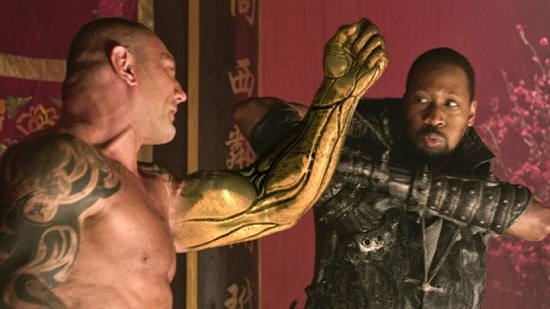
 At a glance, RZA’s directorial debut would seem to owe a sizeable debt to Kill Bill. It’s certainly been sold heavily on this association, with the prominent ‘Quentin Tarantino Presents’ credit, and the presence of the former O-Ren Ishii, Lucy Liu. However, where Tarantino’s two volume film borrowed liberally from a wide variety of B-movie staples of which kung fu was but one, The Man With The Iron Fists has its sights set squarely on evoking the spirit of the blood-spattered Oriental beat-’em-up flicks which flooded America’s drive-ins and grindhouses, rattled the cages of Britain’s censors – never forget, Shogun Assassin was