 by Ben Bussey
It’s no accident that the words ‘cheap’ and ‘nasty’ so often go hand in hand. Horror is perhaps the one film genre which can be done on an ultra-low budget without damaging its chances of reaching a wide audience (well, there’s also porn, but let’s not get into that now). Indeed, it can be argued that the roots of most modern independent cinema are in horror, with the likes of Night of the Living Dead, The Evil Dead and more recently The Blair Witch Project providing not only a creative template but also a business model for generations of cash-strapped filmmakers. However, this has long proved to be something of a double-edged sword. Many inexperienced filmmakers do not approach the genre as fans, but simply as an access point into the film industry. Certainly, there are instances when this approach has paid off – by all accounts Sam Raimi didn’t like horror at all before making The Evil Dead – but more often than not it results in tedious, formulaic dross, the likes of which so often threatens to drown the marketplace. Too many filmmakers and distributors seem to view horror as nothing more than a licence to sell crap, and by extension view genre fans as uncultured, undiscerning numbskulls who’ll happily snap up anything with a bit of sadism in it. (And that perception extends into the popular consciousness, as demonstrated recently by a jawdroppingly awful excuse for journalism at a supposedly upmarket website, which I will not deign to link to here…)
As much as I hate to say it, I can’t help feeling things have only gotten worse this past decade. The digital age has of course brought many tremendous advantages, allowing fledgling filmmakers to massively reduce their budgets and production time, and Blair Witch, 28 Days Later and Paranormal Activity proved that films shot that way can make crazy money. But – and this a big but – the aesthetics of DV leave so much to be desired. The debate rages on as to whether shooting on film will soon be a thing of the past, and I’m sure it will continue to rage on for some time; I look forward to seeing Keanu Reeves’ new documentary on the subject. I’m nowhere near technically knowledgeable enough to contribute to that debate, but so far as I’m concerned one simple fact remains: unless you’re using the absolute top of the range stuff, digital simply does not look anywhere near as good as film, and I get the feeling that’s not going to change.
Then, of course, there’s that key underlying problem with how DV enables anyone with access to a camcorder and a PC to create their own films: the fact that a great many so-called filmmakers don’t have the first clue what they’re doing. I don’t wish to seem elitist or undemocratic, but seriously – a lot of the people out there making films today are simply not cut out for it. I think I can speak for just about everyone in the horror critic community when I say there are few moments I dread more than when the latest no-budget screener lands on my doorstep. Nine times out of ten it’ll have some mindnumbingly prosaic title, and a logline cut-and-pasted from Chain Saw/Dawn of the Dead/I Spit On Your Grave/Blair Witch/delete as applicable. Before you’ve even hit play every fibre of your being is warning you that it’s going to be beyond awful, and very rarely does that feeling prove wrong. A small part of me is tempted to name and shame every bargain basement abomination I’ve had to endure in my tenure at Brutal As Hell, but I’m not sure I have the emotional strength to undertake such a task. And anyway, believe it or not, I don’t write about films because I want to bitch about how terrible everything is; I do it to share with others my own excitement when I happen upon something cool.
And this is the problem with modern microbudget horror: once we’ve endured more than a few of the aforementioned festering piles of elephant shit, it can result in a knee-jerk reaction when approaching other digitally-shot films. It can become hard to see past the wobbly camerawork and flat sound mix, and to appreciate those comparatively rare occassions on which a microbudget horror film actually brings real skill, passion, intelligence and wit to the table. Every once in a while, if you look hard enough, you might even find they’re doing something genuinely new and different. Isn’t that what we look for in independent film overall: a unique perspective and aesthetic that we don’t get from the glossy, overpriced mainstream?
With this in mind, here are what I consider to be some of the best digitally shot microbudget horror films of the past five years, listed in descending order of production cost. They stand as proof that even in the cut-price section we can find real filmmaking craft and ingenuity. None of them are flawless, and certainly none of them will be to all tastes (as if any horror film ever has been); but all of them are different, and anyone looking to pick up a DV camcorder and get to work on their own macabre masterpiece would do well to take note of them all.

Absentia (Mike Flanagan, 2011)
Production budget: $70,000
This one was a really pleasant surprise earlier this year. Funded through Kickstarter, Mike Flanagan’s low-key supernatural chiller works for the simple fact that it has good actors, good writing and good direction. The premise may be reminscent of J-horror, but the film is wise enough not to ape that style, doing its own thing in a simple and understated fashion. Low on special effects and obvious scare tactics, Absentia’s most powerful attributes are Katie Parker and Courtney Bell, whose brilliant performances drive the film. And Flanagan clearly knew the film needed these actresses above all else, as he rejigged the script to work in the fact that Bell was heavily pregnant at the time of shooting; a wise move indeed.
Read my full review here.

Blood Car (Alex Orr, 2007)
Production budget: $25,000
Proof positive that it is possible for a modern horror film to be largely based around environmental and political concerns without being all preachy, po-faced and humourless about it. In fact, it’s possible to do that and still deliver all the schlock, gore and gratuitous nudity that genre fans know and love. Yes, Alex Orr’s film has its cake and eats it too. It’s helped considerably by above average performances from Mike Brune, Katie Rowlett and Anna Chlumsky, but the wit of the direction and writing really lifts it above the pack. The practical gore ain’t bad either.
Read my full review here.

Small Town Folk (Peter Stanley-Ward, 2007)
Production budget: £4,000 (approx US$6,500)
At a glance, Small Town Folk seems like nothing more than another backwoods hillbilly horror, but it takes the concept in a really quite unexpected direction, giving that time-honoured Hills Have Eyes set-up a surprisingly upbeat, action-adventure flavour. And on a microbudget, no less. Peter Stanley-Ward’s film is also particularly noteworthy for making a real virtue of its lo-fi aesthetics; much of it is shot in the Sin City style on blue screen with digitally imposed backdrops, which lends a suitably otherwordly, cartoonish feel to proceedings.
Read my full review at B Through Z.

Dead Hooker in a Trunk (Jen & Sylvia Soska, 2009)
Production budget: $2,500
I rather doubt this film or its writer-directors require any introduction at this point. However, I’ll be the first to admit that on seeing the film at its world premiere over two years ago, I was initially dismissive of it, owing largely to that knee-jerk reaction to DV that I spoke of earlier. It was only when I took a step back that I realised just how much Dead Hooker In A Trunk breaks with conventional wisdom. Where so many first-time filmmakers restrict their action to a single location and a minimal cast, the Soskas keep things moving at all times, hopping locations as gleefully as they cross genre boundaries. Once again, good writing and acting really saves the day, but it certainly doesn’t hurt that there are stunts and special effects which are significantly above average for films made at this budgetary level, not to mention how good CJ Wallis’ soundtrack is.
Read my full review here.

Cockhammer (Kevin Strange, 2009)
Production budget: $500
Given that the very first shot of this film is a woman’s naked breasts, and within two minutes said woman is being bloodily beaten to death, you’d be forgiven for thinking Cockhammer was just another sick, juvenile piece of trash. Well… actually, Cockhammer is another sick, juvenile piece of trash, but it also sports some of the sharpest, funniest and most mind-bogglingly verbose writing I’ve come across in recent years. It’s no mean feat to get an amateur cast to deliver this kind of ridiculously overloaded, expletive-ridden dialogue at a machine gun pace, without faltering or corpsing – sample line: “I swear to God Gert, I don’t know what’s worse, sitting here in this cold damp room waiting to be butchered on film by a fucking lunatic, or the fact that I haven’t had a hard dick in my ass, mouth or vag in hours!” – but Kevin Strange and his ensemble manage to make it seem effortless. Even if you don’t care for the ultra-low brow mish-mash of weed, dick and fart jokes, you have to acknowledge the skill with which it is executed.
Read my full review at B Through Z.

Colin (Marc Price, 2008)
Production budget: £45 (approx US$70)
Few films of recent years have surprised me as much as this one. First of all, it’s hard to believe there haven’t been more zombie films in which the central protagonist is a zombie; secondly, when you hear a film was made for such a pittance, you certainly don’t expect something as intense, atmospheric and artful as Marc Price’s film proves to be. Colin is another film which makes a virtue of its lo-fi production value, boosting the sense of intimacy, and demonstrating that you don’t need to go the found footage route to justify shooting on DV (a lesson that should not go unheeded). And the most vital thing Colin can teach any would-be filmmakers: if you’re going to cast your friends, try to have friends who are as good at acting as Alistair Kirton. Great performances, great scripts: the cheapest special effects of all.
Read my full review here.
 Interview conducted by Ben Bussey
 One thing that really sets The Victim apart from most contemporary exploitation films is the visual style; you went for a more clean, natural look rather than all the grime and superimposed scratches we see in a lot of films since Grindhouse. Was this an artistic or budgetary choice?
 By Nia Edwards-Behi
 It would be fairly easy for me to rehash these same discussions. We all know that Wes Craven went on to make The Hills Have Eyes, and Nightmare on Elm Street, amongst other films, establishing himself as one of the most notable horror auteurs of recent decades. We all know the film was central to the video nasties debacle in the UK, remaining banned until 2003 and only certified for sale in the UK as uncut in 2008. I don’t want to focus on the things we already know. There are times when the things around a film are remembered and talked about more than the film itself. I think this is the case with Last House on the Left. While indeed most of the video nasties would have sunk into obscurity if not for the controversy attached to them, Last House on the Left deserves attention, appraisal and, for me, plaudits. I think it’s too readily lumped together with pure exploitation flicks that may well be fun, but have a lot less to say and a lot less skill in their making. So, let me tell you why I love The Last House on the Left.


 by Ben Bussey


 I’m almost certain that I’ve told this story before, but way back in the late 80’s when my mum bought a VHS player the first two videos she bought were Blade Runner and The Lost Boys, and for the longest while they were the only videos that we had, resulting in them being watched ad nauseam, and for me as an adolescent The Lost Boys had a profound effect. As we’re seeing today, the allure of the teenage vampire can be very popular with young girls; I’m just glad that for my generation this included sex, violence, rock ‘n’ roll and some pretty fucking awesome 80’s hairstyles. Not sparkly, chaste, vegetarian vampires…


 By Ben Bussey
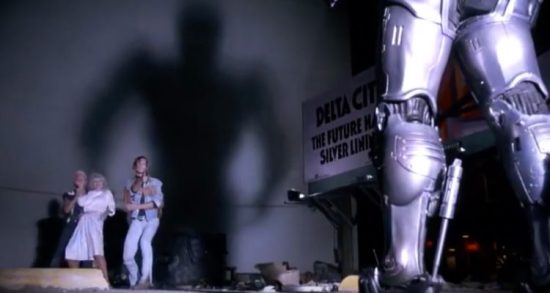
 In case any of our non-British readers need an explanation – cue the obligatory contemptuous glance down the nose at any ignorant heathen who doesn’t know our customs – the 18 certificate is second only to the R18 (which covers hardcore porn, and in any case didn’t exist back in the 80s) as the highest, most restrictive certificate a film can receive from the BBFC, making it basically equivalent to the MPAA’s X and subsequently NC-17, although it also tends to cover the more ‘Hard-R’ movies; and I think we can safely count RoboCop as one of those. Now, when I say it was my first ‘real 18,’ I should explain that I had already seen at least one 18-rated film to my recollection, which was Alex Cox’s Repo Man*; a great film for sure, but one that hardly warrants an 18 given that it received the rating based purely on the amount of swearing (a move not unheard of nowadays, but considerably less common). Of course, a pre-teen boy such as I was then isn’t going to complain about the level of profanity in a film – there’s nothing bigger, cleverer or funnier than rude words, after all, and no weapon more vital on the fledgling battlefield that is the playground – but at that age, we longed to see something more. Not boobies, necessarily; interest in those matters had not quite emerged yet, and girls were still very much the enemy. No, what we really wanted was violence. We knew there was more to it than we’d seen on TV. He-Man and Lion-O swung their swords around, but the bodies of their enemies remained intact. The A-Team fired about a million rounds an episode but nobody ever got shot. Roger Moore might unload his Walther PPK on a roomful of anonymous baddies, but all they ever did was fall to the ground clutching their chests. There had to be something we were missing…
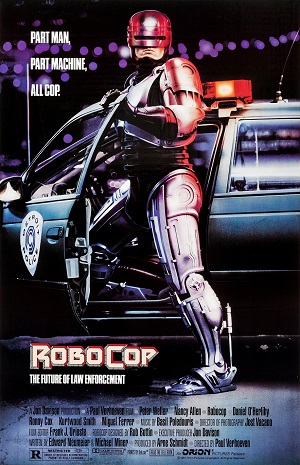 We’re presented with an alternate reality in which the corporations control everything, and as always the primary corporate interest is profit. These yuppies pull the strings from on high in their futuristic ivory towers, with the best suits on their bones and the best Bolivian export up their noses, whilst at ground level the city is in a state of extreme disrepair, with civil unrest and violent crime everywhere the eye can see. In the midst of this, one decent cop finds himself working the roughest beat in town, and winds up bullet-ridden and dismembered on his deathbed before his first day is over. But as a police officer, he sold himself over to the company as soon as he signed up. OCP own him and can do what they want with him. Indeed, they had specifically reassigned him to a high casualty precinct as he was deemed a ‘prime candidate;’ for him to meet his death was all part of the plan. Next thing you know, what little remains of him is resurrected in a high tech mechanical exo-skeleton, and the company send him out on the pretext of fighting the crime which they are in fact complicit in. His memory and personality are gone, and he exists for no other reason than to do his job, with neither the promise nor the expectation of getting anything in return; exactly what those at the top of ladder would prefer of those at the bottom. A dystopian vision of the future in the 80s, and here we are in 2012… the absence of cyborg police officers aside, none of it seems too outlandish does it?

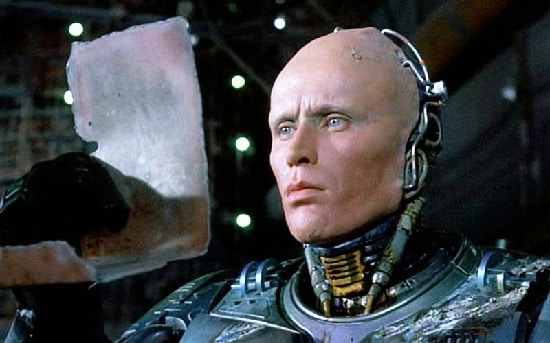 And then, of course, there’s the Future of Law Enforcement himself. Whether we buy into Verhoeven’s Christ analogy or not, from the little we see of Murphy prior to falling under the bullets of Boddicker’s gang and the gizmos of OCP’s boffins, we’re given the impression he’s an inherently decent, salt of the earth guy next door. When he’s reborn as RoboCop, our reaction is complex. On the one hand, we’re mournful for the man who has lost everything and angry at the criminals, both street and corporate level, who stole it all from him; but on the other hand, good golly gosh he’s a badass. Yes, his look and characterisation – indeed, the tone and content of the film overall – owe a sizeable debt to the comic books of the time, with Judge Dredd and The Dark Knight Returns often noted as particularly influential, but RoboCop really is his own beast; a futuristic knight in shining armour, who retains a sense of honour, nobility and – yes – humanity, in spite of the atrocities going on all around him.
 Report by Ben Bussey
 First of those old favourites – and, I won’t deny it, the key thing that drew me to the festival – was Fred Dekker’s seminal 1987 comedy horror The Monster Squad. Now, there’s a hell of a lot I could say about this one, but given that its twenty-fifth anniversary is only a month or two away I’ll save my superlatives for now. Suffice to say The Monster Squad is supremely close to my heart, being the film that got me into horror in the first place, and it remains a real source of joy to me to this day. The chance to see it on the big screen as intended, particularly in an auditorium as nice as the Pictureville, was an opportunity I couldn’t possibly pass up. That said, I must admit I was a tad disappointed that the screening was of a somewhat murky, pixelated digital copy rather than a 35mm print, though I acknowledge this was not for lack of trying on the part of the organisers. Still, given that the film is yet to receive a Region 2 DVD release (the shame!), this might be the only chance many in the audience have yet had to see it. And even in a digital format, seeing it on the big screen still throws into focus little details that might not have been noticed before, even by one who has seen the film as often as I have (and believe me, I’ve watched The Monster Squad a great many times…) I could say more on the subject – and I assure you, I will be doing so in the not-too distant future – but that’ll do for now. Moving on…
 Next up in Pictureville was a real curiosity, and a welcome one, in the form of Hammer’s Captain Clegg (1962) (which, yes, is also known as Night Creatures in some territories, hence inspiring the name of that band). We tend to forget that Hammer didn’t just make horror, but popular films of all kinds, and this film serves as a good representation of that less celebrated aspect of the company’s persona. An oddball blend of mystery, ghost story and swashbuckler, it follows the enigmatic inhabitants of a quiet small town when the king’s men arrive to investigate suspected smuggling. Peter Cushing heads up the cast as an unusual vicar with an alarming dark mop of grey-streaked hair, with an ensemble including a young Oliver Reed as a fairly dull romantic lead who gets to indulge in a bit of fisticuffs and wrestle a fair few snogs out of the delectable Yvonne Romain. It’s all typically cut-price and nonsensical – leave it to Hammer to make a pirate film that’s set almost entirely on land – but it’s teeming with the dark wit and anti-authoritarian undertones that we so often find in Hammer. The 35mm print looked great for the most part; the projection in the first few minutes had a distracting wobble which was quickly corrected, and from then on, the little scratches and occasional jumps just added to the rustic charm.
 Next up in the more intimate Cubby Broccoli screen were two early black and white TV films from Hammer (digital copies, but perfectly decent ones). Directed by Curt Siodmak, famed for writing Universal’s Wolf Man, Tales of Frankenstein (1958) is a pilot for a TV show that never happened. A fairly standard tale of the mad Baron (here played by Anton Diffring) and his experiments, it opens with Frankenstein bemoaning the lack of a decent brain to make his creation work properly; at which point, who should turn up on his doorstep but a terminally ill man and his wife, who have sought out Frankenstein in the desperate hope that he can help them. Entertaining though it is, in some ways it’s not surprising a series never came of it. I mean, what would they have done, put a different brain in the creature every week? See the monster take on a new personality in each episode, like some macabre variation on Quantum Leap…? Even so, it’s a fun little creature feature, and a pleasant window back to the days when wailing theremins, misty graveyards and flashes of lightning over Gothic rooftops had not yet become the stuff of lampoons and Scooby-Doo cartoons.
 The Man in Black (1949) makes for fairly surprising viewing today given that it provides an entirely straight role for Sid James. Though he had a long and illustrious career in straight drama, it’s almost impossible not to immediately identify him as the notorious old perv of so many Carry On films, so much so that when told that his character in The Man in Black is the country’s premier exponent of yoga, one can’t help but immediately picture him stood at the back of the class with Bernard Bresslaw, barking his signature “hyuk-hyuk” as all the girls bend over. However, that’s a far cry from what we have here. Following the efforts of James’ conniving second wife and stepdaughter to cheat his daughter out of her inheritance in the aftermath of his mysterious death, it’s a supremely twisty-turny melodrama filled with yet more of that classic dark wit, in which everyone has an ulterior motive and is out to get someone else. I’m sure they could take the same script today and make a mean episode of Midsomer Murders out of it.
 Coming up after that, whilst Keri took in the short films (which you can read about
  Wrapping up the day, and indeed the festival for me was I Drink Your Blood (1970), and I daresay that was as good a film as any to end on. A joyously absurd mix of Satan-worshipping hippies, small town hicks and sociopathic pie-poisoning pre-teens, it’s so grindhouse that if I hadn’t been told any different I might have assumed it was yet another contemporary take on the genre contrived to tick all the boxes. Cheap and cheerful to the extreme with the obligatory tacked-on overtones of morality, it’s pretty much everything you expect from a madcap midnight movie. As such, it was entirely fitting that the very rare 35mm print the festival had procured was battered to buggery, drained of colour to the point that the whole screen seemed to glow fluorescent pink, and so worn out that it actually broke about two thirds of the way in, resulting in a delay of around ten minutes. Initially I suspected this might have just been showmanship on the part of the organisers, trying to provide that same ‘real grindhouse experience’ that Rodriguez and Tarantino were so keen to mass-produce, but unless they kept the act up very well it would seem to have been genuine. And no, it didn’t detract from the experience at all. Indeed, it gave my fellow audience member Gavin Baddeley time to advise me to look out for the rabid workman who, during a chase scene, would accidentally lose his helmet, and then stop to pick it up. Many laughs were had all around.