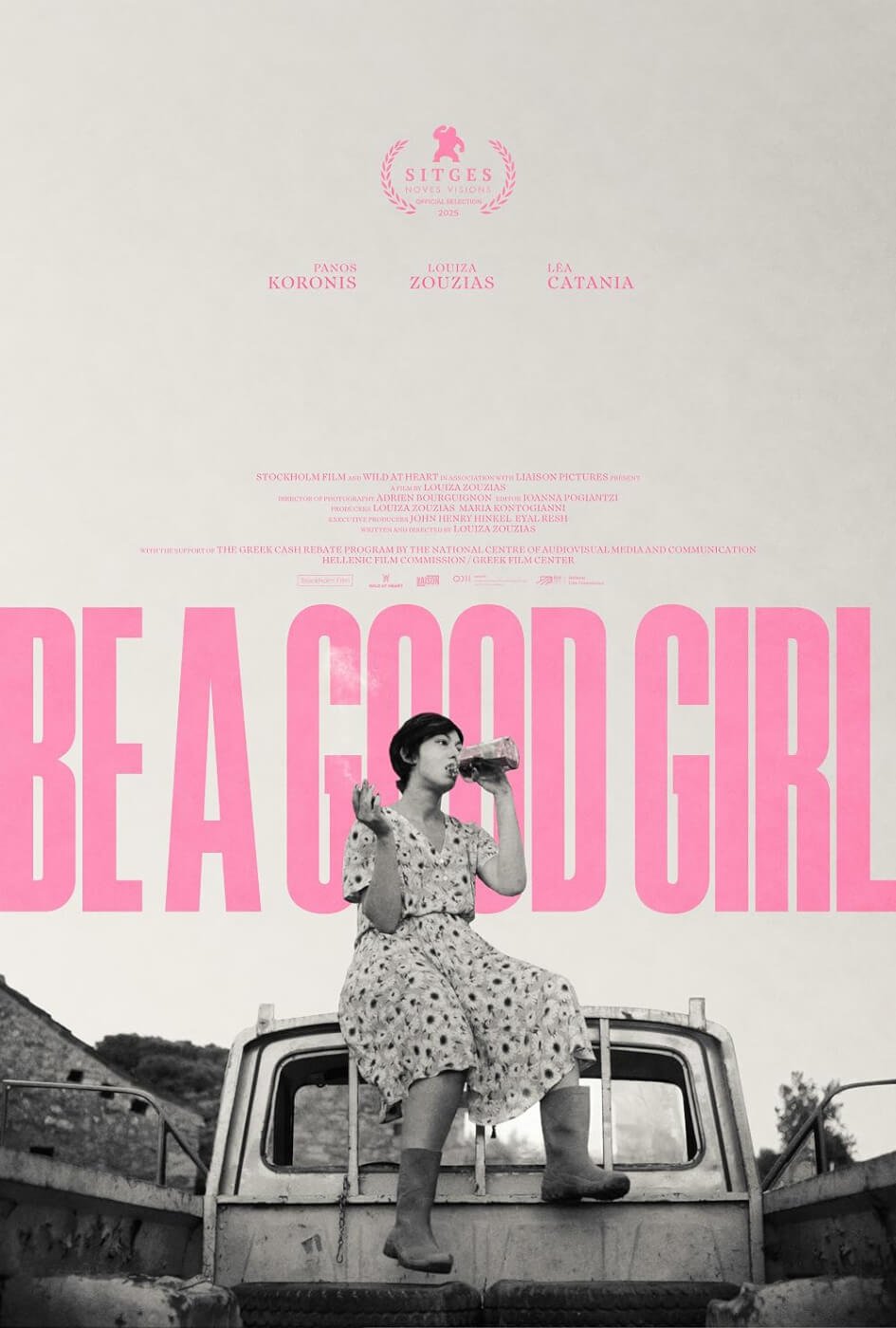

A brief cold open spells out trouble ahead just before Be a Good Girl (2025) cedes into something far more regimented and restrictive. A young woman (the same woman we have just briefly met) kneels submissively as her husband (or at least someone who has cast himself in that role) arrives home. It’s not straightforward: she seems to veer from happy and amused to terrified as he tells jokes and asks questions about the meal they’re eating, but you quickly sense that this is a devil’s bargain for her. She just smiles whenever she can. Edgar (Panos Koronis) is not a catch; he’s piggish, mean and volatile.
The vignettes we get from here allow further insight into Annie’s day-to-day existence, alone in this remote, dilapidated homestead. Annie (Louiza Zouzias) is subject to relentless questions and monitoring from Edgar. Much is clearly riding on the answers she gives, which makes for an unsettling watch, and the camera sticks closely with her, monitoring her authentic reactions and anxieties – expressions which she masks when Edgar is near. So what is going on here? There’s clearly compulsion in how Annie is expected to behave; religion, but of course, is being invoked as an additional factor in Edgar’s sense of superiority and control, yet aside from that, this is not a life crowded with events. Quite the opposite.
This all changes when one day Edgar brings home a captive teenage girl to the house. Annie perhaps wonders whether this is the companion she falteringly told him she wanted, when she admitted she felt lonely when he was out all day at work. But Edgar locks the girl up in an outbuilding, and this terrified young woman, clearly from a very different world than the one Annie has lately been occupying, is now being prepped to become a part of the same warped household dynamic. You get the distinct impression this may have happened before, but there’s still more. Annie begins, slowly and painfully, to understand. The girl, Rebecca (Léa Catania) is being conditioned to replace her – she’s simply a younger model, with no white hairs to enrage Edgar. Annie is hurt and alarmed, yet she really feels for Rebecca, and still wants a friend. What is a girl to do?
Firstly, there’s a fine line between revulsion and laughter, and Be a Good Girl willingly crosses it, especially in the characterisation of Edgar (fantastically acted by Panos Koronis). His rages and melodramatic interludes are absurd; his motivational chats about his intestinal health are grotesque; he looks ridiculous in his best clothes. But he is a monster. Monsters are pathetic figures, as well as fearsome ones: that the film confidently allows time and space to expound all of this underpins the rest of the film very ably. This is a low-budget, black and white independent project with a tiny cast and a limited number of sets, but its sense of purpose and its clever focus on the galling details makes it all peculiarly disturbing. As events begin to escalate, it’s all with a solid basis in character and clear sympathies for both of the women, each of whom are on different points of the scale, one with sharp memories and understanding of the outside world she has only just been forced to leave, and one with apparently only hazy recollections of any sort of life before Edgar. Annie’s chronological age (she’s probably in her early thirties) and her emotional age are not a match, but this makes her attempts to deal with her unfolding situation all the more anxiety-inducing. It’s not all horror, though: there are moments of redemption, even happiness, not to mention moments of frustration, because the oppressed and the harmed don’t simply ping back to being the people they once were when their ordeal is paused or ended.
Storylines of a comparable kind have featured in horror cinema before, and have often been given the gross-out horror treatment by the likes of Broken (2006) and The Woman (2011), where captive women are overtly brutalised and tortured, but the torture here is of a distinctly different kind. Be a Good Girl is not gratuitous; there’s no graphic gore or anything of the kind, and barely a drop of blood is spilled (and even then, never through deliberate violence). The perspectives in the film are always the women’s, particularly Annie’s, and it’s an emotional ordeal throughout, despite the occasional moments of respite. If it loses its centre for a while, then this doesn’t detract from how this tradwife-centred start gives way to something far bigger about selfhood, autonomy and suffering. Be a Good Girl is never, ever comfortable viewing, and this is no doubt exactly what writer, director and star Louiza Zouzias intended.
Be a Good Girl (2025) receives its UK premiere at this year’s Soho Horror Film Festival. For more details, please click here.