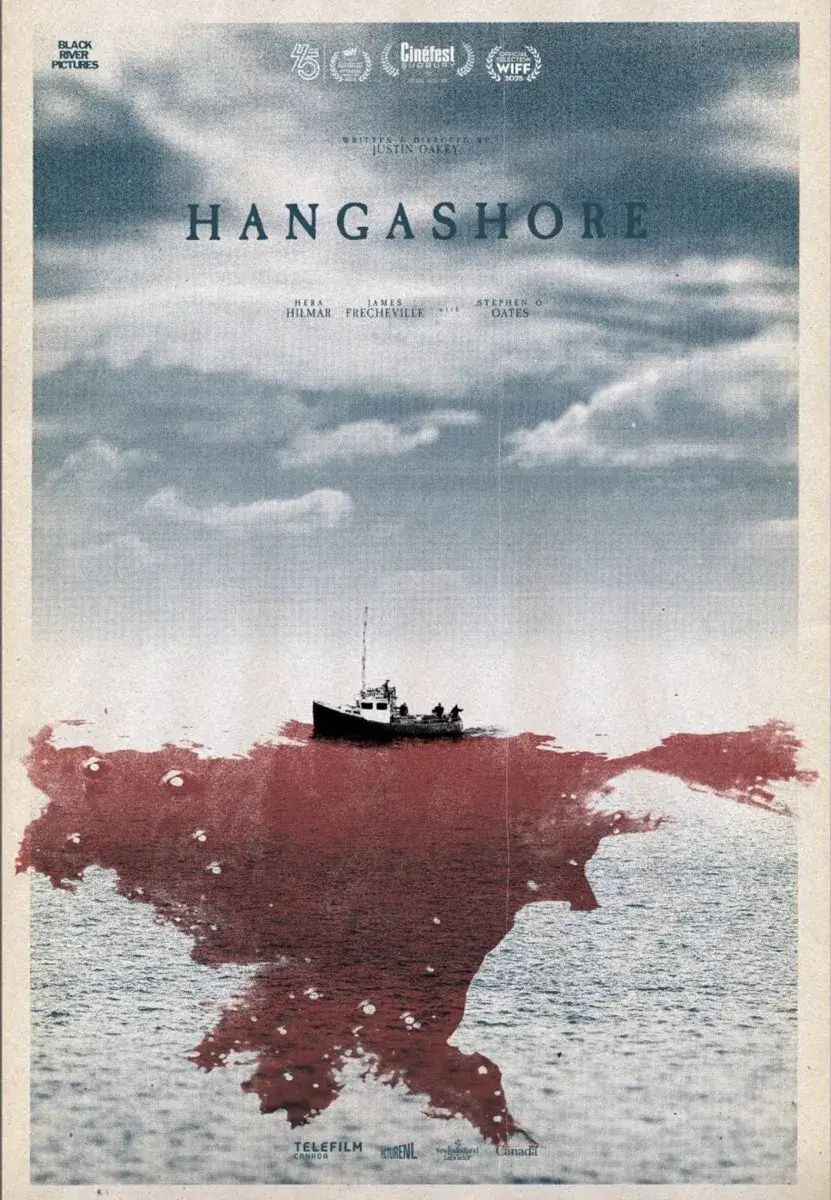

Bitter cold and harsh elements abound as we open on Hangashore (2025), a film which sticks with these bleak, often hostile landscapes throughout its runtime, examining the links between flawed human agendas and the unforgiving natural world which still encircles us. Icelandic artist Vera (Hera Hilmar) is tormented by dreams and memories of her long-gone father; she remembers going out to sea with him, a mariner, before his trips away. One day he did not return, leaving her largely alone to face down adulthood with her trauma: her mother and sister are around, but seem very separate from her; this is, throughout, a very lonely film, with lonely bones. Her art – always of the same seascape – seems less and less able to console her, so she decides to trace her father’s last journey: to Newfoundland, a place only marginally less bleak than Iceland.
Also just limping into harbour in the same part of Newfoundland with a kaput fishing trawler, we also meet Jack (James Frecheville), his ‘like a brother’ crewman Don (Stephen Oates) and Kelly (Bridget Wareham), another member of the crew. They really need a new boat, or at least a new, working engine, so they’ll be sticking around for a while. Their recent haul – seals, which they’ve hunted for their pelts and meat – will have to go on ice. But they have every intention of getting back out there, potentially making more money from this outing before they even think about heading home.
With time to kill, Jack encounters Vera – still sketching away – in the restaurant at the hotel where he has decided to stay for a few days. They strike up something of a relationship, perhaps a surprise given each of their demeanours, but by the same token, no one here is going anywhere fast; perhaps they share that sense of waiting for something. Nor is the plot in Hangashore moving anywhere fast, either: the slow pace of life and change in a wintry Newfoundland harbour dictates the pace of the film, and it is not overtly clear where any of this is going, right up to the halfway point of the runtime. There are clues, however: the malcontent and increasingly drunken Don, the tides of superstition which still hold sway at the port, particularly the superstitions on the subject of women, who should emphatically not be onboard any vessels, it is said. That’s news to Kelly, by the by, who seems to often find herself managing Dom’s behaviour as he grows increasingly volatile, gambling away what little cash he has. Jack, on the other hand, makes his excuses and leaves Dom to himself (and to Kelly), but this, too, may come back to bite him. After the clues themselves, the film’s steadily-ratcheting, ominous soundtrack keeps up the sense that there is an impending disaster here. The remote feel of the place, the sense of people carrying largely unspoken burdens and the alienating effect of the sea itself keep adding incrementally to the rising gloom.
In trying to impose real-life meanings – profit, progress, legacy – onto a world governed by lore and luck, Vera and Jack find themselves moving into a kind of liminal space, somewhere, arguably, between ecohorror and supernatural horror. That much said, it’s little wonder that the script begins to allow itself the odd line from Coleridge’s proto-ecohorror The Rime of the Ancient Mariner; even without this, the parallels would be clear. We begin to live through a version of the poem, albeit transposed onto a modern, if only-just modern world of diesel engines, squabbling crewmen and feckless bar brawls. But just as the poem itself is all about torpor, both physical and moral, so too is this film, and it’s almost certainly too low on action and resolution for many viewers. If it hasn’t grabbed hold of you by around the hour mark, then it’s likely you will struggle to stay invested in the ending.
However, if you are of a mind to enjoy atmosphere and mood over a spell-it-all-out script and sequence of solutions, then Hangashore could work well, perhaps especially once you realise its equally subtle advancement of a feminist subtext, one which only really lands when we look back across the whole of the film – demonstrating skill in the overall construction and writing. There’s plenty to like, even love, although there are no neat resolutions here and nor is there ever a dizzying array of incidents. They payoff instead is in a film which makes you think and offers much to reward the attention. Somehow it’s not a surprise to discover that the director and writer of Hangashore, Justin Oakey, has worked with dark, atmospheric post-black metal band Hexvessel on two of their videos; that’s a great match in terms of the style and atmospherics of Hangashore.
Hangashore (2025) features at this year’s Soho Horror Film Festival in London, UK, receiving its UK premiere there: for more details, please click here.