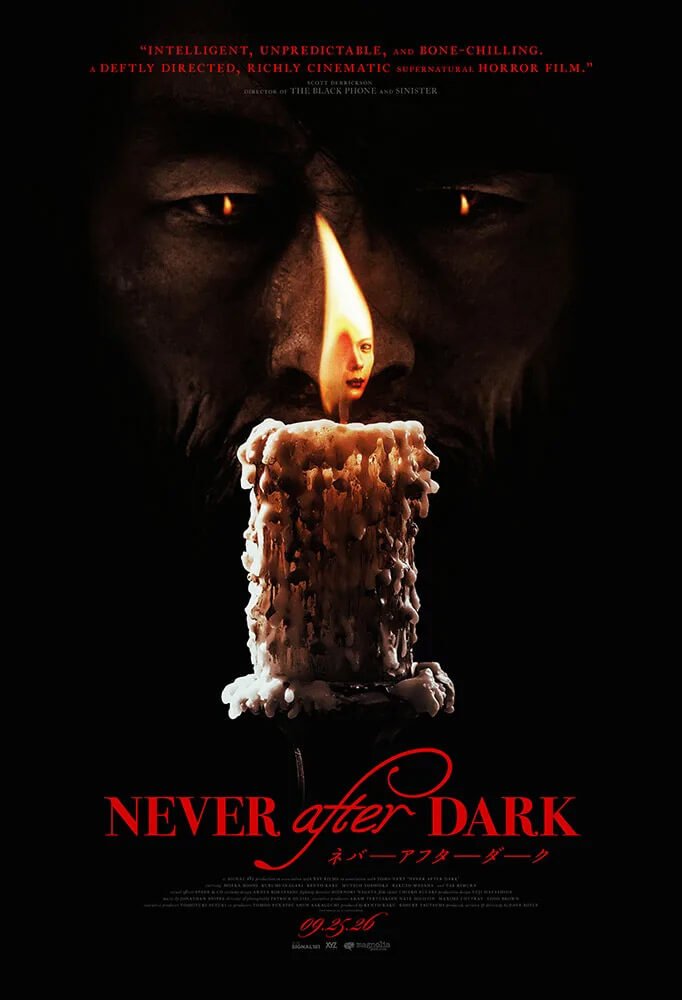

Perhaps ‘enjoyable’ isn’t a perfect word for this, but it’ll have to do – because it’s genuinely enjoyable to find a piece of unsettling supernatural horror like Never After Dark (2026), even if the film pulls away somewhat from pure supernatural horror in its final act. Nonetheless, it clearly knows how to scare, and director Dave Boyle (who has an interesting pedigree as an American primarily making Japanese-medium films) has created something very effective here. It does enough, and does enough differently, to distinguish itself from its peers.
Airi (Moeka Hoshi) is a kind of travelling medium, moving from place to place so that she can help trapped spirits to move on (something she does with a small array of ritual gear, never explained, but apparently highly effective). Airi’s technique is to transmit a version of herself ‘beyond the veil’, so that she can directly address the spirit in question, helping them to detach from whatever place they are haunting. Tellingly, every crossing she makes costs her a lock of hair; it’s clear from her appearance that she does this kind of thing fairly often, as she has a jagged hairline (and clearly no real system of where to take the hair from, but we shouldn’t get distracted by that).
Her latest job is at a rather dated country hotel in the back of beyond, now owned by a mother and her adult son. Mother Teiko (Tae Kimura), who hired Airi, is shyly intrigued by her and her line of work; in fact, Airi’s sole edict that she be allowed to work undisturbed is ignored very hard by both Teiko and Gunji (Kento Kaku), who keep breaking their curfew and coming back to the hotel during the period of time Airi has requested to have to herself. But Airi does what she knows best anyway, helped to some extent by sister Miku (Kurumi Inagaki), who is able to offer her own pearls of wisdom about the spirit world, because she is part of it. It’s a poignant addition to the screenplay that Miku had been Airi’s big sister, but since time on Earth goes on whilst time on the other side of the veil is frozen still, Airi is now the elder, though the two girls bicker just like sisters would.
The haunting at the hotel – which features a mutilated male spectre who has an obsession with one of the rooms in particular – can’t help but be a little reminiscent of The Shining, despite this haunting being limited to one manifestation rather than several. It’s similarly horrifying, however: Boyle uses shadows and darkness incredibly well, and the barest glimpse of this man hurrying to a room in order to pry away at one of the walls for…something, is very effective. The ghost has been regularly appearing to Teiko, terrifying her too, and can be clearly seen by Airi without any of her usual paraphernalia – but, in this form, ghosts are simply re-runs, unable to interact with anyone. They simply repeat old actions, or appear to do so.
To solve the problem, Airi will have to cross over and talk to him, something which Miku warns her against; this is not, Miku pleads, a regular spirit. Airi, who is young enough to ignore advice and yet skilled enough to feel she knows just what to do, begins to engage the spirit of the man – if that is indeed what it is. Her actions lock her into a highly dangerous struggle; on the other side, this is no Stone Tape-type haunting, an action imprinted on a geographical space by some kind of trauma. It’s something else entirely, although trauma is still key.
A mystery to unpick; a mysterious process with which to attempt it; a carefully-constructed, threatening presence which could do real harm; Never After Dark offers an immersive supernatural experience, and is perhaps strongest of all in its initial set-up: when we’re wondering as much as the inmates of the hotel, then we are as vulnerable, and alarmed, as they are.
However, as Miku suggests, this is a different kind of spirit, and the film moves on to fill in some of those blanks regarding the hows and the whys: it’s a gamble, including a different horror genre altogether in this way, but making that kind of a link to another genre is likewise bold. Yes, it dissipates something of the supernatural fright – though by no means all of it, not ever – but it also constructs something else which contains its own sense of peril. Again, this is carefully paced and illustrated. The film continues to be frightening, though it’s a somewhat different source of fear in places. The film also demonstrates that it has left behind any real sense of J-horror tropes, as aesthetically and atmospherically pleasing as many of those were; Never After Dark feels bang up to date (despite having a very mysterious timeline of its own; it could be set at any point over the last forty years, given that it’s lacking in modern tech and trappings).
Beautifully uneasy and meticulously constructed, Never After Dark strives to combine different strands of horror and it’s largely successful in this aim. Its likeable, unflappable protagonist, its appealing setting and its evocative scares do more than enough to reward the audience’s attention across its suitable, economical runtime.
Never After Dark (2026) appeared at this year’s Celluloid Screams Horror Film Festival.