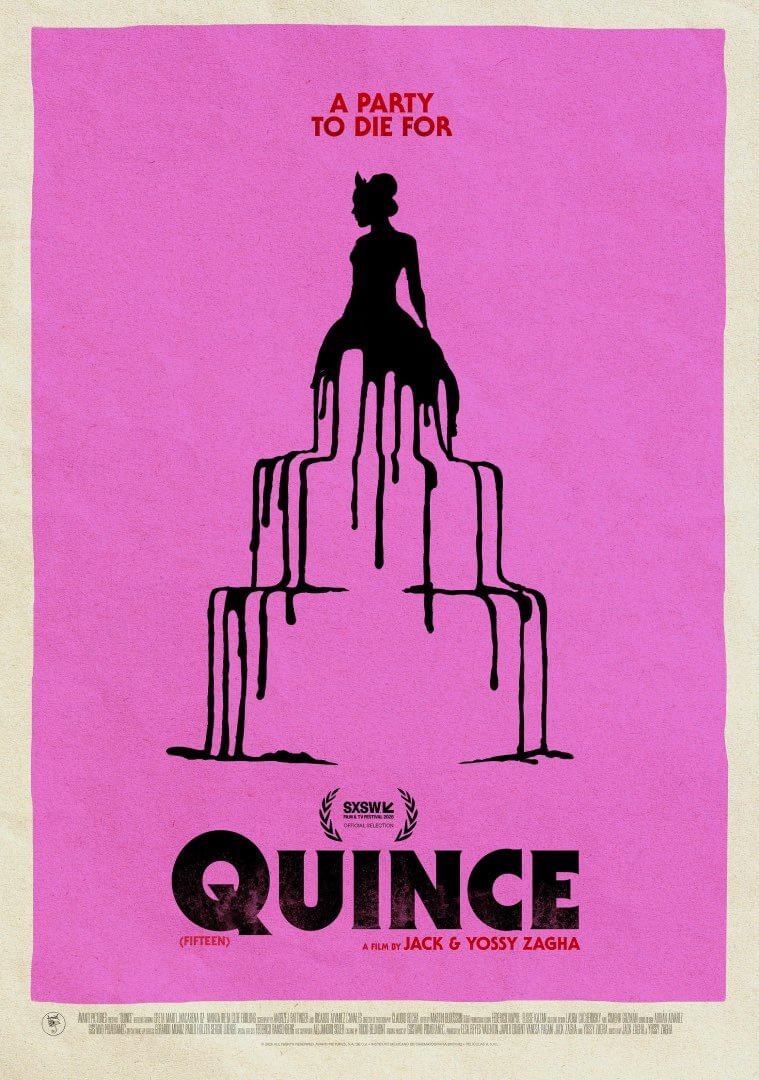

Ligia (Greta Marti) and Mayte (Macarena Oz) are both best friends and outcasts in the ever-brutal world of teenage friendships and rivalries. As they each prepare to celebrate their Quinceañera – the traditional Latin American celebration of a girl’s fifteenth birthday – they on one hand get closer, but on the other, begin to grow apart. Ligia has a boyfriend, Joel, and begins to cede to the pressure – both from him and from others – to lose her virginity, stop being a child. Mayte, who definitely gets the sharp end of her classmates’ jibes about her background and appearance, clings to Ligia, but when Ligia’s life takes a sudden turn, their friendship gets more and more difficult to sustain.
What we have seen, which neither girl knows, is that one night, just prior to their first sexual encounter, Joel (Andre Fajardo) ditched his bike to investigate a strange sound: he heard what seemed to be a baby crying in the open sewer nearby. In a country like Mexico which stigmatises unmarried births, it’s not the most outlandish possibility. He goes to look, and as he stares down into the sewer he is attacked by some strange, cryptid creature which evidently lured him there. Joel gets away, and he tells no one, but when the strange encounter begins to impact upon his health – changing him somehow – he doesn’t think to tell Ligia who, who finally succumbs to peer pressure and throws herself rather miserably at Joel, initiating their first time.
The fact that Ligia has now lost her virginity and Mayte has not is one thing, but there was no protection used, so not only does Ligia become pregnant, but the early pregnancy does not unfold normally. Ligia is different now; she begins to reject Mayte’s desperate, kind overtures, and after a few explosive clashes with the class rich kid Genoveva (Aminta Ireta) she actually becomes friends with her (there’s a certain element of Ligia becoming the pregnant pet of her new group, but she either doesn’’t mind or doesn’t care). She also begins to revel in her body’s new possibilities, as much as they scare her at first. But Mayte – kind, generous and loving – won’t give up on her best friend, and seeks help on her behalf, showing that she is prepared to do anything to save Ligia from herself.
Whilst it’s wonderful to see these kinds of female-led casts, particularly where they explore issues surrounding the female body in this way, it isn’t much time at all until the immense influence of Ginger Snaps starts to make itself felt here. The girls’ initial fantasy dreamscape of their perfect party shares some of the same fantasy elements as the Fitzgerald sisters and their grisly photography projects; Ligia and Mayte fantasising about a grand public death feels and to an extent looks very similar. Likewise, the cryptozoological changes to Ligia’s body – which appal and ostracise her best friend in the world – leading to a sudden understanding of her new sexuality, well; right down to the hair streaks, it looks for all the world like the same, as does the film’s end point, the big Quinceañera bash. Whilst this isn’t a criticism of Fifteen per se – more a compliment to Ginger Snaps – it does beg the question: what makes the newer film stand out?
Firstly: the writing and the acting which brings these girls and their friendship to the screen is very good indeed. Without being overwritten, we get the point that these two are poorer than their peers; Ligia’s mother is a cleaner at her school, which draws down all kinds of unkind comments. Mayte is being raised by her aunt and uncle; she’s motherless, and as much as she’s looking forward to turning fifteen, she knows damn well she won’t be getting the kind of party which she dreams of. Mayte’s poring over magazines and websites is a simple and touching inclusion; she knows she’s different, and she knows she lacks for a lot of the material comforts enjoyed by others, but she focuses her love and concern on her best friend. Ligia lashes out verbally and sometimes physically when she is mistreated, but the closeness of these two girls is a precious thing to observe. As such, when things begin to splinter, it’s horrible. You feel for both of them, even when Ligia allows her latent mean tendencies to come to the fore in defence of her autonomy and pregnancy.
The film also takes place in a deeply religious community: there are Virgin Marys on every corner; girls bear the brunt of the inevitable shame of early pregnancy, and abortion is impossible past a relatively early point, which as we know all too well, does not mean no abortions – it means illegal abortions, something else which is addressed in the film in a squirm-inducing/rage-inducing sequence, albeit one which comes with a strangely affirming conclusion. Performances here are great throughout, even if Ligia’s ‘predicament’ sees her become more and more closed off as the film progresses: it goes with the territory here.
If the film’s rather sudden, more cartoonish levels of concluding violence feel like a bit of a jolt, then nonetheless the film understands the importance of a proper spectacle at the end, and delivers this with a stylish pay-off even if – from this reviewer’s perspective a least – the final note being sounded here is, in its own ways, a tad reactionary, given all that has happened to get us here (and there must have been a discussion about whether or not to show the audience something altogether different at this point). Perhaps there was just one place Fifteen wasn’t willing to go. Nonetheless, this is a well-made film with some great writing and the guts to throw some lesser-seen mythology into the mix. These kinds of stories – with a fantastical note, or not – make for a welcome addition to the growing canon of young women’s horror, and there’s a lot to admire here.
Fifteen (2026) appeared at this year’s Celluloid Screams Horror Film Festival.