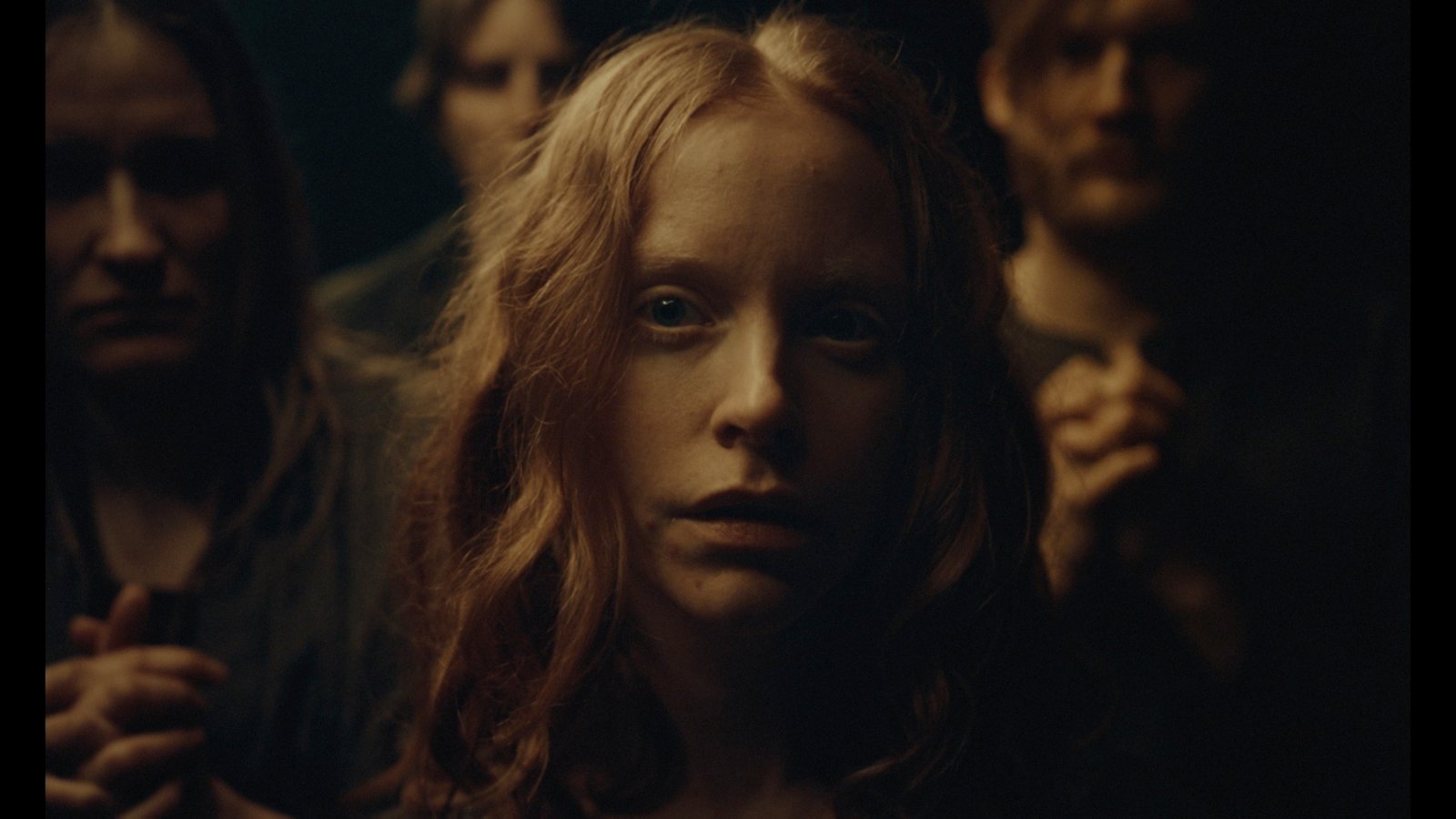
Heresy (2024) begins – in a non-specified, but very much rural, pre-industrial setting – with a young woman, Frieda (Anneke Sluiters) dismayed by the arrival of her period. Although her husband seems, at least initially, kind, it’s clear that her continued lack of a pregnancy is a big problem in this harsh, impoverished community, one where Christianity means a heavy and pervasive, patriarchal system of justice, rather than hope and genuine comfort. Prayer also blends with folk magic, as it always has, and it shows us this young woman trying any means to fix her infertility. In a few deft moves, the film shows us that where God seems curiously absent as a source of relief and succour, his representatives try harder and harder to exercise control, and aren’t above bending the rules somewhat, in certain cases. Take for example local man Gelo (Léon van Waas) who, despite himself having recently been subject to some community justice, thinks nothing of ‘offering’ to try to impregnate Frieda shortly after his punishment concludes. Very kind of him. But when he moves beyond simply making the offer and pursues a terrified Frieda into the ominous woodland on the village’s outskirts, a feminine entity intervenes on Frieda’s behalf.
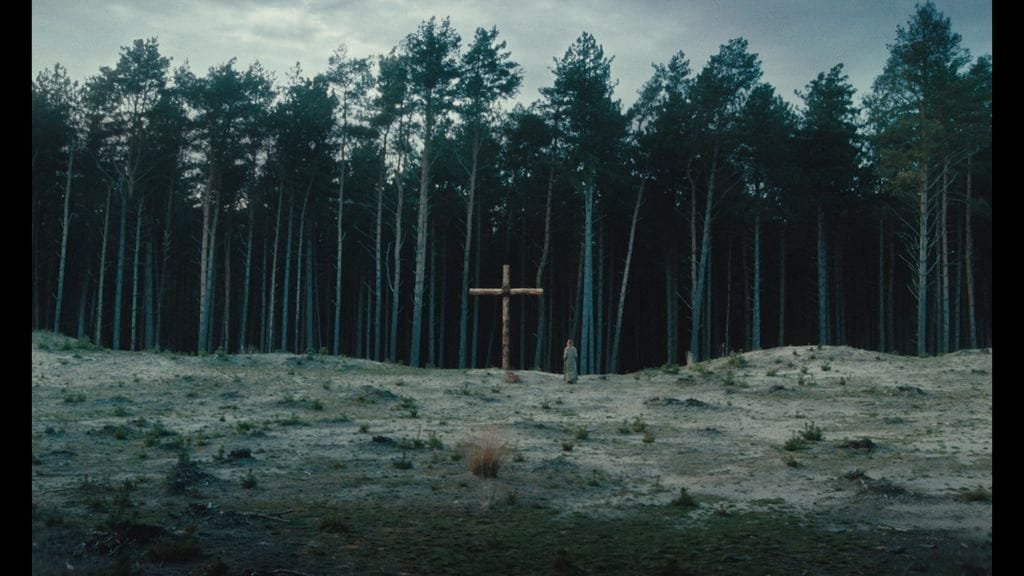
This no doubt saves her life – Gelo is quite clear that his deal is either rape, or murder – but when she returns to the village, her very survival is treated as a source of anxiety. No woman, we are told, has ever re-emerged from those woods. When Gelo’s hideously-rearranged body is later found by the men of the village who enter the woods to search for him (a rapist, maybe, but the town needs a competent butcher) , Frieda’s barren and stubbornly alive condition, versus Gelo’s oh-god-surely-he’s-dead condition, means that her community adjudge her to be in league with the Devil. She becomes a social pariah, but yet, something keeps drawing her back to those woods…
Perfectly acted and surprisingly economical – Heresy (aka Witte Wieven) lasts just sixty minutes – this is a very well-realised historical horror, though director Didier Konings, in this, his first-ever feature, anticipates some of the more expected comments – that his film strongly resembles The Witch (2015). It’s abundantly clear, and yes, Heresy is very Eggers in many respects, if perhaps even less rooted in a specific point in time (though looking pretty damn close to the 17th century setting of the 2015 film). The clothing, the practical realities of living a remote, agrarian existence, the prospect of a dark entity just past the village bounds – and of course, the harried female protagonist, and the rising hope that she can transcend her sullen life of thankless, bloody toil. But though it moots the idea of a ‘duivel’, this is more to do with the villagers’ limited vocabulary for whatever is out there: here, Konings departs from the Old World-meets-New World diabolical horrors of The Witch. There’s more at play here, though left to filter through to us, rather than being overwritten into the script. That would kill off all of the wonderful subtlety, which comes wedded to some wonderful aesthetics. Yes, again, that natural light is Eggersy, but it looks strongly Rembrandt in many places, and much more clearly dreamlike and supernatural in others (with a few scenes which look very much like scenes from Häxan, come to think of it). It’s its own film. If it has a fault, it’s that stark depiction of the sheer, unabashed unfairness of life for women in this historical past, especially when this comes to us via a few moments which feel sadly, horribly modern. We enlightened 21st century women have to have discussions about sexual choking, after all – something which arguably takes place during Heresy – except we don’t have any timely supernatural respite to offset it, only lawyers arguing about whether or not someone just got ‘carried away’, when women turn up dead.
That rather galling comparison aside, it’ll be clear from this review that Heresy is rife with familiar folk horror elements; as-written, they may indeed seem more formulaic still. So why see Heresy, if you’re already well-versed in the classics of the genre?
Well, this is such a solid, careful piece of storytelling. A film of contrasts, it establishes a world which scourges and trades in female flesh, but transfigures the same world, offering us a range of beautiful extended sequences, a sense of a supernatural source of redress and escape. It has a hard-edged feminist subtext which glimmers in a very dark world; it’s also strangely uplifting in ways which, arguably, only horror cinema can really muster: its horrors are not simply Christian horrors, and nor, perhaps, are they horrors at all, in the end. It’s a sharp, vivid vision.
Heresy (2024) is on UK digital now from GrimmVision.