With a slick, highly colourised start, Mother of Flies (2025) initially uses a voiceover to introduce us to some of its key ideas. Ruminating on the permeability of life and death may be a horror-friendly beginning, but of course from the perspective of the everyday, it’s an impossibility: that division works really well to capture the film’s core themes, which are in that clash between the real and the impossible, redemption and a far more punishing reality.
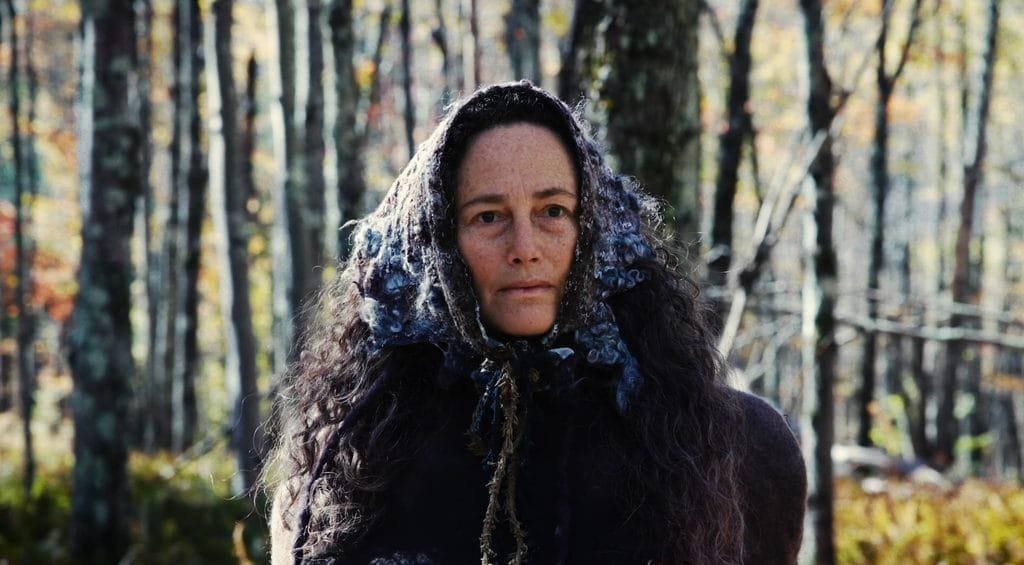
There’s a family here, a father and daughter (played by real-life father and daughter John and Zelda Adams) who have had to deal with hard-edged facts. Mickey has cancer; her dad is picking her up from college to take her to meet a ‘woman in the woods’ called Solveig (mother Toby Poser). Dad of course has doubts about this mysterious arrangement, and so decides to stick around – something not accounted for by Solveig, but she tolerates his presence and invites them both to stay with her at her remote house, deep in the woods.
Mickey wanted to come here because she’s putting her faith – faith being key – in a more permanent cure, as she has lost her belief in the efficacy of modern medicine, having had to come to terms with the likelihood of her cancer returning to claim her. Solveig offers her a three-day process which will purportedly cure her, but this is no health retreat: whatever Mickey had in mind, this is a far more intricate, intimate and often bitterly unpleasant sequence of treatments. It’s a service which Solveig has provided, she explains, to many others who – in their own desperation – had come to eschew another belief system: an impassive, remote Christianity which failed to provide comfort. But it transpires that Solveig herself has needs and expectations from this process – a kind of transaction.
There is so much to commend in Mother of Flies: it’s by far and away my favourite Adams Family project to date. Having written a book on witchcraft in cinema, it makes me wish that I’d see and included this film; it does so much, in such an intriguing way. The warmth between the family members here is a fascinating addition, but it’s no uncomplicated ‘extra’ to proceedings. It’s a family playing with what it means to be a family, to have a family and potentially to lose a family. We have a motherless girl, ‘barren’ through her treatment and facing death, playing alongside her real mother, here appearing as Solveig – a woman offering a chance to push back against these crushing certainties, but haunted by trauma and loss of her own. The presence of John Adams mustn’t be overlooked, either: it’s not to detract from his skill as an actor to suggest that his evident love for Zelda Adams adds a different dimension to his role here, as a man both interested in the possibilities being offered to his defiant, harried little girl and also cynical about them; he hangs on in there for the longest time as a representative of that conventional world still back over there somewhere, beyond the forest boundaries – but this, too, has to give eventually. The complexities of all this, for a team of actors and directors, cannot fail to add something vivid and weighty, lending the desperation of the sick an extra layer of emotional depth.
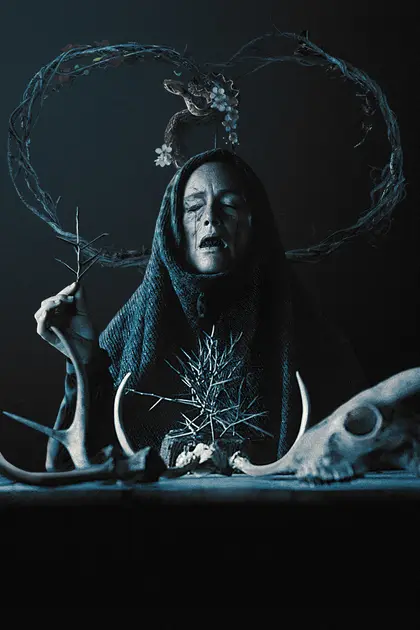
Sustaining all of this: extraordinary camerawork, an array of beautiful and impactful forest tableaux and, in other places, a kind of grotesque, painterly feel when the scenes turn to the more gruesome. For me, there’s some Von Trier in some of those scenes which linger over natural imagery and also on the key objects, significant items (or totems) which punctuate the film. Contrasting all of this almost totally is a fading, remote world of Americana: the diner, the flag painted on its wall, the motel, and (as an outsider) a private health insurance system where “nothing is for free – ever”. Surrounding this mercenary world of definites is the woodland, an America which has been there for what feels like forever – its flora, its fauna, offering solace and shelter to the alienated and desperate.
The voiceover motif, whilst it hasn’t worked so well for me in previous films, works well here: it makes a kind of sense, given that Solveig herself is a witch figure, and so her recitation of spells and rituals feels organically part of a witch’s retinue, as well as forging links to the oral histories and folklore which underpin the figure of Solveig and her actions, so it plays an undoubted and enriching role. It works. Then there’s a wealth of contextual knowledge, often expressed in archaic vocabulary which builds a bridge between past and present.
Stark, beautiful and perplexing, Mother of Flies feels like a rite in its own right. Sure, it’s narratively minimal, more of a mood piece – but spell-like, with savage and haunting imagery (and a stand-out performance from Toby Poser, ably supported by John and Zelda Adams). I tried and missed seeing this film at several points on the festival circuit last year, but I feel so glad I’ve finally got there. Mother of Flies is full of love, lore and terror, and it’s a brilliant modern witchcraft film.
Mother of Flies (2025) is available on Shudder.