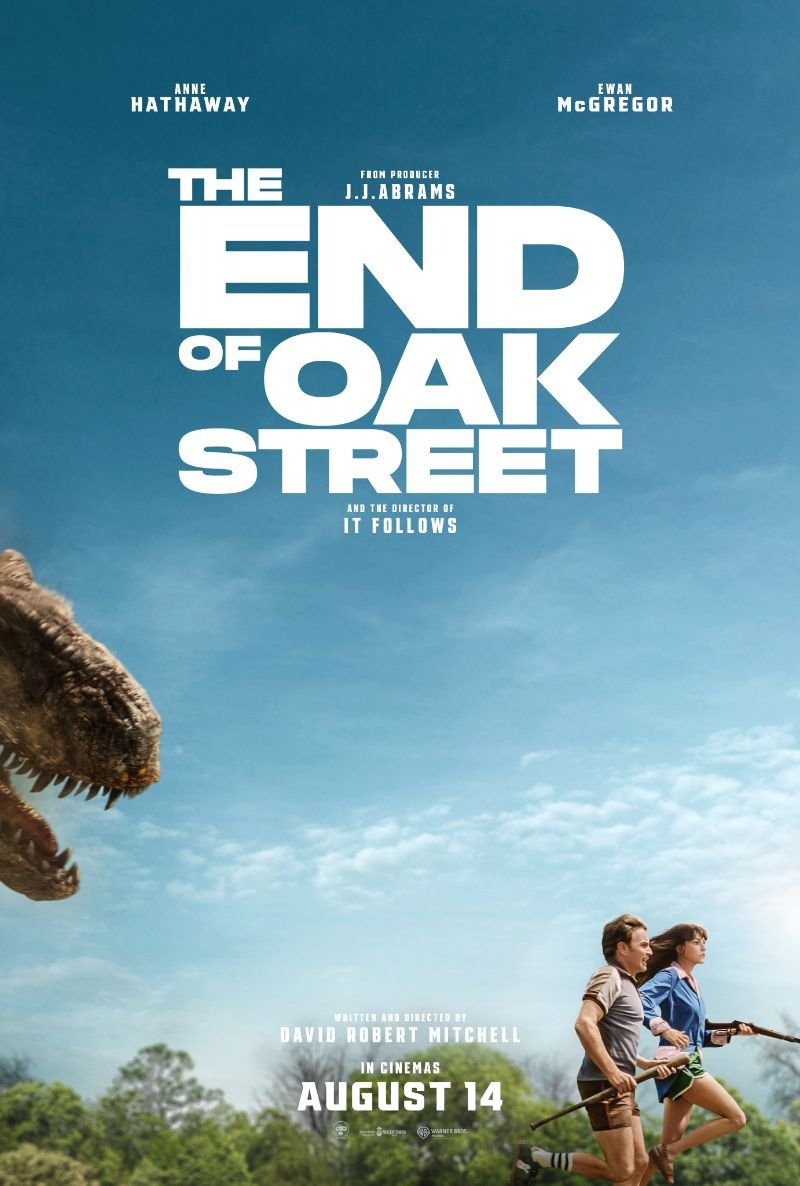
There’s a popular line of films and television which consists of finding an idyllic (or idyllic-seeming) retro America, and then menacing it with something bloody horrible – as if to say it was never that good, not really, but also because once you’ve created a weird feeling of deja-vu over the clothes, toys and TV – if you’re of a certain age, at least – then you need to do something with them, and why not showcase all those vintage bikes by having their owners pedalling for their lives? To be fair, though, The End of Oak Street (2026) isn’t simply a new spin on the kiddie horror we might so easily recognise. Instead, it shifts its attentions slightly to the nuclear family, lobs in some quantum physics and then successfully assaults said family with a slew of timeline-defying dinosaur species, all now furry and feathered in line with up-to-date dino-knowledge (which also makes them look more Eighties), but all continuously hungry – and amazingly quick to adapt to suburbia, come to think of it.
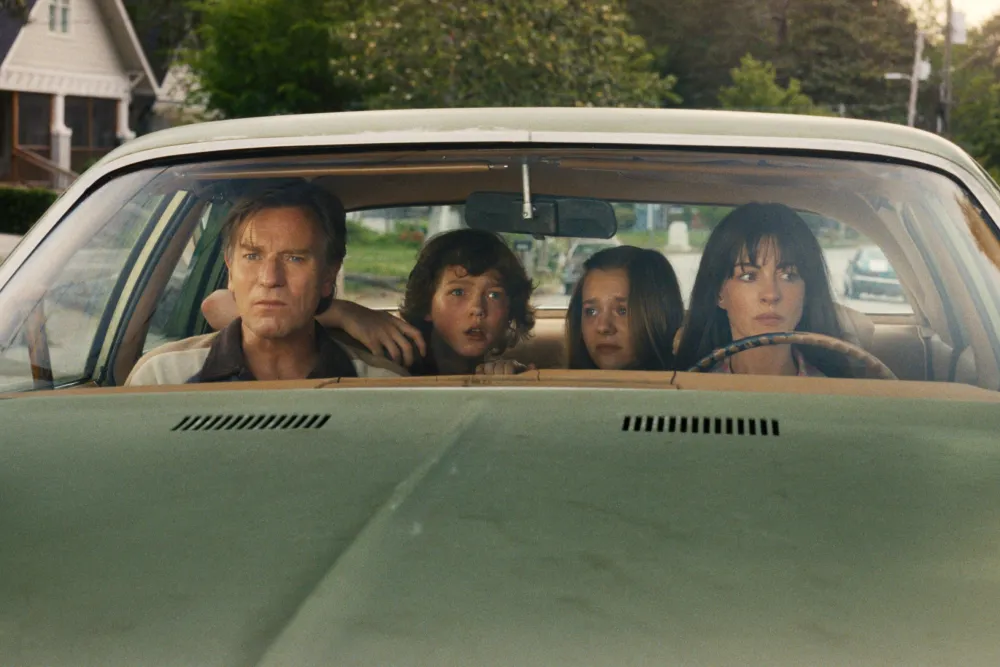
Let’s break that down a little more. We begin the film at a sunny, smiley block party in the early Eighties, as briefly established by a snippet of music and a glimpse of a TV show, where we meet the Platt family: there’s dad Greg (Ewan MacGregor), mother Denise (Ann Hathaway) and kids Brian (Christian Convery) and budding astrophysicist Audrey (Maisy Stella). There’s trouble in paradise: Denise and Greg have differing parenting styles, and it seems that she’s on the cusp of walking out on the family, now that the catharsis of fantasising about doing this in her novel manuscript just isn’t as cathartic anymore. However, all of this is about to be superseded by some strange goings-on (which you may already have heard being hinted at on the radio). At first, odd things start turning up: a long-extinct plant in one neighbour’s yard, a pile of mystery dung in another; but then the strange, brilliant light which seems to herald these odd additions goes one further and seems to transport the entire neighbourhood into the middle of a tropical Jurassic-ish world, where it’s quickly co-opted by the ravening wildlife. You’d swear dinosaurs had been sneaking in through windows all their lives.
Does this sudden, life-endangering shift compel the beleaguered residents of the area to group together, sharing resources, knowledge and weapons to try to survive? It’s always worth being cautious when you start to overlay ideas about political commentary onto dinosaurs (more so, I’d say, than with other, palimpsest-like movie monsters such as zombies and vampires) but if director David Robert Mitchell – who gave us the ultimate palimpsest monster in It Follows (2014) – happened to want to make a comment about the dangers (or perhaps benefits!) of eschewing community for the insular family unit, then he’s done it here, because they emphatically do not group together. Admittedly, forming a posse is a challenge when there are great, shaggy-haired dinosaurs lumbering through the streets, but it’s interesting that the Platt family’s interest in the plight of their neighbours is momentary at best; at worst, they’ll just hunker down and watch the guy next door getting pecked to death by a mob of pterodactyls. It’s so pronounced, the Platts barely even use any of their neighbours’ names. We don’t know if they’d have been any better off had they attempted to help others (though we do see that those who help them actually seem to end up doing a lot worse), but certainly, any dissatisfaction with suburban living is quickly set aside here, although Team Platt does eventually admit one more member – newly-orphaned new girl, Jeannette (Jordan Alexa Davis). Now: how are they going to escape? If they were transported here, can they use the same means to travel back?
So that’s the narrative frame. There’s a certain amount of engineered peril in places – often because a) the Platt family have a dog that they never bring indoors and b) they haven’t taught the same dog any recall, so he keeps running off, which prompts to Brian to climb out of the house to rescue him, which means his sister has to go look for Brian, and so on. However, despite this, and despite some similarity between dinosaur pursuit scenes (with lots of ‘it’s behind you’ going on), the creatures themselves look pretty good, though arguably Mitchell’s relish for killing off/menacing domestic cats won’t make him many friends, not least because we all know the cats would probably outlive the people. The human side of the ordeal is pretty bloodless, though, which enables it to feel borderline comedic in places (you see the flinging around but not the macerated body parts) and arguably, there are some – only some – comedic scenes to offset some of the tension and some of the more repetitive aspects of the film as a whole (because there’s only so much dinosaurs are ever going to do).
Overall, The End of Oak Street is an enjoyable enough film, even if it lacks some of the gravitas of It Follows and instead operates like a pulpy, retrospective riff on – and I realise this isn’t the first time this comparison is being made – early Spielberg, bigger budget and all. There’s a bit of Chris Columbus in here too, that same adventure aspect coupled with a family dynamic – right down to a fantastical antipathy to the possibility of parents getting divorced; here, instead of Mrs Doubtfire gaining access to a broken/breaking home, it’s a velociraptor, but the end result is similar. If you have been waiting for an honest-to-goodness dinosaur movie and you don’t mind any set-up to get there, then you will love this; fussier viewers might scratch their heads at the fact there are more split diopter shots here than guns – in America! – but hey, it’s still fun.
The End of Oak Street (2026) is in cinemas now.