Zombies and Christmas: why haven’t we had more of this combination before? The overlaps kind of write themselves: gluttony, conspicuous consumption, a strong tradition of being trapped in the house. Unholy Night (2026) begins well, and clearly has a sense of how these two things could work well, but after a bold opening sequence which seems to suggest the kind of fun overkill you might expect from the schmaltziest time of the year (and the potentially bloodiest genre), it unfortunately loses that impetus. In trying to do too much it does too little, and there are some questionable decisions in here at the filmmaking level (this review is based on an early cut of the film, so there’s still a hope that the AI/CGI-generated exterior shots may yet get replaced).
We start with a picture-perfect Christmas gathering, but there’s a knock at the door: all hell breaks loose, as an undead man lurches into the home, killing everyone in his way (save for a little girl, who is helped to escape by her father). This is a hopeful taster of what’s to come, but we’re then taken elsewhere with a different family. It’s not as picture-perfect, but this Canadian-Italian extended family certainly has its standards, with even a mild break in tradition being met with sheer dismay (adult son Gino’s Hawaiian shirt has to go; you slice, never cube a melon). Finally, everyone is sat at the table to eat. Being a Catholic family, the dead are mentioned almost as much as the living, as if they’re still around; well, funnily enough, it seems they are.
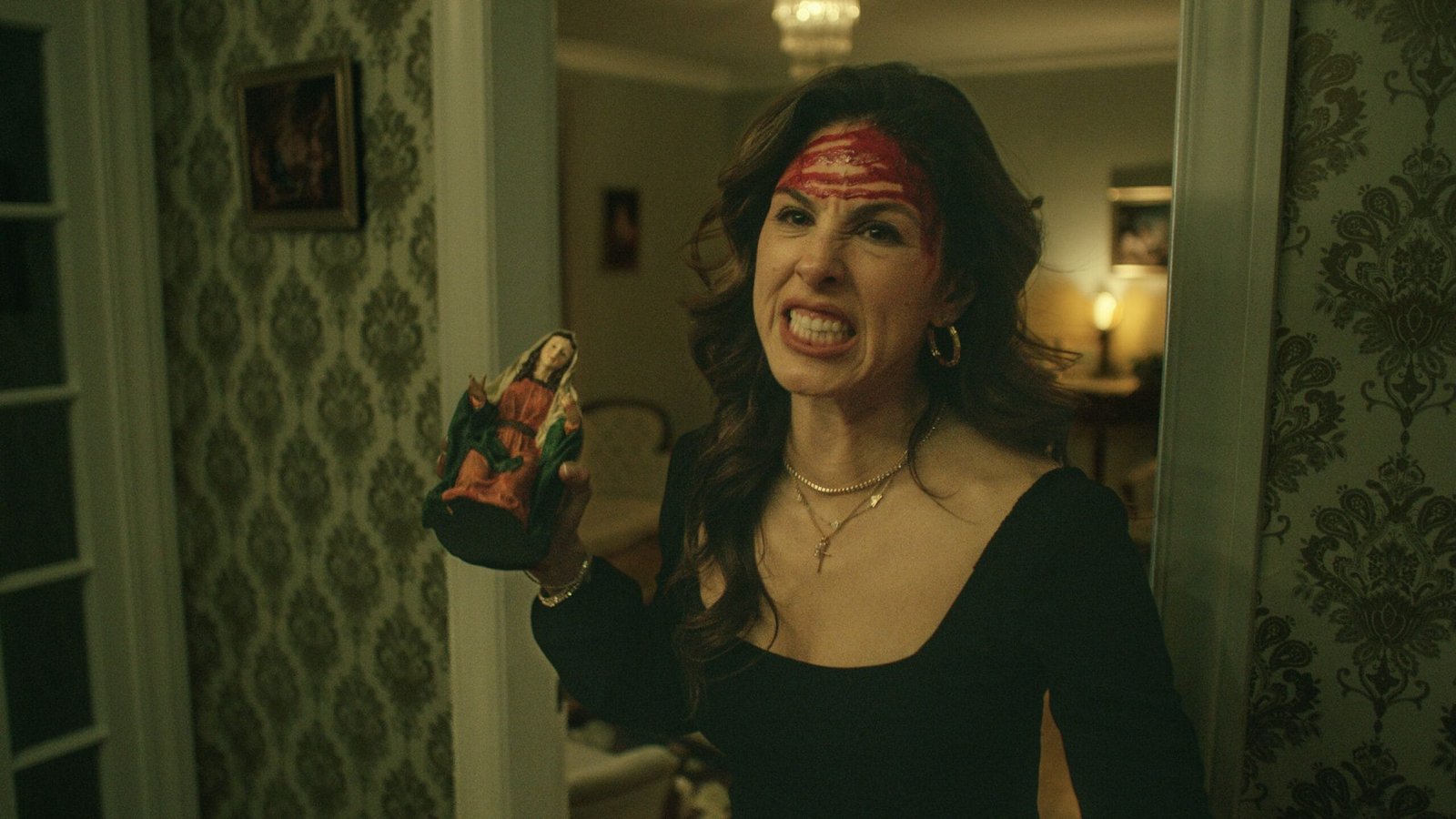
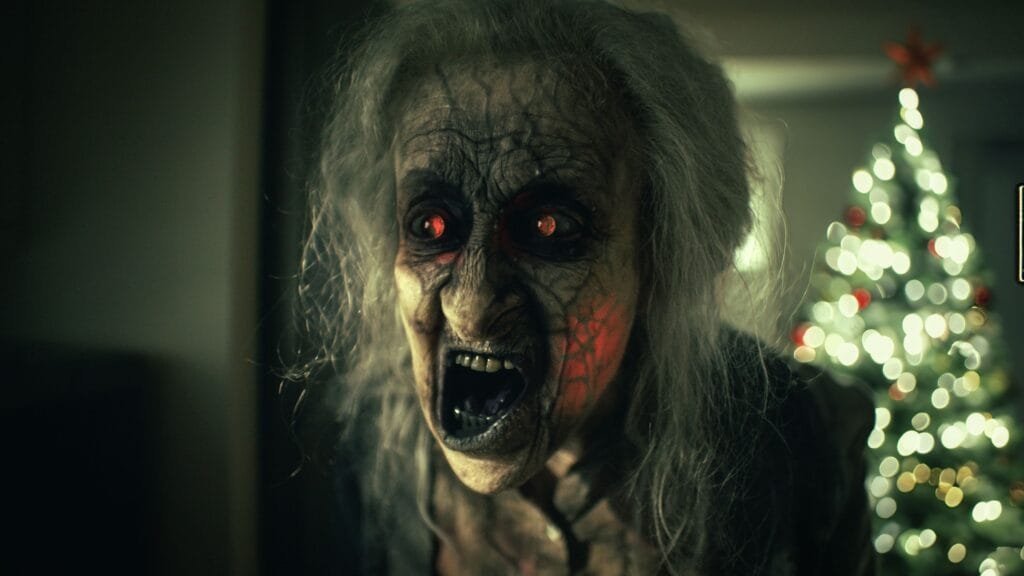
There has been an arrival. Upon hearing a commotion in the kitchen, Gino (Marc Bendavid) and the rest of the clan peer around the doorframe to see Nonna (Jacqueline Robbins) standing at the hob. The issue here – as we might guess from hints in that opening scene – is that Nonna is, or was, deceased. She seems fairly tranquil at first, but after a little family bickering, we soon have a temporarily outraged, undead Italian matriarch, disturbed whilst cooking, and ready to commit ultraviolence (see image above)…
We’re still operating within the film’s quicker-paced early segment at this point, so it may seem that the family members are being offed so quickly that we’re going to run out of them, but this doesn’t continue for too long. It becomes more imperative to work out why, exactly, members of this particular family are finding their way back (we soon encounter other extended family members too, returning to their old homes). It turns out that the picture-perfect gathering we already saw going badly wrong actually happened to mama Lucia (Toni Ellwand) during her own childhood; it wasn’t a different family at all. Lucia cites ‘disrespect for one’s ancestors’ as a potential cause for all this. An alternative Italian tradition, perhaps? Even more importantly, the family needs to find a way to reverse it, and to send the dead back to wherever they came from, which is also currently unclear. But perhaps it isn’t just this one family? Keen to offer help to old flame Rene (Shailene Garnett), who is back in the area and getting swept up in the same unfolding panic, Gino makes it his business to get to the bottom of the situation.
There are some great ideas here, with a strong, engaging start and a film which seems to be confident in its tone and direction of travel. That initial threat ebbs and flows, however, and that undead rage is absent from some of the zombies, occasional in others and permanent in just one, which affects the film’s impetus. Of course, this isn’t a straightforward zombie film and much is made of the mystique of what’s happening and why, but it does mean a varying level of risk, with moments where it feels like the living are putting themselves in harm’s way simply so that we can add a zombie sequence where there are, at that point, none. The appearance of some of the zombies themselves vary, too, in line with how their demeanour shifts around. There’s a blend of CGI effects (not great) and some practical ones (better), but despite some fun – more than truly formidable – zombie scenes, the film endeavours to shift more towards the family dynamic, but in so doing, spreads itself rather thin.
There are different ways to adapt the zombie theme, but it seems to work better with consistency; either it’s all-out carnage (name any one of a number of titles), or else it treats the undead as a puzzle rather than an immediate threat (such as in Handling the Undead), but it feels necessary to pick an approach and stick with it. However, Unholy Night wants to ponder the situation, as well as having the undead operating as some kind of classic zombie threat.
But there’s one thing which unites the rest of the film, and that’s finding an answer to that question: why are the undead coming to Christmas dinner (or wandering around more generally)? One idea has a lot of potential here: something gets mooted early on which suggests that domestic and familial roles are so pressing, perhaps particularly in a traditional, conservative family set-up such as this, that they can potentially be enough to raise the dead. Are things not being done properly? Sauces not made? Shoes being worn indoors? Time to come back to sort it all out; Nonna’s first move, remember, is to start cooking. That has promise, because it could allow a whole lot of discussion around gender, class and all of those big social topics which often come up in zombie cinema – being a genre which often lends itself to such, whether a horror, a horror comedy or anything in-between. Sadly, this turns out to be a bit of a red herring, left behind in favour for a far more bland proposal, which itself dissipates.
It feels like we run out of justifications, but having gone down the track of offering a number of different justifications, the steady, if occasional array of zombies and deaths feel less interesting. Characterisation and relationship building can’t quite get off the ground against this shifting backdrop, either. Unholy Night has some charming and inventive aspects, though it drifts wide of the mark after its initially very promising opener, becoming a much more diffuse and variable proposition as it goes. It remains surprising that zombies turn up at Christmas so comparatively seldom, but despite some engaging content here, that door remains open.
Unholy Night (2026) received its world premiere at the Fantasia International Film Festival 2026.