In 1983, the Director Of Public Prosecutions published its first list of movies which were tagged with the tabloid-friendly label of Video Nasties. These cinematic outliers were deemed to have to power to deprave and corrupt and, if the title in question had been successfully prosecuted under the Obscene Publications Act of 1959, any dealer stocking it could be fined or jailed. In one case, involving Romano Scavolini’s Nightmares In A Damaged Brain, one of its distributors was sentenced to eighteen months in prison (eventually reduced to six months on appeal, but sheesh).
It was a heady time, driven by moral outrage, framed as a battle for the very soul of the United Kingdom, and the seventy-two films that appeared at one time or another on that DPP list attained a level of notoriety their filmmakers never expected (unless, arguably, you were Umberto Lenzi). Thirty-nine remained banned, thirty-three were dropped from the list. All of them became must see items, of course.
As the memory of those crazy days fades and those of us who lived through the Nasties era scratch our heads and wonder what all of that hysteria was about, did those movies actually threaten the fabric of society as we knew it? Let’s take a look at one of them…
MARDI GRAS MASSACRE (1978, dir. Jack Weis)
*** THIS REVIEW CONTAINS SPOILERS ***
In New Orleans, a serial killer is picking up women to sacrifice to an Aztec goddess and it’s up to the crack Louisiana law enforcement team of Detective Sergeant Frank Abraham (Curt Dawson) and Detective Sergeant Mayer (Ronald Tanet) to stop the slaughter. Over the course of their investigation, Abraham hooks up with kind-of witness and reluctant lady of the night Sherry (Gwen Arment). Surprise! It’s looking as though she could be next on the murderer’s hit list…
Marketed as an “American Splatter Movie” on VHS by an offshoot of Derann Film Services called Goldstar, it was blindingly obvious what the fate of Mardi Gras Massacre would be once the BBFC got hold of it and, regardless of the stonkingly awful effects and shoddy filmmaking techniques, it received the inevitable ban and would not get a reprieve until 2022, when the uncut version was finally made available on disc. It’s since played in full on television, which gives you an idea of just how shocking it’s considered in these more enlightened times.
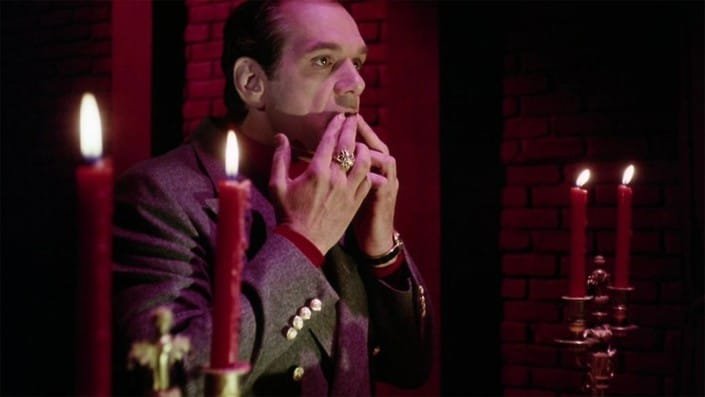
The opening ten minutes gives you a fair idea as to what this movie’s M.O. is going to be as a well-dressed john called, ahem, John (William Metzo) calls in at a bar and makes enquiries as to the evilest hooker he can take home. Directed to a woman called Shirley, he negotiates a price of two hundred dollars and the two head for his swanky (well, as swanky as the production budget will allow) apartment, which has its own bespoke sacrificial space.
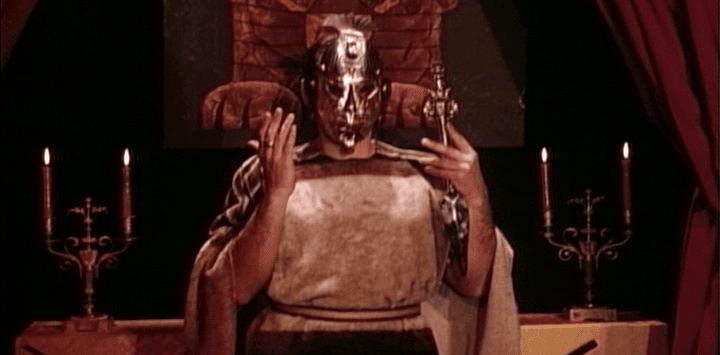
After showing his apparent kink by tying up Shirley and giving her a massage, things go awry for the poor lass fairly quickly. John disappears behind a curtain and then reappears wearing a weird mask and carrying a ceremonial knife, before going through the process of offering the victim to his goddess. Firstly, he stabs the hand which accepted the money, then he stabs one of the feet which brought her to his place before finally cutting out the source of her evil – her heart – and placing it on an altar.
I will accept that the above description may sound utterly horrific, but when you see the action played out on screen and you witness the abysmal effects work – set to an incongruous disco soundtrack – then the main point of offence is more likely to be that you’ve given up your evening to watch dross like this. The actress involved doesn’t seem especially terrified about her plight, but that’s fair considering she’s clearly breathing after she’s been bumped off.
The ritual/crappy body effect sequence is Mardi Gras Massacre’s central trick and it does not deviate from any of its spirit-crushing detail when it’s repeated twice during the runtime. Yep, considering you’re promised a massacre, you get a grand total of three in the ceremonial kill column, plus one bloodless blade to the guts as John is ambushed by a hapless pimp attempting to steal his money. I think it’s a blade to the guts, but that scrap is filmed in such an undetailed and confusing way that it’s only my best guess.
Considering the fact that Weis’ unenticing mix of slashing and sleuthing plods on for over an hour and a half, there must be something to fill the gaps between the unconvincing gore scenes and has this movie got the subplot for you, as Frank and Sherry navigate their fledging, badly written, astonishingly dull relationship. They go for dinner, they get their own slushy montage, they smooch, they fight, they break up. All the while, the investigation doesn’t seem to be going anywhere and Frank’s oppo Mayer represents the viewer by calmly suggesting that his partner is an arsehole.
Good call, Mayer, for Frank is a gigantic arsehole, looking down on Sherry’s profession even though he’s hardly squeaky clean. If the writing were better, it may have been an insight into Frank’s inability to deal with seeing the worst of humanity day after day. As it is, I’d had more than enough of him well before he decides to slap Sherry because she talked back to him. Having wasted a good third of the movie following around this pathetic excuse for a bloke, I wanted John to switch things up and start sacrificing dickheads instead. This, unfortunately, does not happen.
The eviscerations are nowhere near the most gruesome parts of the movie. That’s reserved for some of the least sexy exotic dancing you’re ever seen as scantily clad women hoof in and out of terribly framed shots and provide further padding for a story that’s already bursting with inessential content. Flubbed lines are left in, some performers are clearly so aware of the camera that their avoidance of its gaze becomes hilarious and that’s before we even get to the technical aspects of this film, with flat, static camerawork and editing of both picture and sound which appears to have been carried out with a pair of safety scissors.
The title isn’t even accurate, either, as John’s “three must die” plans for Fat Tuesday are thwarted by a late in the day rescue courtesy of Frank, who finally decides to pull his finger out and do some actual cop work, although he’s given the vital details of John’s location by a helpful Big Easy barkeep rather than joining any of the numerous dots. Our Aztec goddess worshipper’s plans are foiled and he ends up in the drink following a chase that’s both low on speed and destruction. A search of the water only succeeds in locating that weird mask and John is nowhere to be found. Spooky, huh? Well, no. How about a complete bloody waste of time?
Weis’ previous movie, 1976’s Crypt Of Dark Secrets – also horror, also set in Louisiana – sees a murdered Vietnam vet resurrected by a witch before time-honoured revenge is taken and, although it’s not great by any stretch of the imagination, it’s several notches up on Mardi Gras Massacre if you have a hankering for more of this auteur’s filmography. The swamp setting and the fantasy elements of Crypt work far better than the urban backdrop of this one, hampered by not only the lack of urgency in driving the plot forward, but a dearth of procedural elements beyond some rudimentary questioning of witnesses and a late in the day pounding of the beat, once the forces of law and order have finally realised the killer is likely to strike again – well, duh.
Weis did manage to snag some actual carnival footage and insert his leads into some of the crowds, which adds a little flavour to the final act, but it’s far too little, far too late. It’s also clear that the ultimate pursuit through the supposedly teeming streets was filmed at a totally different time in empty locations. So much of Mardi Gras Massacre feels like filler that, after the first slaying, it’s possibly to tune out at almost any point and pick it up later having missed nothing of any consequence. You could comfortably enjoy a restorative nap during the second act, it’s that lacking in incident.
As a grindhouse quickie, Mardi Gras Massacre isn’t possessed of the imagination, the wackiness or the grimy business that are the stock-in-trade of so many zero budgeted efforts. There’s one idea here and it’s stretched to way beyond breaking point, before the first half of the flick is up. The censor-baiting effects work, as laughable as it is, gave it a level of notoriety it absolutely did not deserve. To anyone being lured in by its previous ban and “Splatter Movie” tag, allow me to advise you that your ninety-six minutes is better invested in thousands upon thousands of other movies. Or, indeed, watching paint dry. If you do decide to go against this advice, you’ll just end up hating Frank Abraham and possibly yourself.