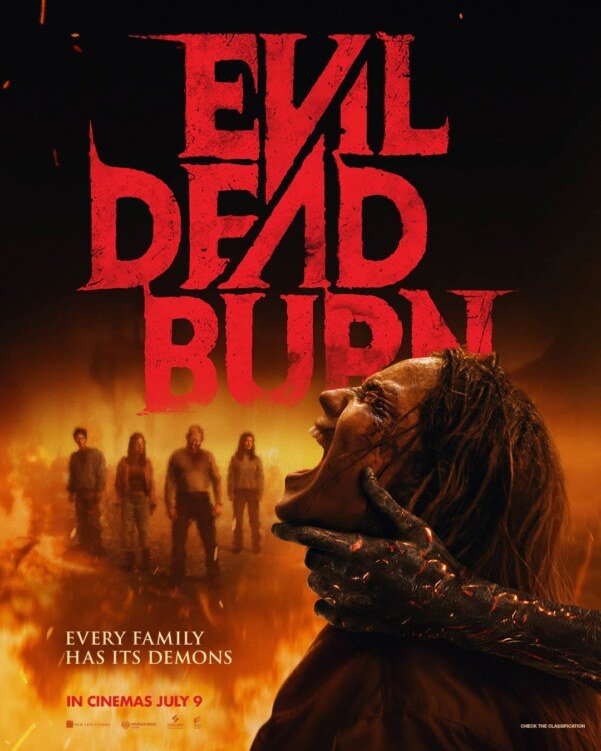
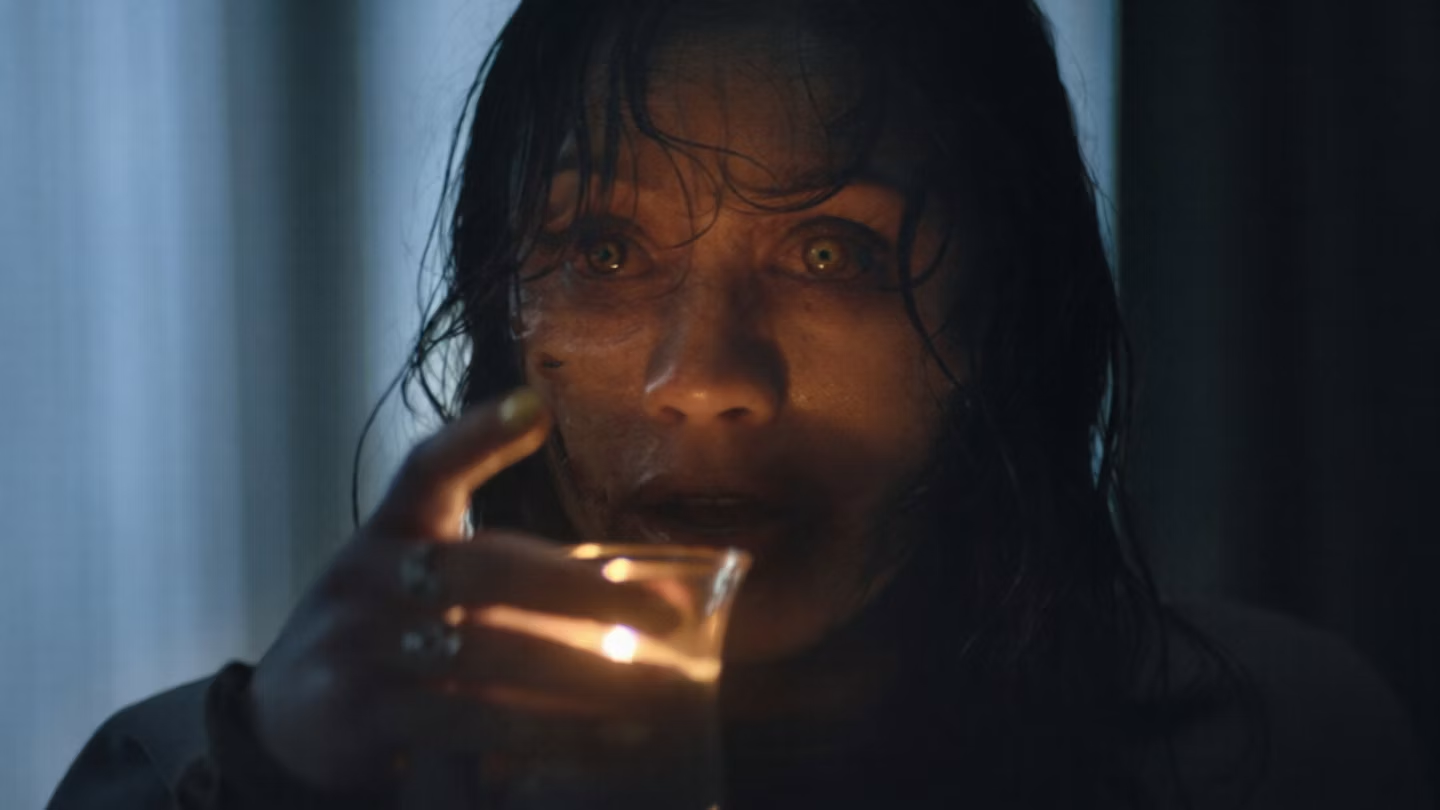
As the poor, plot-irrelevant saps we meet briefly during Evil Dead Burn‘s pre-credits sequence die their genuinely horrible deaths, I almost had to laugh. Not because years of viewing increasingly horrific gore has burned away my nerve endings, though perhaps that is partly true; no, it’s the fact that the original Evil Dead (1981) was outright banned in the UK during the ‘Video Nasty’ furore for scenes which, sure, are unpleasant – but so far removed from Evil Dead Burn in terms of sentiment, severity and tone that it feels almost unreal now. The very notion of getting something like Evil Dead Burn made in the 80s – SFX capabilities notwithstanding – much less getting it BBFC-certificated is utterly implausible. Never mind that ankle; Evil Dead Burn quite happily mauls and massacres every inch of the human form, starting immediately and never relenting. If it overdoes it with the callbacks and ‘just one more thing’ at the very end of the film, then this doesn’t seriously detract from an overall deeply disturbing, unflinching study of family-centred ultraviolence. Mind you, the Deadites (never referred to as such here, but still the go-to term) used to be a lot more jovial. There are a few moments of almost-levity, but unlike some of Raimi’s projects, this isn’t a film setting out to make you laugh.
Why so serious? The film wisely decides not to bother with a convoluted plot, instead using the existing framework with one key add-on in order to get things off the ground. We’re told that researcher Benjamin Price was part of an organisation called the Circle of Wise Men, making it his life’s work to track down knowledge about the Necronomicon, what it can do – and, key here, a means to send the entities it summons back to hell. Seems said entities don’t much like that. In a series of recordings, Price warns that should the Deadites detect the presence of a certain artefact, it will ‘summon’ them and they will stop at nothing to procure the object for themselves. This is all unbeknownst to Price’s grandson Joseph who, despite inheriting all of Benjamin’s research, chooses to use it merely to get ideas for his abortive writing career. But rooting around in his grandfather’s archive seems to do just what Benjamin warned: to call up the unstoppable force which wants to get rid of the Price family once and for all, and they want that dagger. This is why two blameless fishermen come in for a battering from an arisen Deadite, for no other reason than they’re in the way: we have met this young lady before, and it seems she hasn’t mellowed.
Honestly, it wouldn’t make for much of a film, but the Deadites could probably have just waited it out. The Price family is an unhappy, dysfunctional unit which is probably only a few degrees away from implosion even without the onslaught to come. Joseph (Hunter Doohan) has inherited the family lakehouse, but neglected it; it’s doing a House of Usher long before anything worse happens there. He wants to be a writer, but without the writing part, a strange but common affliction in writers. At his birthday party in his brother Will’s bar (Will is described as a restaurant owner; presumably the restaurant is somewhere else), Will (George Pullar) tries to prompt him to make a start by buying him a very expensive pen. So Will has it made, right? He has money, and a wife, Alice (Souheila Yacoub) but he’s a brittle, paranoid control freak, and he’s offered up to the audience – despite this never being, or setting out to be a nuanced character study – as a man who’s very easy to loathe, as soon as we see his controlling and coercive behaviour towards Alice. After an argument at the birthday gathering, Will decides he’s going to take their car and drive home, despite Joe and girlfriend Thya’s best attempts to stop him. Cue road safety advert par excellence as he slams into the arisen Jessica, there simply to pass on the curse to him and his family: some do it with physical contact, and some with words; Jessica chooses the latter, but mainly because she is cut to pieces in the car windshield. Will then dies horribly in a fireball; what could be better than a tragic roadside death to drag his brooding, resentful and traumatised clan back together?
It’s a dark sense of humour that plumps for a cremation after all of this, but hold tight: the film has great fun treating Will’s memorial with all the contempt the man deserves. The comedic touches here are in many ways as mean and callous as the violence itself, even if considerably lower in the mix – or at least, less of a priority – every time we get a new Evil Dead instalment. But things are about to get a lot worse, given that Will’s body was infiltrated right before he died, and he now wants to pass on his gift to other members of the family…
If you are someone who enjoys the feeling of being challenged by the gore and violence you see on screen, then it’s hard to think of a horror film in the past decade which does it better. Where the likes of Obsession and Longlegs might have one or two signature scenes where it really goes all in, Evil Dead Burn decides – for the largest share of its runtime – to do it continually, and if director Sébastien Vanicek and his team of writers did a bit of storyboarding which they then made fit, then this is the type of film and script where it works just fine. Actually, the script and the pace here are near spot-on, with only a little looseness around the final act and a stubborn determination to keep the kills coming until long past the end credits, when we’d clearly, really had enough by then. Evil Dead Burn throws in some aspects of home invasion alongside its supernatural content, but really what it does it to literally and physically tear a family to shreds, even while they try to work through their grief, their broken relationships and – when it comes to Alice – their misguided antipathy towards her. Mother Susan (Tandi Wright) is a toxic boy mom whose favourite, crispest son can do no wrong; her husband Edgar, who reads like a disgruntled step-parent but isn’t, is angry at everyone, but hates Alice with a special passion. Grandma Polly (Maude Davey), Benjamin’s widow, has dementia, and veers in and out of coherence. Where some reviewers have been critical of the broken family dynamic at the heart of this film, largely, it seems, because this is a commonly recurring trope in modern horror, here it gives the Deadites something substantial to work with. As family members try and (spoiler:) fail to withstand the malign influence they can soon feel creeping into their bones, there’s a nicely-crumbling façade already there, ready to be kicked to pieces.
The only real misstep for me comes right at the end of the film, with a certain Deadite looking (and feeling) a tad insubstantial and just too CGI-y for this reviewer’s liking; the rest of the film clearly makes use of CGI too, but it has a grittiness to it which doesn’t call undue attention to itself and looks rather good. So that could have been better, and the needless attempts to do more dot-joining before the film was really over was unnecessary, but given that the next film – a prequel – will be on the way in a couple of years, I’d say things are looking fairly positive for fans of this particular, devastatingly nasty and ugly brand of horror. Now, as to why we’re craving this boundary-testing kind of overkill in this day and age? That’s not a debate for now, but I guess *gestures at everything*
Evil Dead Burn (2026) is available in cinemas now.