In 1983, the Director Of Public Prosecutions published its first list of movies which were tagged with the tabloid-friendly label of Video Nasties. These cinematic outliers were deemed to have to power to deprave and corrupt and, if the title in question had been successfully prosecuted under the Obscene Publications Act of 1959, any dealer stocking it could be fined or jailed. In one case, involving Romano Scavolini’s Nightmares In A Damaged Brain, one of its distributors was sentenced to eighteen months in prison (eventually reduced to six months on appeal, but sheesh).
It was a heady time, driven by moral outrage, framed as a battle for the very soul of the United Kingdom, and the seventy-two films that appeared at one time or another on that DPP list attained a level of notoriety their filmmakers never expected (unless, arguably, you were Umberto Lenzi). Thirty-nine remained banned, thirty-three were dropped from the list. All of them became must-see items, of course.
As the memory of those crazy days fades and those of us who lived through the Nasties era scratch our heads and wonder what all of that hysteria was about, did those movies actually threaten the fabric of society as we knew it? Let’s take a look at another of them…
DEAD AND BURIED (1981, dir. Gary A. Sherman)
When visitors to the sleepy coastal town of Potter’s Bluff wind up dead, Sheriff Dan Gillis (James Farentino) returns from the big city to investigate and finds that nothing is as it seems in this outwardly idyllic landscape. Gillis, with his criminology degree and “hometown boy made good” tag, vows to get to the bottom of the gruesome goings on, but the town’s mortician/coroner Dobbs (Jack Albertson) is less concerned with discussing possible motives and more preoccupied with restoring the mutilated corpses to a level of aesthetic beauty that qualifies his work as an artform. At home, things are getting decidedly odd, with Dan’s doting wife Janet (Melody Anderson) disappearing at all hours and always seeming to have an air of knowing more than she’s letting on…
Directed by Gary Sherman, who helmed the superb London Underground chiller Death Line almost a decade earlier, and with Alien scribes Ronald Shusett and Dan O’Bannon on screenplay detail plus FX royalty Stan Winston providing the often impressive make-up trickery, it seems odd that something with the genre pedigree of Dead And Buried should share the same area of DPP real estate with other, far scuzzier celluloid transgressors. Yet here we are, and there it was.
Its bow on VHS wasn’t exactly down to some fly by night, exploitation heavy label either, with it landing a rental release courtesy of the generally reputable outlet which was Thorn-EMI Video. That, however, was no defence against the BBFC once there’d been the inevitable complaints from the amusingly fragile home audience of the 1980s, emboldened by a handful of puritanical individuals to complain about all and sundry.
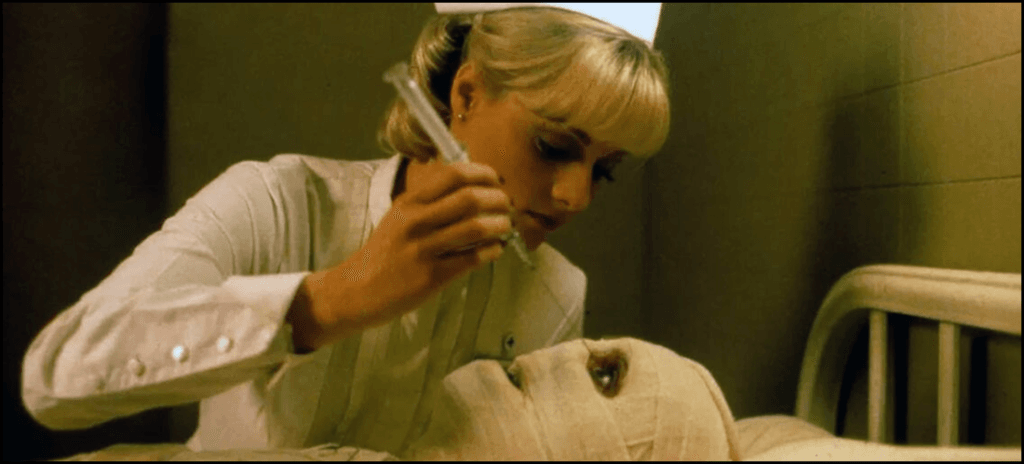
When I use the term “generally reputable,” it’s worth noting that Thorn-EMI found themselves in even hotter water with another title – Tony Maylam’s shear-happy slasher flick The Burning. Sherman’s spooky tale didn’t cause as much of a ruckus, but it wound up on the Nasties list nonetheless before it was eventually dropped a little further on down the trail. A 1990 release was cut by about half a minute to shorten some of the murdery antics – which included the sight of the alluring but deadly Lisa Blount’s faux nurse sticking a syringe in a patient’s eye – then it resurfaced again just before the end of that decade, at which point those previous cuts were finally waived.
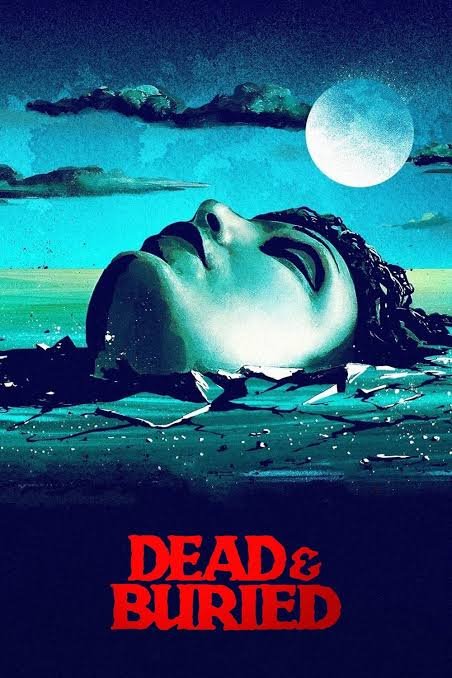
Given Shusett and O’Bannon’s input and given the fact that a certain Ridley Scott movie is inevitably mentioned on the box art, it’s fair to say that some viewers were expecting another round of Alien-style claustrophobic tension, but Dead And Buried is altogether stranger and looser, narratively-speaking, than Scott’s tightly controlled galaxy of horrors. Sherman creates a vivid, otherworldly, small town atmosphere where the close-knit community’s veneer of friendliness barely conceals their coldness to the outsider. As one of the trailers stated, “There’s one way in…and no way out.”
The opening sequence is an absolute doozy and sets the uneasy mood for the rest of the proceedings. Christopher Allport’s photographer is capturing attractive shots of the landscapes when the previously mentioned Blount shows up, seduces the snapper and catches him off guard just long enough for her accomplices to appear out of nowhere, beat the poor guy, throw a net over him and set him on fire, capturing their handiwork on their own cameras.
It’s a startling sequence, made more chilling by the fact that the violence is meted out in such a matter of fact way and there’s no emphasis on gore. It’s possibly this which made some of the video viewing public switch off in disgust, which to me only serves to underline that Gary Sherman is great at delivering memorable horror moments without drowning the audience in gore, although he also knows exactly when to deploy a gruesome special effect.
The investigation of the killings is approached in an unusual way, in that we immediately know who’s responsible and the viewer is entertained/frustrated by the fact that Gillis is always several steps behind, obstructed by both Potters Bluff’s info-light population and something far more devastating which the story takes its time to reveal. Farentino, who was more familiar to folks in terms of his television projects – for instance, he played the pseudo Roy Scheider role in the execrable small screen treatment of Blue Thunder but it’s absolutely not on him that the ‘copter’s television outing was so bad – is excellent here, blundering his way through a case where the clues are somehow right in front of him, yet impossible to spot. Anderson, who’d been done slightly dirty by her damsel in distress role in Flash Gordon, gets to flex a little here and delivers by far the most upsetting line in the movie.
Stealing the movie, however, is the superb Jack Albertson in his final on-screen role (he was part of the voice cast for The Fox And The Hound, which is his last credited movie). As Dobbs, he’s comedically cranky, obstinate, sometimes philosophical, sometimes straight talking, taking great delight in pushing Gillis’ buttons and stringing him along for the sport of it. Or is there something more sinister at play? Even for a coroner, Dobbs has a particular interest in the mechanics of death and takes glee in providing obtuse semi-answers that instantly mark him out as a suspect.
With the whodunit replaced by a whydunit, Dead And Buried throws the need for convoluted killer unmaskings out of the window, instead homing in on a number of creepy set pieces where unwitting folk stop off in Potter’s Bluff and very soon realise that’s a very bad idea. Even when you think some of these people have escaped, there’s a disturbing visual cue in the very next scene to let you know they definitely haven’t.
Lower key than its writers’ space shocker or its director’s Seventies subterranean slayings, Dead And Buried seems to be a title which is often overlooked, strangely lacking the inbuilt cachet attached to other, less accomplished works which were handed a ban. This is, in my book, a crime equally as heinous as those committed by the parochial perps here. It’s dripping in dread, with a streak of deliciously dark humour throughout, and it’s easily one of the best movies on the Video Nasties roster.