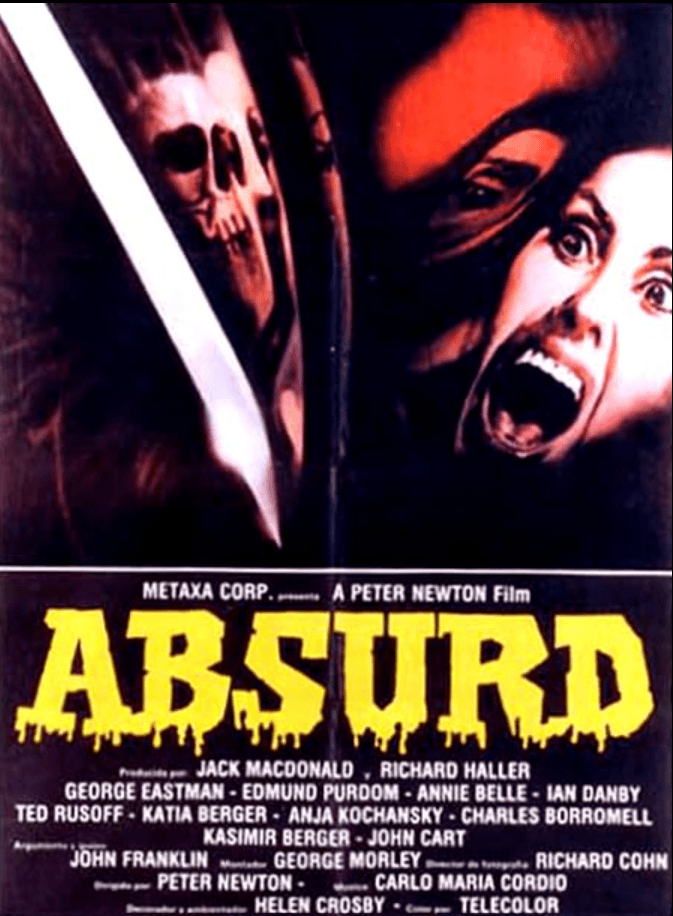
In 1983, the Director Of Public Prosecutions published its first list of movies which were tagged with the tabloid-friendly label of Video Nasties. These cinematic outliers were deemed to have to power to deprave and corrupt and, if the title in question had been successfully prosecuted under the Obscene Publications Act of 1959, any dealer stocking it could be fined or jailed. In one case, involving Romano Scavolini’s Nightmares In A Damaged Brain, one of its distributors was sentenced to eighteen months in prison (eventually reduced to six months on appeal, but sheesh).
It was a heady time, driven by moral outrage, framed as a battle for the very soul of the United Kingdom, and the seventy-two films that appeared at one time or another on that DPP list attained a level of notoriety their filmmakers never expected (unless, arguably, you were Umberto Lenzi). Thirty-nine remained banned, thirty-three were dropped from the list. All of them became must see items, of course.
As the memory of those crazy days fades and those of us who lived through the Nasties era scratch our heads and wonder what all of that hysteria was about, did those movies actually threaten the fabric of society as we knew it? Let’s take a look at another of them…
ABSURD (1981, dir. Joe D’Amato)

Escaping from a church-sanctioned series of medical experiments, Mikos (George Eastman) arrives in small town America, with a Vatican priest (Edmund Purdom) in hot pursuit. The chase ends with Mikos being disembowelled on a set of railings – is there any other need to include railings in horror movies unless someone ends up on the spiky end? – and that would appear to be that. But no! The experiment was to give its recipient healing powers and before you can say “Who left that drill lying around?” Mikos regenerates and escapes, driven insane by the dodgy clinical trial and hellbent on wiping out everybody who stands in the way. Plus, a few people who aren’t really in his way at all…
I wasn’t someone who went out of his way to seek out the Video Nasties at a young age. I certainly wasn’t going to ask my parents to rent them for me. Yes, it was a badge of honour for kids in the playground to say they’d watched things like Faces Of Death (I bet they’d only seen the box in the video rental shop) but I wasn’t interested in being cool and that’s a good thing, because I never have been from that point onwards. That said, I did manage to rent Absurd when I was sixteen from a hire place which had clearly never been raided by the police and continued to display it proudly on the shelves long after the Video Recordings Act had come in.
The back cover of the Medusa release had no details of the plot whatsoever, opting instead for the following text: BRUTAL!…SHOCKING!…VIOLENT!…SAVAGE!…NOT FOR THE SQUEAMISH! I’d been conned many times by video era hyperbole and my first thought was, who are they trying to kid? Ninety minutes after slotting the tape into our VHS machine, I had to admit it was all of those. Neither I, nor my younger sister who watched it with me, ever forgot Absurd because it contained a level of gruesomeness we hadn’t previously experienced. Was it scary? Not especially. Were we expecting to see some poor unfortunate getting his bonce band-sawed in glorious colour with no cutting away? Absolutely not.
Absurd, re-titled from the original Rosso Sangue, is a quasi-sequel to Anthropophagous, also on the Nasties list, also directed by D’Amato and also written by Eastman (under his real name of Luigi Montefiori), who starred as another killer driven to madness but in a different, more tragic way to what we’re given here. Make no mistake, this is absolute nonsense on stilts, frequently tasteless and often clumsily realised, but the British Board Of Film Classification were having none of it, certainly once it started causing upset in the living rooms of folks who, er, rented a film which featured a bloody axe on its front cover. In any case, the BBFC hauled it in, instructed Medusa to cut just over two and a half minutes from it and then it was free to be released back into the wild with that all important 18 certificate.
The problem with the cut version is that, if you lose all of the gory business, what are you left with? Not a lot, to be precise. The set pieces are the show and, although by modern standards most of the effects look pretty unconvincing now, the impact of such over the top violence was resonant way back when. Montefiori provided the scripts for a number of action and horror pieces and he was always looking for really dreadful ways to bump people off.
We’ll come to the worst of those when I get around to covering Anthropophagous, but elsewhere Luigi was quite fond of having folks collide with power tools and there’s a pickaxe death in this one which was recycled in more stylish fashion a few years down the line in Stagefright, another Montefiori screenplay joint given excellent directorial treatment by Michele Soavi. Soavi himself was apparently an assistant director on Absurd, but he’s not actually in the credits. He appears briefly as a motorcyclist who crosses paths with Mikos and, not much of a spoiler alert, dies. He’s not credited for that, either.
Outside of the Mikos mayhem, Absurd is a bit of a plod, bogged down initially by Purdom’s role as the chief source of exposition and then dragged down by a Superbowl party where the parents of Katia and Willy Bennett (Kayta and Kasimir Berger) are doing their darnedest to enjoy American football at a friend’s house while their kids, babysitter and nurse are being menaced by Mikos, who has turned up again at the place where he previously had his insides torn out because of a hilarious contrivance that I don’t feel I should ruin here.
The Bennetts employ a nurse because Katia is currently bedbound due to a spinal condition, so when it comes to the point where Mikos is trying to gain access to Katia’s room as she desperately attempts to extricate herself from the various straps holding her in place, that very concept takes the proceedings in a chilling new direction. Or it would, if D’Amato could have generated so much as a sliver of tension for any of the shock sequences. Carlo Maria Cordio’s score work, for once, doesn’t particularly help either, which resorts to an annoying, repetitive keyboard battering that usually signals something bloody is about to happen but doesn’t get the hairs on the back of your neck standing up as, say, Carpenter’s work on Halloween did.
While we’re on the subject of Halloween, Absurd is a combination of beats from the first two of those movies with a science gone awry subplot, then stuck in a blender and with added censor-baiting elements on top. In terms of a rapidly healing killer being tracked down by someone who has to stop him at any cost, I’m curious as to whether the makers of the following year’s Silent Rage took a passing glance at D’Amato’s work and swapped out Purdom’s character for Chuck Norris. Purdom does face off with Eastman come the end of the film, but not once does he roundhouse kick him, which is a shame. To be fair, the priest is there to be Absurd’s version of Loomis but, let’s face it, he’s not Donald Pleasance.
Viewed with 2026 eyes, Absurd is an even more curious mix than I’d encountered on my first contact with such disreputable scuzz. The murders are still pretty nasty and it’s easy to see why the BBFC hacked all of them, but there’s a sense of the ridiculous hanging over the whole thing and a large proportion of the runtime is inexcusably dull. Considering the inherent wackiness of the story, the tone is so resolutely po-faced it always risks becoming an unintentional laugh fest and it’s only because Eastman’s tale has the good sense to have Mikos find a prolonged and extravagant way to reduce the cast by one at regular intervals across the piece that will keep even the most tolerant of horror hounds watching. Absurd? Yes, it is.
Oh, by the way, this movie also goes under another, alternative title of Horrible. Sometimes filmmakers just bring it upon themselves, don’t they?