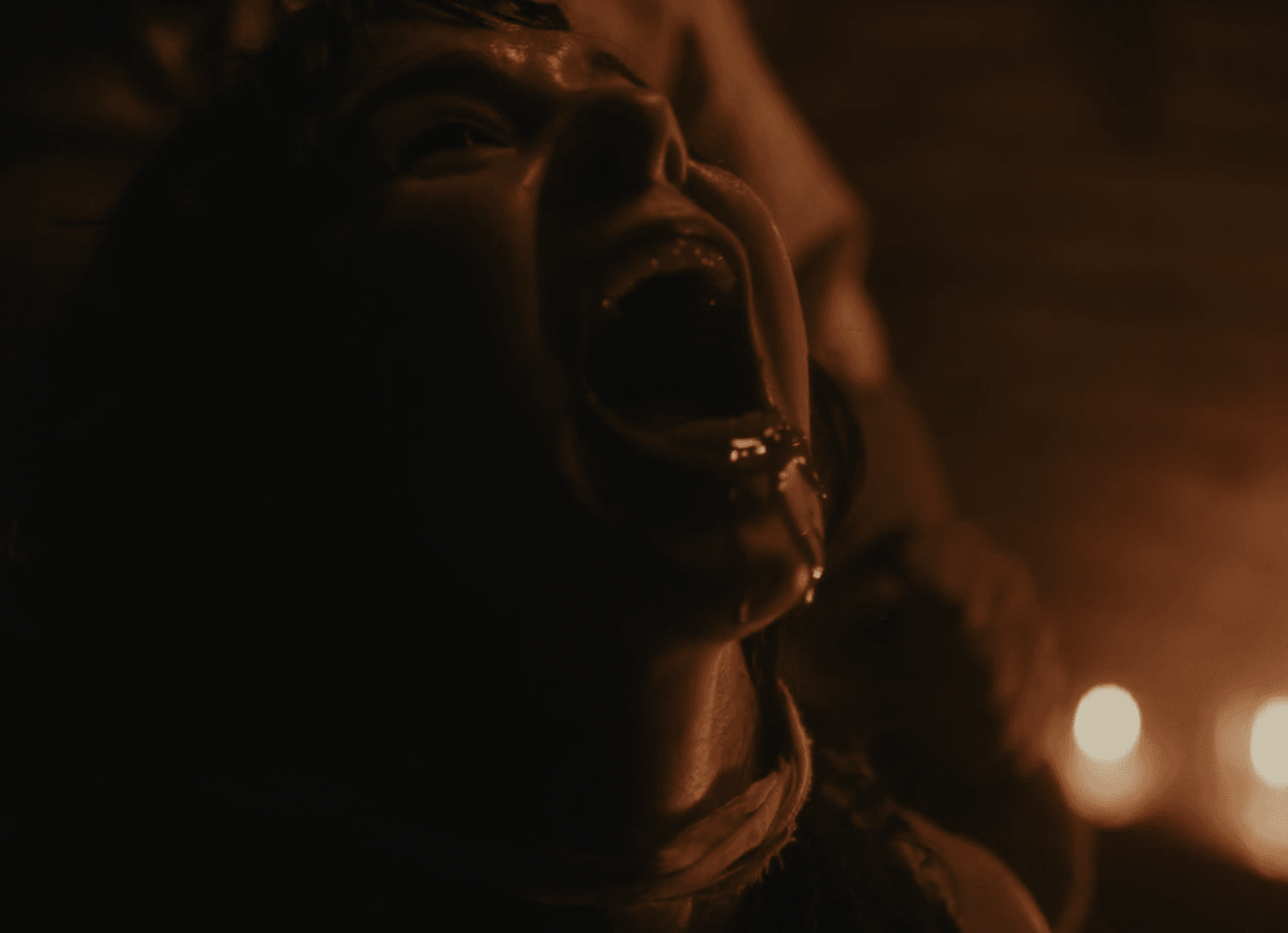

The Whistler (2026) opens with some on-screen text introducing the María Lionza cult, a Venezuelan belief system which believes, amongst other things, that spirits live amongst us, ready to possess the living. This being established, we next see a fearful woman creeping in and out of a sugarcane field in the dark, trying to avoid the light of a car’s headlamps. She fails, and is caught by the farmer who has clearly been driving around looking for her. He then forces her to participate in a ritual, trying to draw down a particularly fearsome spirit known as ‘the whistler’. But even when this seems to be successful – what he wanted or needed to happen – the woman later escapes into the dark again, and it’s clear that her being loose is now a real threat.
So there’s something ominous out there; we skip over a brief period of time before seeing a young, urban couple, now driving through the same sugarcane region we’ve already seen. Due to strategic cane fires, i’s raining ash when they arrive; the young woman of the pair, Nicole (Diane Guerrero) sees this as an ominous sign, but she may be predisposed to such omens. She and her husband Sebastian (Juan Pablo Raba) are visiting Venezuela from the US due to the death of Seb’s father; they were already grieving the death of their young daughter, Dani. Perhaps not especially surprisingly, Seb’s father is the farmer we’ve already seen – Vicente – and this visit is to attend his funeral.
With the patriarch of the family and the farm now gone, it should fall to Seb to take his father’s place: that is certainly the preference of his mother, Isabel (Laura Garcia Marulanda). But Seb is uncertain; he has a life in America; he doesn’t really see himself throwing it all away to become a farmer. Besides, he could sell the place, take his mother to America, and start over. Isabel is resistant to losing her home, but she brings up a practical consideration, too. It seems that there are squatters on the land who will not leave, and this is not good news for any attempts to sell. The people on the property are María Lionza practitioners: they have been taking resources from the farm, too. Nicole even recognises someone lighting fires on the estate in the name of her spiritual beliefs – a member of staff called Petra (Indhira Serrano). It’s a confused picture, but clearly this is a complicating factor in any future plans. And things step up a gear when Nicole stumbles upon a María Lionza ceremony taking place in the woods; when she witnesses a spirit manifesting in the body of a young woman, it does so with the voice of Dani, Nicole’s deceased child, calling out to her. Suddenly, Nicole finds herself propelled much closer to the shadowy believers and their belief systems, desperate to hear her child’s voice again.
There’s a lot of region-specific lore to digest early on in The Whistler, and right at the start of the film, motivations – anyone’s motivations – are not quite clear. More exposition does follow, but later – and tends to arrive in blocks. But despite this, other aspects of the film are very clear throughout, positioning The Whistler squarely in the ‘folk horror’ category. There’s the remote location, the arcane practices, the mysterious rituals and the arrival of outsiders, even if Seb comes with rather more understanding than Nicole. We also get a fractious balance between material concerns and spiritual solutions, and in this aspect, the film begins to migrate more towards contemporary spiritualist titles like Talk To Me and Baghead.
But, recognisable elements or not – no horror film is ever made in a vacuum – this is a very worthwhile venture indeed. The Whistler elects to develop even its more familiar plot points in its own way, with its own emphases and visuals. This is a very sombre, atmospheric film which takes its time, but doesn’t feel vague or obtuse. It boasts a wealth of simple, effective sensory elements throughout. The sound of the whistle itself – a simple enough thing – is incredibly sinister. We also get smoke, flame, lamplight and candlelight (and total darkness), all used in scenes rich with visual symbols and metaphors, also punctuated with sparing, but effective scenes of gore and violence, but only where these bring something specific to proceedings. Although partly shot in neighbouring Colombia, it’s intriguing to feel so immersed in a very different version of Venezuela than, particularly recently, audiences might be used to considering. The location shoots are beautiful, lush and expansive, although shimmeringly, oppressively hot. But this is no puff piece either: woven into the film are many of the social issues which have beset the country.
You could count the upsurge in María Lionza worship as part of this: people often turn to new, or resurrected spiritual solutions in times of hardship. We also come to understand the poverty, the lack of healthcare and the regular power-cuts, and of course the presence of displaced squatters points to other kinds of deprivation. Their presence on the Castillo land allows for an interesting blend of material and spiritual anxieties, asking the big question: should people accept the world as it is, or as folk belief says it is? Can people – can these people – meaningfully redress what is happening around them? The whistler itself acts as a manifestation of betrayal and greed, an aberrant force which strips away what little people have, so it feels like little surprise that it’s out there now, or that its impacts are most strongly felt by those who have already lost so much.
Whilst it might not be a revolutionary film in terms of some of its key narrative points, The Whistler still sets itself apart through its steady, thoughtful, human-focused approach. Its story is brought together by supernatural events, rather than being subsumed by them: ultimately, this is a film all about grief, and what it does with this theme is its strongest aspect. It’s interesting to note that director Diego Velasco and his writing team have had limited experience of the horror genre so far, but perhaps that has worked in this film’s favour here, allowing its horror elements to be used without any weight of genre expectations to detract from its overall aims.
The Whistler (2026) will be released from April 17th after its world premiere at Fantaspoa in Brazil on April 11th.