We start in a giallo-lit spin class as the opening credits of Thinestra (2025) run; the credits are rolling as if they’re on wheels, too. It’s a neat statement of visual intent for a film which takes beauty norms, particularly around weight, as a central theme, playing with aesthetics and style as it goes. In this instance, it turns out that the spin class is part of a dream, one in which Penny (Michelle Macedo) winds up eating the instructor. Clearly, Penny’s unsustainable efforts to reach an arbitrary target weight are getting under her skin. She lives and works in LA, too, a place coded worldwide as a city of extremes, and certainly a place heavily invested in prohibitive beauty standards. Penny works in advertising – an industry which clings onto a number of other, beauty-conscious industries: modelling, media, fashion. This makes it double-pronged for Penny: she’s the one who retouches the images, so she knows there’s a lot of lying going on, but she can’t help aspiring to the lie, anyway.
One evening, in a moment of weakness, she discloses to the current campaign model (Mary Beth Barone) just how miserable her weight is making her feel. Openly taking pity on her – helpful for morale, I’m sure – she hands Penny a small packet of diet pills labelled with the brand name ‘Thinestra’ (obviously named by a Satanist with a lisp). They’re not yet widely available, but – she avers – they have amazing effects. Penny accepts the pills, but she doesn’t start taking them straight away. For now, she’s sticking with the low carbs, meal replacement shakes and general misery, made ever more difficult by the fact that Christmas is coming, with all of its constant temptations. A festive biscuit-related blow-out finally sends Penny to the point of taking one of the pills. Surely, at this stage anything is worth a shot?
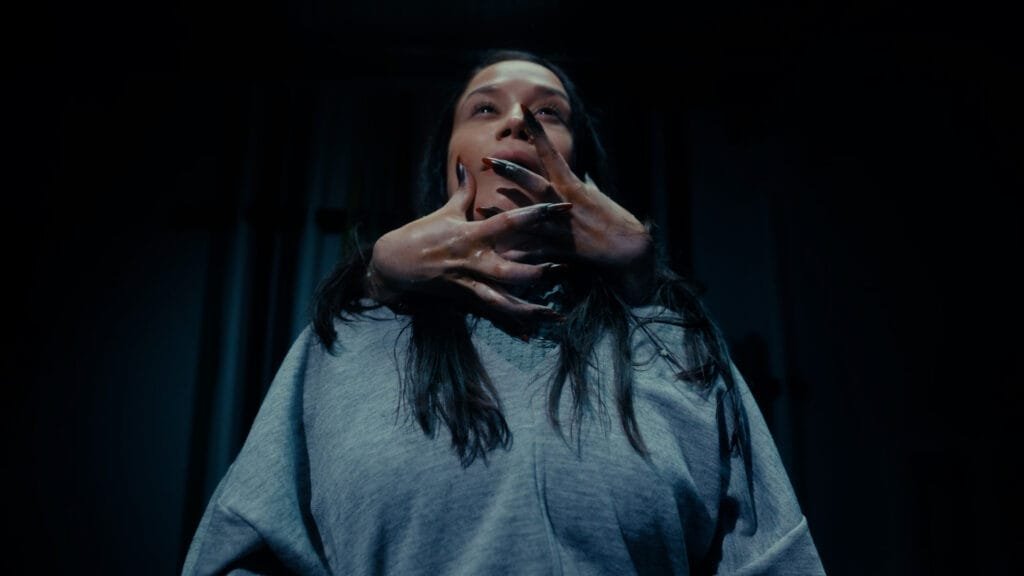
Of course this is a bad call: the pill works incredibly, horribly effectively, but comes at a cost – unleashing, temporarily, an alter-ego who comes out and, as alter-egos seem given to do, wrecks Penny’s life in a range of increasingly grisly ways.
I know what you’re thinking, so let’s get on and discuss the fact that Thinestra‘s story arc very much resembles The Substance (2024). Swap out ageing for dieting, and there we go. Thinestra also struggles the most in those scenes which most strongly mirror scenes in The Substance: starting with a fitness class, for instance, or the surreptitious presentation of the pills to a desperate woman by a beautiful user of the same medication. Despite these close similarities, though, Thinestra does have its own ideas, and does take things in its own direction. It’s much more given to laughter – not wry laughter, but a more open sort of humour, with plenty of bizarre hallucinations and dreams to flesh out Penny’s innermost thoughts. However, it never feels as though it’s laughing at Penny; she knows these things are ridiculous, and so do we. The film very clearly sends up the culture which both enables and then punishes disordered eating, rather than any individuals stuck in the system. Michelle Macedo plays Penny just right, too, as a likeable, fallible young woman; it’s easy to stick by her, even as things get worse and worse under the influence of the medication (and despite some minor issues in terms of reconciling the lighter tone of the first part of the film with the inescapable miseries of the last act).
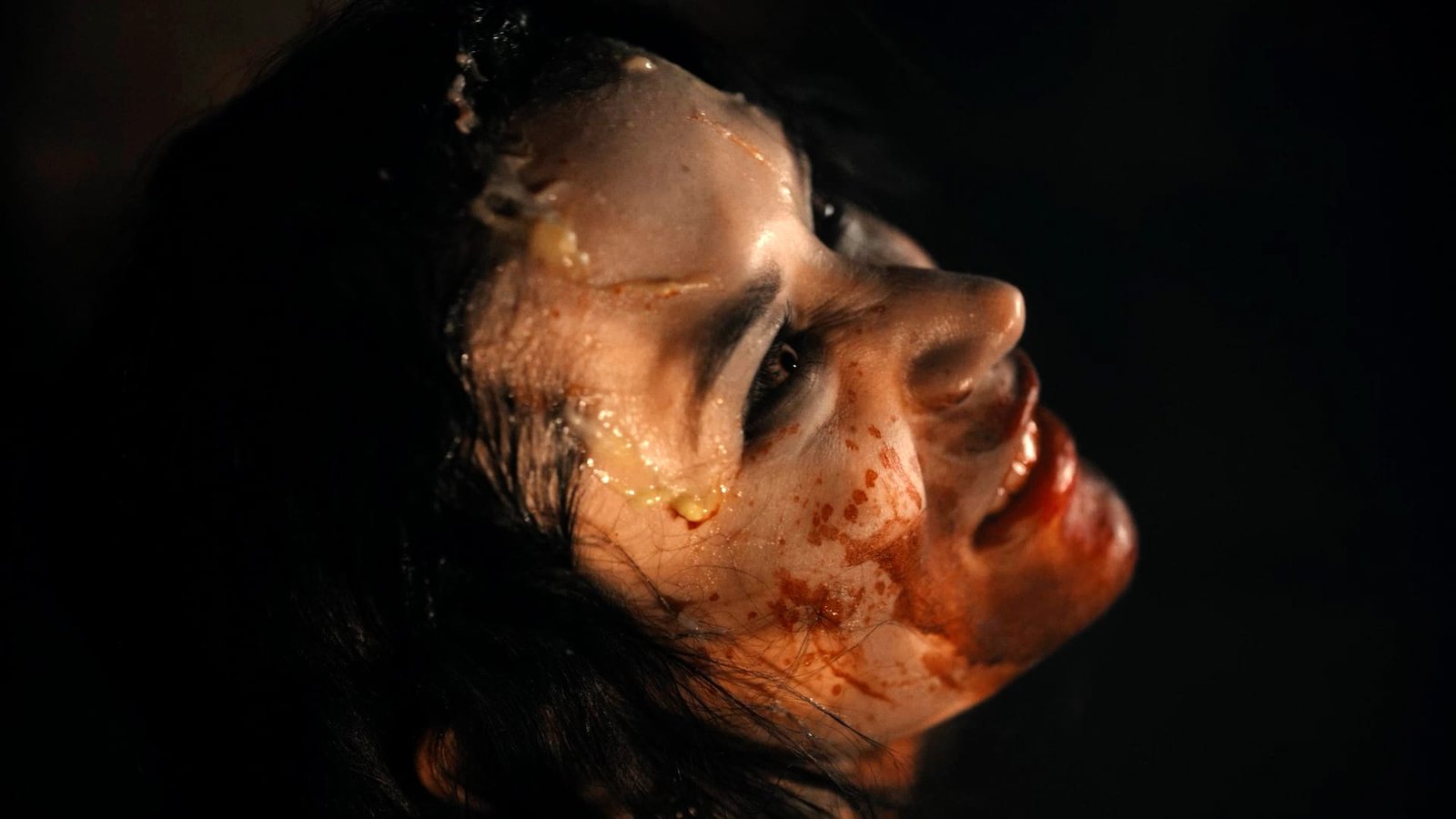
There are other key differences. Female friendship is important in Thinestra, whereas The Substance feels very, very lonely in that regard. Penny’s co-worker Chaela (Shannon Dang) is a welcome addition, allowing for some good dialogue and also ensuring that Penny has at least some social outlets, even if these situations often become stressful places of comparison for her. There’s a broader range of characters here overall. But Thinestra is definitely still a body horror, and boasts some good, budget-busting sequences of abject horror content: there’s garbage eating, fat-secreting, bruises, vomit and blood. Even if the film struggles in how it’s going to bring all of this together – whether literally or metaphorically – it nonetheless brings the goods if you like your body horror to leave you feeling a little destabilised and in need of a shower.
In Thinestra‘s critique of beauty norms and the consumption culture which sustains it, it also pays a nod here and there to other films – The Neon Demon (2016), perhaps, and Excess Flesh (2015) – but, although it would have been nice to know a little more about Thinestra and where it comes from without its rather simplistic wrap-up, the film has many merits, and, once again, isn’t just a re-tread. In fact, there’s another layer of tragedy here, and that’s the way Penny doesn’t listen to the good advice given by her mother; society’s great irony is to ignore women of a certain age whose age virtually guarantees that they’ve lived through all of this and could comment on it, but once you reach that age, no one cares, which is perhaps another nod to the plot of The Substance, as well as key to what unfolds in Thinestra.
Thinestra (2025) is available to stream from 14th April.