By guest contributor Adam Page
Let’s talk about dread. That particular kind which doesn’t make a fuss slamming doors or leaping out from closets. This one seeps. A feeling you get rereading the fine print on a contract you’ve already signed. That sense, creeping up your spine at 2am when you realise the map you’re using is, and always has been, wrong, and the thing that really is out there has been watching you follow it with something like amusement.
In 1994, John Carpenter managed to bottle this feeling. In The Mouth of Madness (1994), on its surface, is a horror movie about a missing novelist. But beneath that surface, and Carpenter is very interested in surfaces and what lies beneath them, in whether the concept of “beneath” even means anything by the end, is one of the most faithful adaptions of H.P. Lovecraft ever committed to celluloid. And that really is incredible, because this movie doesn’t adapt a single Lovecraft story. Not one. It adapts all of them. And adapts the idea of them. It manages to adapt what Lovecraft was actually trying to do, which most moviemakers who’ve tried to put Cthulhu on the screen have completely missed.
H.P. Lovecraft was born in Rhode Island in 1890 and spent the majority of his life in economically straitened anxiety, writing for pulp magazines that paid next to nothing. But at his best, what he did was totally reframe horror. Before Lovecraft, horror was mostly about evil. About things that wanted to hurt you and were opposed to you. Even if you couldn’t defeat them, you could understand them. Dracula wanted your blood, the ghost usually wanted revenge. They are comprehensible desires that can be mapped.
The great innovation of Lovecraft, and it is genuinely great, was to propose that the most terrifying possibility wasn’t that the universe was filled with things that wanted to hurt us. Instead, it was filled with things that had no opinion of us at all. That in the vast cosmic scale, we exist as bacteria in the gut of something unaware and vast. That all our concepts of good and evil, reality and fiction weren’t basic properties of our existence, they were coping mechanisms. Nothing but thin shells of meaning we had built over an abyss that had no interest in those shells and would eventually dissolve them.
His creations: Cthulhu, Yog-Sothoth, the entire squirming collection of Outer Gods, weren’t evil. Evil implies a relationship. They were just other. Just their existence was enough to shatter a human mind, not because they were hostile, but because our fragile human minds weren’t designed to process what they actually were.
This is a real philosophical position. It’s also the most purely terrifying idea in horror literature’s history. And it is almost impossible to put this on screen, because screens need images, images need comprehension, and comprehension is exactly what these creatures preclude.
It’s for this reason most Lovecraft adaptions fail. They show the monster. They give it a shape and teeth and motivation. Doing this, they domesticate it and make it legible. But this betrays the entire project. They make a movie about a big ugly creature and not the dissolution of meaning. John Carpenter understood this.
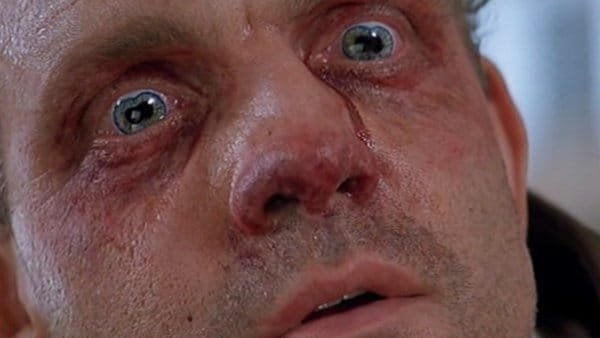
In the film, Sam Neill plays John Trent, an insurance fraud investigator hired by a publishing company to find their most valuable asset; Sutter Cane, the world’s best-selling horror novelist, has gone missing, right before delivering his final manuscript. We are told that his novels are so viscerally disturbing that readers have been institutionalised, and violence is increasing around those who’ve read them. Early in the movie, a word is used almost casually that you should hold onto: reality. It keeps coming back and meaning less.
Trent is played by Neill with the confident swagger of a man who has never once considered that his mind could be someone else’s real estate, and is a dedicated sceptic. He doesn’t believe in monsters; he believes in insurance fraud. Things that can be quantified. In other words, he is exactly the sort of person Lovecraft spent his written career slowly and gleefully destroying.
Neill is brilliant here; totally underrated in the canon of horror performances. He gives Trent a very specific kind of doomed competence. He’s the sort of guy who figures out angles for a living and has never come across an angle he couldn’t work out. We watch that certainty erode and it’s the central pleasure of the movie.
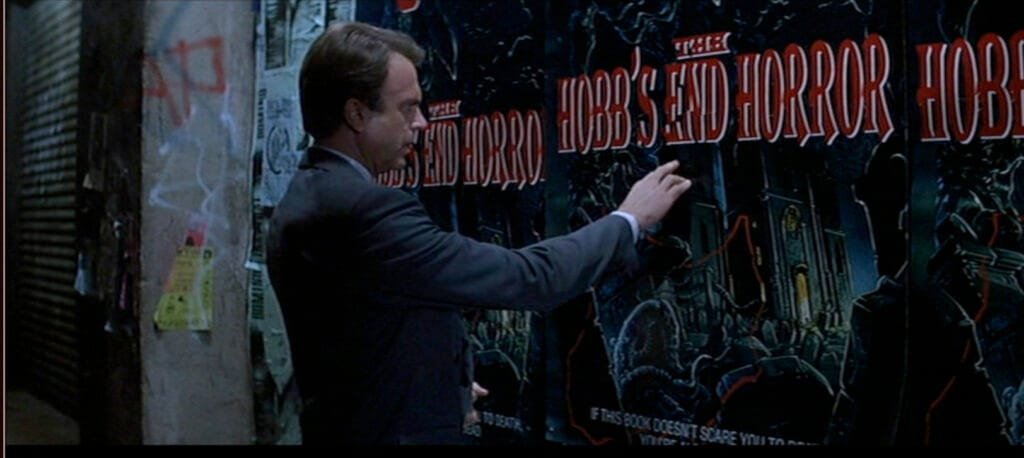
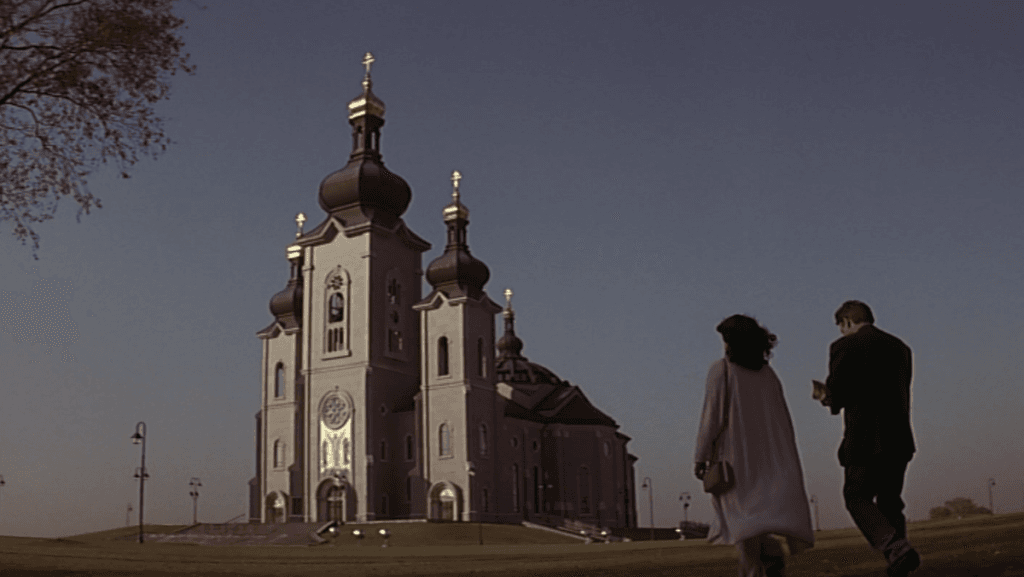
Trent and Linda Styles, a Cane editor played by Julie Carmen with just the right amount of fraying composure, drive to locate the fictional town where Cane sets his novels, Hobb’s End. It’s a town that, logically, can’t exist as it was dreamt up by Cane. And yet.
Carpenter films Hobb’s End like a memory of New England that has been just slightly corrupted. The streets are too quiet and the angles of the building are subtly and persistently wrong. There’s a scene featuring a cycling child/old man that is one of the most effectively creepy moments in 90s horror. Not because of what it’s showing us, but what it’s suggesting about time and loops and the paper-thin quality of cause and effect.
When we finally encounter him, Cane is played by Jürgen Prochnow in a performance of barely-contained ecstatic horror and he is not a villain in a conventional sense. Instead, he’s something which is more unsettling: a conduit. A man who has discovered, or was shown, or maybe always half-knew that his fiction was transmission. He wasn’t making up the Old Ones, he was writing them into existence. And the act of enough people reading his work was literally reshaping reality.
This is a key Lovecraftian insight that Carpenter and writer Michael De Luca seized on: it isn’t enough to have monsters. You need to attack the framework of knowledge and go after the truth itself.
The central horror of the movie, which Carpenter delivers with almost academic precision, is that the distinction between the novels of Cane and the world Trent lives in has been eroding for the whole runtime, and possibly before it began. Reality is a consensus and belief is a structural material. So when enough people believe in the world of Sutter Cane, Sutter Cane’s world becomes the only one.
This is Lovecraft at full distillation. Not the tentacles or ancient underwater cities, but the epistemology. The idea that what we call sanity is just the brand name on a popular shared hallucination.
In 1994, John Carpenter was in a strange middle period. He was post his imperial phase; Halloween, The Thing, Big Trouble in Little China, etc, and not yet fully in the late career which is still being assessed by critics. In the Mouth of Madness landed between Body Bags and Village of the Damned with a reception so lukewarm, it was almost criminal. Audiences weren’t sure how to deal with it, and critics filed it away with a vague shrug.
They were wrong.
Watch it today and what we notice is the control. Carpenter is a director who knows exactly what he’s doing. The movie uses colour temperature as a psychological indicator. The “real world” of Trent’s frame narrative has the familial desaturated blue-grey of institute florescence, and Hobb’s End slides into a warm, nostalgic palette which makes it more inviting and therefore more dangerous. When they come, the scares are exactly timed. Carpenter has always been a metronome disguised as a moviemaker. And the score which he composed himself (he often does, a gift to cinema that isn’t celebrated enough) is a dread engine that oscillates, melodically simple but complex in its deployment and knowing when to push and when to let silence do the work.
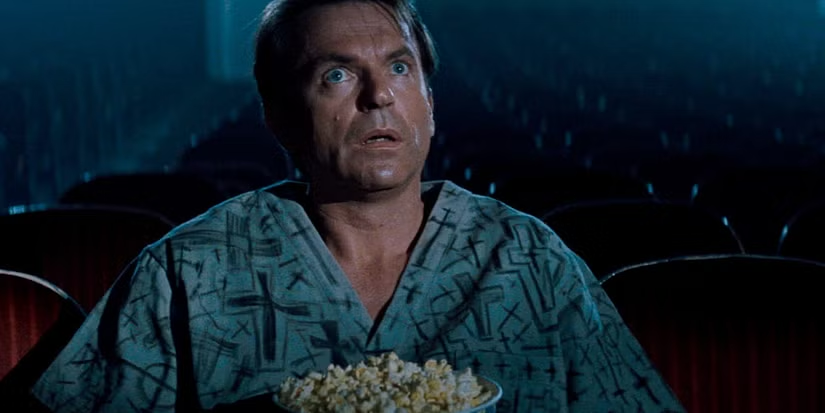
The famous final scene of Trent in the theatre watching his own story on the screen and laughing with the specific hilarity of a man whose last defence against despair has been breached, is one of the finest endings in American horror. Neill plays it not as a breakdown, but more as an arrival. It’s the laugh of a man who has finally understood the joke, and it is everything. The joke is on him, and it started long before he was born. It will continue long after every idea of him has been dissolved.
Roll credits.
What I find honestly moving about In the Mouth of Madness, more than thirty years on is that it was made by people who took Lovecraft’s ideas seriously as ideas. Not as Intellectual Property, or as an aesthetic surface to be raided for tentacle imagery, but as philosophical propositions about the nature of reality and consciousness, and the granite-solid human need to believe we are in the story and not the other way around.
The movie asks a question which it refuses to answer. And that is, if fiction and reality are the same thing, which one do you want to live in? Trent spends the entire movie trying to determine whether he’s a character or an investigator. The formal trick of the movie, with nested realities, stories within stories and the frame which reveals itself as also framed, isn’t cleverness for its own sake. It’s the whole argument. The medium is the message. We’re watching a movie about a man in a movie about a man in a movie. At some point, we have to realise we’re in a theatre, itself a kind of Hobb’s End.
Lovecraft knew that the scariest thing he could tell us about wasn’t a monster, but the size of the darkness outside our circle of firelight, and the possibility, remote but unavoidable if considered, that the firelight was never ours to begin with. Something else has been tending it. And it stays lit for its own reasons.
In the Mouth of Madness is one of the rare horror movies that actually went there, and looked over the edge. Not just at those monsters waiting in the dark, but at the dark itself. How it has shape without form, intention without mind and always the patience of something that has never needed to hurry.
Sam Neill laughs in that theatre. We laugh along with him, because we’re already inside.