By guest contributor Adam Page
There is a very particular type of genius which gets buried alive by success, and Christopher Lee probably knew this better than most. For decades, if we thought of Christopher Lee, we thought of a cape, a set of fangs, and two puncture wounds on a trembling ingenue’s neck. Dracula. The role which made him and, if you were to ask Lee in one of his more candid moments, almost unmade him.
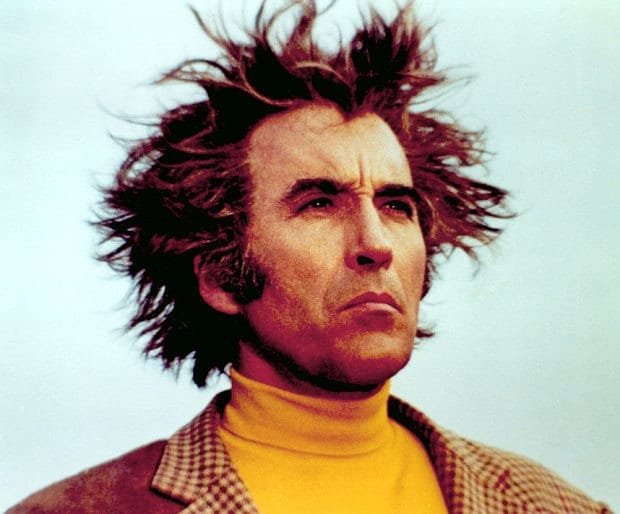
But somewhere in the mists of 1973, on wind-ravaged islands north of Scotland, something happened. Something Lee himself would spend the rest of his long life pointing to and saying: that one. That’s the one. Not the Count, or Saruman the White. Or The Man with the Golden Gun. The Wicker Man. Lord Summerisle. A man who never raises his voice, never bares any teeth, and never threatens you with anything more than a smile and a perfectly poured glass of wine.
And yet.
Let’s set the scene, because context is everything.
In the early 1970s, Britain is embroiled in an identity crisis that would make your head spin. Its fabled Empire is a ghost of itself. The counterculture revolution has soured into something a lot murkier. And British horror, specifically Hammer Horror, has spent almost two decades selling fear as something Gothic, reassuring and very nearly comfortable. With Hammer, you knew where you stood. The monster was the monster. The hero was the hero. Christopher Lee had made a handsome living playing the former and was very, very good at it. But Lee was bored. If you know where to look, you can see it in the later Hammer movies. The weariness behind the red contact lenses. The feeling of a man just reciting lines from a contract he would have loved to shred.
Then along comes Robin Hardy and Anthony Shaffer with a script which was, and I say this with the full weight of a man who has been a horror fan for three decades, truly strange. It wasn’t horror-strange. Or monster-strange. It was strange in the way a folk song is strange. Or in the way the British Isles themselves are strange, if we scratch deep enough beneath the surface of orderly queues and church fêtes.
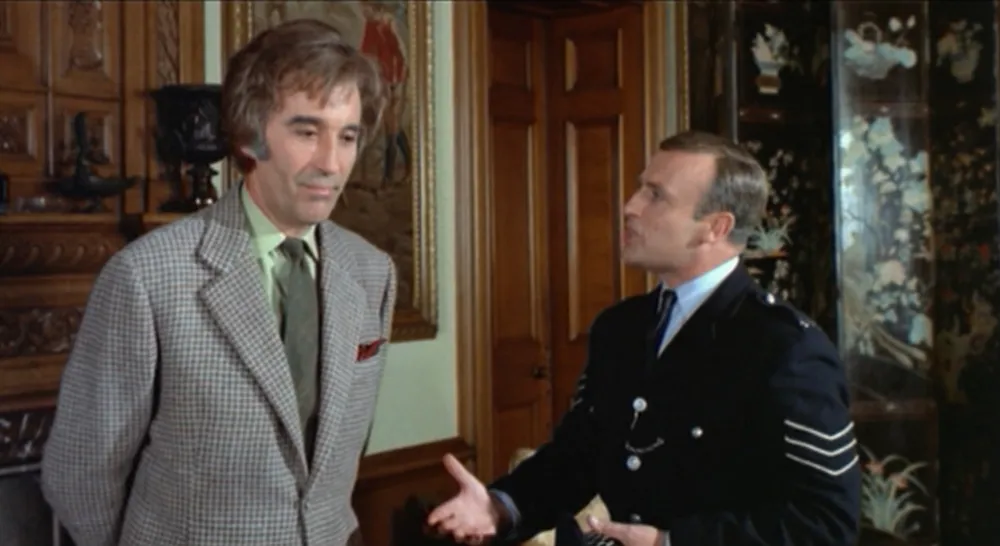
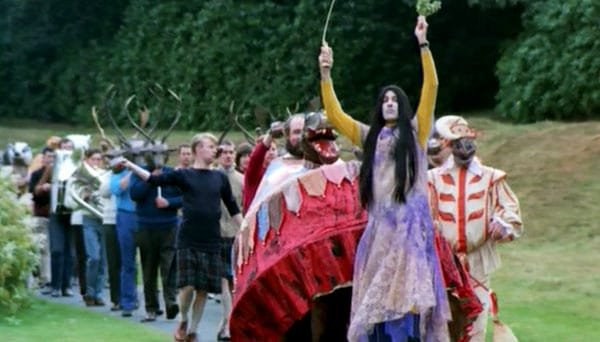
The Wicker Man follows Sgt. Neil Howie, played with Protestant rigidity by Edward Woodward, who is a deeply devout police officer. He arrives on the fictional island of Summerisle to investigate the disappearance of a young girl. He instead finds a community that has completely rejected Christianity in favour of something much older. Something pagan. And something which involves naked women dancing round fires and schoolchildren learning about the phallic symbolism of the maypole with the cheerful attitude of children learning long division.
And there presiding over all of it, with the ease of a man who truly can’t understand why he’s making such a fuss, is Lord Summerisle. Lee plays him as, in a stroke of brilliance, totally reasonable. That’s it. That’s his whole performance. It shouldn’t work, yet it is extraordinary.
Summerisle doesn’t leer or scheme, at least not visibly. He is welcoming, and he is educated. He quotes his grandfather, a Victorian scientist who brought back the island’s agricultural productivity by reviving the old gods as a kind of motivational framework, with real filial warmth. He shows off the harbour to Howie with the pride a landowner has when they are genuinely doing good by their tenants. I would imagine he serves excellent tea. By every surface measurement, he is a perfectly delightful man.
And because Lee plays him like this, resisting every temptation to wink at the audience, or signal his villainy, refusing to give Howie or the audience any purchase on what he really is, Lord Summerisle becomes one of the most quietly frightening villains in British cinema history.
Something I think Lee understood about performance that a lot of actors never quite grasp is, restraint is not the same as doing less. Restraint is doing exactly what the scene calls for and not one thing more. It’s an act of real precision.
Consider Dracula. That role requires projection. He is a supernatural force, and Lee played him as one, with physicality and presence. With those incredible eyes that could go from blank to murderous in half a second. Within its parameters, it’s a great performance. You are supposed to feel the threat. The makeup, the sound, the camera, they all conspire to tell us: this is the danger.
In The Wicker Man, there is nothing to tell you that. You have to figure it out for yourself.
Lord Summerisle’s danger is totally architectural. It lives in that structure he has created on the island, in a belief system he has either cultivated or cynically maintained. And, brilliantly, the movie never completely resolves which one it is. Is Lord Summerisle a true believer? Or is he just a pragmatist who discovered the old gods are good for the apple crop and goes along with it? Does he feel anything when the fire climbs towards Howie?
Lee keeps all these questions genuinely open. Every scene is played as though Summerisle himself considers them the wrong questions, or at the very least, unanswerable ones. There is a scene towards the film’s end where Summerisle tells Howie the crops will be good next year, and he says it with the confidence that is either serenity of faith, or the denial of a man who has maybe made a huge mistake and can’t afford to examine it too closely. Lee gives us nothing to resolve that ambiguity. He just inhabits the certainty and lets us decide what its made of.
That is not Dracula. That is not Saruman the White, who is basically Dracula with a staff and better dialogue. It’s something rarer and harder: a performance which trusts the audience to do some of the work.
Lee was hugely vocal on his feelings about The Wicker Man. In countless interviews across the decades, he went back to it, calling it the finest British horror movie ever made. He called Lord Summerisle his best role. And coming from a man with his filmography; close to 300 movies and 61 screen deaths (both Guinness World Records) that is more than a simple throwaway comment. That is a deeply considered position.
And so, why? What did he see in Lord Summerisle that he didn’t see in the Count?
Part of it, I think, is authorship. By the time Lee was done with it, Dracula had become a franchise. The character had existed before him, and would exist long after. Contractual obligations were involved, along with the commercial needs of Hammer and the slow, grinding machinery of sequels. It was work. It may have been skilled and often genuinely inspired work, but it still seemed like work nonetheless.
Lord Summerisle he created. There was no template. The screenplay from Anthony Shaffer may have given him the scaffolding, but the man living inside that role, the flavour of his conviction, his specific charm, and the warmth that seems to make everything a little worse, that was all Lee.
There is also the question of intelligence. There is no doubt that Lee was a genuinely erudite man. He spoke multiple languages, and was a serious student of history. He had served in military intelligence during the Second World War. He was not, it can be safe to say, a man who found deep satisfaction frightening people just for the sake of a production company’s quarterly returns. He was clearly interested in ideas, and Lord Summerisle is a role created entirely from ideas. Ideas about reason and faith and the nature of belief. What it means to build a community around a mythology you might or might not personally endorse, and the violence that is found in even the most pastoral-looking systems of thought.
At its core, The Wicker Man is a movie about two types of certainty colliding. Howie’s particular brand of Christianity is judgemental and rigid, seemingly uncomfortable in its own skin. It makes him cruel in small ways, despite the fact it gives him genuine moral courage. The paganism of Summerisle is joyful and fluid, seemingly inclusive. But he doesn’t hesitate to burn a man alive when the harvest calls for it. Neither of these worldviews comes out clean, and both are shown to contain their own forms of terror. Lee clearly understood this. He plays Summerisle as a man who has really thought about these things, not as a bland antagonist, but as someone with a philosophy, no matter how monstrous that philosophy eventually proves to be.
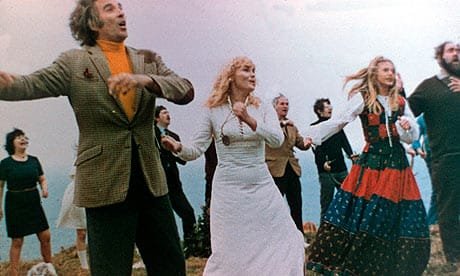
There’s a moment towards the very end that always lingered with me. The Wicker Man is about to burn, and Howie is trapped inside, praying and singing and dying. The islanders are about to sing too, Sumer is icumen in, a middle-English song so old it pre-dates the Black Death. Their folk hymn will rise to meet his, two strands of devotion colliding in a cold Scottish sky. Summerisle stands apart, watching, his hair whipping in the wind.
Lee plays the scene almost completely internally. There is a fleeting look across his face which the camera catches. It isn’t triumph exactly. It’s more complicated than that. Doubt perhaps, or reverence. Or maybe just the expression of a man who has just set something irreversible in motion and it watching it complete itself. It lasts for maybe three seconds. It tells us almost nothing conclusively. It stuck with me for years.
Dracula certainly never gave Lee a moment like that. At the end, Dracula is always defeated; he is comprehensible and containable. Summerisle stands singing on that cliff edge in the wind, and the movie ends, and we still don’t know exactly what he is.
Famously, The Wicker Man was butchered on its release. It was dumped as a B-movie. Director Alex Cox joked (?) that the original negatives had “ended up in the pylons that support the M4 motorway.” It took many years for the movie to find its deserved audience. The Wicker Man is genuinely and uncommonly good. And at its centre is a performance by Christopher Lee that gets better on every viewing.
Christopher Lee played Dracula nine times. He was the villain in a Bond movie, a Star Wars movie, and in a fantasy trilogy that made more money than some nations’ GDPs. By any metric imaginable, he was one of the greatest monsters of 20th century cinema. But the role he pointed to, over and over, until the end of his life, the role he wanted on the record as his finest hour, was a man who warmly hosts you, pours you a nice drink and shows you the apple orchards. Then, when the calendar calls for it, burns you alive.
I think there is something poetically appropriate about that. A man who spent decades frightening people found his greatest performance in a man who never frightens anyone. Right up until the moment when it’s too late to matter.
That is craft. That is the difference between a career and an art form.
I have a feeling the gods of Summerisle would approve.