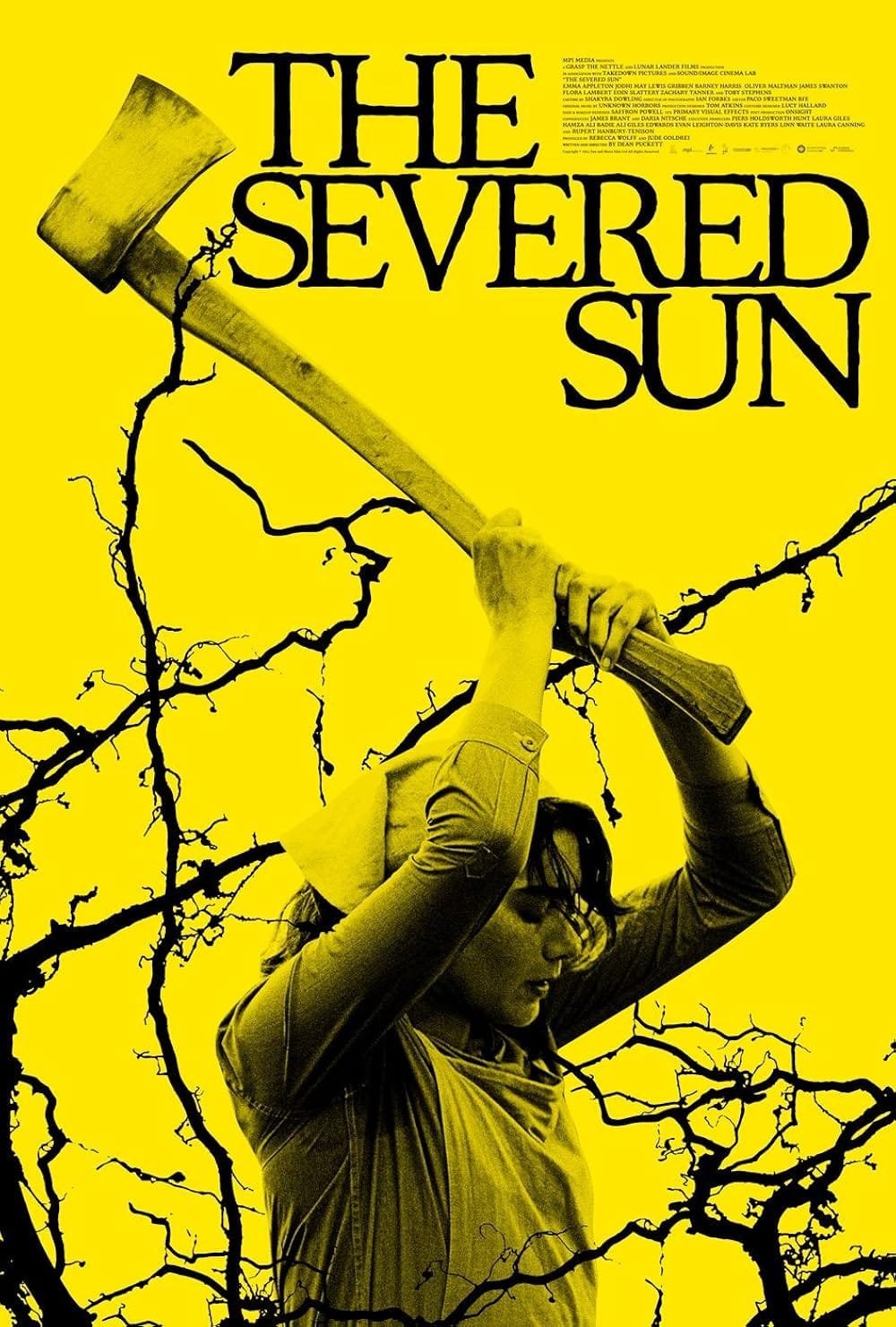

The Severed Sun (2024) opens in a remote religious community, just prior to a calamitous event. A young woman named Magpie (Emma Appleton) has, presumably with the tacit approval of her bruised and battered elder stepson David (Lewis Gribben), concocted a plan to poison her monstrous husband. Husbands tend to be monstrous, by the by, round these parts. A vase of foxgloves perhaps provides a clue as to how he’ll be dispatched; this appears to be a pre-industrial society, one where people lack access to any kinds of mod cons.
Or is it? At first, the sunlit uplands of The Severed Sun seem timeless, though perhaps with some clues – clothes, buildings – that this could be the early 20th Century. However, a few momentary inclusions disrupt this impression; this could be now, or it could be in the unspecified future. The film is never safely grounded in a specific timeline. What is certain is that this small group of people have put themselves under the power of an unswerving pastor – who just so happens to be Magpie’s father. This doesn’t seem to mean she enjoys special treatment; the pastor (Toby Stephens) has especially high expectations of her, as her dutiful behaviour is so enmeshed with his own soft power. When Magpie and both of her boys absent themselves from prayer meetings after her husband’s untimely, and very much accidental death, grief can only be used as an excuse for so long. There’s also work to be done: these people are subsistence farmers, working the fields by day.
However, something else is stirring here. Magpie seems touched by unsettling, fragmentary visions of some kind. She begins to succumb to sinful behaviour, seemingly at the behest of a dark ‘Beast’ figure. There’s something in the soil, Magpie asserts, but its influence begins to reach out, affecting both her and those close to her.
If this brief synopsis sounds familiar, then yes: there are folk horror elements here which read as familiar. In practice however, The Severed Sun has much to recommend it, and weaves a striking atmosphere while it steadily transforms many of the more expected, core ideas. Here, folk memory is all about the trappings of a lost civilisation, but a very particular version of civilisation, one which seeks to retain the most conservative, paternalistic elements of what came before – marriage, faith, authority. The world has reverted to a feudal system, blurring into religion at its edges, true, but mainly as a means to entrench old, regressive systems. In some respects, The Severed Sun reminds me of the Jim Crace novel Harvest (and I can’t comment on the recently-released film, only the book). There’s the same need to glean clues about an indistinct timeline; there’s a corrupt lord of the manor, exploiting supernatural belief as a new means (or at least an attempt) to further consolidate his pre-existing political power. The sight of the clan worshipping amidst the ruins of a church building is also reminiscent of Harvest, with its own village which never got around to building one. There are shades, too, of more typically dystopian ideas – of a future which has lost sight of many of the meanings in its past. Is that why the Beast comes into being? – Is this a repressed atavistic urge, an amalgamation of a horned god, Pan, Satan – or something else? The pastor certainly sees an opportunity in the appearance of the Beast (played by James Swanton), but perhaps this is a force which cannot be so easily harnessed.
It’s hard to comment on any folk horror (or even folk horror-adjacent) films made in a post-Midsommar (2019) world without mentioning Midsommar and its own isolated rural community. On first glance, there are some aesthetic similarities, but The Severed Sun is quieter, less grandiose – even if just as beautiful, and suffused with soft, golden light throughout (the film was actually made during a heatwave). The emphasis on the supernatural is different in the younger film, too, with something very clearly present, an embodiment of covert lusts and disobedient impulses. Sex and sexuality are important in the film, but a broader urge to question the system itself is important, too. And, if we’re talking genres, there are allusions to nature ‘resetting the balance’ here: if there’s been some event, some catastrophe, then in the world of the film memories of that event, too, are lost, save for a new creation myth and this remote, picturesque, stifling place. Is this, then, an eco-horror, where people’s attempts to reassert old, unfair systems trigger some kind of response from Nature itself? Maybe, and it’s an engaging possibility, but the film holds back on providing easy answers.
For funding reasons, shooting on The Severed Sun had to be scaled back to just 12 days, with a whole script rewrite at very short notice. More was planned here, with more overt elements and more exposition, but honestly, its real charm lies in the pared-back approach which director and writer Dean Puckett has taken, whether by necessity or otherwise. The narrative gaps provide space for interpretation; the light touch itself feels very purposeful, allowing the story to develop and meander into interesting places. All told, The Severed Sun is a beautiful, raw, singular piece of cinema, with superb performances, too.
The Severed Sun (2024) is currently on a limited cinema run ahead of its UK VOD release.