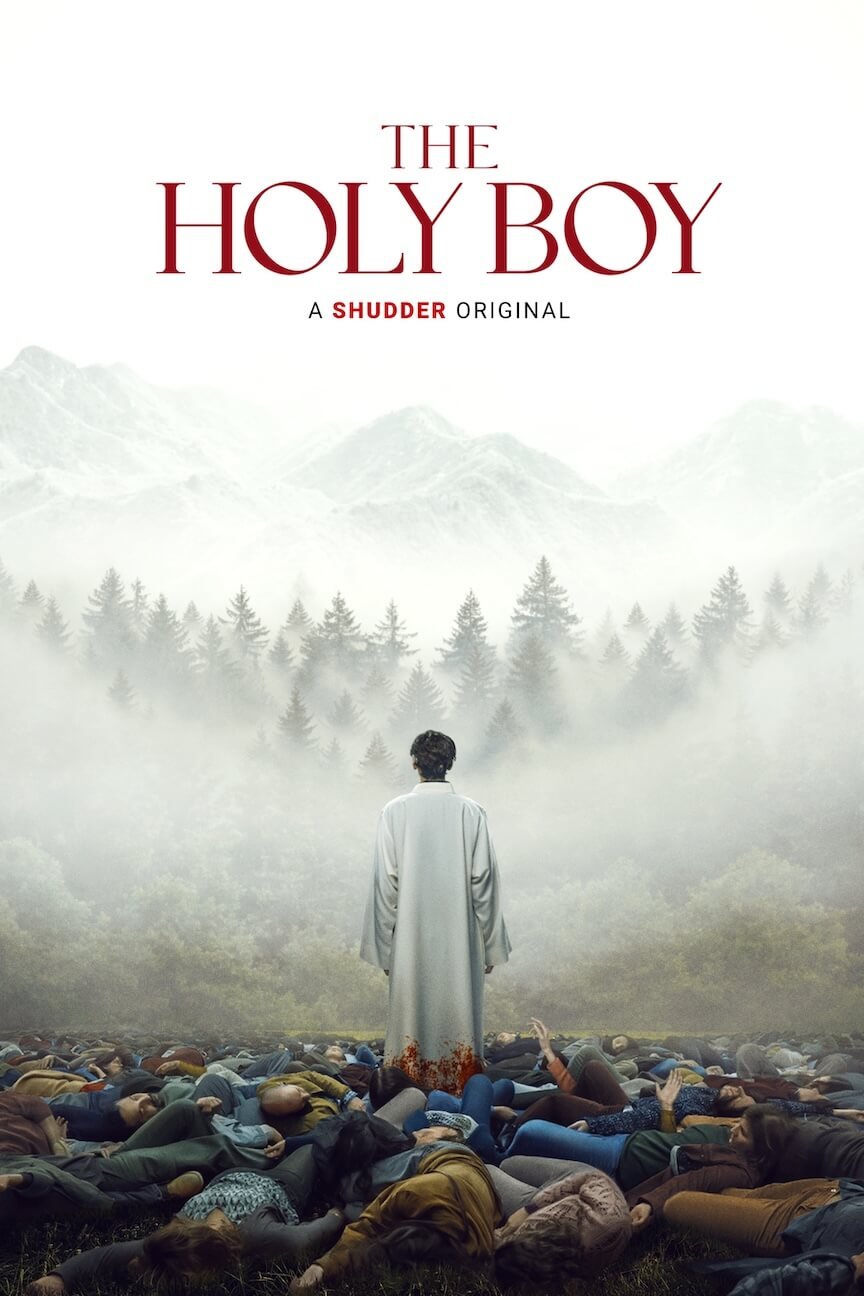

A family with a young baby seem strangely unconcerned by radio reports, playing in the background as The Holy Boy (2025) begins, looking back at a catastrophic rail disaster in the village of Remis – their village. Perhaps they’re cocooned by the day-to-day business of early parenthood; whether or not this is the case, however, something shocks mother Anna so badly during feeding time that she immediately turns, and crawls away to an open window, throwing herself out. The baby remains in his high chair, oblivious. It’s a nightmarish start to a complex and challenging piece of film, something quite unlike anything else which has been released in recent years.
We next encounter a bereaved and devastated father, Sergio (Michele Riondino), a stranger who has taken a short-term gym teaching contract in Remis, no doubt to distract himself from his despair. He arrives into the so-called ‘valley of smiles’ (a moniker which provided the film with its original Italian language title) with seemingly absolutely no intention of ever smiling again; in fact, he finds the relentless optimism bizarre. No; his path is heavy drinking via troubling hallucinations and a determination to alienate his neighbours, though with the rugged determination often shown by bar staff in films, the beautiful and considerate Michela (Romana Maggiora Vergano) decides she is going to help him with his suffering.
To do this, she takes Sergio to a covert meeting with someone at first known only as “him”: his appointment, like the rest of the village it seems, is actually with local teenager Matteo (Giulio Feltri). Sergio has already met him; he’s enrolled at the local high school, though, oddly, excused from all of his gym classes – but perhaps this strange ritual explains the reasons why he has been preserved from any sort of exposure to harm. Matteo’s father, the stern Mauro (Paolo Pierobon) acts as a go-between, but essentially, it turns out that the boy can somehow ‘heal’ through touch – a hug, to be exact. It seems to work, too: after hugging Matteo, Sergio begins to recover, taking control over his life again.
However, soon there are hints that his trauma has shifted, rather than healed; nor is this process, including Matteo’s strange ability, uncomplicated. Matteo, it transpires, is the baby from the film’s opening scenes, whose mother (who somehow survived) could likely tell the tale of her own ordeal, if everyone here was less damn reticent. Plus, Matteo is now fifteen years old, and like any teenager, is starting to desire his own independence, as well as managing the awakening of desires and ideas which do not sit easily with his special role in this place – a village which despite the shadow of the rail disaster is always, unflinchingly, unreasonably happy.
The Italian setting, Italian language and above all, the intricate blend between Catholicism (with its saints, angels and miracles) and more worldly harms feel oddly like coming home, given Italy’s longstanding impact upon genre film’s aesthetics and themes. The interplay between Italian city natives and secluded Italian villagers calls to mind shades of Fulci’s irreligious period in places, albeit without the most brutal overtones of Don’t Torture a Duckling – there’s just something of the same unease, though the more we are granted Matteo’s own perspective, the more I found myself thinking of Penda’s Fen, despite that production being quintessentially English; the fact that these two titles are remote from one another and seldom mentioned together should give some indication of how singular The Holy Boy actually is. Still, what is above doubt is the impact of Sergio’s presence here, triggering a range of issues, but chiefly exposing the cracks in this Potter’s Bluff façade; he arrives at just the point where Matteo seems to be coming to a similar realisation about his role and prospects.
At just over two hours long, The Holy Boy is an outlier in the Shudder canon, where the films are usually capped at ninety minutes and throw all of their madness at you within this timeframe, but The Holy Boy really needs that extended runtime. This is a slowly yielding, slowly unfolding drama. That tension between Sergio, an outsider whose own bereavement makes him want Matteo to enjoy a normal adolescence all the more, is cleverly pitched against the villagers, who – whatever their positive traits – have commodified this boy for their own needs, ignoring his personhood to hide from their own unhappiness. But then, the burgeoning friendship between Sergio and Matteo is framed by a more grounded sense that this kind of friendship between a grown man and a child is inappropriate; this is the one thing which seems to make the villagers drop those smiles of theirs, but then it does feel strange, placing the audience briefly on the same alert footing. There are so many layers and levels here – but then, in amongst all of these weighty, unsettling qualities, the film finds some time to be mischievous, giving a further sense of the plausible sophistication behind Matteo’s character. There’s lots of evidence of careful directorial control from Paolo Strippoli.
The Holy Boy is quintessentially slow burn, and the horror here is almost entirely psychological: despite noting some similarities or kinship with earlier Italian titles, prospective viewers should not expect much in the way of violence, ultra- or otherwise. But the way in which is continues to carefully unfold its ideas right up until the film’s close is commendable, and the film provides much to weigh up, being as it is a subtle, ambiguous but devastating take on trauma – a part of human existence which is perhaps necessary, however painful. It leaves questions behind, too, as does this rewarding film.
The Holy Boy (2025) will be released on Shudder on Friday, 27th November.