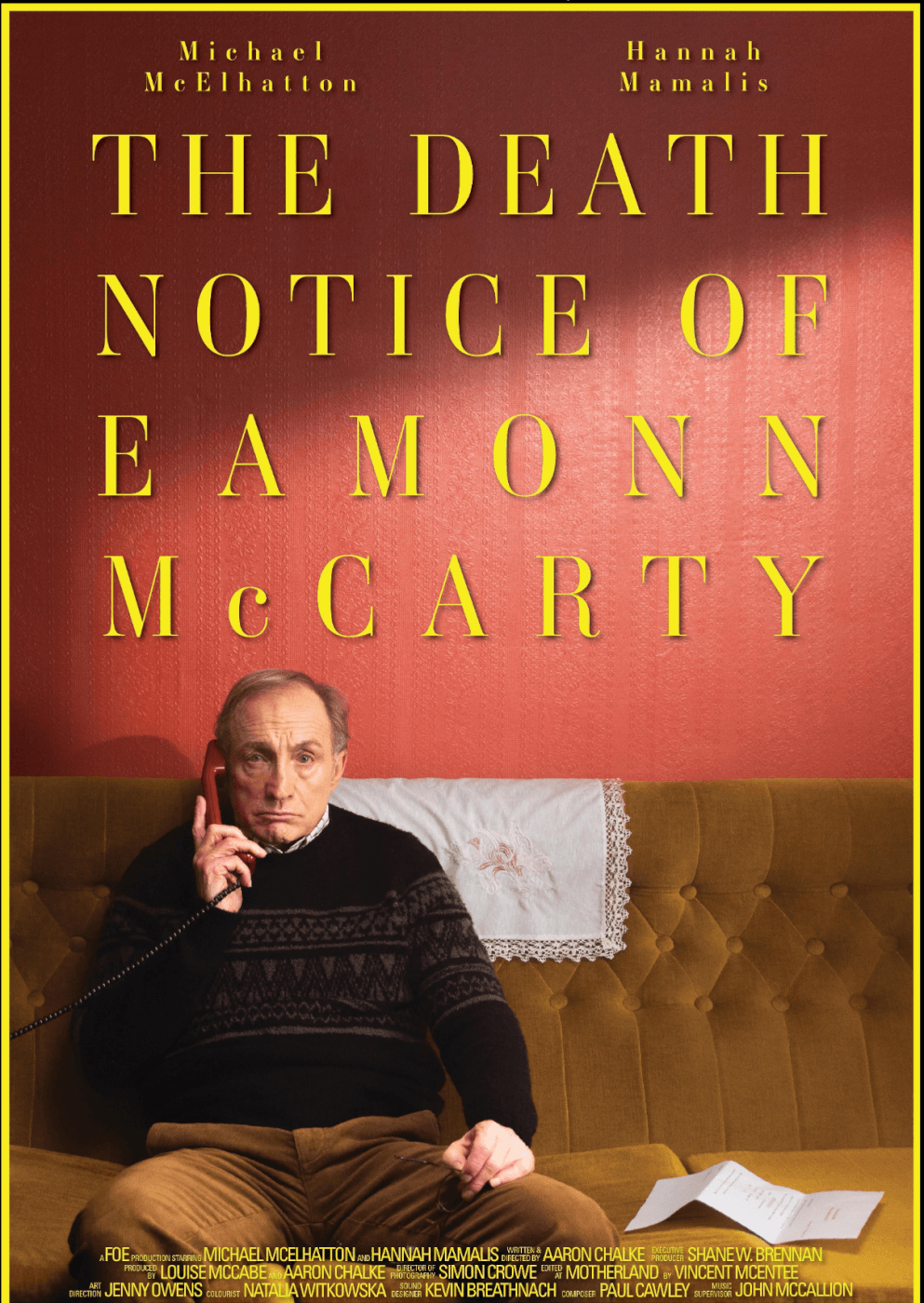

There always feels like something better to be doing than waiting around on the phone, and The Death Notice of Eamonn McCarthy (2025) makes that point in an unusual way, imagining a modern Ireland which has finally bureaucratised every step of life’s path (a kind of sci-fi lite, if you will). Here, the Public Notice Office presumably allocates all of life’s major milestones – given they now have the power to designate you a date of death (framed as an ‘expiry notice’). If that’s bad enough, then consider what usually happens when bureaucracy is involved: things go wrong, and accordingly, they’ve gone wrong here.
Eamonn McCarty himself (Michael McElhatton, Chernobyl, Game of Thrones) has recently received his own expiry notice by post: he knew it would happen, but due to it getting lost in the post he only has one day, rather than the statutory six-month period. He’s understandably a little peeved about this, and feels he has to discuss this issue, so he’s made the call to staff member Geraldine (Hannah Mamalis) to complain; after all, he now has greatly limited time to put his affairs in order. Feeling awful about the mishap, especially as it’s her first day in her new role, Geraldine offers to do what she can to help him with the logistics of his final twenty-four hours. She is probably breaking protocol to do so, but how else is a sympathetic young woman expected to behave when she’s talking to a guy who has only just found out he’s about to die, all because the Public Notice Office messed up?
The Death Notice of Eamonn McCarty could very easily have played this for laughs, poking fun at the failings of a world filled with protocols, escalation policies and complaints procedures, and yes, it encourages a knowing smile at all of this, but it’s certainly not a comedy. Before you know it almost – given that the film is only around thirteen minutes long – it’s subtly asking you to consider what’s genuinely important in life, offering its understated deeper meanings via a pared-down script and two phenomenal performances from McElhatton and Mamalis, who each communicate a rich backstory without ever really pausing to provide a chronology of their lives. It’s enough to know that time moves very fast in life, and – not knowing how long we have (again a point made succinctly and sharply by the film’s central premise) – sometimes you realise it’s been misallotted, leaving little opportunity to redress the wrongs. But there are opportunities, and the film bestows us with subtle moments of hope by presenting us with a recognisable time and place, albeit with one fantasy element, introducing one key restriction and one key chance which compels its lead character to act.
The Death Notice of Eamonn McCarty won Best Irish Short at Foyle Film Festival, qualifying it for consideration at the 99th Academy Awards.