
By guest contributor Søren Ahrensborg Kamper
In the 1990s, LucasArts borrowed actors, costumes and the language of cinema to make a galaxy on a CD-ROM. The results were sometimes awkward, often ingenious – and rather more interesting than their reputation suggests.
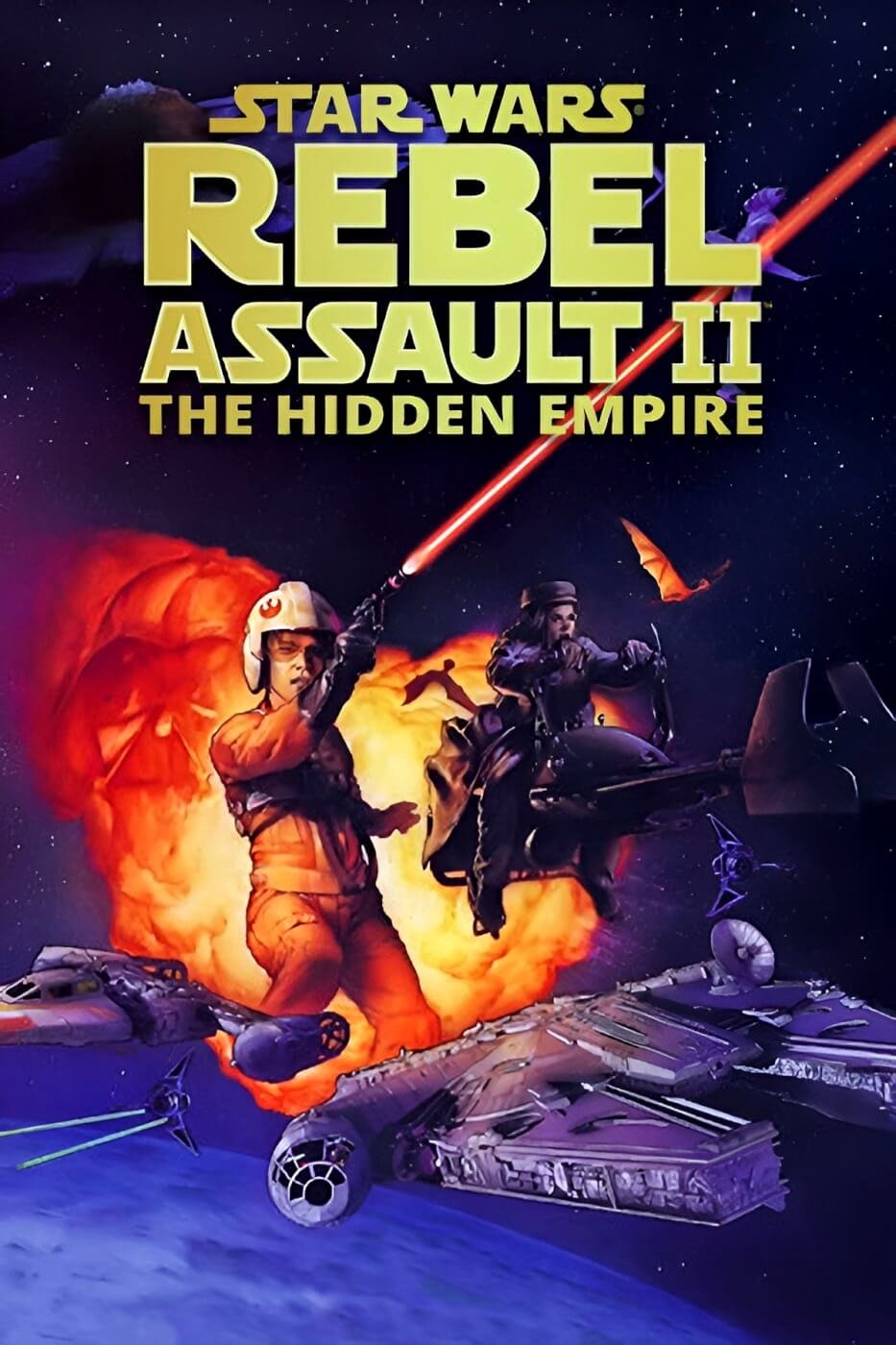
In a science-fiction film, the director decides what the camera can show. In a LucasArts production in 1995, the more pressing question was what the camera could afford to find. During the filming of Rebel Assault II, a Rebel pilot crossed a blue floor, climbed blue stairs and ducked behind obstacles that did not yet exist. The corridors and machinery would be created later. The actor had to look as though he believed in them now. Blue-screen tricks were hardly new to cinema; what was peculiar was that, once this miniature film reached a home computer, the audience would stop watching the pilot and start controlling him. The same adventure demanded two quite different kinds of belief.
The pilot was Rookie One, played by Jamison Jones in Star Wars: Rebel Assault II – The Hidden Empire. When Jones remembered the shoot years later, he described the unnerving business of reacting to machinery and creatures that were not there. During one scene Vince Lee, a creator on the game, stood on a ladder to supply Admiral Ackbar’s voice for the actors. Jones found Lee’s performance so funny that he broke into laughter during a take. This is not how we tend to picture a Star Wars film shoot. There should be a hangar and a spacecraft; in this case, one of the admirals needed a ladder.
For a few years in the middle of the 1990s, games like this offered a strange proposition. They did not merely borrow stories from the movies, or print familiar characters on a box. They tried to make new science-fiction cinema: filmed performances, designed shots, elaborate composites, musical cues and all. Jones was even photographed in 24 different poses so the game could turn his body into an image the player could move. Then, just when the story began behaving like a film, it handed the audience the controls. This was an actor becoming his own special effect.
A galaxy made from blue paint
The timing matters. The CD-ROM was selling itself as the future: suddenly a home computer could carry moving pictures, recorded voices and enough storage for a game to indulge in the luxury of spectacle. That did not mean it could show a feature film at cinema quality: video had to be compressed, screens were small and the technology was temperamental. But a recognisable human face on a monitor could still feel like a special effect in its own right.
LucasArts had a particular advantage. It worked within the Lucasfilm family, close enough to the vocabulary of Star Wars – its sound, design and visual effects culture – to know which details mattered. Jones recalled that the production used costumes from Return of the Jedi. A genuine costume, however, does not provide a genuine space station. You still need the space station. In this case, somebody would paint it in after lunch, technologically speaking.
The live-action sequences were directed by Hal Barwood, a co-writer of The Sugarland Express (1974) and Dragonslayer (1981). He had already helped tell science-fiction and adventure stories on film; now he was trying to fit a galactic war onto a handful of CD-ROMs. In a 2010 interview, he recalled the production as exceptionally fast and short of money. His estimate for the live-action filming was about five days. He also listed the problems: combining performers with 3D models, capturing the video and making the blue-screen process hold together. Five days is scarcely time to lose a piece of set dressing, never mind shoot a corner of the Galactic Civil War.
In her review of Roof (2026), Warped Perspective editor Keri O’Shea praises the way a film with a largely fixed location can use performance, camerawork and tone to suggest a bigger world beyond its few square metres. LucasArts faced that problem, only turned inside out. It could imagine an entire galaxy, but hardly any of that galaxy could be put in front of a real camera. The director had to create a convincing sense of place through faces, gestures, eyelines, editing and sound. Where a low-budget film might hide its limitations with a carefully chosen angle, here the set itself was almost entirely an act of faith.

An X-wing, an inner tube and the art of cheating…
Visual-effects artist Mark Christiansen offered one of the best accounts of how this sort of illusion could work. In a later conversation about his early LucasArts work, he described a test shoot involving a makeshift cockpit rig balanced on a large inner tube. Crew members rocked it as though a starfighter were taking enemy fire. The team even looked to Top Gun (1986) for the faster, more physical energy of its cockpit photography. An inspired reference, considering LucasArts did not have a working spacecraft to strap anybody into. Instead of a real fighter and a hangar, it had an inflatable tube, a platform and some determined hands.
Christiansen then had to fit those shots into spacecraft environments built with 3D software, compositing the results in early versions of After Effects. There was no modern camera tracker to match the movement automatically: he did much of that work by eye, with keyframes and a feel for the image. He made the shadows deeper, used motion blur and tried to keep the audience watching the pilot rather than admiring the novelty of computer graphics. It was a filmmaker’s solution to a technical problem. If an image is too eager to show off its effects, there is a good chance the audience will start looking for them.
This is where the comparison with B-movie craft becomes more useful than the old joke about awkward CD-ROM acting. Another of Warped Perspective’s contributors, Adam Page’s essay on Roger Corman’s X: The Man with the X-Ray Eyes finds a cosmic unease in images made on a modest budget, despite effects which plainly belong to their era. Rebel Assault II is not that film’s equal in dramatic ambition, nor does its tale of missing spacecraft invite much existential dread. Yet the craft invites a similar question: what can an image suggest beyond what the production can actually afford to put on screen? In the best moments, the audience supplies the missing universe itself.
The film footage in Rebel Assault II is not always persuasive. Movements can be stiff, edits can feel abrupt, and digital backgrounds sometimes look as though the actors have strayed into an especially expensive screensaver. Yet the mixture is also touching in its earnestness. The costumes and performances insist that this is Star Wars; the hardware keeps reminding us that we are watching it through a mid-1990s computer. Both impressions are true, and the disagreement between them is half the charm.
When the hero finally had a face
Two years later, LucasArts returned to the idea with Star Wars Jedi Knight: Dark Forces II (1997). Its central figure, Kyle Katarn, had already existed as a game protagonist. Now he acquired a live-action face in Jason Court, and his adventure through a new conflict with Dark Jedi was punctuated by filmed scenes. Where Rebel Assault II sold the immediate sensation of being inside a Star Wars movie, Jedi Knight put more weight on character, temptation and a serial-adventure structure. It was no longer enough to provide the spaceships. The man with the lightsaber had to carry a scene.
Court’s memories of the production explain the difficulty. The scenes took a couple of weeks to shoot, he recalled, followed by extra voice recording. He often spoke to boxes or light stands on the blue set, with the director supplying replies from off camera. A film actor normally has another face to respond to, another rhythm to work against. Court sometimes had to imagine both before the computer-generated characters even existed.

This helps explain why some of these sequences now seem so oddly theatrical. The performers have been asked to play intimate conversations in an invisible architecture, with imaginary threats and creatures beyond the edge of the frame. When Kyle lifts a physical holodisc into the light, the small object gives Court something real to hold and examine; a shot of his face can carry the discovery without another speech about Jedi destiny. Elsewhere, the compositions fall back on familiar film grammar: close-up, reaction, sinister reveal, one face replacing another. We know the language; the effects are speaking it with an accent.
There is another split, too. During a cutscene, the actor’s body and expression tell us who Kyle Katarn is. Back in the game world, Kyle becomes a figure the player can move through large 3D environments. One mode asks us to watch him; the other allows us to act through him. Ordinary cinema need not reconcile those two relationships. Jedi Knight has to change them repeatedly, sometimes within minutes, without losing the story altogether
The film that could be interrupted
That is the most curious thing about the experiment. Movies organise time for us. They decide where to look, how long a conversation lasts and when a character gets to draw a weapon. Games can borrow those decisions for a filmed scene, but must surrender much of that authority the moment play resumes. Rebel Assault II frequently feels like a string of short science-fiction scenes, interrupted by an elaborate test of reflexes. Jedi Knight makes the interruption more productive: its action, exploration and moral choices help determine what kind of hero eventually returns to the screen.
The join was visible even to reviewers at the time. Ron Dulin’s GameSpot review admired the vastness and control of Jedi Knight’s interactive world, while being distinctly less impressed with its filmed performances. That contemporary criticism matters: the cracks in the illusion were obvious long before the CD-ROM era became an object of nostalgia. Yet the filmed story also did something an ordinary cinema screen could not. The player’s behaviour could draw Kyle towards the light or dark side, altering the later story and leading to different endings. The branching was limited, as Dulin acknowledged, but a fixed dramatic question – will this man resist temptation? – had become a responsibility shared, however imperfectly, with the audience.
Perhaps the strangest cut is one that never appears on a film-editing timeline: the transition between two versions of the same character. One Kyle Katarn is Jason Court, a specific face and performance captured forever on video. The other is an animated figure who can be steered down corridors, kept waiting, made to fight or sent to his death. The player agrees that they are the same man. The special effect is not only in the blue-screen composite. It is in the viewer’s mind, working to reconcile a fixed performance with the freedom to disobey it.
None of this means that Rebel Assault II and Jedi Knight are neglected cinematic masterpieces. Some dialogue belongs in a Saturday-morning serial; some effects have aged about as gracefully as the average family computer from 1995. Nor should they be credited with inventing digital filmmaking. Blue-screen compositing, miniature tricks and the marriage of actor and impossible world had a long history before LucasArts picked up a camera. What these games offer is a particularly revealing point in that history, when film techniques were being compressed, rearranged and tested inside another medium.
For a brief moment, a studio better known for interactive adventures became a peculiar little producer of science-fiction screen drama. Its actors stared at boxes, its spaceships rode on an inner tube, and its editors tried to make two incompatible kinds of spectatorship feel like one continuous story. The results were uneven, but the ambition was real. The history of science-fiction cinema is full of productions which built extraordinary worlds out of whatever was available. Sometimes what was available was a blue staircase, a box of old costumes and a CD-ROM drive. The galaxy was expected to turn up later.
About the author: Søren Ahrensborg Kamper writes about the history and design of Star Wars games at Star Wars: Gaming, including a chronological database of the franchise’s video games. Our thanks to Søren for this guest feature.