It’s 1888 and Victorian London is gripped by a series of brutal murders. Prostitutes are found mutilated and the city is rife with rumours as to who the killer might be. A group called the All Ladies Ghost Hunting Society has their own specific theory as to the murderer’s identity, believing it all to be the work of a ghost. Millie (Cathy Wippell) is particularly keen on bringing the reign of terror to an end and enlists the help of her friend Tamworth (Tom Stourton) to document the Society’s ongoing investigations on his cutting edge innovation – a moving image machine…
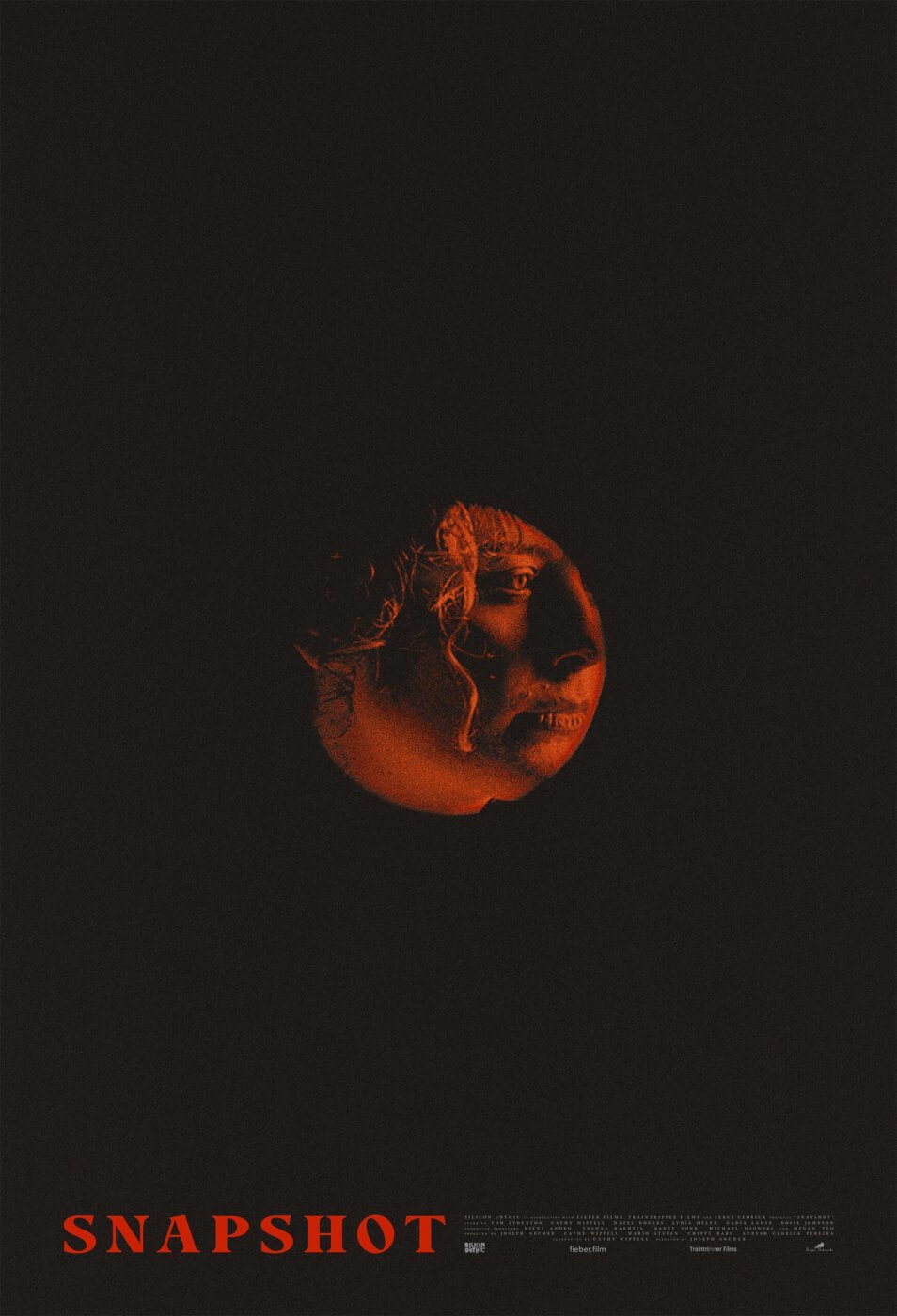
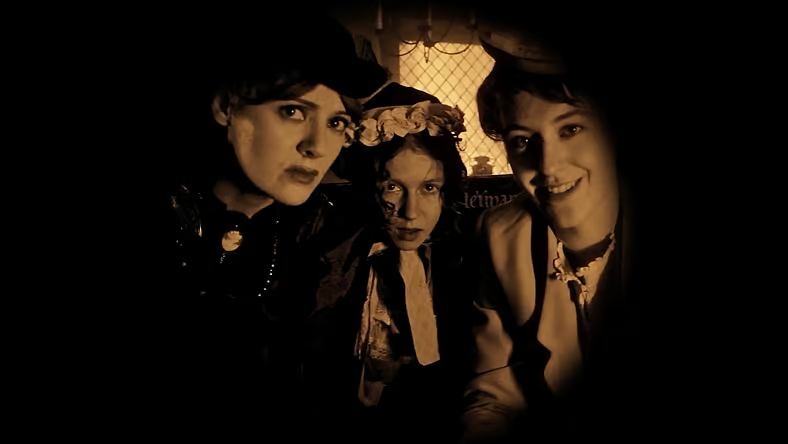
Just when you think there’s nothing new which can be brought to the found footage genre, director Joseph Archer and writer Cathy Wippell take us back to an unexpected era in Snapshot (2026), coupled with a visual style which is both a boon and what must have been its own, enforced technical nightmare, the circle in the middle of the screen throwing sharp focus onto the detail it captures while leaving so much around the edges tantalisingly undocumented.
Snapshot features a group of smart, strong, female characters whose struggles in this bygone era are as depressingly relevant as today, viewed by most men as providing either a good wife or a convenient, disposable, sexual partner. The police don’t seem to be particularly competent – or indeed, interested – when it comes to solving this disturbing string of murders, especially as the victims are seen to be of ill-repute and the newspapers of the time compete to publish the most salacious story to a drooling public, facts be damned.
A tour guide, showing a bunch of blokes the various sites where the killings have occurred, is told to cut the chitchat and show them “where she got bumped.” Charming, you might think but take a moment to consider how death is often reported, and speculated upon, now. There are also several darkly comic, vox pop asides in which Tamworth records the theories of a series of a generally clueless male population pretending what a ghastly business it all is while still gleefully pontificating on who the killer might be.
In contrast to the mainly grubby, sparingly-glimpsed male supporting cast, Snapshot turns its lens on a fascinating sisterhood, each of them rebelling against polite society in their own unique ways, be it Millie’s reluctance to be married off to someone wealthy but dull, Nadia Lamin’s Madame Evelyn, who has built her own business on simple male lust and Molly O’Brien (Lydia Helen), a fearless, fearsome force of nature for whom the term “side hustle” could have been invented way back in the late nineteenth century.
Snapshot is never satisfied with playing the greatest hits of the found footage subgenre and anyone expecting the usual creeping about and sudden, loud jump scares may wonder why this has been replaced by a study of how women can raise themselves up, only to be constantly living in fear of being torn down, disgraced, or worse, courtesy of behavioural rules constructed by a patriarchy that obviously wouldn’t indulge in this sort of behaviour in these more enlightened times (stares directly into pinhole camera for full sarcastic effect). The final act, when matters take a surprisingly dark turn, ups both the gruesomeness and the tragedy as the killings hit close to home and Millie’s loosening grip on her sanity sends her into a spiral.
Visually, Snapshot is a feast, the sepia tones capturing both the beauty and grime of England’s capital city. The dialogue has a taste of the olde worlde about it while still feeling modern enough for it not to get bogged down in any of that bodice-ripping vocab, and the quieter sequences in which the characters discuss their lives are as vital as the building suspense. In terms of gore, it’s never gratuitous, but the lingering camerawork as the image machine glides unblinkingly around a bloody corpse is effective and disturbing.
Setting the tale in the Jack The Ripper era is a clever concept, as that period of English history comes inbuilt with its own set of archetypes and numerous portrayals in both novels and movies. Most audience members will arrive with their own set of expectations and Snapshot delights in undermining most of those. Even the initially jolly, pub singalong to Two Lovely Black Eyes turns on a shilling into something far more chilling and the tune resonates throughout the rest of the runtime, right to the disquieting final shot.
From a synopsis which immediately suggests a black and white Blair Witch Project, Snapshot tears up the found footage rulebook to deliver a fascinating genre blender in which the concerns of the past line up with those of the present. Questions about unreliable – or just plain inaccurate – reporting are raised, as is the chaos of multiple media outlets all trying to be the one who shouts the loudest. This extends to the ordering and editing of Tamworth’s footage itself. Has it been assembled to present a particular narrative, and are all those inserted frames of carnage a means of hooking the watcher at the expense of the truth?
Horror fans may feel like Snapshot only flirts with the truly nasty side of the crimewave gripping the seedier side of London, but viewed as a skilfully-penned drama with elements of psychological suspenser and serial killer thriller, those detours into the darkest corners of the human mind land all the better. It’s a consistently impressive labour of love from Archer and Wippell and brings a hitherto untapped level of depth to a subgenre that always seems to be about to breathe its last. You’ll want to see this more than once – and you’ll need to.
Snapshot (2026) featured at this year’s Spirit of Independence in Sheffield, UK.