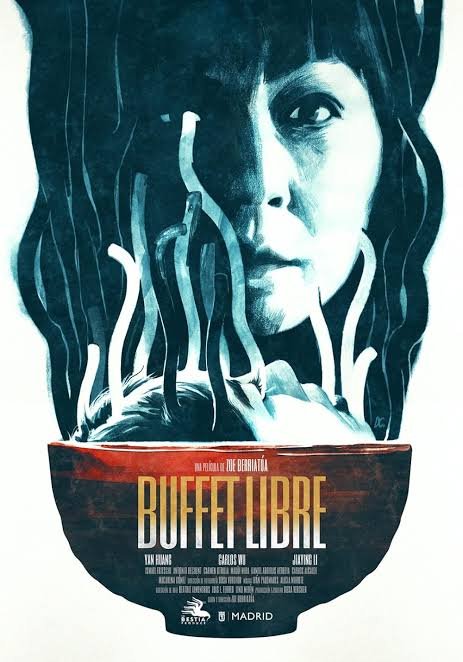

A camera whirls through an unkempt indoor food market in Madrid; it’s soon equally swirling with racist stereotypes about the Chinese vendors working here which – at least briefly, in the world of Buffet Libre (2025) – turn out to be true. The Chinese, represented here by wife Xian (Yan Huang) really are catching and killing street pigeons – but times are hard. Xian, and Japanese husband Ikki (Carlos Wu) are illegally living at their restaurant, their accommodation is cramped and squalid, their hygiene is questionable and, probably as a consequence, their customers are few. Ikki is more interested in young waitress Bo (Jiaying Li) anyway, and the younger woman isn’t even pretending not to openly fleece the daft old goat out of presents and money he doesn’t have, but at least someone’s being upfront here.
The couple is in serious debt to the smarmy market owner and his henchman, and things get quickly worse when their sole customer on a given day falls ill after eating some sushi (if you ever wondered what would happen to you if you accidentally ended up with the window display food). So, what to do? Ikki is all strained passivity; Xian is all misguided activity (well they do say opposites attract) – but as they struggle to run their restaurant whilst being continually waylaid by creditors, customers and rivals, the solutions open to them become ever more desperate and murderous. The sushi-eater doesn’t recover. A plan is formed.
It feels like – and it is – an established horror trope by now: when the going gets tough in the food business, start eating people – and reap the whirlwind. Thing is, that really isn’t how it happens in Buffet Libre. It’s a story with an element of nasty fantasy rumbling away, but often largely in the background, once it’s established; the film is far more about desperation and poverty – things rendered inescapable, in Xian’s case, by her love for her husband. The film is perhaps surprisingly low on blood and gore, and stands out all the more for that; there are just a few brief scenes and frames which show anything remotely grisly, and the film leaves far more to the imagination than it shows to us, because it turns out that the flesh and blood ain’t the point. We soon shift our gaze to the human relationships at the core of the narrative, and with a few shock moments of exception, we stay there.
This is nicely, even sensitively done, given the premise, this rare blend of human drama and grim, unspeakable slivers of reality (it reminds me somewhat of a Thai film called Meat Grinder (2009), which had a similar feeling and similarly unusual balance). Other aspects of the film occasionally come to the surface, each often very surprising in their own way. The racist stereotypes which get almost casually dropped in at the start feel surprising (it’d be very unlikely to see or hear such things in many films, unless the racists were being straightforwardly set up as villains). Here, it’s just woven into the narrative, though more engaging perhaps are the attitudes of a Japanese husband towards his Chinese wife and to an extent vice versa, each of whom bring their own baggage to proceedings, each stereotyping the other. The equally casual premise of endemic corruption in Spanish society, albeit amplified by the aforementioned racist tropes, can also feel surprising. But perhaps most plausibly, and most carefully done, is the presentation of a marriage where people have just settled into a familiar, terse apathy. It’s tested in unorthodox ways here, but the malingering pipe dreams of a man out of his depth, who keeps blethering about getting rich through ‘crypto’, using today’s shorthand for ‘not going to happen mate’, tells us all. Xian is by far the film’s best-rounded, closest-studied and most sympathetic character, a woman who seems to strangely bloom under tremendous pressure. All of the lead roles are well acted here, but Yan Huang really is exceptional, and kinda hard not to love, whatever else goes on…
Buffet Libre is a good-looking film, too, usually looking appropriately and despicably grimy; even when the going gets briefly good, behind the scenes is the same squalor. The film’s use of fantasy and dream sequences feel genuinely well-integrated here, too, working successfully within the film as a whole and bringing some ingenious plot touches along with them. If Buffet Libre has one sin, it’s that it loses some of its grand forward momentum just after the hour mark; it could have easily been fifteen minutes shorter and really lost nothing. But this is overall a bold and well-devised film, spinning off from the expected in a range of engaging, inspired ways. There’s even a Macarena Gómez cameo, which always makes the heart sing.
Free Buffet (2025) featured at this year’s Dead Northern Film Festival in York, UK.