A brief preface…
When I was writing my book on witchcraft in horror cinema, Celluloid Hex, I originally wrote an additional chapter on a fairly-obscure Italian occult horror mash-up, Baba Yaga (1973). It was a lot of fun to research, and yielded a lot of interesting material, but when I was doing layouts for Celluloid Hex it just didn’t fit very well with the general tone and direction of the book, so with a few regrets, I removed it. Still, it’s a shame for all that work to go to waste, so you can find the chapter in its entirety below. If the film sounds good to you, then you could do far, far worse than pick up a copy from Shameless Films (at the time of writing, the DVD is only displaying as being available from Amazon rather than direct from Shameless, but I’d happily amend this if that changes). And of course, if you are tantalised by all this talk of witchcraft in film and would like to know what did make it into the book, please do grab a copy – I still have some print copies left!
Meanwhile, back in Europe…
The story of Baba Yaga (1973) is the story of a rapidly modernising Italy, particularly a Milan which found itself as both an industrial sprawl and a hub of fashion and pop culture by the 1970s. It’s a Milan of opportunities, of a great nightlife, a great arts scene and growing social freedoms – but it is also a fraught place, rife with social divisions and dilemmas. Still, flux brings positive change too, and a comic artist with a distinctive, subversive style was about to encapsulate his ideal of modern Italian womanhood – before pitching her against forces rather difficult to control. This would lead to an unholy meld of comic book and cinema, a story which connects various threads of folklore, magic and art to threaten our heroine – and the city of Milan – with the old menace of witchcraft.
To understand Baba Yaga, first we need to take a journey into a different artform, because it’s this which impacts upon this particular piece of Eurohorror and its own adaptation of Eastern European folklore. Director Corrado Farrina based his film on a certain comic strip…
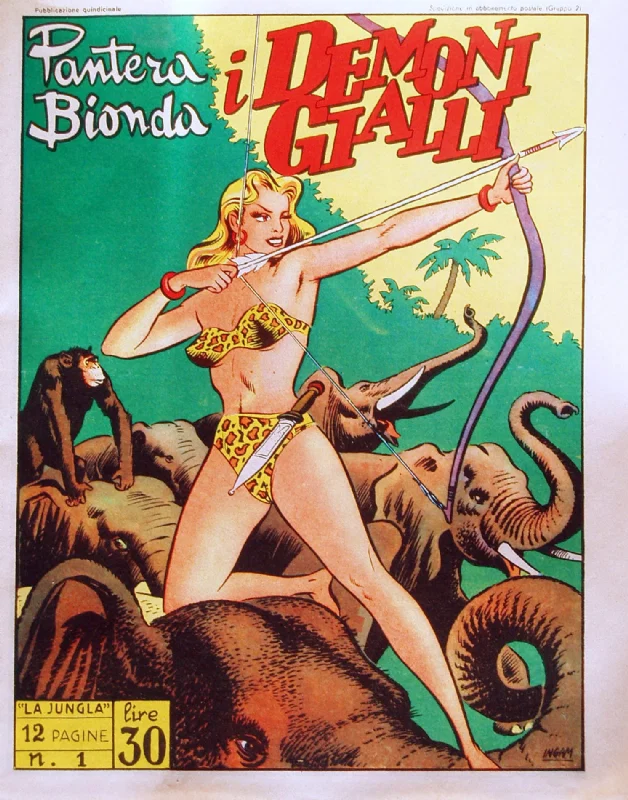
In Italy, the development of comic book culture, particularly with regards to female characters, took until the post-war years to get off the ground. Financially hammered by World War II, with the after-effects of the war leading to shifts in priorities, ambitions and attitudes, the entertainment industry slowly reanimated towards the end of the 1940s. 1948 saw Italy’s very first female comic character, a Tarzanesque woman called Pantera Bionda (Blonde Panther) who quickly incurred the wrath of the Italian censors for her lack of clothing. Scanty clothing or not, she reflected a Europe- and America-wide movement towards drawing unorthodox women who eschewed many feminine norms. Having minimal clothes on is, after all, eschewing a feminine norm in itself for many prospective audiences.
Comics have regularly challenged this thinking, and in the Sixties, the appearance of the French comic character Barbarella helped to entrench the new concept of comics for adults – even comics with erotic subtexts, very much not intended for children. By now, the social changes which had begun to emerge in the post-war years had developed into a definable movement. Free love blended with science fiction in the character of Barbarella, whose space adventures also tended to be a bit risqué. As Cara Takakjian notes in her essay on a character called Valentina (1), Barbarella’s success meant that these stories soon started appearing in neat single volumes of their own: this helped to legitimise the idea of a new erotic comic genre, spawning a number of other female characters, many of which could claim some kin with Barbarella: archetypal goth chick Vampirella, for example, was an inhabitant of the distant planet Drakulon: she discovers and steals an earth ship when it crashes on her world and she realises humans have the blood she needs. And, in Italy, a fan of the Barbarella artist Jean-Claude Forest began formulating ideas for his own unconventional heroine. Step forward, Guido Crepax, creator of the popular Valentina character and comic.
Crepax had trained as an architect in Milan prior to starting work as a jobbing artist: working on anything from medical illustrations to album covers, he honed his line work, moving in a wholly different direction to the more mainstream likes of Marvel and DC in America. In the 1960s, Crepax turned his attention more specifically to comic book style art and began to contribute to Linus, a magazine dedicated to the form (itself evidence of the surging popularity of comic art by this decade).
Undoubtedly, Guido Crepax is best known for his character Valentina Rosselli – modelled on silent film star Louise Brooks, as well as on Crepax’s wife – a woman who represented the modern push/pull in Italian values which had both permitted but challenged earlier characters such as Pantera Bionda. Although Valentina first appears as girlfriend to a mysterious American with superpowers, from the very beginning Valentina is in many ways shown as a modern, self-sufficient woman: she’s strong and has a mind of her own. She has a successful career as a photographer, she lives independently, and she calls the shots with the men in her life, rejecting them or accepting them as she sees fit. In The Lesmo Curve, one of her very first outings, Valentina is covering an important race which just so happens to be a stitch-up, with the lead driver, Johnson, the target of a fortune-hunting crime syndicate who have tampered with his car. Luckily, Valentina’s lover Mr. Rembrandt uses his powers to keep both Johnson (and by proxy, Valentina) out of harm’s way. A pattern soon emerges: Valentina, an intelligent, liberated girl – in the crowded and rather madcap Milan of the late 60s and early 70s – nonetheless often finds herself disarmed, confused – and disrobed. As she moves out of the shadow of her Mr. Rembrandt, there are more and more opportunities to get into mischief: Valentina began appearing on her own in print in 1968.
For Crepax, Valentina’s position as an enlightened career woman was always of vital importance to her characterisation. He wanted her to belong to the new Italy, a place which afforded women the potential to live their own lives. It’s just that her own predilections often see her daydreaming about being rather literally confined, shall we say. Valentina is frequently whipped, blindfolded, gagged and otherwise stripped of volition, though it’s worth pointing out that this tends to be in the realms of Valentina’s own fantasies. These daydreams are all part of Crepax’s mores, of course, but it’s also worth remembering that Valentina herself has these fantasies. They’re not being imposed on her. They are her. In this respect, she occupies the space between female autonomy and fantasy which would later make her the perfect character to pitch against old magic on-screen. Though, to be fair to Valentina, she gets whipped and tied up by a very wide range of people, anyone from Nazis to astronauts. She has atrocious luck.
Crepax’s visual style is integral to our understanding of Valentina. Keeping this style has been a challenge for adapting Valentina to the screen, but working to retain as much as possible of Crepax in any adaptation has been vital to keep that sense of his most famous creation. Valentina’s perceptions, often communicated via images of her eyes taking in whatever is going on around her, define her as the key figure in any of her narratives. Her perceptions are often prioritised over a neat narrative; often disadvantaged by being charmingly naïve, or otherwise out of the loop, Valentina often strives to maintain her normal routine as all manner of madness unfolds. All of this makes her an ideal character to adapt to film – at least, the kind of film envisioned by Corrado Farina in 1973.
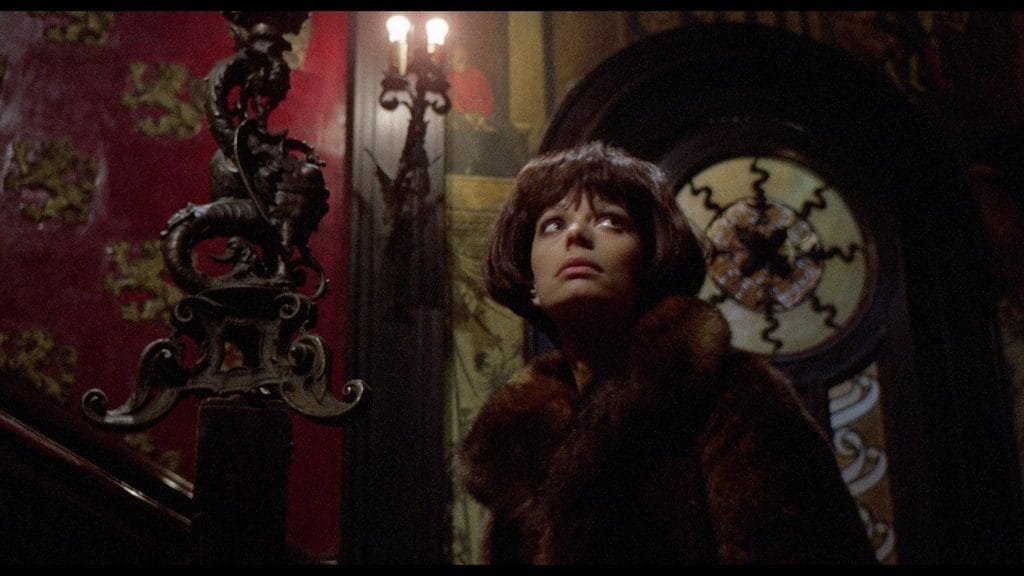
Farina, by no means an exploitation movie devotee, nonetheless created Baba Yaga from the original cartoon of the same title, with Crepax’s blessing. Crepax appears in a brief cameo in the film, as well as getting namechecked by some of Valentina’s friends, keen to show off their pop culture credentials. Perhaps the key difference between Valentina in her comics and on-screen is that, in Baba Yaga, her sadomasochistic fantasies are no longer simply (or mainly) the province of her imagination. This time, she is really fully at the mercy of a sexually voracious older woman. However, no one could disagree that the casting of Isabelle De Funès as Valentina is inspired; the actress looks impressively like Crepax’s artwork – although Farina actually wanted the Italian actress Elsa Martinelli to play Valentina. Her opposing character in Baba Yaga, eventually played by Carroll Baker, was due to be played by former beauty queen Anne Heywood, whose withdrawal from the project was rather abrupt and led to her being successfully sued by the studio for breach of contract. Carroll Baker steps up with some panache, though Farina felt that she looked ‘too American’ for the role as he envisaged it. So, the film contains an actress the director didn’t choose, against an actress the director felt he had to choose in haste. It’s not an auspicious start, but the resulting film has a great deal of charm. Also, despite its initially rather brutal editing by a team who felt that it was overall ‘too slow’, it carries its own share of contemporary context about the Italy of the day (2).
“Witches don’t exist…if anything, it’s the world we’re living in…”
In the film, we begin by seeing Valentina leaving a party late one evening, refusing a lift home with a male protector, her sometime boyfriend Arno (George Eastman) as she feels perfectly safe to walk back to her apartment on her own. However, on the way, she intercepts a grand old car when she stops it from hitting a stray dog. An equally grand old dame gets out and introduces herself, full of apologies – but tells Valentina that their meeting was preordained in some way. The woman, Baba Yaga herself, takes a personal object from Valentina which she promises to return. Somewhat perplexed, Valentina returns to her apartment, but her encounter with Baba Yaga seems to have troubled her: she has a sequence of Crepax-worthy fantasy dreams, Nazi uniforms and all.
The next day, Baba Yaga visits Valentina and returns her item, inviting Valentina to visit her at home very soon. Valentina goes on with the day job, but things no longer run smoothly for her. Her camera seems to have been sabotaged somehow. A girl gets injured, seemingly by the camera itself. Sensing that something is amiss, and also oddly drawn to the strange older woman, Valentina does visit Baba Yaga, noticing a large hole concealed under the stairs of the ramshackle, otherwise deserted house. Baba Yaga gives Valentina a doll during her visit, telling her that it will ‘protect’ her. It’s wearing fetish gear, but there we are – it’s just another odd moment in a perplexing day. Valentina, almost in a trance, agrees to take the doll with her.
This sequence of events culminates in Valentina quickly losing her cherished autonomy, an autonomy which has in reality been declining ever since Baba Yaga stepped foot outside that car. Valentina’s camera now seems to have been used mysteriously without her knowledge, with images of the doll, Annette, made flesh, appearing in photographs as a real woman. More threateningly, the camera itself is now apparently the property of Baba Yaga, who phones Valentina and tells her to come and retrieve it. When she does so, the enamoured femme fatale subjects her to a bit of lesbian S&M, confining Valentina and whipping her – to a perhaps surprisingly ambiguous response from Valentina. But finally, boyfriend Arno comes to the rescue, flinging his girlfriend’s captors down into the mysterious ‘mouth to hell’ below the house. The punchline to all of this is that, according to a neighbour, the house has not been occupied in many years. Valentina’s would-be female lover was never really there at all…
Meanwhile, as Valentina strives to make sense of what is happening to her, the Milan in which the film is set is in flux, with clashes in social attitudes apparent throughout the film. The struggle between conservative and progressive values is on display throughout, creating a perhaps simplistic, yet uncertain backdrop against which the idea of the supernatural can thrive. It seems to be the case that when times they are a-changing, old beliefs and fears become resurgent. For example, when trying to rebut any notion of supernatural forces at play, Valentina’s companion points out that they are living in the twentieth century – the era of medical advancements, of space travel. But the new Milan is beset by protest and the spectre of revolution, with clashes taking place on the streets. Progress hasn’t swept everyone up just yet, with Milanese slums taking their place on screen alongside the grand architecture and ultra-cool interiors. And, even when the young and the hip seemingly espouse forward-thinking values, such as the burgeoning civil rights movement, Valentina hosts an awareness-raising photoshoot where she photographs a black man who has been directed to channel his ‘primitive drives’, just like his ancestors did. Perhaps it’s well-intentioned, but it does not play well now.
Perhaps oddly, the Church is conspicuous by its absence here, but then again, perhaps that’s the point: the old moral certainties are merely background, entrenched enough to be tedious without being overt, but yet offering nothing in the way of help when something decidedly witchy sneaks back into modern Italy. In Valentina’s case, she may be a part of this new Milan, this Milan of shifting social attitudes, modernisation and protest – but she is also overshadowed by the conservatism which continues to manifest itself in 1970s Italy. As much as she struggles to live on her own terms, she is overcome by a chance event which overtakes her life. And, ultimately, when it comes down to it, she needs a man to come and rescue her: again, old habits die hard.
However, the real threat to Valentina is something completely detached from the modern world she knows. In the film, it’s old money (and ultimately, old magic) which threatens Valentina’s autonomy. In many regards, the appearance of the ‘devil witch’ herself is a manifestation of the dark heart which still beats in modern Milan. Just as progress seems inevitable and very much of one kind, with ideas of feminism and equal rights providing Valentina with definable goals and a path to follow, a chance encounter exposes her to something rather different, something which her pre-existing experiences do not enable her to resist. Via Baba Yaga, sexuality and arcane knowledge subtly interweave themselves into Valentina’s otherwise straightforward, and forward-looking life.
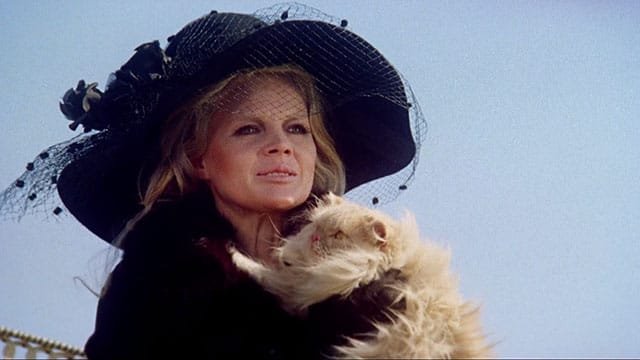
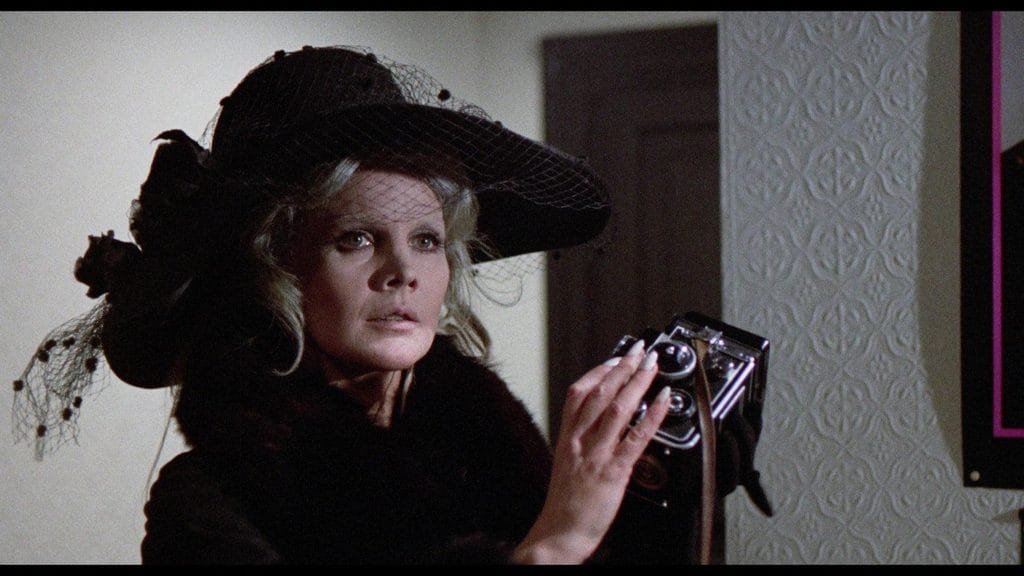
Baba Yaga herself is a strange figure, in that her very name does not belong to Italian folklore and she certainly does not usually appear in the form she takes in Milan. As imagined here, she’s a creative adaptation of an ancient magical being, brought somewhat up to date by Crepax and Farrina (though still very much represented by both of them as a woman of an earlier generation, all old world glamour in her veil and her wide-brimmed hat).
Originally an ancient figure of Slavic myth, the original Baba Yaga appears in many stories in different guises; she’s often an ambiguous figure and she’s perhaps most noteworthy for her enchanted dwelling-place: the Slavic Baba Yaga has a hut with legs – chicken’s legs to be precise – which can move from place to place. Both helping and hindering people according to her mood, Baba Yaga often promises wealth and power, albeit with conditions. Variously attested to as a sorceress, a midwife, a ferocious old crone or a matriarchal figure, she is perhaps an unlikely candidate for Crepax and then Farina to adapt so extensively for a film about Valentina in modern Italy. Then again, though, perhaps via her status as an old, established figure of legend, an ambiguous character who represents a pre-modern world, Baba Yaga is herself the perfect witch, a woman who adapts and shapeshifts one more time, proving to modern Italy that it’s not safe just yet.
Her new incarnation as a mysteriously wealthy stranger, with all the trappings of old money – the Rolls Royce, the sprawling (if ramshackle) estate, the effete but likely expensive garb – combines with her supernatural abilities to endanger and seduce Valentina. It’s an assault on two fronts, if you like, old money and old magic, and it that respect Baba Yaga is the ideal figure to cross over into a changeable, even fraught modern-day Milan.
“Milan is beautiful in fog, like a woman with a veil”
Baba Yaga also makes use of old and new forms of magic – representing ancient European beliefs about witchcraft with her ability to shapeshift, her enchantment of Valentina’s item and her delivery of a ‘familiar’ to infiltrate Valentina’s life. These are all abilities which hark back to the medieval period, or indeed earlier, where (usually) women were accused of changing their physical forms and of charming people via stealing items, which they would then enchant. Baba Yaga knows how to do all of these things; here, as the apparent custodian of hell itself, her practices definitely reach back through time, her links to the past coming via her ancient name and her recognisable practices. Not for nothing does Baba Yaga have a clock with no hands, hanging in her abode: it seems to symbolise her permanence, but also her position as someone not operating under the usual confines of time. However, Baba Yaga has also moved with the times in other respects. In this, she is a figure all about revolutionising magic, making it fit into the modern world in which it needs to operate. A key way in which it does this is via the medium of photography, with the object of the camera forming a connection between past beliefs and present concerns, a relatively new technological advancement (at least in an affordable, available form) which begins to operate under the thrall of ancient witchcraft.
Valentina, as a professional photographer, uses her camera as her locus of control over her life: the camera provides her a living, it’s the bedrock of her career and her means of controlling her immediate environment, as she directs her subjects to where she wants them. She often poses her subjects erotically too, which could form a contrast to how she ends up later in the film – being controlled, rather than doing the controlling. She is therefore in charge of so many aspects of her life thanks to the good quality camera equipment available by the 1970s. So, when her camera is enchanted by Baba Yaga, Valentina is massively destabilised by this. Suddenly, she is no longer in control of her world, and worse still, the camera begins to act like an instant hex, with one protester Valentina photographs falling down as if dead when she presses the button.
All of this is strange and terrifying enough, but Baba Yaga reminds us that photography itself is a kind of witchcraft in many respects; all Baba Yaga is doing is making this relationship more overt. The concept of ‘glamour’, which we now associate with the narrower sense of pleasing artifice and good looks is the basis for Valentina’s career, but the word itself has formerly enjoyed more of a witchy meaning, in the sense of the manipulation of reality via witchcraft. Its literal meaning was at first ‘magic spell’. The word has now come full circle, with an array of witchcraft-lite spell books recommending ways for young devotees to utilise glamour magic, including improving their good looks, no doubt intended for the generation which first encountered this idea in The Craft (1996). Photography can also misrepresent truths to us, creating a deception, freezing a moment forever in time – the great impossibility made possible. All of these things have a kind of magic to them, and it’s little surprise that Baba Yaga makes the camera into a battleground in her domination of Valentina.
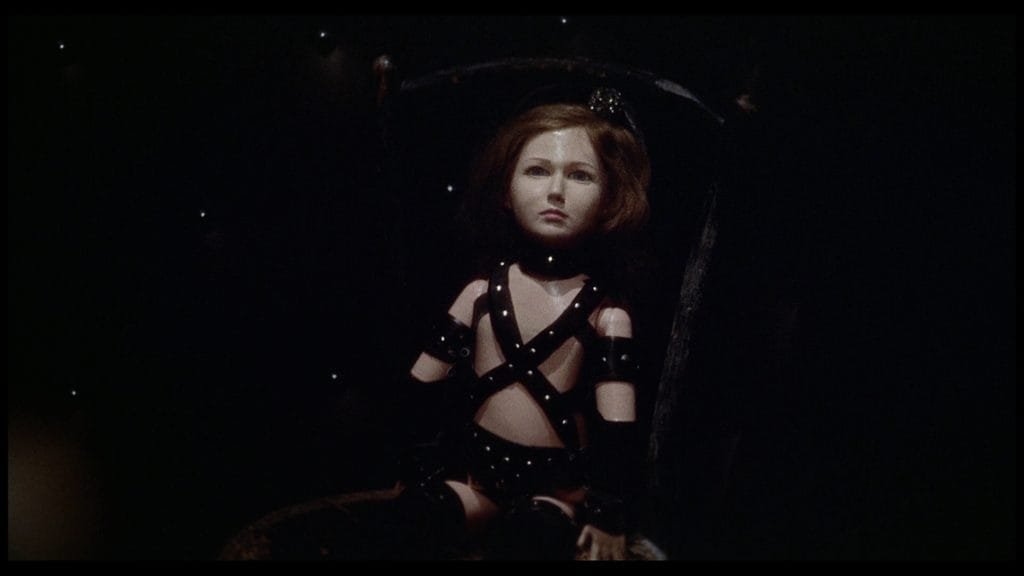
Another development within the film relates to the introduction of the familiar, Annette, given to Valentina by Baba Yaga to watch over her. Like any good witch’s familiar, Annette does what her mistress bids her to do, but in so doing she herself inhabits Valentina’s world, again through photography. Annette begins to appear as a real woman on Valentina’s developed rolls of film, insinuating that she has a life of her own – she isn’t just a doll, and she has the ability to move around of her own accord, a direct emblem of Baba Yaga’s sexual desire to control and isolate Valentina. The fact that we see Valentina and Arno attending a screening of the Expressionist classic horror The Golem earlier in the film paves the way for this later development, given that Annette is herself a seemingly inanimate doll, brought to life and controlled by a sorcerer. No one believes Valentina that the strange doll is getting up and walking around, of course, but the evidence is there in her photos; how else could it be accounted for? Annette allows her mistress, and her sexual desires, to more fully infiltrate Valentina’s life.
Of course, as we’re talking about old meeting new in this film, it can’t be ignored that Annette herself is rather singularly attired. Annette is not dressed in the whimsical frills you might expect for an old-fashioned porcelain doll, the kind she first she appears to be: instead she is clad in fetish gear, studded leather with a collar and straps, an outfit she retains when she magically transforms into a real girl. Crepax has a predilection for this kind of wear, naturally linking it with niche sexualities which take place on the fringes of modern society – even in enlightened Milan. The film’s lesbian subtext is also on the fringes of what would be considered mainstream and acceptable, here turned to the purpose of adding more scandalous and titillating content to the narrative. Lesbianism, whilst now more accepted overall than it had been in Italian generations past, was still itself often not discussed or acknowledged openly. Whilst many Italian women ‘came out’ as a result of the efforts of groups like Fuori! (Out!), these organisations tended to be male-dominated, and even feminist groups often reacted to lesbians in their midst with a kind of awkward silence (4). This attests to the confluence of taboos which Baba Yaga is able to weave into its narrative – as well as its balancing act between erotica and horror, which in its own way reflects the surge in occult-themed magazines and pulp fiction taking place elsewhere, and having an impact on other cinematic projects.
Baba Yaga’s witchcraft might not be grisly or destructive in the ways that the dark arts are represented elsewhere in film. Nor does it particularly occupy a great deal of screen time, come to that. But its real power is in its hold over an otherwise independent girl, a girl who previously thought she belonged very much to a modern world where magic no longer existed. In this regard, Baba Yaga represents witchcraft’s great adaptability and its resourcefulness, as well as speaking to a kind of anxiety – that these old forces could come back. This is very much a shared anxiety in witchcraft cinema, though seldom given such an ambitious and unusual artistic treatment as it received via artist Guido Crepax and director Corrado Farina in this singular witchcraft film.
References:
(1) Cara Takakjian, Bound and Dreaming: Female Empowerment through Sado-Masochistic Fantasy in Guido Crepax’s Valentina. Interdisciplinary Comics Studies, Vol. 7 no, 4.
(2) Curti, Roberto (2016). Diabolika: Supercriminals, Superheroes and the Comic Book Universe in Italian Cinema. Midnight Marquee Press (p.139)
(3) Attributed to Ornella Vanoni.
(4) Wilson, Perry (2009) Women in Twentieth-Century Italy. Macmillan International Higher Education (p.154).