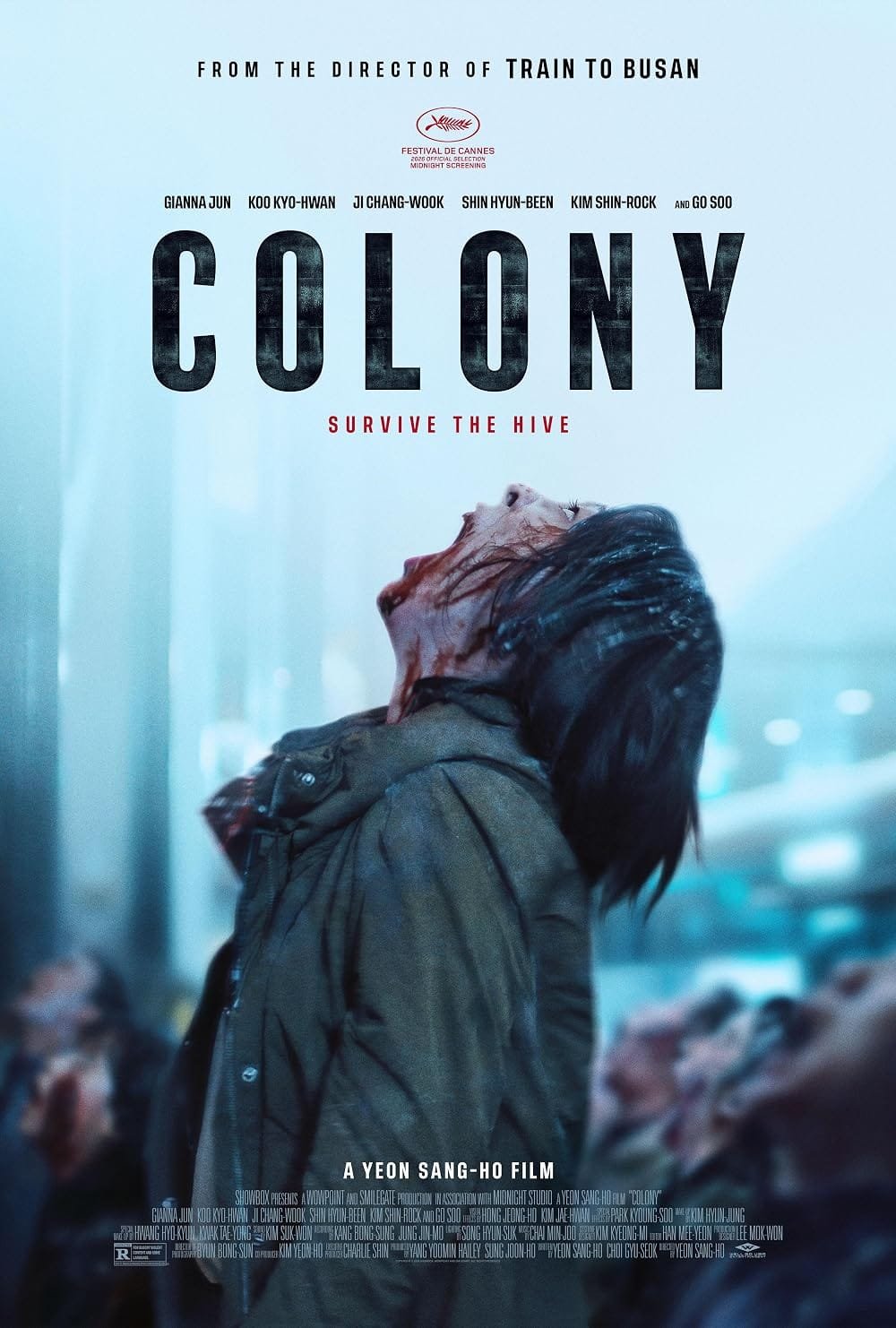
It feels like a while since we had a really good, honest-to-goodness zombie flick. For a while there, there were enough of them that we could debate whether zombies should be able run or not; with a few exceptions, though, the genre has stalled since the ferocious Train to Busan a decade ago (despite the subsequent appearance of sequel Peninsula), so given that Colony (2026) is another South Korean foray into the genre by the very same director, hopes were high – maybe a little too high. The resulting film is entertaining enough, though its convoluted reason for the outbreak cycles through derivative and overcomplex, and it’s just too long, with a tendency to rehash the same scenes over and over. Does it do as promised? Yes, admittedly it does, but with a few unnecessary pitfalls along the way which impact on its overall sense of direction and impetus.
We start with a very clear statement of intent: Seo Yeong Cheol (Koo Kyo-hwan) calling the police to tell them he is a bio-terrorist, about to launch an attack on the Doongwoori Building – a mall and conference centre. He then injects himself with an appropriately bright green substance – the antidote – and heads off to watch a speech being given by CEO of Chains Bio, Kang Woo-chul (Kim Jong-tae). Chains Bio has just launched a new – and I’m trying to get the science straight here – bio-chip which will enable humans to better communicate with one another by…connecting people’s brains together (why the hell anyone would want that is beyond me) via some kind of fungal mould? Uh, oh, by the way. But the specific whys and wherefores don’t really matter, thankfully. The point is that we acknowledge this ability is about to be manipulated by perennially-smirking former employee Seo, whom it seems has more than one grievance to keep him going across the course of the film, and when he confronts CEO Kang in his private rooms, he injects him with another Bad Science syringe full of what immediately turns Kang into a vomiting, mindless zombie, who then goes off to make more zombies.
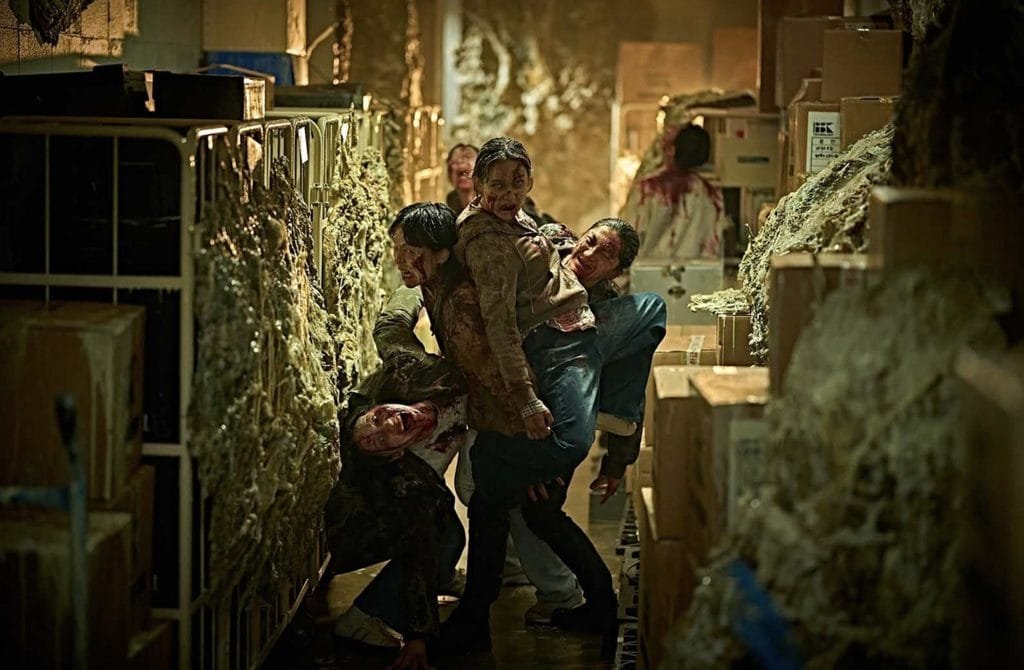
These zombies not only run, but they start off leaping about on all fours, and the infection spreads very fast – there are some nicely physical, choreographed sequences – resulting in the Doongwoori Building being quarantined: the police did have a bit of a warning that this was going to happen, of course. Unlucky for her, Professor Se Jeong (Jun Ji-hyun) is in the building too, after receiving an invitation to watch the CEO’s keynote speech; thinking she is about to be headhunted for a new job, she’s instead very clearly thrown into the Final Girl role, bringing her own scientific expertise to bear on the situation so that she and a peculiar little gang can get to safety.
When it all gets going – which is not very long at all into the runtime, to give it credit – Colony clearly knows that audiences want to see something of an onslaught, and it sort of delivers. One thing which is strange to note, despite the zombies looking every inch the walking dead, all smeared with blood and a weird mucus-y substance, is that the film intimates, rather than outright shows, its violence. It’s strange. It has a 15 certificate here in the UK, which will doubtless open it up to a wider audience, but you never really see the bites and there’s nothing here to much trouble Tom Savini or Howard Berger at night. It can feel a little coy, due to this tacit approach to people biting big holes in other people, as the rather large crowd of survivors gets picked off by zombies which, under the mind control of smirking man, ‘evolve’ through a number of stages until Seo can essentially control them, like an army, sending them hither and yon as the mood takes him. Understanding that he is a living antidote, the survivors are keen to catch up with him, but he eludes them regularly and tries to get them killed.
Meanwhile outside, the police and the army try to mount a rescue (of Seo) as scientists try to understand what exactly Seo has done, and how (leading to arguably the film’s greatest scene, taking place in an impromptu lab which Mr Grievance has set up out in the sticks). There are great bits, but Colony is unnecessarily derivative (a pinch of 28 Days Later, a healthy dollop of The Last of Us), and then overcomplicated; these are familiar ideas, rejigged to the point of pointless complexity. There are also leaps of faith which I didn’t really understand, introduced and then abandoned. How would you ‘just know’ that a dab of antifreeze behind the ears would make one ‘invisible’ to the zombies? Then sending someone on a perfume run? Odd, as is abandoning the idea just when it seems like it works.
Perhaps Yeon Sang-Ho feels he has ‘done’ zombie horror in its most straightforward, grisly form already and fancied doing it a different way, but equally, it’s clear that he loves the genre enough to keep returning to it every few years: Colony has some good scenes, some great scenes and moments of high action which rank alongside Yeon’s best work, but taken as a whole, it just isn’t as compelling as his earlier films, as it doesn’t commit to either the human storytelling or the expected ultraviolence. The wait for an all-out zombie flick goes on, I fear.
Colony (2026) is in cinemas now.