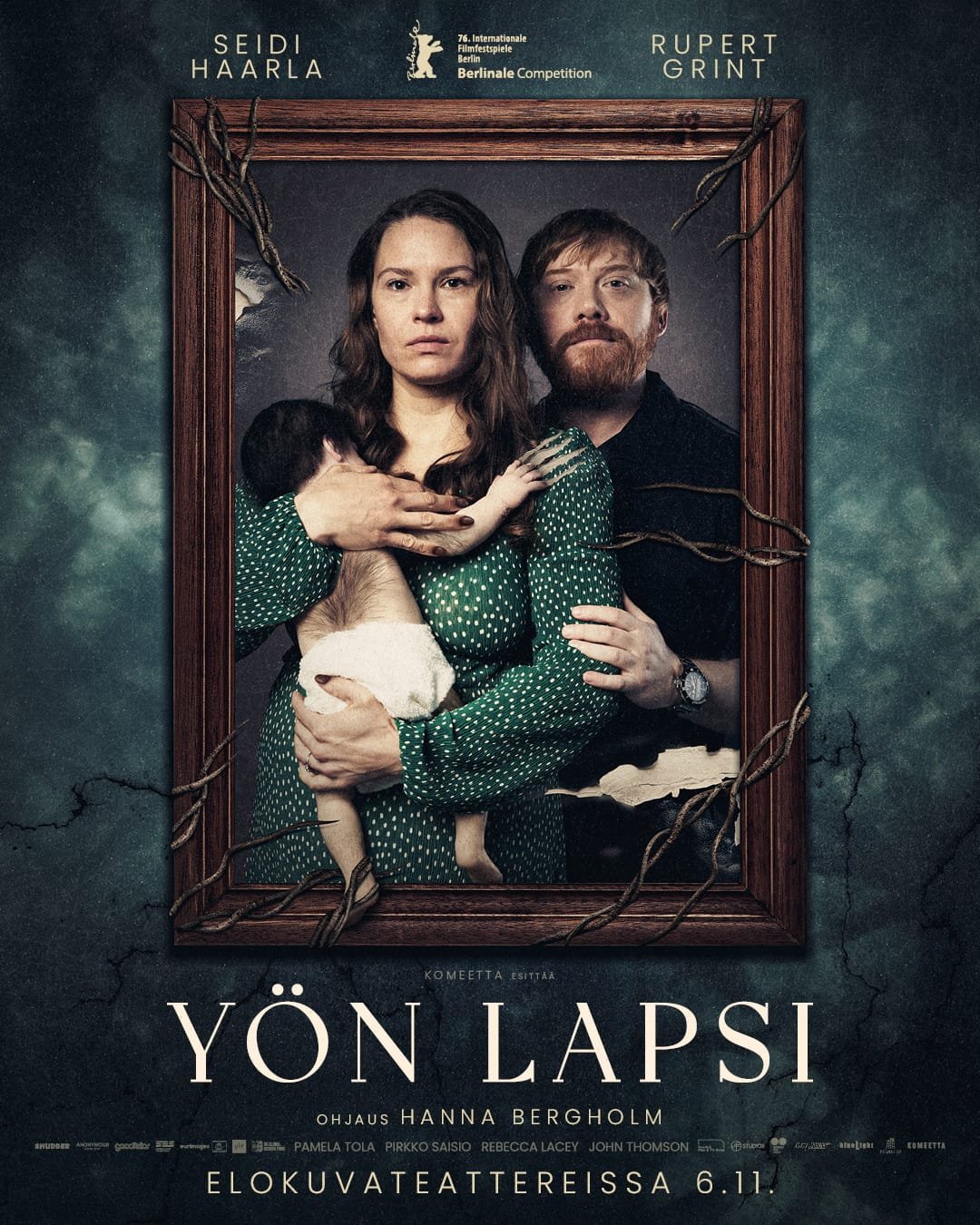
Nightborn (2026) is a film hectic with female and feminine anxieties. In common with director Hanna Bergholm’s last feature film, Hatching (2022), it explores childrearing and infant care through a supernatural lens, and whilst the supernaturalism itself flows parallel to the very real human issues in the story, the supernatural elements themselves are beautifully handled and well put together throughout.
Husband and wife Saga (Seidi Haarla) and Jon (Rupert Grint) have decided to set up home in the Finnish forest where Saga spent her childhood summers. The house, which previously belonged to Saga’s grandmother, is a fixer-upper for sure; the forest itself seems to have staked a claim on the place. But Jon and Saga seem blissfully happy and determined to make a go of it. They have also decided that they want children; Saga, with all the confidence of a non-parent, declares that she would like three babies in the next five years. Jon, with all the naivety of a non-parent, nods the idea through.
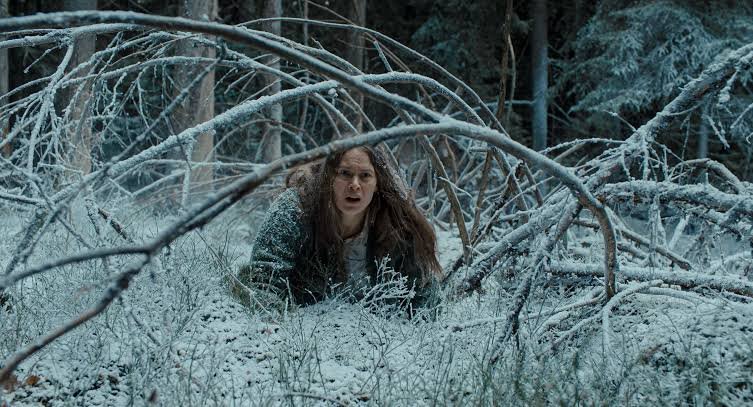
That shimmering, verdant Finnish (actually: Lithuanian) forest doesn’t stay beautiful and idyllic for long, however. As the couple explores the woods near the house, the place falls oddly silent; it’s a haven for pareidolia, too, and funnily enough, Londoner Jon notices it first – though that doesn’t stop him getting it on with his wife and then, the next thing we know, Saga is giving birth, bloodily and traumatically. Jon, bless him, goes and gets her a bunch of long-stemmed roses to mark the occasion, thus neatly signifying to the audience that he is well-meaning, but a little daft. Nothing could be less use in the circumstances; he may as well have brought in a traffic cone.
More pressingly, the baby himself is gearing up to be a challenge, even by newborn standards. He hates being touched, he hates sunlight and he was born covered in hair. Saga, still running on the fumes of societal expectations and oxytocin, wants to believe that everything will be fine, even though she is exhausted, has significant birth injuries to heal from and is already suffering from acute anxiety.
Yes, Nightborn is a dark fairy story, and there’s a reasonable school of thought which could interpret the whole film as an allegory for the feelings of panic and destabilisation which first babies can bring; it’s mentioned in the film a few times that children can feel like little aliens, impossible to understand or deal with. But at the heart of this film is a woman in (mostly) realistic circumstances, becoming lonelier and lonelier. Saga is trying so hard to inhabit a role she’s been prepared for all her life; as she struggles and becomes submerged in doubt, people around her deal with it by babying her or ignoring her concerns by turns. Of course, the deep dark woods played a role in this child’s conception – Kuuru (a name with various nature-based meanings in Finnish) responds to his environment differently to most babies, but Saga’s plight as a new mother is what really carries the film.
However, underpinning this are elements of Finnish faery lore; the forests, which cover most of the country, were thought to harbour potentially malign elemental spirits, akin to the faery folklore found in different variants throughout Europe. It’s clear to see some links with the folklore about changelings in the film (and equally clear to see how changeling lore itself derived from exhausted, alienated parents who blended their doubts and anxieties about childrearing with supernatural ideas as a means to externalise and to explore them). Kuuru (who is nearly always carefully hidden, remaining in shadow or being filmed from the back) bites, maims and grunts his way through his first few months, to the soporific smiles of everyone – except Saga. It’s maddening, for us and for her, and some of the film’s more extreme sequences approach awkward comedy on several occasions.
Fair play to any film which refuses to flinch away from the grisly realities of childbirth and nursing like this, even if it’s employed for some degree of shock factor. Horror cinema has generally proven itself least likely to flinch, but even so, a small run of films over the past twenty years or so have dared to show us details which would have been impossible previously. The birth scene here, which follows directly on from the sex scene in the film in a startlingly quick edit, with a shot of the baby’s head tearing its way into the world (and I am not exaggerating here) does exactly what it sets out to do: make us look. That popping perineum is not the only source of blood in the film. There is lots of it. Lots and lots, running from nipples, filling sanitary pads and even sometimes drenching the floors.
Then there’s the crying. Kuuru cries constantly, and that squalling baby sound is hardwired to get under one’s skin: it does so very successfully here, running through the biggest share of the film’s dialogue. Pertinent to all this is the lack of connections between women in Saga’s life; no one listened to grandma’s (useful) tales; Saga’s mother, bless her, has hard and fast boundaries and no desire to play granny; Saga’s sister tries, but has a long list of ‘recollections which vary’ when it comes to their childhoods. It all leaves Saga – who isn’t perfect by any means – wide open to the events which overtake her.
The more isolated Saga becomes, the more the fantastical elements of the story come into play, offering a visually accomplished and often artistic breakdown of reality. There’s no neat exposition checklist, and the film even hangs onto some ambiguity as it rolls to a close, despite the tragic and unsettling events at its core. Don’t let the gore fool you: there’s more at play here, despite – if we’re being picky – a couple of oddball physical scenes which don’t quite fit with the tone used elsewhere.
Nightborn (2026) comes to Shudder from July 31st.