By guest contributor Adam Page
I want to start by addressing something that may seem like a ludicrous claim on its surface. I want to argue that Sam Neill, the charming New Zealander who played Alan Grant in Jurassic Park and whose default facial expression is a sort of warm, self-deprecating amusement, is arguably the most important horror actor of the 1990s (I know one of these movies is from the 80s, but just go with it). Not the most bankable or prolific, but the most important. And I will make this argument by what I have termed the Sam Neill Goes Batshit Trilogy. Three movies spanning roughly sixteen years, if we’re generous with our bookends, and in which Neill plots a trajectory from diabolical composure, through psychological collapse and finally arrives at a destination that could only be described as beyond all human reckoning.
Of course, I’m talking about The Omen III: The Final Conflict, the wildly underrated In the Mouth of Madness (which I recently discussed at length), and Paul W.S. Anderson’s cosmic horror Event Horizon. What unites them, beyond the existential dread and some impressive eyebrow acting, is Neill himself. The through-line isn’t directorial or thematic. It is, brilliantly, the performance of an actor who understood something about horror that a lot of his contemporaries just didn’t: the monster is most frightening when it starts as the most reasonable person in the room.
“I was conceived of a jackal…”
To begin at the beginning, and the most elegant performance Neill ever gave in a horror movie which is also, and I say this with real affection, the most openly camp. The Final Conflict, third in the Omen franchise, had a near impossible task. Lee Remick and Gregory Peck had died in the first movie in what is still one of cinema’s best marriage portraits gone horrifically wrong. Damien, played by Harvey Stephens, had been truly unsettling. And so how do you make the adult version of the Antichrist compelling and not just ridiculous?
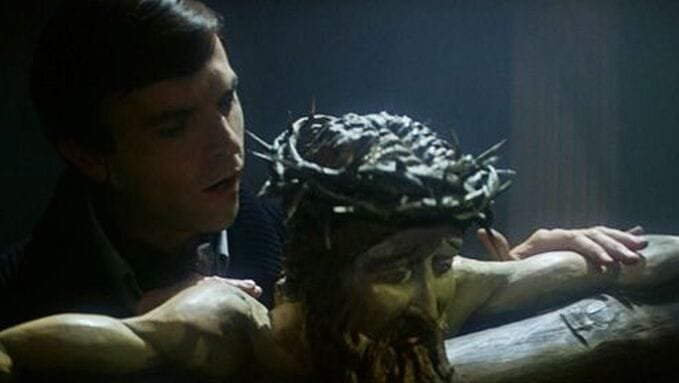
It turns out, the answer is Sam Neill. And more specifically, him standing in front of a large crucifix, delivering a monologue to Jesus Christ that begins as theological argument, and ends up somewhere close to romantic rivalry. It’s one of the greater unhinged set pieces in 80s horror and it works because Neill plays it with total and unwavering sincerity. There isn’t a single wink to the camera or flicker of self-awareness. Damien Thorn believes what he is saying, because Neill believes it, and so we believe it too. That is a genuinely remarkable achievement, given that what he is saying basically is: I’m going to murder all the baby boys born in this specific twelve-hour window, and I’m quite looking forward to it.
What Neill brings to Damien is a quality that I don’t think a lot of other actors could have, which I can only describe as a boardroom malevolence. Here, Damien isn’t the sneering villain of lesser horror movies. At any gathering he attends, he is the most impressive man there. He is charming and witty. Genuinely erudite about his own mythology in a way that suggests he’s done quite a lot of reading about himself, which is, frankly, fair enough. Neill plays him with that kind of confidence which only comes from people who have never, not once in their lives, experienced a moment of self-doubt.
The sexuality of his performance is also worth talking about, because it does work that the movie’s critical reputation always undersold. Damien’s relationship with the journalist Kate Reynolds, played by an excellent Lisa Harrow, is more than a villain chasing a victim. Neill plays it as real desire complicated by destiny, almost as though Damien is really annoyed that he finds this woman so compelling, when he has some urgent apocalyptic business to attend to. There is a scene, you know the one, that is still genuinely shocking not because of what happens, but what Neill communicates in the aftermath. The look on his face isn’t triumph. More interestingly and disturbingly, it’s regret. Neill seems to be saying that the Antichrist is capable of feeling the wrong thing at the wrong time. And I think that small crack of humanity in the demonic is what makes him the most monstrous.
The movie isn’t perfect by any means. The director, Graham Baker, is more capable than visionary, and the third act plotting is, shall we say, theologically convenient. Neill’s performance, though, rises above the material with a cheerful contempt for the limitations put upon it. He seems to be acting in a better movie than the one he’s been given, and in doing that, he creates a character who stays in the memory long after the movies slightly anticlimactic conclusion. At the end of The Final Conflict, Damien Thorn doesn’t feel defeated, he feels temporarily inconvenienced.
“Every species can smell its own extinction…”
Okay. In the Mouth of Madness. Now we’re cooking. Into territory where I need you to sit down because this movie, and I will defend this until I’m blue in the face, is John Carpenter’s most formally daring movie, one that understands Lovecraftian horror at a primal level and does something incredible with it. It takes the idea that reality is a construct and fiction can become fact, that the simple act of reading can rewire the world, and builds those ideas into a narrative structure that enacts its own themes. The movie doesn’t just describe madness; it performs madness. Standing in the centre of it all, a fixed point in a universe which is actively dissolving, is Sam Neill as John Trent.
The genius of this casting is apparent straight away. Trent is an insurance investigator, and professionally speaking, a man whose entire career is built on the premise that most things that appear extraordinary will have a mundane explanation. He is sceptical by vocation and cynical by disposition. In the early sequences, Neill plays him with coiled energy, all rapid-fire dialogue delivery and physical confidence. He is a man moving through the world like it owes him a clearly itemised invoice, and he is genuinely funny in a way that disarms the audience. We like John Trent, and trust him. We accept his version of reality because he seems so utterly certain of it.

And then Carpenter starts to pull it all apart.
John Trent’s unravelling across the movie’s runtime is one of the great acts of sustained psychological deterioration in American genre cinema. What separates it from so many similar trajectories in lesser horror movies is how granular Neill’s work is. He doesn’t snap all of a sudden. Instead, he erodes. Each time he encounters something genuinely inexplicable, it takes a specific toll and Neill follows that toll with brilliant precision. About halfway through the movie, there is a moment where Trent explains to Linda Styles, Julie Carmen doing fantastic work basically as an audience surrogate, why none of what they’re going through can be real: “God’s not supposed to be a hack horror writer!” Neill plays that explanation with desperation barely hidden by the apparent reasonableness of the argument. On a level that he refuses to acknowledge, Trent knows he’s already lost. His rationalising is all performative. That of a man talking himself out of a truth he’s already understood.
The physicality in the later sequences is something else completely. By then, Trent is fully immersed in Hobb’s End and Neill has thrown off all the confident, coiled energy, replacing it with something raw and exposed. He walks differently and holds his body differently. There’s a very particular quality of wrongness in how Neill carries Trent through the final act; that of a man who no longer fits in his own skin. It’s technical acting of the highest order, and invisible enough that we don’t consciously notice it, but powerful enough that it builds a deep unease.
The framing device of the movie, Trent in a padded cell explaining his story to Dr. Wrenn and finally walking the deserted streets, is where Neill gives what might be the single most quietly devastating moment in the trilogy. The laughing in the cinema. It starts as a regular movie-crazy laugh but keeps going, changing character and becoming more genuine and more terrible. It’s the laugh of a man who has finally understood the cosmic joke and found it honestly hilarious. The laugh of someone for whom sanity is no longer an option. Neill holds it for a little longer than is comfortable and in doing that, changes what could have been a cliché into something which feels like a real emotional truth. It looks like when someone totally comprehends their own irrelevance in the face of cosmic indifference. It looks like that laugh.
“You can’t leave: she won’t let you…”
Event Horizon, then, is a movie which has been vindicated by time in spectacular fashion. When it was released in 1997, it received reviews ranging from merely dismissive to openly hostile. Critics called it derivative; a haunted house movie in space – as though that was an insult. And at the time, Paul W.S. Anderson wasn’t yet a director whose name commanded real attention. Around thirty minutes were cut by the studio prior to the movie’s release, and the damage that caused to the narrative coherence of several key sequences is still plain to see, scar tissue on an otherwise excellent body of work.
And yet. Here we are, twenty-nine years later, and Event Horizon is regularly described as one of the defining horror movies of the decade. Why? Certainly because of the ideas; the notion that a dimension of pure evil could exist alongside our own, accessible with some advanced mathematics is one of the best unsettling conceits in modern sci-fi horror. Absolutely because of the production design too, the interior of the ship full of Gothic overtones and a central gravity drive that looks like a medieval torture device remain one of cinema’s greatest sets. But mainly and definitively because of Sam Neill.
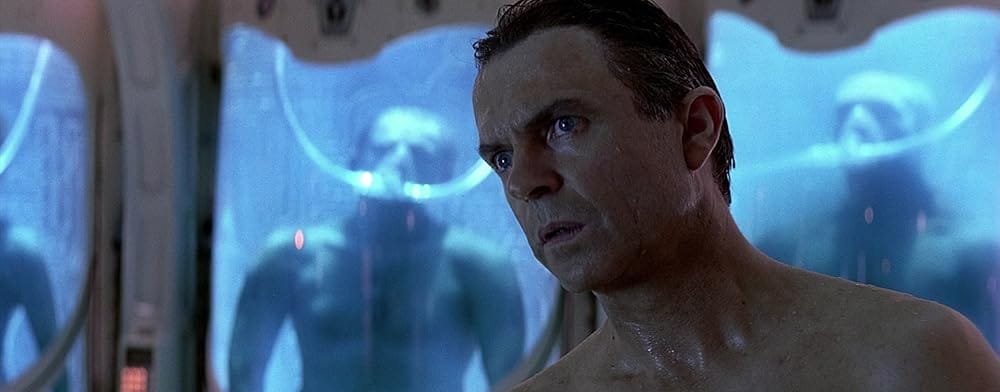
His Dr. William Weir is the most complex character in these three movies, and Neill’s performance here is the most technically demanding. Essentially, what he has to do is play three versions of the same man across the movie’s runtime and has to make each one feel like the natural and terrible consequence of the one before. His first Weir is a man totally hollowed out by grief; his wife’s suicide haunts his every interaction; every quiet moment and every time Neill lets the professional surface slip just a little, we see how enormous the absence beneath is. Neill doesn’t play the grief as distraction, but foundation. Weir can’t separate his obsession with the Event Horizon from his loss, as the ship represents something more than scientific achievement. On some level, it represents the doorway back to the person who is no longer there.
The second Weir, beginning to hear and be influenced by the ship and slowly being unwound by whatever is inhabiting it, is where Neill’s physical work becomes extraordinary. He uses a quality of listening that is seriously unnerving. He starts to become attuned to sounds and suggestions nobody else can hear and Neill plays this not as an obvious distraction, but more like a terrible attentiveness. He becomes more present as the ship starts to take hold of him. More alert and focused. The wrongness of this is near impossible to articulate, but impossible to miss.
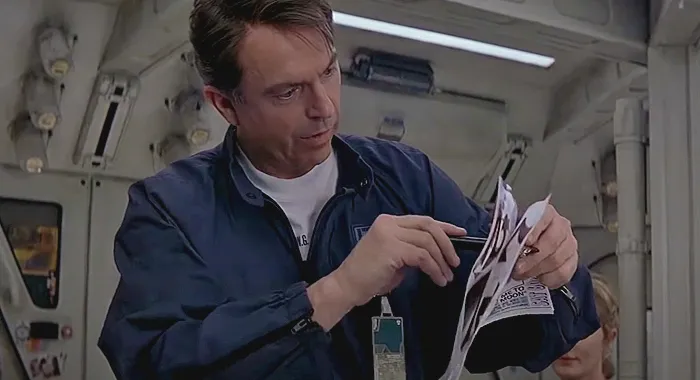
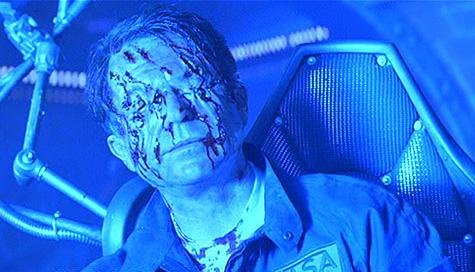
Then we have the third Weir. The sequence where Weir reveals himself, eyes ripped out, covered in gore and speaking with an awful calm about what he’s seen and where he’s going, is truly one of the best horror performances of the decade. By this point, Neill is operating on a totally different register than anyone else on screen. Laurence Fishburne is genuinely excellent in this movie, but following Weir’s transformation Neill acts him off the screen every time they share it. Neill has found something in Weir’s corruption that Fishburn’s Captain Miller can’t access: a kind of ecstatic peace. The most frightening thing about this third Weir isn’t the violence or supernatural wrongness. It’s his serenity. He is a man who has found, in a dimension of pure evil, the answers to all the questions grief raised in him. It’s a horrible kind of love story. The ship gave Weir his wife back, and he has decided that the terms were acceptable.
“Where we’re going, we won’t need eyes to see.” Neill delivers this perfect, horrible line with the gentle tone of a man offering directions. It’s the line that haunts the trilogy, and afterwards, us. And I think it works exactly because of the three movies in this unofficial trilogy: because we watch Neill play control, then watch him lose it, and now we understand what it looks like when control is gone so completely that even its absence becomes unfamiliar.
What the Sam Neill Goes Batshit Trilogy traces, and yes I’m aware I’ve named it a little flippantly, but I hope all those preceding words have shown that its affectionate and not dismissive, is a meditation on the relationship between intelligence, control, and horror. Damien Thorn is the most powerful being on Earth, and Neill plays his ruin as a natural consequence of the hubris of his certainty. John Trent is the most rational man in any room, and Neill plays his breakdown as the unchangeable fate of anyone who invests too completely in their ability to understand the universe. And William Weir is the most educated man on that ship, but his corruption is played as the horrifying fulfilment of a mind that was simply too large for the reality it had been given.
These performances, I think, are about the limits of the human. They’re performances about what is waiting beyond those limits. And taken together, considered as a body of work and examined with the seriousness they deserve, they are among the most important contributions any single actor has made to the horror genre in the last fifty years.
Sam Neill went batshit three times in three different registers and with three different instruments. The end result is a triptych that tells us a lot about what we fear, about our intelligence failing, or reality shattering, or love becoming the crack through which the darkness enters, than almost any other sequence of performances in the genre. He deserves all of these words.
And probably an apology for the title.