By guest contributor Adam Page
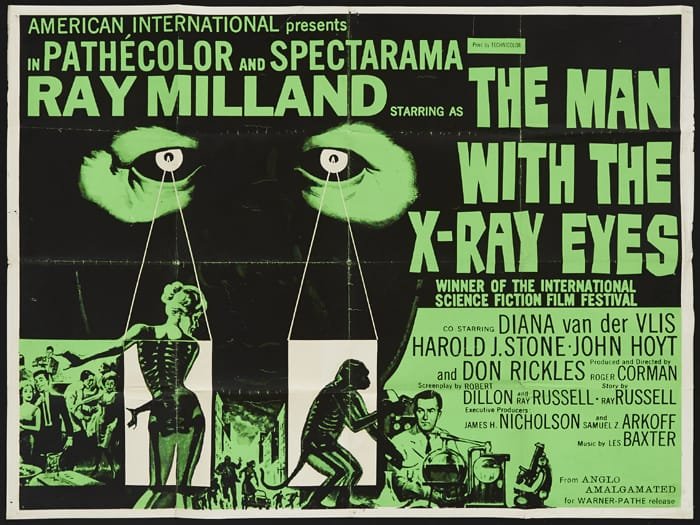
There is a certain kind of dread, and it’s one that has nothing to do with jump scares or monsters or chainsaws. It doesn’t announce itself; it quietly seeps in, until suddenly things are very wrong. Roger Corman knew this in 1963, probably by accident, the way most great things are understood, when making X: The Man with the X-Ray Eyes. He was working on a low-budget science fiction movie with Ray Milland and an AIP budget that wouldn’t cover the craft services on one of today’s studio movies. Instead of the modest exploitation thriller he had intended, what he created was one of the most quietly frightening movies of the 20th Century. It’s a Lovecraftian nightmare wearing a lab coat, blinking at us through the carnival sideshow lights and asking that question serious people have always been too comfortable to ask: What if you could see everything? Would you survive?
The answer, of course, is no. Obviously no. What were you thinking?
“I’m curious, intensely curious…”
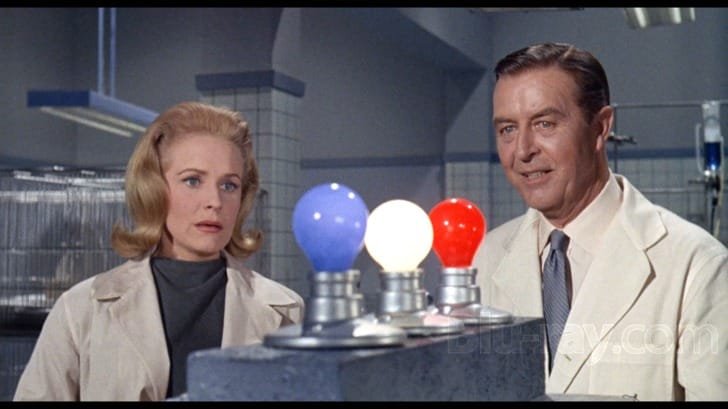
Dr. James Xavier, played by Milland with the quiet dignity of a man who is aware he’s being nibbled to death by the universe, is a research scientist with the belief that human vision is unnecessarily limited. He develops eye drops with enzymes and hormones, allowing him to expand the visual spectrum. Because this is a Roger Corman movie, and also how tragedy works, he tests the drops on himself.
At first, it’s incredible. He can see through buildings. He can see through clothes, which the movie handles with all the leering restraint of a Times Square peep show but also, somehow, with a real philosophical unease. He wins at cards, and becomes a faith healer at a carnival, able to guess illnesses with unnerving accuracy as he can literally see through the skin to the rot beneath. But if you wait long enough, every gift reveals its invoice.
The drops keep working and the spectrum keeps expanding. And we discover what lies beyond the limits of our ordinary human perception isn’t more of what we already know, enhanced and filtered. What lies beyond is something else completely.
Something which shouldn’t be looked at.
Something which is looking right back.
H.P. Lovecraft spent the majority of his writing life articulating a very specific theological concept, which is: the universe isn’t hostile to human life. Hostility has an implication of awareness. The universe is indifferent to human life, and what is lurking in its deeper geometries operates on scales and with motivations so totally incomprehensible that upon genuine contact with them, the human mind simply shatters. Goes dark, and folds in on itself like a collapsing star.
Lovecraft called this cosmic horror, and it’s a very precise term. It isn’t the horror of the monster under the bed. It’s the horror of the realisation that there is no bed. Or room, or house, or planet. Just an infinite black void, with something incredibly huge moving in it that hasn’t noticed you yet. But when it does, your noticing will have been the worst thing that’s ever happened to you.
Whilst Corman was a Lovecraft reader and did adapt some of his work for the screen, X: The Man with the X-Ray Eyes isn’t one amongst those projects. However, X: The Man with the X-Ray Eyes is Lovecraftian to its bones, in the very specific shape of its horror. Because it knows that the really unbearable thing isn’t the monster. The unbearable thing is the knowing.
Xavier doesn’t get devoured and his discovery doesn’t kill him. He is destroyed by the simple, unfiltered fact of what the universe really looks like when the merciful limitations of our ordinary human perceptions are removed. His experimental eyedrops don’t give him power. They rip away his protection. They take away the necessary and beautiful lie that our world ends at the edge of what we can see.
In terms of an ending, which is either the greatest or most disturbing ending to a B-movie ever committed to celluloid, depending on your tolerance for the abyss, Corman’s instincts here are truly brilliant. After Xavier’s experiments go wrong, after he accidentality kills a colleague and flees into a sort of hunted, half-insane existence, he shows up working in a carnival. He has become a mentalist. Mentalo, he calls himself. It’s a name which should be funny but somehow isn’t.
He sits hidden behind a curtain, telling people what’s wrong with them. He spots a young girls broken ribs, he tells an old woman that the lump in her back is nothing, but he knows she is beyond his help. The audience claps, delighted. They think it’s all a trick.
This is the part of the movie I find the most devastating, and also the most true to the Lovecraftian tradition. Because reading Lovecraft, knowledge is never empowering. It becomes contaminating. His scientists, scholars and explorers who discover the truth about the universe don’t become gods. They become patients or corpses. Or they become the sort of person who can no longer share a room with others without frightening them. On his carnival stage, Xavier is Lovecraft’s archetypal knower; possessed of knowledge that can’t be communicated, which separates him entirely from the safe ignorance of all those around him, knowledge he would give anything to un-know and can’t.
He can see everything. He can see through the tent, and through the whole town. We now understand, he can see further than any human eye was ever meant to reach. He is completely and utterly alone.
“There are great darknesses. Farther than time itself…”
Ray Milland is brilliant in this movie. He had won an Academy Award for 1945’s The Lost Weekend, playing a different sort of man destroyed by a substance he couldn’t stop using. That movie dealt with alcoholism. This movie is about something stranger, and it could be argued more honest. The alcoholism of pure perception and the addiction of seeing more than is good for you, that inability to close your eyes even if closing your eyes would save your life.
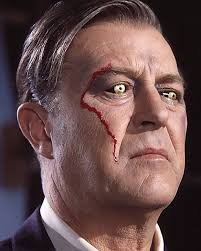
Milland plays the disintegration of Xavier with a restraint which becomes its own sort of terror. He doesn’t chew on the scenery. Instead, he stands very still, watching things we can’t see and let’s his face do the work. There are scenes where his eyes, fitted with hideous gold and black contact lenses, lock onto something off-camera and we feel, really feel, that whatever he’s seeing would kill us to see. That’s acting. That’s craft from a man who understood the assignment even if nobody told him.
By the final act of the movie, Xavier is barely there in any human sense. He moves and speaks, pleading for help. But already he’s gone to where the rest of us can’t follow. He’s seen too far and the co-ordinates of his mind are no longer any we can share.
Xavier is at his absolute nadir. He is haunted, hunted, half-mad and seeing through everything. He can no longer stop. He stumbles into a revival tent, where a preacher is working the crowd. Xavier yells out in the voice of a man who has been watching the universe slowly kill him for the whole runtime: I can see! He means it as both confession and curse. He’s seen too much and can’t stop. Someone has to make it stop.
The preacher is a man of God, and therefore intimately aware of the Biblical solution to this sort of problem. He quotes from the Book of Matthew: if thine eye offend thee, pluck it out.
Xavier rips out his own eyes.
End of movie.
In various Q&As, Corman has claimed there was a brief discussion about adding another shot after this: a shot of Xavier, eyeless and screaming I can still see! Still seeing something, without his eyes, because what he’s perceiving now has nothing to do with physical eyes. It was cut for time, or budget, or maybe the fact it would have been too much for a 1963 audience. A little too much, even now. But the implication is hanging in the frame like smoke. The eyes were never the point; they were just the door. And that door is now open. It won’t close.
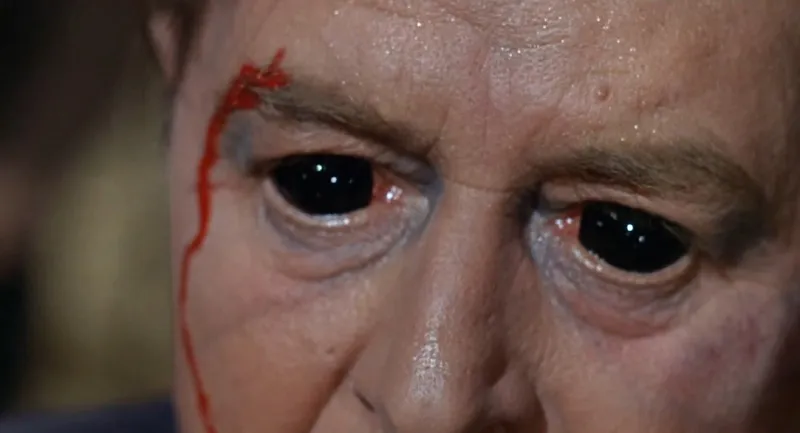
That is pure Lovecraft. The protagonist won’t survive the revelation. He can’t integrate it or become stronger from it. The knowledge wins, because it always does. The universe is under absolutely no obligation to be compatible with human sanity.
What I always found interesting about cosmic horror as a genre, and I think Lovecraft and Corman both understood it in their different ways, is that it isn’t really about the cosmos. It’s more about the limits of what we can endure knowing.
The story of Xavier is the story of anyone who has seen something they can’t un-see. The doctor who knows what the diagnosis is, but can’t explain it to the patient in a way they will accept. The person who knows, on a basic level, that the structure of their life is hollow, scaffolding over nothing and has to keep on getting up and making the coffee and going to work because what’s the alternative? Or the addict who can see with horrible clarity both the destruction and path back but goes for the bottle anyway because unmediated clarity is its own kind of unbearable.
We have perceptual limitations and we wear them like insulation. As Lovecraft himself wrote, ‘The most merciful thing in the world, I think, is the inability of the human mind to correlate all its contents’. We can see only a thin band of the electromagnetic spectrum, and thank God for that, because the rest of it would give us madness and cancer in pretty much equal measure. We perceive time only in one direction, and can only hold a certain amount if things in our consciousness at once. These aren’t deficiencies, they’re load-bearing walls.
Xavier takes away those load-bearing walls, but seems amazed when the house falls down.
X: The Man with the X-Ray Eyes is sixty-three years old now. It looks cheap because, like the majority of Corman’s work, it is cheap. The special effects are dated and the psychedelic light show that is Xavier’s expanded vision has the lo-fi quality of a high school laser show. But none of that matters. What Corman made and Milland acted, and what writers Ray Russell and Robert Dillon put down in a script that shouldn’t have been that smart, is a movie that still earns its dread.
It does so because it asks the right questions. Not what’s out there in the dark, which is what horror movies usually ask, but what does it cost to know, and that’s the question that will keep you up at night. At its core, the Lovecraftian tradition is a meditation on epistemology; the relationship between knowing and surviving. On the distinct possibility that when reality is undiluted, it’s incompatible with human life.
Xavier stands in that carnival tent with his destroyed eyes, having seen the centre of the universe and what is nesting there. Something, Corman implies without actually showing, that is looking back, and the only thing left for him to do is the only thing he can’t do. Stop looking.