
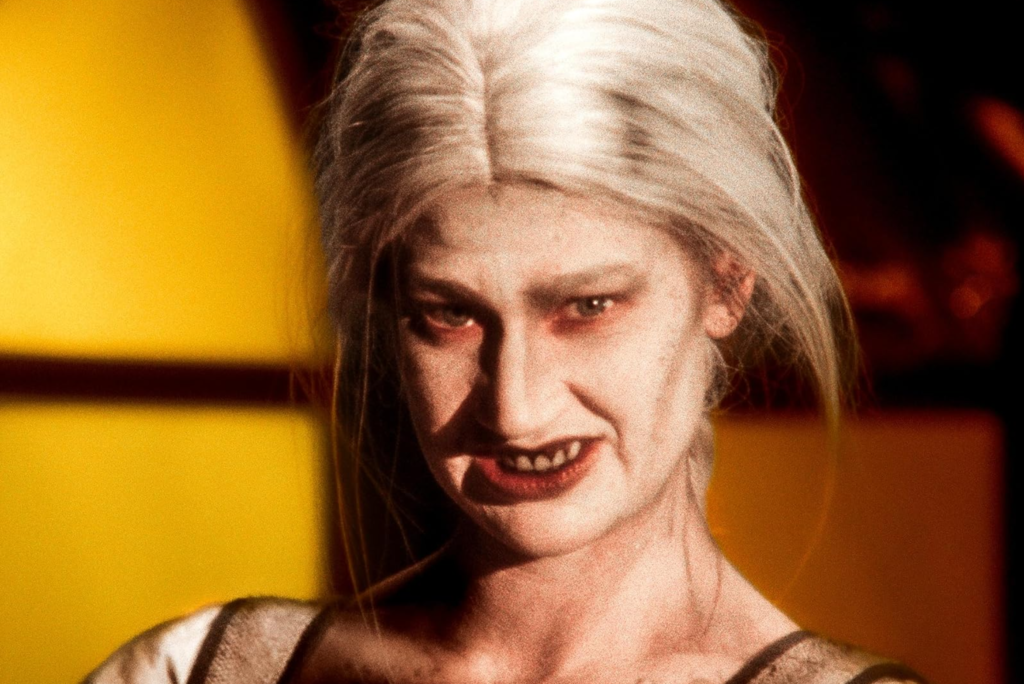
A nameless female gravedigger (director Grace Glowicki) has a work-related issue: she stinks. This has made finding a partner very difficult. Who wants a girlfriend who smells of grave dirt and dead things? She tries to fix the issue by concocting perfumes for herself – which don’t work. The day (or night) job goes on, and so does the search for love.
However, a particularly busy evening of funerals, with graveside eulogies to match, throws a young man into the gravedigger’s path. He’s there to grieve his late sister, but when the gravedigger saves his life (apparently from an aggressive, pursuing dog mask), they begin a passionate relationship. Not only does he not mind her smelling the place up; he quite likes it. Someone for everyone, etc.
Their relationship is disrupted when the gravedigger’s lover has to head overseas to seek a medical cure for his infertility. It’s clearly not coincidence that a film starting with a Mary Shelley quote for its epigraph is going to have someone dying tragically at sea, leaving only a disembodied finger (rather than a heart). Moving on from this, the film perhaps inevitably starts to channel Frankenstein, as the gravedigger starts to bring her rudimentary scientific expertise to bear on the thorny issue of reanimating her man. To do this, she will have to make use of what’s available: his finger, his dead sister, and some inventive experimental thinking.
Dead Lover (2025) wears its non-existent budget on its sleeve as a point of pride, looking partly like a 1920s silent film (cosmetics, wigs and all) and also somewhere between Ed Wood and Garth Merenghi’s Darkplace – though with extra gurning. Whether it’s all a choice or not quite, it also deliberately blurs its timeline: some of the costumes and hair look like something from the 18th century; some of the accessories (and fabrics) look positively 1980s. There’s also the small matter of the ground-breaking male fertility treatment; all of this makes an initial impact, true, but once seen and acknowledged, it all starts to feel like diminishing returns. Once you’re immersed in the film’s visuals, you start to scan around for different aspects to enjoy. So there’s a script (deeply self-effacing, blending jokes with accentism, cliches and fart gags) which relies heavily on dramatic monologue, voiceover and stage play elements, such as the presence of a dramatic Chorus. Glowicki, who also co-wrote Dead Lover, winds up carrying a lot of the film: in a project with such a small cast, she is responsible for much of the film’s ongoing tone, pace and style, too, right down to sex scenes and Victor Frankenstein-akin experiments, all in the service of keeping her lover around for good. There’s also a number of set pieces which must have been fun to storyboard, and some deliberately provocative and unflinching scenes.
In a word, then, it’s odd. More than that, it dearly wants to be odd. That, plus its love for gender-bending, unprecedentedly weird intimacy and self-effacing dialogue/monologue will endear it to many audiences who’ll note certain inclusions and chalk up the ensuing film as a much-needed piece of social commentary, but not all films offer, or need this kind of meta-analysis. Whilst the film’s lo-fi bloody-mindedness is to its credit – it sticks to its guns – it felt throughout as though not only was it winking at someone in the audience other than me, but perhaps not quite landing any deeper points, either. The aesthetics are bold, but it’s not too long before the film starts to groan under the weight of not-very-much. To cut to the chase, there simply isn’t enough here for a feature, even a relatively short one like this. It may offer something for a late night screening and just the right assemblage of people, but Dead Lover positively revels in its limitations in ways which just don’t land for this reviewer.
Dead Lover (2025) screened at this year’s Final Girls Berlin Film Festival 2026 on Saturday 7th March.